Archive for the ‘memoir’ Tag

Emily Nunn knows food. She wrote about it as a staff writer for The New Yorker and Chicago Tribune, among other publications. She also knows heartbreak and self-damaging behavior, which she shares in The Comfort Food Diaries.
A description of her seemingly-ideal life in Chicago where she lives with her boyfriend, dubbed “the engineer” and his lovely daughter, “the princess,” fades quickly. After Nunn learns that her brother has committed suicide she begins her own self-destructive tailspin through alcoholism and ending the romantic relationship.
Nunn reveals her backstory as she seeks to find balance in her life. The loss of her brother, her parents’ dysfunctional marriage – and ultimate divorce – her relationship with other siblings, relatives and friends fill the pages. At the suggestion of a friend, she embarks on a “comfort food tour.”
The direction of this tour is different than what I anticipated. Rather than a road trip around different parts of the country in search of consolation fare, Nunn sojourns to the places of her past and the role of food in her past and present. This isn’t a one-food-fits-all look at comfort, it is only about Nunn and her perceptions.
My family, for example, has dishes deemed “classics” in lieu of comfort foods. Not because they are universal, instead because they’re unique to us. Nunn, with her family and friends, has her own.
In addition to narrating her quest, Nunn shares recipes with her memories and new experiences. Her writing style is conversational and honest. She also knows how to whet the appetite.
The Comfort Food Diaries: My Quest for the Perfect Dish to Mend a Broken Heart
Three-and-a-half Bookmarks
Atria Books, 2017
310 pages
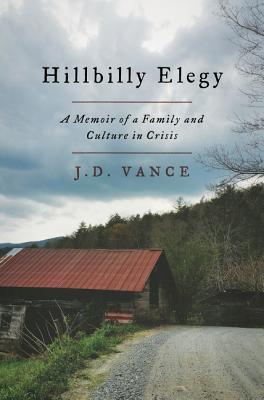
Hicks, rubes, country bumpkins and hillbillies all conjure the same image: poor and uneducated. J.D. Vance’s Hillbilly Elegy, subtitled: “A Memoir of a Family and Culture in Crisis” examines the consequences of the often unbroken cycle of poverty. The poor have fewer choices and those available are not always the smartest or best options.
Vance, a self-identified hillbilly and Yale Law School alum, describes his damaged upbringing in Ohio and his family’s strong ties to the Appalachia region of Kentucky poignantly and, occasionally, humorously. There’s no sugar coating.
Vance is quick to note that his background is not unique. Single parents, drug addiction, low-paying wages, unemployment and teen pregnancy are among the detrimental factors faced by many, including the author’s mother. Vance credits his grandparents, with whom he lived for much of his childhood, for instilling a sense that life could offer more.
Although he didn’t initially embrace the idea, a stint in the Marines after graduating from high school and his grandparents’ efforts, eventually Vance recognizes the value of education as a means of changing his life’s direction. Being aware of not wanting to replicate his mother’s behavior also helped.
The fact that he’s a successful lawyer and is happily married does set him apart, though, from those he grew up around. A few family members provide exceptions, but not many. Interspersing statistics with his own experiences, Vance notes that the region and the cyclical existence of its inhabitants make it difficult to merge into a more positive lifestyle.
Hillbilly Elegy
Four Bookmarks
Harper/Collins, 2016
261 pages

When I was a kid, my grandparents lived in Napa. I dreaded the inevitable drives with my parents through the valley to the small, mostly-family-run wineries. Curvy and narrow roads and not being old enough to even sip wine further contributed to my discomfort.
The roads remain narrow, but seem to wind less; my grandparents aren’t alive, and now there are more wineries than I could have ever imagined. Several years ago, my husband and I discovered HALL Wines, so I looked forward to reading A Perfect Score by Craig and Kathryn Hall.
The co-proprietors of HALL and WALT Wines are relative newcomers to the industry; they didn’t launch their first wines until 1995. Although, Kathryn grew up on her parents’ vineyard in Mendocino County (California); Craig, on the other hand, admits to once having little knowledge of wines.
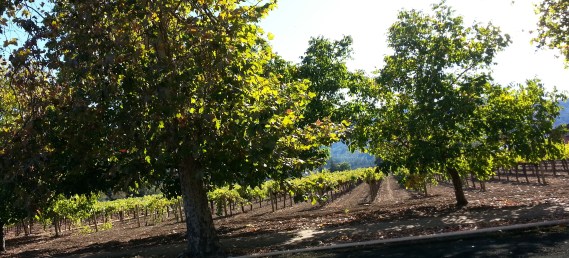
This is several stories woven into one: How the couple met, came to purchase property in the Napa and Sonoma valleys and ultimately how one of their wines, a Cabernet Sauvignon, earned 100 points from wine critic Robert Parker, Jr., in 2013.
The Halls had their share of setbacks, but their apparent optimistic dispositions and a lot of good luck served them well. The book addresses life in Napa Valley, the camaraderie among vintners, the concerns of neighbors regarding the Halls’ construction plans, the philanthropy of winemakers, the caliber of the Hall staff and more.
This is a quick, fun read and made me want to open a bottle of HALL wine.
A Perfect Score: The Art, Soul, and Business of a 21st Century Winery
Three Bookmarks
Center Street, 2016
207 pages

Coming to My Senses: The Making of a Counterculture Cook by Alice Waters is like dining at what’s supposed to be a very good restaurant but only a few of the entrees are enjoyable. Unfortunately, not all of Waters’s memoir is interesting. The parts that are, really are though.
Waters is credited with helping change the culinary scene in the 1960s by opening Chez Panisse which relied on a prix fixe menu that changed according to what was fresh that day.
Waters shared too much minutiae from her childhood. I don’t care about a costume party when she was four years old or that her step-grandmother was a cold woman. Things pick up when she transfers from college in Santa Barbara to Berkeley. What I found most interesting was how a trip to Paris her junior year of college and her years in Berkeley made such an impact.
The narrative is told mostly in chronological order leading up to the opening of the restaurant. Anecdotes about life post-opening are indicated in italics throughout most of the chapters. These asides are noteworthy, but they are also distracting.
The story of Chez Panisse begins with Waters’s desire to replicate flavors she experienced in Paris through a cozy, hip bistro-like ambiance. What set her apart at the time was what is now recognized as the slow food movement and the reliance on the freshest possible ingredients. Yet, there’s scant mention of either, nor of her recognition today as an advocate of sustainable agriculture.
Coming to My Senses: The Making of a Counterculture Cook
Three-and-three-fourths Bookmarks
Clarkson Potter Publishing, 2017
306 pages

Foodies and artists, often one in the same, should enjoy Lucy Knisley’s comic book memoir, Relish: My Life in the Kitchen. It’s humorous, educational and a quick read.
At an early age her parents instilled an appreciation of gourmet food. I’d like to think I did, too, with my own kids, but I never considered serving my toddler children poached salmon. I did, however, insist that they at least try new things even if they only took one bite. The result – years later – is they all have fine palates and enjoy a good meal.
But back to Knisley.
She shares stories about leaving the City for upstate New York following her parents’ divorce. She relates her initial displeasure at having to be around farms, chickens and seed stores. Eventually, her text and accompanying illustrations reflect a tone of gratitude. It’s clear she has good relationships with both parents, but she does include some of the rough spots they endured. These were, no surprise, Knisley’s teenage years. She makes no effort to (literally) draw herself in a better light; this is a highlight.
Humor underlies these chronicles of coming-of-age, food cravings, travel and love for her parents. Knisely also includes illustrated recipes, cooking tips and explanations of cooking techniques.
Among my favorite chapters is the account of her efforts to recreate the croissants she so enjoyed in Italy. Her determination is as evident as her failure, but her humor saves the day. This is always the best ingredient no matter the endeavor.
Relish: My Life in the Kitchen
Five Bookmarks
First Second Books, 2013
173 pages

Hive-Mind by Gabrielle Myers is labeled a memoir, but it’s slightly more than that. Written in diary-like form, Myers describes her summer of 2006 on a farm in Northern California. This is no kiddie account, though. While it’s the focus of her narrative, Myers alternates the chronicle with a look back to her relationship with her mother and growing up in Virginia. As if this isn’t enough, she also includes poetry.
It’s evident that sharing the earlier memories is cathartic; this is true of the latter ones, but is less obvious until the end. Myers’s descriptions of life on the farm, from early spring to late September, are vivid and stunning. I can practically feel dirt stuck in my fingernails as she, Baker (also working on the farm) and Farmer (the woman who owns the land and decides the daily chores) sow and weed and sweat and harvest. The author is also impressive in describing meals prepared from food on the farm.
Farmer is an enigma. This may be Myers’s point: Farmer never reveals enough about herself to know who she is. Myers shares her own thoughts and reactions, but that isn’t enough to make Farmer compelling. Baker is an open book and, consequently, is more interesting.
Myers isn’t writing about coming of age, but of becoming aware. This is evident as she connects the different phases in her life following a 1995 conversation with her mother: “… how I feel can become how someone else feels.”
Hive-Mind
Three and three-quarter Bookmarks
Lisa Hagen books, 2015
299 pages

In a way I’d love to frequent a place often enough that I’d be known, if not by name, perhaps by where I liked to sit or what I ordered. Colman Andrews recounts the numerous places around the world where this is the norm for his dining experiences. In My Usual Table: A life in Restaurants, Andrews shares his earliest recollections as a child dining in many of the landmark eating establishments in the Los Angeles area. As a kid he, with his family, was a regular at Chasen’s, the Brown Derby and Musso & Frank Grill (only the latter remains today).
Where does one go from there? Apparently, everywhere. Andrews grew up to be a wine connoisseur, dining critic and co-founder of Saveur magazine. He’s also authored several cookbooks.
My Usual Table is an eat and tell memoir with casual and not-so-casual name dropping: Wolfgang Puck, Ruth Reichl, Alice Waters, among others. Some meals are described vividly, some barely mentioned while he focuses on those associated with the meals. What’s most fun is following Andrews’ time line, which precedes, for example, the farm-to-table concept to the present.
Andrews is a fine story teller, but his voice begins to wear thin about 2/3 through. It’s difficult consuming and digesting such rich, often heavy fare for too long. I enjoy dining out, but there’s nothing like a home cooked meal or an occasional burger for basic sustenance. I’m happy, afterall, to have my usual table be in my own dining room.
My Usual Table: My Life in Restaurants
Three-and-a-half Bookmarks
Ecco, 2014
311 pages
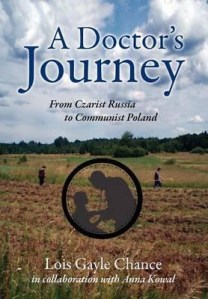
A Doctor’s Journey by Lois Gayle Chance, in collaboration with Anna Kowal, is the true story of Alexander Kowal’s arduous trek from farm boy to physician during World Wars I and II. The book is subtitled From Czarist Russia to Communist Poland.
This independently published work incorporates Alexander’s written accounts, family memories, and, as the author notes in her preface, “the imagination of the writer.” The result is an engaging account of a remarkable man in a historic period. With a few missteps here and there, it, nonetheless, deserves praise for Chance’s ability to set credible scenes and smooth dialogue (which is where, she admits, she took creative license).
The story begins in 1907 when Alexander’s aspirations of becoming a teacher are thwarted; as the oldest son he’s destined to inherit the family land, which has been handed down for generations. Nonetheless, a teacher encourages him apply to become a doctor, and Alexander is awarded a scholarship to study medicine. After ultimately receiving his father’s blessing, Alexander begins his journey.
Chance is weakest in her repeated foreshadowing of the obvious. She writes, “Once home, his family gathered around and he showed them this precious possession, his medical diploma. He never dreamed that nearly a century later it would be cherished by a daughter who hung it proudly in her office …” Of course not! Who can, let alone would, imagine such things?
Alexander’s story, driven by his determination, is filled with aspects of ordinary life, except it occurs in an extraordinary era.
A Doctor’s Journey
Three Bookmarks
Outskirts Press, 2013
271 pages
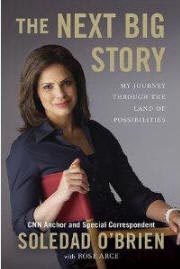
Broadcast journalist Soledad O’Brien’s voice is honest, moving and completely engaging in her memoir, The Next Big Story. I’d expected nothing less than an accurate and fair narrative. It’s also a celebration of opportunities, not just for her as the daughter of a mixed-race marriage, but everyone willing to work hard for the prize. O’Brien acknowledges that for many the ability to make that reach is often riddled with obstacles.
Thanks to the values instilled by her family, O’Brien admits she wasn’t always aware of any impediments. Yes, she is bi-racial, and yes, she grew up in a predominantly white community, but she was never beaten down. This was largely due to her drive to keep up with family expectations.
Much of O’Brien’s story focuses on her journey to become a respected reporter. It wasn’t something she anticipated, but once she discovered journalism she was hooked. She shares her early days of trying, often unsuccessfully, to get meaningful stories on the air. Through hard work, strong friendships and tenacity, she worked her way to anchor weekend news programs locally then nationally. Along the way she married, had children, but continued her quest to share other people’s stories. CNN’s Black in America and Latino in America documentaries are hers, both award-winning works, although she never mentions the accolades.
Most riveting are O’Brien’s accounts of covering such catastrophic events as the tsunami in Indonesia, Hurricane Katrina and the earthquake in Haiti. These are all familiar, but O’Brien’s insider retrospective evokes emotion and suspense.
The Next Big Story
Four Bookmarks
Celebra Books, 2010
321 pages
Anna Quindlen’s Lots of Candles, Plenty of Cake is a poignant, yet cheerful perspective on getting older. This is the kind of book to share with friends, particularly if they’re around the age of what is now considered to be the new-40s.
As in most of her writing, Quindlen relies on personal experience to make her points. Her writing career includes several stints as a columnist (at the New York Times and later Newsweek) as well as authoring several works of fiction, nonfiction and children’s books. She has a keen sense of observation. Better still, she’s an extraordinary wordsmith. Those two skills result in crafting pieces readers can easily make connections with. Of control, she writes: “I thought I had a handle on my future. But the future, it turns out, is not a tote bag.”
Quindlen examines the important aspects of life, which can be applied to most people, women in particular: friendship, family, love, parenting, and more. She’s humorous and honest. She writes of near-misses, both good and bad. She reflects on how much her younger self was sure she knew and how her older self readily acknowledges what she doesn’t. Without citing the tired phrase that youth is squandered on the young, it’s a major thread. Quindlen puts a new spin on it.
Yes, this is a memoir, but it is much more. It’s a guidebook to accepting that each morning we wake up is a gift – even if we’re older than we were the day before.
Lots of Candles, Plenty of Cake
Four Bookmarks
Random House 2012
182 pages



 The Blue Page Special