Archive for the ‘love’ Tag
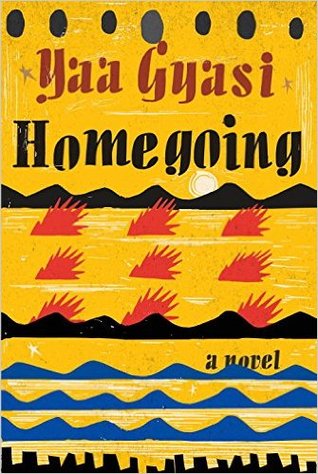
At first, Homegoing by Yaa Gyasi seems more like a collection of short stories than a novel and that, along with the title, is part of its beauty.
Spanning more than 300 years, this is an epic tale of the evolution of a family. Each chapter focuses on a specific character and could be a stand-alone story. Fortunately, a thread connects one to the other, even though there are some knots and loops along the way. These simply enhance the narrative. There is a chronology but not in the traditional sense.
In 18th century Ghana, Effia, the young beautiful daughter of a village chief is married to an Englishman, where she lives in a castle. She’s unaware that her half-sister, Esi, is imprisoned in the castle dungeon as a slave to be sold and sent to America.
The author traces, through the years, the lives of the sisters’ descendants as they experience warfare among Ghanian tribes, plantation slavery, British colonization, the migration from Alabama to Harlem, and more.
Gyasi provides portraits of 14 distinct main characters and a supporting cast of dozens more. Each is nuanced through his or her experience, determination and environment. Almost equally important are the landscapes; the element of place shapes the individuals in ways that can’t be ignored. There are lush and harsh jungles, shorelines, cotton fields, inner-city Baltimore, Alabama coal mines and smoky jazz bars.
Survival and the strength of family ties resonate in every chapter as each character takes a turn in the spotlight.
Homegoing
Four Bookmarks
Alfred A. Knopf, 2016
305 pages

Emily Nunn knows food. She wrote about it as a staff writer for The New Yorker and Chicago Tribune, among other publications. She also knows heartbreak and self-damaging behavior, which she shares in The Comfort Food Diaries.
A description of her seemingly-ideal life in Chicago where she lives with her boyfriend, dubbed “the engineer” and his lovely daughter, “the princess,” fades quickly. After Nunn learns that her brother has committed suicide she begins her own self-destructive tailspin through alcoholism and ending the romantic relationship.
Nunn reveals her backstory as she seeks to find balance in her life. The loss of her brother, her parents’ dysfunctional marriage – and ultimate divorce – her relationship with other siblings, relatives and friends fill the pages. At the suggestion of a friend, she embarks on a “comfort food tour.”
The direction of this tour is different than what I anticipated. Rather than a road trip around different parts of the country in search of consolation fare, Nunn sojourns to the places of her past and the role of food in her past and present. This isn’t a one-food-fits-all look at comfort, it is only about Nunn and her perceptions.
My family, for example, has dishes deemed “classics” in lieu of comfort foods. Not because they are universal, instead because they’re unique to us. Nunn, with her family and friends, has her own.
In addition to narrating her quest, Nunn shares recipes with her memories and new experiences. Her writing style is conversational and honest. She also knows how to whet the appetite.
The Comfort Food Diaries: My Quest for the Perfect Dish to Mend a Broken Heart
Three-and-a-half Bookmarks
Atria Books, 2017
310 pages

I nearly quit reading Americanah by Chimanda Ngozi Adichie twice. The first time I thought about setting the book down for good was in the first 50 pages; the second time was 30 pages later. I’m glad I persevered, though.
At its heart, Adichie’s vast novel is a love story. It turns out to be so on several different levels: love for country; love between a man and a woman; love of self.
Perhaps part of my initial disinterest was the difficulty of keeping track of who was who; it wasn’t easy. Eventually, the voices and experiences began to sort themselves out becoming distinct and engaging.
Although the story is not told in chronological order, the narrative focuses on Ifemelu, a young woman who leaves Nigeria for America. This triggers a journey to find herself and to address the issue of race for the first time. In the process she leaves behind Obinze, the love of her life. His experience is briefly addressed, but Americanah is about Ifemelu more than anyone else.
The self-confidence and intelligence she exhibited in Nigeria serve her well in the U.S., despite some setbacks. Eventually, she becomes successful as a blogger writing about race. She also finds romance, but Obinze is never far from her mind or her heart.
Ultimately, Ifemelu returns to Nigeria. Ironically, just as she idealized America before her arrival, she idealizes the country she left behind. Disappointment exists, it seems, on both continents. In Adiche’s hand, hope is also present.
Americanah
Four Bookmarks
Anchor Books, 2014
588 pages

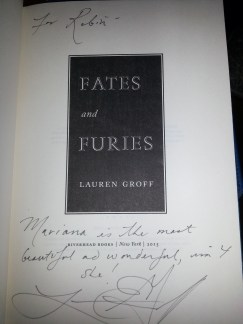
My favorite passage by Lauren Groff is where she signed my copy of Fates and Furies at the request of my son Tim’s girlfriend. Groff wrote: “Robin – Mariana is the most beautiful and wonderful, isn’t she!” The answer is yes. It is such a stark contrast to the tenor of the novel; I’m led to believe that Groff doesn’t have it out for everyone, which is a comforting thought.
The novel is divided into two categories: fates and furies. The first section begins with newlyweds, Lotto and Mathilde, consummating their marriage on the beach, but he is the focus here. It’s all about him: childhood, banishment from his family to boarding school, college days and efforts to succeed as an actor are portrayed in detail; but not too much as to squelch the imagination. Little is revealed about Mathilde – until furies, which is aptly named.
In an effort to avoid the need for spoiler alerts, suffice it to say there are elements of Gone Girl meets Claire Underwood.
Groff’s writing is clever, humorous and rich in detail. The references to various plays and Greek tragedies, however, are distracting metaphors.
Full of unlikable characters, the book, nonetheless, was appealing. Lotto’s a selfish man who exudes charm. Real charm, not something he turns on and off at will. Mathilde is mysterious and bitchy. They are flawed thanks to the characteristics Groff imbues in them. Neither is someone I want to meet, but I was more than content to know them through the distance of fiction.
Fates and Furies
Four Bookmarks
Riverhead Books, 2015
391 pages

To say A Little Life is a big book is an understatement. At slightly more than 800 pages it’s, in the words of my greatest presidential fear: Huge, very, very huge. Hanya Yanagihara has crafted a novel that traverses several lives, particularly Jude St. Francis’s. The name is not insignificant. St. Jude is the patron saint of lost causes.
Jude is one of a quartet of friends, Willem, Malcomb and JB, who meet in college. Although the friendships among the four are always part of the story, most of the narrative revolves around Jude and Willem. Their backstories, their lives before college, define them. In fact, Jude’s past is what drives the novel.
From the onset, it’s clear that Jude has secrets. His inability to reveal them is a compelling, and often frustrating, element. It is also evident that Jude is the physically weakest of the foursome. He walks with a limp, which he reluctantly and vaguely attributes to a car accident. He has no family or past connections. He’s awed by the care and companionship of his friends.
Yet, little by little Jude’s history is divulged. As the four men grow older their friendship is often tested. They each pursue different careers, but Jude and Willem remain particularly close throughout.
The power of Yanagihara’s work lies in the personalities and the situations she creates. The author illustrates the definition of friendship through the actions of the characters and shows that the strongest bonds are made of trust. Then love.
A Little Life
Four-and-a-half Bookmarks
Anchor Books, 2016
816 pages

For some reason it seems the stack of books on my nightstand never, ever shrinks. Some titles have been there for longer than I care to confess. When I saw that The Light Between Oceans has been made into a movie, it was time for me to rescue it from the mountain of titles. (If I decide to see the film I need to read the book first.)
Written in 2012, this is M.L. Stedman’s debut novel set off the rocky coast of Australia following World War I. The author provides lyrical descriptions of the harsh life of a lighthouse keeper, Tom, made more comfortable by the love and vibrant personality of his wife, Isabel.
Tom has returned from the war surprised and guilt-ridden by his survival. He is well suited to the solitary life on an isolated thread of land. It isn’t until he meets Isabel while waiting for his next lighthouse assignment that he realizes what’s been missing from his life. They marry, and after Isabel miscarries multiple times, they believe their hopes of having a family will elude them. That is until a small boat washes ashore with an infant child and a drowned man.
Tom wants to turn the baby over to authorities; Isabel does not. What follows is a succession of heartache and lies borne of love. Stedman’s characters are real, full of faults. She raises poignant questions for all involved and readers are left to consider what they might do in a similar situation.
The Light Between Oceans
Four Bookmarks
Scribner, 2012
343 pages

Anthony Marra is the master of foreshadowing. At times he’s subtle, then he’s as obvious as an agitated teenager reeking of cigarettes claiming he doesn’t smoke. This was true of his first novel, A Constellation of Vital Phenomena, and follows suit in his most recent: The Tsar of Love and Techno.
Marra has chosen a similar setting in Russia with another interesting cast of characters; however, he spans more time, beginning in 1937 continuing to present day. He expands the setting from Siberia to Leningrad/St. Petersburg to Chechnya: landscape is a crucial element.
The narrative begins with an artist in the propaganda department whose job is to erase enemies of the state whose images appear in paintings and photographs. He does this by blotting out faces with ink or by painting something new, which is often his dead brother’s face. It appears in a myriad of scenes representing various phases of his life: child, teenager, middle age and old age.
With each chapter comes a new narrator, in a different setting providing a singular element to the overall novel. The stories are a progression. It’s no spoiler alert to note that the pieces do eventually fit together (very well). Even if they didn’t, Marra’s writing is full of wit and pathos. The images of the pollution-wreaked mining community in Siberia are stark and frigid; just as a Chechnyan hillside is pastoral and warm. The men and women introduced by the author are so human their breath practically turns the pages.
The Tzar of Love and Techno
Four bookmarks
Hogarth, 2015
365 pages

I was baffled by Emma Hooper’s Etta and Otto and Russell and James. It’s sweet but confusing. It’s a love story that considers lost chances and perhaps poor decisions. It’s also surprisingly descriptive in its brevity.
Etta is 83 years old when she embarks on a trek across Canada to the ocean. The five-sentence letter she leaves as explanation to her husband sets the tone for the novel: “Otto, I’ve gone. I’ve never seen the water, so I’ve gone there. Don’t worry, I’ve left you the truck. I can walk. I will try to remember to come back.”
This isn’t the kind of thing she’s planned, she simply leaves to see the coast. Briefly, Otto considers trying to find her. Ultimately, it’s Russell who does so, while Otto remains on the farm.
Along her trek, Etta gains unwanted attention from the media and towns people she encounters. She also acquires a companion in James, a source of bewilderment.
The relationships among the four title characters are complex. Otto and Russell have known each other since childhood. Both love Etta. Hooper develops the bond between Etta and Otto through letters the pair exchanged during the war. Their correspondence evolves from the mundane to the heartfelt.
Hooper intersperses the characters’ backstories with their present day adventures: Etta bound for the sea, Russell in search of Etta and Otto discovering daily rhythms on his own. Meanwhile, there’s James, who’s difficult to describe. Hooper has crafted a terse novel unpredictably rich with humor and longing.
Etta and Otto and Russell and James
Almost Four Bookmarks
Simon & Schuster, 2015
305 pages

Isabel Allende is among my favorite authors. I am reminded of how I feel about my kids: I love them even though they sometimes do things I don’t always like. Allende’s most recent novel, The Japanese Lover, is like that.
The story involves too many secrets, predictable plot lines and cardboard characters. Alma Belasco, a woman of means in her 80s, moves into Lark House, an unconventional nursing home. There she meets 23-year-old care-giver, Irina Bazili. The two bond, and soon Irina is helping Alma’s grandson, Seth, work on a book about Alma and the Belasco family history.
Of course, Irina has a past about which little is revealed, but Alma has secrets, too. As Seth and Irina learn more about Alma, it’s apparent there’s a lost love. Yawn. The younger couple believes the romance is still going strong, although this is all based on speculation.
There was, in fact, a lover. He started out as the youngest son of the Belasco family’s Japanese gardener and Alma’s childhood best friend. One of the most interesting aspects of the narrative is when Ichimei and his family are uprooted from their San Francisco home and relocated, with thousands of other Japanese-Americans, to an internment camp.
Given his role as title character, Ichimei is one-dimensional. Even Alma could have been so much more – especially in Allende’s hands. Alas, this is one of those books I didn’t like much; nonetheless, I look forward to the author’s next work.
The Japanese Lover
Two-and-a-half Bookmarks
Atria Books, 2015
322 pages

The first sentence in Eka Kurniawan epic, Beauty is a Wound, is a doozy: “One afternoon on a weekend in March, Dewi Ayu rose from her grave after being dead for twenty-one years.” It sets the perfect-wtf-tone for the entire novel.
Set in Indonesia, the narrative combines elements of the island nation’s history with folk lore, superstition, mystery and love. It’s farfetched in scope and captivating in its depiction of a myriad of characters.
Dewi Ayu is of Dutch heritage and her beauty is renowned throughout the island. Her story includes her childhood, survival during the Japanese occupation and eventual career path as a prostitute. She has three daughters whose beauty is also the stuff of legends and a third daughter, whose appearance is so repulsive that out of consideration for others, keeps herself hidden. Also, because of Dewi Ayg’s exquisite looks, she a very popular lady of the night.
Ironically, the ugly daughter is named Beauty.
At times it’s difficult keeping track of who’s who, which political regime is in power and who’s a spirit or not. The effort is worth it. Kurniawan jostles back and fourth among characters and time frames as he tells Dewi Ayu’s story.
Many of the subplots are like fairy tales. They are easy to get caught up in before the author reveals the connections each element has to another. Don’t expect a happily-ever-after outcome, but do be prepared for an engaging, if often exaggerated, explanation of how a woman suddenly is among the living again.
Beauty is a Wound
Four Bookmarks
New Directions Paperback, 2015 (translated edition by Annie Tucker)
470 pages


 The Blue Page Special