Archive for the ‘families’ Tag
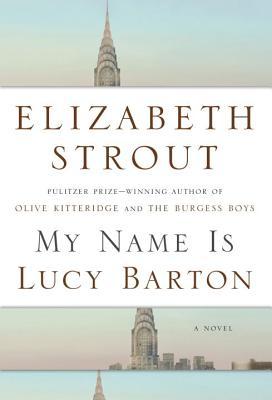
My Name is Lucy Barton is a statement and not only the title of Elizabeth Strout’s new novel. It’s an affirmation as Lucy reflects on the relationship with her mother, which is like a faulty wire: occasionally there’s no connection.
Lucy is from a rural Illinois town where growing up her family lived so far below the poverty line as to make it seem something to attain. Lucy’s life is revealed as she lies in a hospital bed with a view of the Chrysler Building in New York City talking with her mother whom she hasn’t seen or spoken with in years. Strout is methodical as she merges Lucy’s past with the present.
The rich, stark pacing and imagery serve to expose family dynamics in the narrative. That is, Strout’s writing provides enough detail to shape a situation or character, but not so much that there is little left to the imagination. In fact, this is what makes some aspects harrowing: imagining what life was like for young Lucy. She lived with her older siblings and parents in a garage until age 11.
Her mother’s brief presence provides the vehicle to see Lucy’s past; the extended hospitalization gives Lucy time to consider her adult life as a mother, wife and writer.
Lucy should despise her parents and her past, yet she doesn’t. Her family was shunned and her parents were apparently abusive in their neglect. Lucy is grateful for her mother’s presence. The mother-daughter bond, at least from Lucy’s perspective, overrides past sins.
My Name is Lucy Barton
Four and a half Bookmarks
Random House, 2016
191 pages

Families can be so complicated and Anne Tyler has banked on this fact in all of her novels. Her most recent, A Spool of Blue Thread, is no exception.
Abby and Red Whitshank are the kind of folks that raise their four kids, go to work every day, are regarded favorably, pay their bills, have a peripheral connection to a church and know little about either each other or their family history. At one point, in a jesting tone, the omniscient narrator notes there are two family stories: one about the family home on Bouton Road in a respectable, comfortable Baltimore neighborhood, and the other about Red’s sister’s marriage.
Of course, there are more, many more. And Tyler slowly, almost teasingly, reveals them. There’s a good reason why she spends so much time describing the Bouton Road house built by Red’s father.
Initially, the novel appears to focus on Denny, the ne’er-do-well son who floats in and out of the family’s vision. Once he’s clearly established as unreliable and secretive, the focus shifts. Multiple times. Denny has two sisters, but they are the least developed characters. Stem, the youngest son, soon becomes a focal point, as do Red’s parents. Though separated by a generation, the secrets and pasts associated with these three are what move the narrative.
Tyler is not afraid to throw in surprises, which in retrospect were actually subtly foreshadowed. Her ability to show the strengths and foibles of family life are engaging, occasionally humorous and always insightful.
A Spool of Blue Thread
Four Bookmarks
Alfred A. Knopf, 2015
368 pages

I was baffled by Emma Hooper’s Etta and Otto and Russell and James. It’s sweet but confusing. It’s a love story that considers lost chances and perhaps poor decisions. It’s also surprisingly descriptive in its brevity.
Etta is 83 years old when she embarks on a trek across Canada to the ocean. The five-sentence letter she leaves as explanation to her husband sets the tone for the novel: “Otto, I’ve gone. I’ve never seen the water, so I’ve gone there. Don’t worry, I’ve left you the truck. I can walk. I will try to remember to come back.”
This isn’t the kind of thing she’s planned, she simply leaves to see the coast. Briefly, Otto considers trying to find her. Ultimately, it’s Russell who does so, while Otto remains on the farm.
Along her trek, Etta gains unwanted attention from the media and towns people she encounters. She also acquires a companion in James, a source of bewilderment.
The relationships among the four title characters are complex. Otto and Russell have known each other since childhood. Both love Etta. Hooper develops the bond between Etta and Otto through letters the pair exchanged during the war. Their correspondence evolves from the mundane to the heartfelt.
Hooper intersperses the characters’ backstories with their present day adventures: Etta bound for the sea, Russell in search of Etta and Otto discovering daily rhythms on his own. Meanwhile, there’s James, who’s difficult to describe. Hooper has crafted a terse novel unpredictably rich with humor and longing.
Etta and Otto and Russell and James
Almost Four Bookmarks
Simon & Schuster, 2015
305 pages

Disturbing and lyrical are the best words to describe Lida Yuknavitch’s The Small Backs of Children. Graphic and violent could also be added to the list.
Set initially in an unnamed Eastern European village, the narrative involves characters known by single-word descriptions: photographer, writer, playwright, filmmaker, poet, performance artist, widow and girl. Everything centers on the girl.
It is her image as she flees the bombing of her home that is captured by the photographer. The girl has already been victimized by soldiers long before she loses her parents and brother in the explosion. Yuknavitch’s writing is as vivid as the photo that eventually earns the photographer critical acclaim.
The girl runs into the forest and finds her way to the widow’s home where she learns about art and more about survival. Theirs is a quiet, comfortable relationship. Their pasts are always near, but their focus is on the moment.
Meanwhile, on the other side of the world the artists believe they must bring the girl to the United States. The hitch is they don’t know who she is or where to find her. As often happens, money solves most problems and here it comes to the rescue in a round-about way. Even with resources the task isn’t easy.
The realistic descriptions of physical and sexual violence make this a difficult book to read. Fortunately, this is overshadowed by demonstrations of humanity and the author’s powerful writing. At its core, it questions the extremes endured to appease consciences.
The Small Backs of Children
Lidia Yuknavitch
Four Bookmarks
HarperCollins 2015
222 pages
Our Souls at Night by Kent Haruf is best described as sweet. This terse novel was published posthumously, and its content makes me imagine that the author was in his final days when he penned it. This is a story of finding a way out of loneliness while believing that the opinions of others have little value or impact.
Addie Moore and Lewis Waters are widowed and living in the fictional town of Holt on Colorado’s eastern plains. This is Haruf’s preferred setting as many of his previous works have centered around this small communityand its residents. Anyone familiar with his writing will recognize names and places.
One day, Addie calls Lewis. They have known each other for years, but only peripherally. She wonders if he would like to spend the night. This is no brazen, immoral solicitation. It is one lonely heart reaching out to another.
Addie’s son and grandson figure into the narrative as does Lewis’s daughter. The townspeople make sure these adult children are aware of what their parents are doing.
Haruf provides a lot of detail such as teeth brushing and lawn care for someone trading in a scarcity of words (after all, the book is less than 200 pages long).
Unfortunately, the premise, which is touching and somewhat whimsical, overshadows the writing, which is too mundane to be enchanting. Anyone who has experienced a meaningful relationship (be it lover or friend) will appreciate the warmth drawn from conversations that happen just before sleep.
Our Souls at Night
Three bookmarks
Alfred A. Knopf, 2015
179 pages

For a minute forget that Elizabeth Gilbert wrote Eat, Pray, Love. It may take a little longer, but the idea is to not let this dissuade you from reading The Signature of All Things. Gilbert’s novel is as different from her memoir as ice milk is from ice cream. The latter is much richer and nuanced; it’s worth every moment of guilty pleasure spent under its grip.
Gilbert transports the reader from London, across the seas (on multiple occasions), and to Tahiti and Amsterdam. Philadelphia provides the lengthiest setting where the brilliant, unattractive Alma Whitaker is introduced to the world: her birth is literally the first sentence of this epic narrative. In Gilbert’s words, Alma’s childhood “was not yet noble, nor was it particularly interesting …” Thus, the focus turns, albeit temporarily, to Alma’s father, Henry Whitaker.
Henry stole his way out of poverty. He didn’t just acquire wealth, he attained knowledge and became a leading botanist and businessman. Alma’s mother, a stoic and harsh parent intent on fortifying her daughter’s intellect, also possessed a great mind and interest in botany.
Through humor, interesting botanical descriptions and strong, insightful characters, Gilbert creates a story that not only spans continents, but also scientific ideas along with notions regarding love and relationships. The vivid imagery of the various landscapes is a bonus.
Alma is a passionate character rich in curiosity (and foibles). Yet, despite the limits placed on her gender, she explores life in miniscule proportions and unexpectedly reveals its grand scale.
The Signature of All Things
Four-and-a-half Bookmarks
Viking, 2013
499 pages

The Book of Unknown Americans by Cristina Henriquez is a timely read with the issue of immigration never far beneath the political surface. Yet, the novel isn’t about politics, but people.
Arturo and Alma leave Mexico for Delaware because they want to do more for their teen-aged daughter, Maribel, who suffered a brain injury. They believe she’ll benefit in a better school. They’re not illegals; they have work visas. Each chapter is told from one of the character’s perspectives, some in greater detail than others; only never Maribel’s.
Woven in with the challenges of living in a new land with a new language is the relationship that develops between Maribel and Mayor.
Sixteen-year-old Mayor Toro lives in Maribel’s apartment building; his parents left Panama when he was less than a year old, but he’s never fit in. From Mayor’s perspective, Henriquez writes: “The truth was that I didn’t know which I was. I wasn’t allowed to claim the thing I felt and I didn’t feel the thing I was supposed to claim (Panamanian).”
This sums up the experience of those introduced in the book. Henriquez has created a montage of immigrants: from Mexico, Panama, Puerto Rico, Guatemala, Nicaragua, even Venezuela and Paraguay. These places are all part of the Americas, which is what makes the title so appropriate with its double entendre. In brief, compelling chapters, among those told in Alma and Mayor’s voices, the neighbors share their pasts explaining why they left their native countries for the U.S.A.
The Book of Unknown Americans
Four Bookmarks
Alfred A, Knopf, 2014
286 pages

Although I read a lot, it’s been a while since I held a book I didn’t want to put down. Even at 500-plus pages, I hated to turn the final one of Anthony Doerr’s All the Light We Cannot See. Doerr is garnering a lot of well-deserved attention including being named a finalist for the 2014 National Book Award and #1 New York Times bestseller.
This story is about hope and connections, those that are tangible and those we simply know exist. Marie-Laure, a young girl in Paris, is blind. Her story is told in turns with that of Werner, a German mining town orphan with an aptitude for science and gadgets. The novel jumps around the years just before WWII and during the August 1944 bombing of Saint-Malo on the French coast.
From the onset, there’s a sense the two youths will meet, but how and when leave much to the imagination. Werner builds a small, crude radio from scrap parts. This ability ultimately earns him a spot in Hitler’s army. Marie-Laure relies on her father who builds small models to recreate, first, their Parisian neighborhood and later Saint-Malo where they flee. The hand-crafted items are meant to aid communication with good intentions in a world rife with evil.
Doerr’s work is easy to embrace for its vivid descriptions of the kindness and fear individuals extended or induced during the war. Mostly, though, the characters are so finely fashioned that they come alive in the mind’s eye.
Five Bookmarks
All the Light We Cannot See
Scribner, 2014
530 pages

The Family Fang by Kevin Wilson is exasperating and slightly intriguing. Camille and Caleb Fang are performance artists in the extreme. Their definition of art is to create irresponsible chaos amidst the realities of daily routines. The Fangs have children, Annie and Buster, who are used as props and/or unwilling co-conspirators. The kids, also known as A and B, have no interest in being part of their parents’ far-fetched ideas. Once old enough they leave home to pursue more traditional artistic endeavors: Annie is a film actress and Buster writes novels.
When the novel begins, however, both Annie and Buster are experiencing low points in their lives. Though resistant, they return to the family home. Wilson creates a palpable sense of anger and frustration on A and B’s part. This spills onto the reader. In a way Camille and Caleb are like the king who wears no clothes when they create their exaggerated scenarios, most of which are ill-conceived. It’s their children who wonder why no one else can see what they do.
Wilson combines a fair amount of humor, elements of a low-key mystery and the pathos associated with children who have been psychologically harmed and become adults who haven’t outgrown the affliction.
Unfortunately, the narrative doesn’t work. Too many questions arise making suspension of disbelief impossible. For example, if the Fangs are so successful as performance artists why aren’t they recognized? More importantly, why didn’t anyone call social services to keep Annie and Buster out of the fray?
The Family Fang
Three Bookmarks
Ecco, 2011
309 pages
The Vacationers by Emma Straub is as bright as a day on the beach and also as gritty. Full of poignant, laugh-out-loud descriptions, Straub masterfully portrays a family in crisis.
Jim and Franny Post, with their teenage-daughter, thirty-something son, his girlfriend, and Franny’s best friend Charles and his partner are slated to spend two weeks together in a large rented house on Mallorca. Each chapter represents one day of the vacation and every day includes various perspectives provided by the connected tourists. These are separate views more than distinct voices. Each character hopes to project, or better yet protect, a certain image, because everyone has a secret – some known to a few, others hidden.
The Posts, married 35 years, are financially well-off, privileged. Their daughter, Sylvia, is set to start at Brown in the fall, and the trip was planned as a family celebration. However, in the interim from when the trip was conceived and actually occurs, Jim has had an affair and lost his job. Some know this; others don’t.
As the emotional baggage is shuffled around, the Posts direct their own disappointments to Carmen, the girlfriend. She’s perhaps the most honest among the group, but she is also subjected to the family’s rude behavior. Only Sylvia demonstrates fleeting moments of kindness and understanding.
Yet, the novel isn’t about being mean to others. It’s focused on what people do to live with themselves, even when they’re basking in the sun and have been out too long without sunscreen.
The Vacationers
Four Bookmarks
Riverhead Books, 2014
292 pages