Archive for the ‘fiction’ Tag
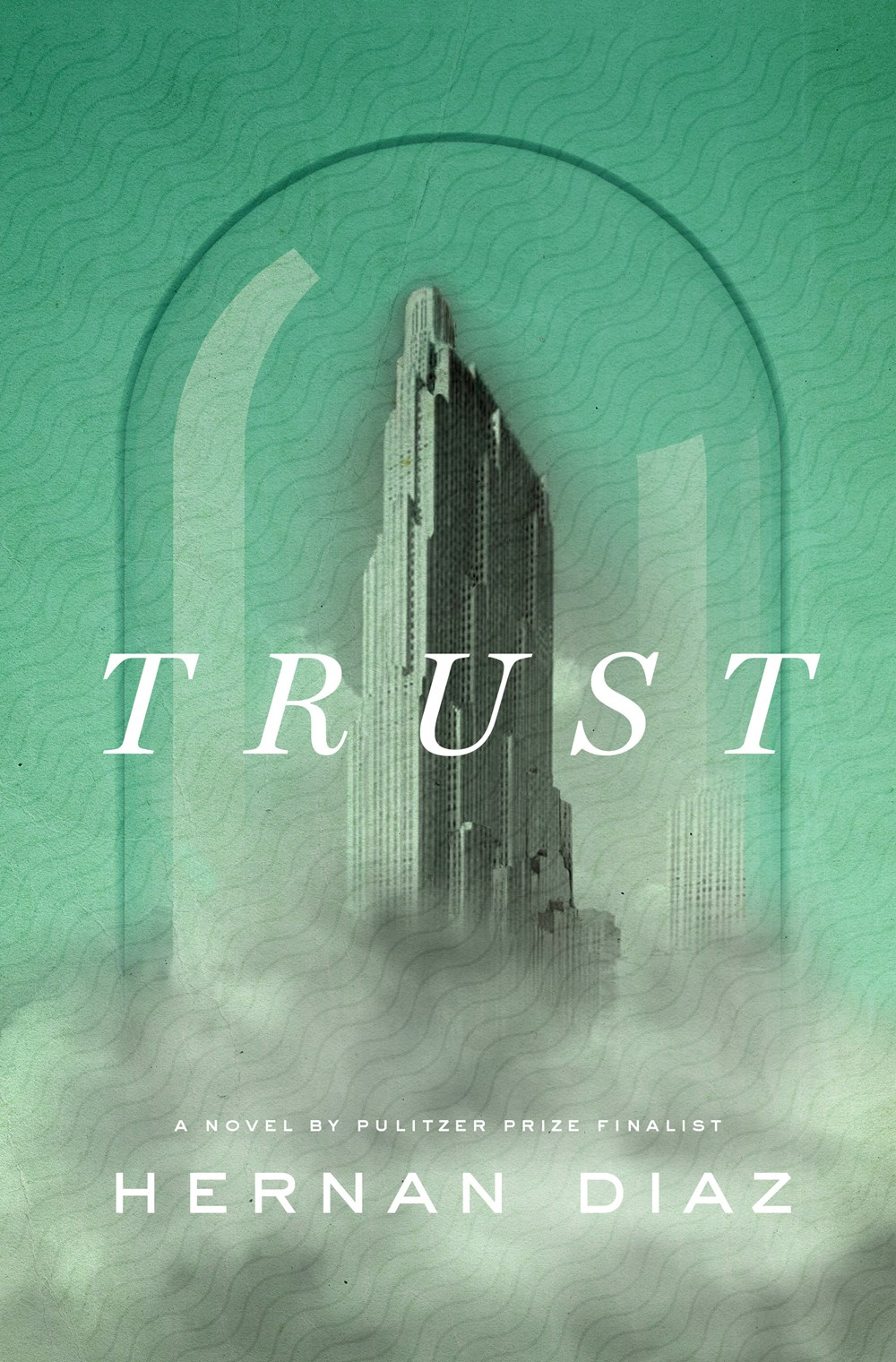
Initially, Trust by Hernan Diaz is confusing. There are four different parts to the novel, but it works to think of this as four mini- books in one.
The different elements are: Bonds; My Life; A Memoir; and Futures. Each has a different author, but all about Andrew and Mildred Bevel.
“Bonds, A Novel by Harold Vanner,” opens Diaz’s series. It was written in 1937 as a work of fiction about Benjamin and Helen Rask, their wealth and lifestyle, set mostly in New York City. It’s the roaring ‘20s, but the couple, neither flaunt their wealth nor seek attention. Helen, does however, fund foundations and is a patron of the arts.
Next, “My Life by Andrew Bevel”, is a series of the wall street tycoon’s life intended as the basis of a novel, but in this context appears as a haphazard assortment of half-finished notes. This is meant to counter Vanner’s novel, based on the Bevels; it took a while to figure this out.
The third part is written by a newly introduced character, Ida Partenza. She’s hired by the now elderly Andrew Bevel to tell what he considers to be the “true” story about the Bevels. She’s given limited access to records and transcripts. Bevel wants Ida to portray their lives as he sees fit, which isn’t necessarily the way things happened. This is something Ida soon realizes, until she finds the final segment: “Futures written by Mildred Bevel,” which is more of a diary, but connects all of the components while resolving any residual confusion.
Of course, Diaz is the author of Trust in its entirety. It’s best described as a mystery and a reflection on the past. What we want to recall isn’t always the way things actually were.
Trust
Three and three-quarters bookmarks
Riverhead Books, 2022
402 pages
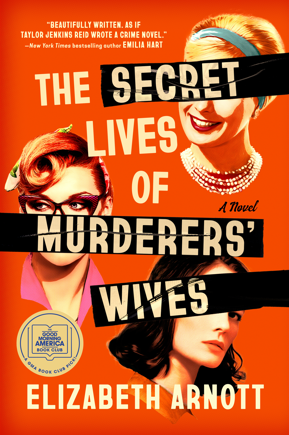
The Secret Lives of Murderers’ Wives is one of those titles that both intrigues and leaves one skeptical about what to expect.
Set in 1966 Southern California, author Elizabeth Arnott strategically references popular songs, fashion and events of the era to set the scene, which takes some edge off this thriller. The three main characters are, indeed, the ex-wives of infamous serial killers now incarcerated.
Their husbands’ notoriety has made the women’s lives difficult; they have few friends and the relationships they do have are mostly misguided. None of the women had a clue regarding the dangerous, and gruesome, lives their husbands led away from home.
Bev is the only one of the three with children; she believed he was the family-man he projected to her and those in their circle. Brash Margo’s husband was former would-be-politician. Elsie works as a clerk at a Los Angeles newspaper (with aspirations to be a reporter). Each man was convicted of horrifically killing multiple women. It’s not entirely clear how the ex- wives met but they do form a bond as victims in their own right.
When several young, local women are found murdered, Bev is the first to suspect there’s a connection; one that’s soundly dismissed by the police. Law enforcement is convinced gangs are involved; Bev is certain one man is responsible. This is when she and her friends begin their own investigation.
The engaging, well-paced narrative leaves one wanting to double check that windows and doors are locked at night.
The Secret Lives of Murderers’ Wives
Four Bookmarks
Berkley, 2026
312 pages with acknowledgements
Buckeye by Patrick Ryan has all the elements of a (good) soap opera: broken relationships, infidelity, family issues and so much more especially, or perhaps, because the setting is a small Ohio town (hence the name).
The fictional work spans six decades, but actual events serve as the backdrop.
Cal Jenkins and Becky Hanover grow up and marry in rural Bonhomie, Ohio. Carl was born with one leg shorter than the other; this made him ineligible to serve later when World War II breaks out. However, it’s VE Day when things begin to change for him. That’s when Margaret, relatively new to town and certainly a stranger to Calvin, walks into the hardware store where he works and kisses him in celebration of the war’s end.
Buckeye begins in the present, moves seamlessly to the past for a brief time, before moving forward. Margaret is married to Felix, but theirs is a passionless marriage; Felix is gay. There’s more backstory. He joins the navy when war is declared and is later lost at sea in the Pacific.
Meanwhile, Becky is preoccupied with her paranormal abilities; Cal is skeptical. It’s not long before Margaret and Cal begin spending more time together.
Ryan’s character-driven narrative is engaging and credible — well, perhaps Becky is less so because of her obsession with reaching the dead. Still, we watch the couples evolve with the times and situations particularly those associated with the numerous lies and secrets that slowly, but predictably, rise to the surface.
Buckeye
Nearly four bookmarks
Random House 2025
452 including acknowledgements
When was the last time you put pen to paper, placed it in a stamped envelope and mailed it? Or, when did you last receive a handwritten letter? These are the explicit unspoken questions lingering within the pages of The Correspondent by Virginia Evans. Plenty of implicit ones fill the pages.
The novel is a series of letters written by 70-something Sybil Van Antwerp . Through years of letter writing, Sybil’s daily routines, her history, emotions and relationships are revealed. Her complexities are relatable. She is kind, ornery and persistent. She writes letters to authors, friends, her brother, the son of a former colleague and many, many others. Sybil has much to write about; she’s a retired lawyer, avid reader, mother, divorcee and lifelong learner.
Yet, for all these qualities, she’s not entirely likeable. She holds a grudge and misses a lot that’s right in front of her. Some of this is due to her diminishing eyesight, but more can be attributed to her stubborn personality. When opportunities arise to make amends, she’s a mixed bag. She extends olive branches to those with whom she had peripheral contact, while refusing with family members, including her dying ex-husband.
Evans is heavy handed when it comes to lessons to be learned such as establishing and maintaining relationships. Sybil is not completely aware of the impact of her letters. Still, Sybil’s commitment to written correspondence is commendable, particularly considering her frequent lack of face-to-face social skills.
Nonetheless, it’s time to buy some postage stamps.
The Correspondent
Three and three-quarter bookmarks
Crown 2025
285 pages including acknowledgements
(I’m back. I took a blogging break, but reading continued as usual: a lot. I’m not sure I’ll blog about everything that I read over the past (too many) months since I last posted, but thanks to a friend’s encouragement I’m reigniting my passions of reading and writing.)
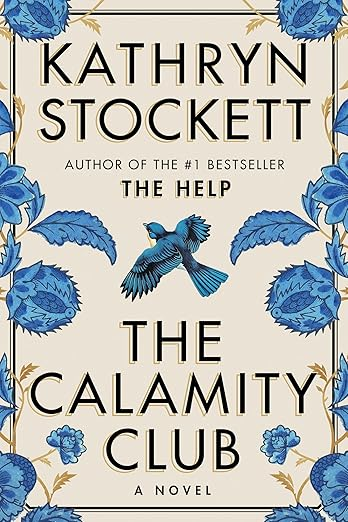
When I picked up my copy of The Calamity Club from the library (a book with an exceptionally long wait list), I was thrilled until I realized it was more than 600 pages. Once I started reading, I forgot about the weight — er number of pages — and couldn’t put it down.
Set in the depression in Oxford, Miss., Kathryn Stockett’s novel has multiple intertwining threads, yet none get tangled enough to be confusing. All address some heavy, intense issues in an often amusing, but always poignant manner.
Birdie is a hardworking, intelligent, unmarried woman. She’s perceptive and speaks her mind. She goes to Oxford to learn why Frances, her newly-married, social-climbing sister, hasn’t communicated with anyone in the family. Frances and her husband live with his mother in their well-appointed home.
Eleven-year-old Meg has been abandoned by her mother and is considered “unadoptable” at the county orphanage where the sadistic director is particularly harsh toward her. Meg is witty and resourceful in spite of her situation.
Birdie and Meg are only two of the many, many interesting characters inhabiting the pages. All have distinct voices/personalities. The setting is vividly described and the hardships of the era are palpable.
A myriad of secrets, including some surprising connections, and a unique, actually kind of crazy, solution to solving the problems associated with poverty, racism and abandonment converge in some laugh-out-loud and tear-sniffling moments.
Stockett’s last book (The Help) was published in 2009. It was worth the wait for The Calamity Club.
The Calamity Club
Five bookmarks
Spiegel & Grau, 2026
656 pages
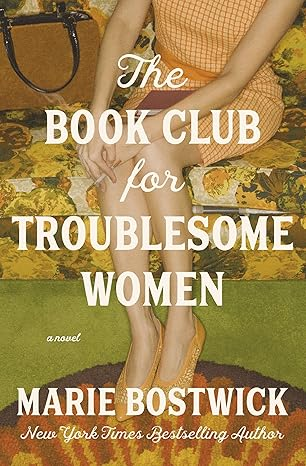
Set in 1960s in a northern Virginia suburb of Washington, D.C., Marie Bostwick’s novel, The Book Club for Troublesome Women is a misnomer– at least by today’s standards.
The housing development where the women live is new, so none of the neighbors know one another well. After visiting the local bookstore, Margaret Ryan decides to form a book club. She invites three other women to discuss Betty Friedan’s The Feminine Mystique, which has just hit the shelves. The group calls itself The Bettys.
Bostwick ascribes interesting attributes to each woman. Marilyn, Viv and Charlotte are all married with children. Charlotte is brash and creative unlike anyone Marilyn has ever met. Bitsy, the youngest and married to a much older man, is desperate to get pregnant.
The novel focuses on the personalities and friendships, which are initially in line with the times in which they live. This is primarily focused on the sexism they face in their marriages and outside their homes. Slowly, and predictably, as the women grow closer they begin to change by challenging the norms of the day.
There’s plenty of humor and nostalgia, even for those who weren’t part of that era. The women’s frustrations at not being taken seriously are palpable, but so is their joy when they are.
The final chapter takes readers to the early 2000s. As for the title, these women aren’t troublesome; rather they’re brave, progressive and evolve to become defiant. There’s little that’s unexpected, but it’s a fun read nonetheless.
The Book Club for Troublesome Women
Almost four bookmarks
2025, Harper Muse
371 pages, including acknowledgements and Discussion Questions
Keiko, a 36-year-old convenience store employee in Tokyo, is the main character in Sayaka Murata’s poignant novella, Convenience Store Woman. She’s had the job for 18 years and is perfectly content with her life. The work gives her the structure she needs to feel valued – even though she’s the only one who sees it that way. She knows that she’s out of step with the rest of the world.
The problem is that her family and friends consider the job unsuitable for a woman Keiko’s age. They also question the fact that she’s unmarried and worry she has never had a boyfriend. This falls in line with the perception, both hers and others, that she doesn’t fit in. Yet, at the Smile Mart, she does. She’s a diligent, dedicated worker. She also has little to no social life outside the store. She’s unmarried, considered unskilled by those who don’t understand what she brings to the position and, perhaps most importantly, has no desire to conform.
When a new employee, Shiraha, is hired, Keiko is dismayed at his lack of motivation and disregard for company policies. Although he doesn’t last long at the store, he ingratiates himself into her life.
Murata provides a heartwarming glance into the power of believing in oneself, but not before having Keiko consider how culture and those around her, including the wormy Shiraha, make her question her self-worth.
This is a short work that’s long on ideas and feelings.
Convenience Store Woman
3.75 Bookmarks
Translated by Ginny Tapley Takemori
Grove Press, 2018
163 pages
The Ministry of Special Cases by Nathan Englander is a gripping narrative about family, sacrifice and grief.
Although those elements are far from uplifting, Englander’s characters demonstrate the power of parental love and the ability to find inner strength where it once seemed impossible to exist.
Set in Buenos Aires during the time of Argentina’s Dirty War when people were “disappeared”, Kaddish Poznan is a ne’er do-well Jew, the illegitimate son of a prostitute. The sins of his mother taint all aspects of Poznan’s life. Only his wife, Lillian, tries to see his potential; but his son, Pato, despises him.
Poznan is always one scheme away from success; some are near brilliant and others simply far-fetched. His steady, albeit clandestine, work involves removing names on tombstones in the Jewish section of a cemetery for wealthy families wanting to stay under the regime’s radar.
When Pato disappears, Poznan and Lillian do everything possible to find him. Much involves needing large sums of money which leads to some humorous but agonizing situations for the parents. In their search for Pato, the couple ends up at the Ministry of Special Cases. This proves to be an exercise in futility thanks to the maze of bureaucratic red tape and ineptitude. All of this stumps Poznan, but motivates Lillian, which creates a rift between them.
Englander’s characters are vividly described as is the situation in Argentine at the time when thousands of people were killed or kidnapped by the country’s military leaving families ripped apart.
The Ministry of Special Cases
Four Bookmarks
Vintage International, 2007
339 pages
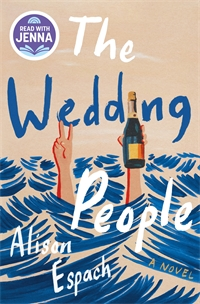
When Phoebe Stone abruptly leaves her Midwest college teaching job at the beginning of the semester, she heads to an upscale hotel on the Rhode Island coast. It’s a place she’d always dreamt of going with her husband, but he’s left her for another woman and Phoebe needed to get away; she’s had enough.
Alison Espach’s humorous and compassionate novel, The Wedding People, is as much about self-discovery as it addresses misplaced emotions, chance encounters and probable bad decisions.
The hotel is booked for a weeklong private affair and Phoebe is easily mistaken as a wedding guest; albeit without any luggage. It’s a large group of family and friends. No one takes particular notice until the bride, Lila, realizes Phoebe’s presence has the potential of ruining the festivities. Lila has planned everything, while sparing no expense, practically down to the minute. The unanticipated presence of a stranger could ruin everything.
Yet, Phoebe intrigues Lila, who spends time in the older woman’s room regaling her with the efforts involved in planning the wedding. Phoebe learns how Lila met her fiancé, the relationships she has with her mother, her sister-in-law to be and many of the (invited) guests.
Phoebe assures Lila that she has no intention of being a disruption: she plans to stay at the hotel one night and not interact with anyone. This soon goes awry.
The engaging, well-paced narrative, full of nuanced characters, leads Phoebe to a better understanding of herself, an acceptance of others, new friendships – and more.
The Wedding People
Four Bookmarks
Henry Holt and Co., 2024
367 pages, includes acknowledgements
I’ve struggled with how to review All Fours by Miranda July about a woman’s search for, well, more particularly when it comes to sex.
The unnamed narrator, an artist, by all accounts has a good, if not completely satisfying life with her husband and child. After receiving a large sum of money for the use of some of her work, she plans a trip to New York City. Rather than flying, she drives.
She stops 30 miles from her Southern California home, briefly meets Davy, learns his wife is an interior decorator stays at a nondescript motel. There she uses the money to hire the young man’s wife to redecorate the room.
While the upscale redecorating takes place our narrator fantasizes about the man, the man and his wife and mostly the man being with her.
Rather than a road trip, the novel becomes a jaunt through sexual fantasies. Once the remodel is complete, the narrator and Davy routinely meet. He’s adamant about not having sex with the narrator, their relationship is a close to being unconsummated as it gets. This is only the first third of the novel.
The remaining thirds feature plenty of sexual escapades that do occur in the posh room, but all involve women. Once home again, the narrator’s marriage becomes a co-living, co-parenting relationship; and she returns weekly to the motel room where she meets other women.
There’s humor and sex so this may be for the faint hearted. There’s also a lot of repetition.
All Fours
Three Bookmarks
Riverhead Books, 2024
326 pages