It’s obvious that my husband and I are tourists in Rome. We wear expressions of awe and confusion. One thing we don’t do is always carry a guidebook. There’s nothing wrong with them, but I was surprised to count the number of people who approached Trattoria da Teo with books in hand.
Our B&B host told us about Teo’s. We didn’t know we needed reservations. The restaurant, like most in Rome, opens at 7:30. This was something many with Rick Steves and Frommer’s weren’t aware of either, but a fair number was. Perhaps the guidebooks should be more detailed. We sat in the small piazza watching people go to Teo’s door only to be turned away. We waited more than 30 minutes and once inside were told there was one remaining table available for someone without reservations.
Although this is a popular Trastevere eatery, we weren’t wowed. The food wasn’t photogenic, but there were a few bright spots, including the lightly breaded calamari with artichokes. Read the rest of this entry »

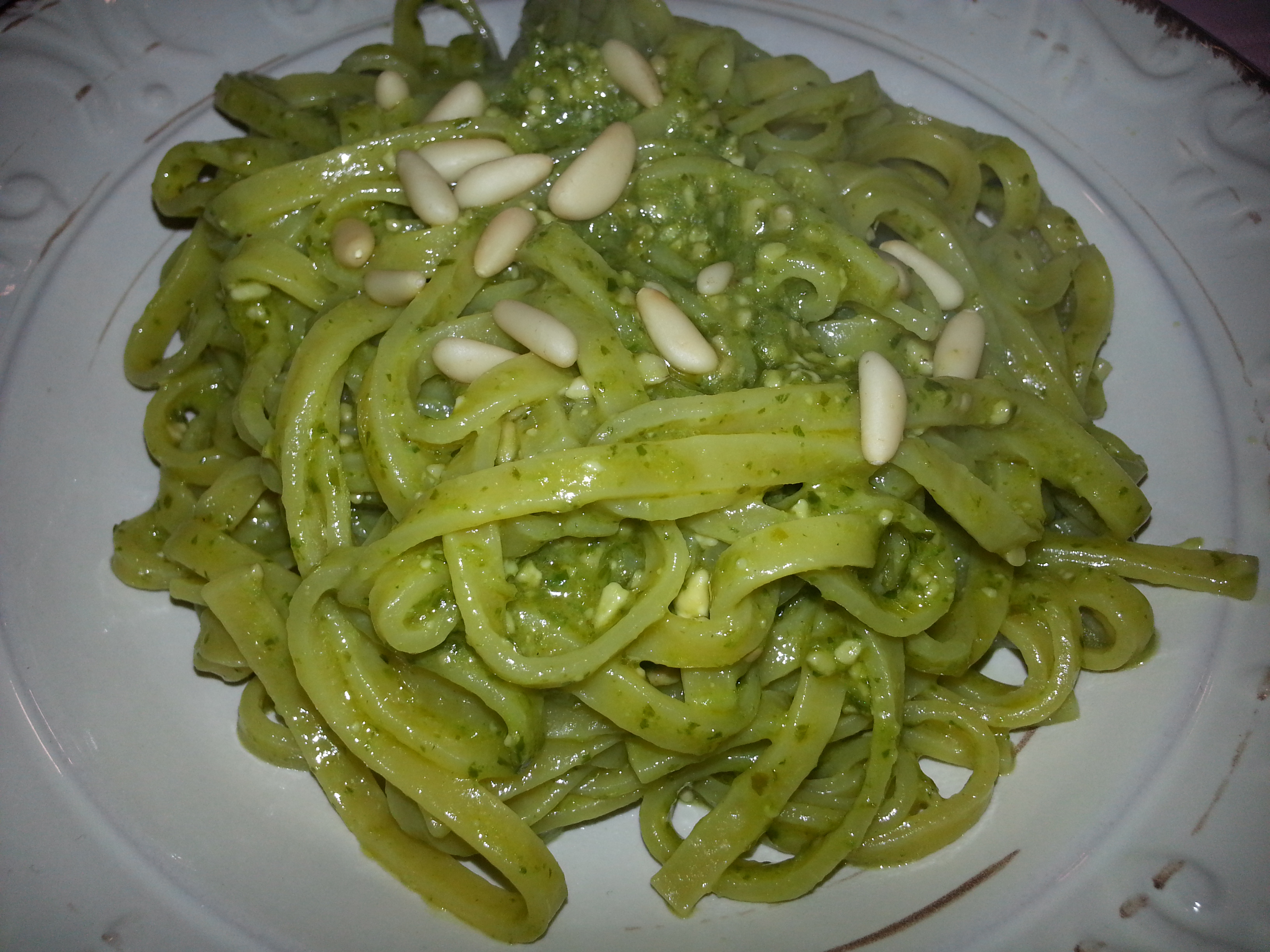
I’d been told many times that pesto made from basil grown in the Cinque Terre is especially good. The warm sun and coastal air make the licorice-flavored herb uniquely pungent. Basil is not a mild flavor, so I was intrigued by the idea of a different, perhaps stronger taste. I ate pesto several times over the course of three days to make sure.
Rest assured, it was very good, but I think the local olive oil may also be a contributing factor. Although, each dish I sampled allowed the rich green basilica to shine. The oil did not overpower, which can be the case with some versions.
We stayed in Riomaggiore where in late February it is still the low season. We found only two restaurants open. In nearby Manarola, there were more options, but not an overwhelming number.
My pesto dinners were surprisingly different, albeit only slightly. One, at Pizzeria da Mam’angela, featured potatoes. Osteria Maite’s had pine nuts and was a darker green, but both were mixed with perfect al dente tagliolini, a linguini-like fresh pasta.
La Scogliera in Manarola offered several options for pesto, including lasagne, gnocchi and minestrone. I had the latter. The soup was rustic and hearty . The serving was just right for a late lunch.

At home a large serving of pasta with pesto would suffice as a meal. One night I opted to eat as Italians do and had a primi plati and a secondi plati (grilled swordfish). It was a lot of food. The second evening I had only pasta. Perfecto!


Years ago I gave myself permission to stop reading books that couldn’t hold my interest. Nonetheless, I still struggle with the idea that once I start something I should finish it. As I slogged my way through Amy Bloom’s Away, I wondered when I’d set it down for good. I never did.
Bloom’s slow-paced story is about the determination of a mother’s love and the sacrifices she endures. It’s also a narrative about immigrants and fitting into not just new environments but adjusting to different customs and expectations.
Lillian Leyb is a seamstress living in New York City’s lower east end in 1924. As she becomes romantically entangled with her employer and his son, her past is slowly revealed. She left Russia where her husband and, presumably, her child were killed. Lillian becomes a kept woman until she learns from her cousin, a recent arrival from the homeland, that her daughter is still alive. Thus begins Lillian’s journey across the United States including the expansive Alaskan frontier en route to Siberia to find her daughter.
Lillian experiences both the kindness and cruelty of strangers; she’s befriended and betrayed. Bloom incorporates humor and pathos in Lillian’s trek by explaining what’s in store for those Lillian encounters – from her east end companions to those in a Seattle brothel and later a women’s prison in Alaska. Through it all, Lillian remains determined to find her daughter.
Although Away was no page-turner for me, I’m glad I stuck with it. It just took time.
Away
Three Bookmarks
Random House, 2008
240 pages

The heroics/horrors of war, tests of familial love and loyalty to one’s country merge in Kristin Hannah’s The Nightingale.
In Oregon 1995 an unnamed elderly woman prepares to move from her home at the insistence of her adult son. This sets in motion her recollection of life in France during World War II. At its heart, the novel is about the relationship between sisters Vianne and Isabelle, ten years her junior. Following the death of their mother, their father leaves them with a stranger. Despite their shared grief and sense of abandonment, the two have nothing else in common.
The war years show how, as adults, the sisters remain at odds. Vianne struggles to keep her daughter safe and maintain the family home after her husband goes to fight. Meanwhile, Isabelle wants a role in her helping her country overcome German authority.
The sisters’ personality differences are repeatedly described, yet the strained relationship doesn’t always ring true. Vianne acknowledges that she failed in her responsibility as the older sibling to help Isabelle; she attributes this failure to dealing with her own sorrow at the time. Isabelle has an air of entitlement – at least when it comes to emotions; this sense of privilege doesn’t follow her as she works with the French Resistance.
The novel progresses with the war; occasional interruptions remind the reader of the elderly woman. This becomes a guess-who exercise: who is it and how did she end up in Oregon. Only one of the questions is answered.
The Nightingale
Three-and-a-half Bookmarks
St. Martin’s Press, 2015
438 pages
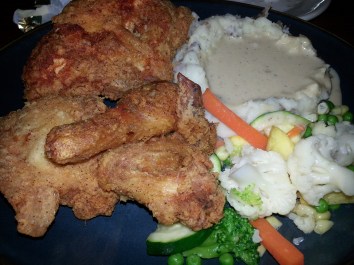
I have a hard time ignoring a restaurant’s boastful claims and proclamations. Even though I’d never heard of the Castle Café before, this meant I had little choice but to order its “World Famous Pan-Fried Chicken.”
I’m glad I did.
The menu and our server noted that the order takes 30 minutes to prepare. Fortunately, I was in good company, so time passed quickly; it was my order delaying our meal. When it arrived, I wasn’t disappointed. Chicken Fried Chicken is also on the menu; what distinguishes the pan-fried version is that it’s cooked on the bone – part of what contributes to the half-hour prep. The former is a chicken breast pounded thin.
For the famous rendition, it’s possible to order all white, all dark or a combination. I opted for the latter. Four pieces of golden, crispy chicken served with real mash potatoes, cracklin’ gravy, mixed fresh vegetables, and cole slaw made this a hearty meal. Homemade, hot-out-of-the-oven Parker House rolls made this a complete feast.
The juicy chicken and gravy made from the pan remnants evoke images of Sunday dinner. This was an impressive meal.

Other offerings include burgers, grilled and fried entrees and house-smoked meats for pulled pork or brisket sandwiches. A metal tray served as the plate for the brisket topped with tangy barbecue sauce served on a brioche bun with French fries; this was clever plating.
If anyone asks, I’ll agree the fried chicken deserves its accolades – even if it is a small world, afterall.
Castle Cafe
Four-and-half Plates
403 Wilcox
Castle Rock, Colorado

I nearly quit reading Americanah by Chimanda Ngozi Adichie twice. The first time I thought about setting the book down for good was in the first 50 pages; the second time was 30 pages later. I’m glad I persevered, though.
At its heart, Adichie’s vast novel is a love story. It turns out to be so on several different levels: love for country; love between a man and a woman; love of self.
Perhaps part of my initial disinterest was the difficulty of keeping track of who was who; it wasn’t easy. Eventually, the voices and experiences began to sort themselves out becoming distinct and engaging.
Although the story is not told in chronological order, the narrative focuses on Ifemelu, a young woman who leaves Nigeria for America. This triggers a journey to find herself and to address the issue of race for the first time. In the process she leaves behind Obinze, the love of her life. His experience is briefly addressed, but Americanah is about Ifemelu more than anyone else.
The self-confidence and intelligence she exhibited in Nigeria serve her well in the U.S., despite some setbacks. Eventually, she becomes successful as a blogger writing about race. She also finds romance, but Obinze is never far from her mind or her heart.
Ultimately, Ifemelu returns to Nigeria. Ironically, just as she idealized America before her arrival, she idealizes the country she left behind. Disappointment exists, it seems, on both continents. In Adiche’s hand, hope is also present.
Americanah
Four Bookmarks
Anchor Books, 2014
588 pages

This is a good time of year for a heartwarming story, even a predictable one. A Man Called Ove by Fredrik Backman fits the bill.
Ove is a Saab man. He’s not employed by the Swedish automaker, he’s loyal to it. It’s his gauge of measuring a person’s character (in Ove’s world it usually applies to men). Ove is all about character. He raises his eyebrows at those who drive BMWs or Audis; he tolerates Volvos.
Set in his ways like a train on a track, Ove only cares about his route. Except, anyone sharing his path must abide by the same rules he does. He doesn’t necessarily set the directives only that he follows them to an extreme.
At times funny and sad, Ove’s story is initially about his decision that it’s time for his life to end. Of course, this is no laughing matter, but humor surfaces as life intervenes in his efforts to take action. Distractions get in the way. He must contend with neighbors, a stray cat, being in the wrong place at the wrong time, and his wife Sonja.
Set in Sweden, Backman alternates chapters to reveal Ove’s past and its impact on the present. It’s easy to visualize Ove as a grumpy old man, although he’s only 59; it’s also not difficult to see, or at least initially suspect, there’s more than meets the eye. It’s most evident in his love for Sonja. What happens comes as a surprise to Ove and the reader.
A Man Called Ove
Three and three-quarters Bookmarks
Fredrik Backman
Atria Books, 2014
337 pages

Epic Russian novels have long appealed to me for many reasons: the history, the descriptions of stark landscapes and lively urban settings, the storytelling, and the names. Ah, the names.
Author Amor Towles ties all these elements together in A Gentleman in Moscow.
Count Alexander Ilyich Rostov, known as Sasha among a few and as the Count among many, is sentenced to house arrest at Moscow’s grand Metropol Hotel in 1922. This is an engrossing tale about a man who grew up with every comfort and advantage during tsarist Russia. Although his lifestyle changes, it unexpectedly expands.
At the beginning of his confinement, the mother country is in the early stages of political and economic changes that continue for decades. The Count is undeterred by his reversal of fortunes. Towles presents a contented man, knowledgeable, kind, charismatic, happy with routines, yet imaginative. As the Count’s story moves through the years he faces challenges greater than the restrictions of his movements, but always with a good attitude.
Towles injects humor and history with a hotel guestbook of intriguing characters. Interestingly, each chapter begins with the letter A, like the count’s (and author’s) first name.
Here is a novel of the never-wanting-it-to-end variety. The Count’s humanity, his relationships/friendships, and the rich memories of his childhood overshadow his loss of freedom. At times it’s easy to forget that he is a captive in a majestic hotel. He can’t actually check out any time he wants, but why would he want to leave?
A Gentleman in Moscow
Five Bookmarks
Amor Towles
Viking, 2016
462 pages

In Emma Cline’s novel, The Girls, narrator Evie Boyd recalls her involvement as a 14-year-old with a Charles Manson-like cult. The names are changed, the location is different, but Evie’s perspective still provides enough nuanced similarities to the Helter Skelter summer of 1969.
The setting is northern California. Evie’s parents are divorced and after falling out with her childhood friend, Evie meets Suzanne who’s a few years old. Suzanne introduces Evie to Mitch and others at a commune on a nearby ranch. He is meant to be charismatic and profound, but it’s Suzanne that Evie is drawn to. She ingratiates herself into life at the ranch to be with Suzanne. Her interest is occasionally reciprocated by the older girl.
Cline imbues Evie with all the pathos associated with a young teenager. Her obsession with Suzanne is puzzling: is it sexual or is it her need for an involved maternal figure?
When Evie returns to the ranch after a brief absence, its allure has begun to fade. She can sense there’s an itch to scratch, but isn’t sure of its source. It’s at this point that a few inconsistencies surface in the narrative.
Years later, reflecting on that summer, Evie wonders what kept her from participating in the violence carried out by Suzanne and others under Mitch’s directive. If she hadn’t been told to leave, would she/could she have acted as they did? This raises the question of how we think we might respond in certain situations and how we actually do.
The Girls
Three-and-a-half Bookmarks
Random House, 2016
455 pages

Who’d imagine that an uninvited guest who shows up at a baby’s christening with a bottle of gin could divide, then fuse, two families over a span of 50 years? Ann Patchett, of course. Humor, tragedy, quirky, yet believable characters result in a compelling story.
In Commonwealth, Patchett creates a novel within a novel – of sorts. She deftly illustrates the Rube Goldberg effect initiated by one man’s attraction to another man’s wife. The havoc it inflicts is expected, the alliances it forms aren’t.
The Cousins and Keating families are brought together when Beverly Keating divorces her husband to marry Bert Cousins. Beverly is a beauty with two young daughters; Bert, the gin-carrying party crasher, is egocentric and the father of two girls and two boys. The Keating girls move with Beverly and Bert to Virginia, while his kids stay with their mother in southern California during the school year.
The six children spend summers together in Virginia. Their combined disdain for their parents and unrestricted activities form bonds that continue into adulthood. The novel begins in the early ‘60s long before the concept of helicopter parenting took flight. Bert hastily retreats when his kids arrive, leaving Beverly, who’s emotionally detached, to manage alone.
Much of the narrative follows Franny, Beverly’s younger daughter. Franny’s relationship with her sister and step-siblings is told in flashbacks moving from childhood to young adult to middle age. In Patchett’s hands, Franny is optimistic; she looks for the best– even when it’s unlikely to surface.
Commonwealth
Four-and-a-half Bookmarks
HarperCollins, 2016
322 pages