That Kind of Mother by Rumaan Alam makes one wonder whether to emphasize the word that with a judgmental tone or of nonchalance. In either case, Jacob is Rebecca Stone’s firstborn who fills her with love and anxiety; she is certain she doesn’t know how to mother. Thanks to Priscilla, the kind, easy-going La Leche League liaison, Rebecca gradually gains confidence as a new parent. However, this slow-to-reach self-assurance is, initially, completely dependent on Priscilla to the point that Rebecca offers the African-American woman employment as Jacob’s nanny.
The situation allows Rebecca to pursue her endeavors as a poet. It also creates a strong friendship between the two women that transcends race and maternal roles. A few years later, when Priscilla becomes pregnant and dies during childbirth, Rebecca immediately offers to adopt the baby. Rebecca’s husband uneasily goes along with the plan. Rebecca’s adult daughter, who is also expecting a child, agrees. The result is a melding of the two families, but less so of the different cultures.
Rebecca has grown up with privilege and her marriage to Christopher, an older, English diplomat, allows her to maintain the lifestyle to which she’s accustomed. Consequently, she’s made a lot of assumptions regarding race. Even after formally adopting Priscilla’s son, there is much she misunderstands.
Interestingly, Alam writes from a female perspective, and gets things right. His writing is engaging as Rebecca’s life, her family and career undergo major changes leaving the reader to question how else to face similar experiences.
That Kind of Mother
Four Bookmarks
Ecco, 2018
291 pages
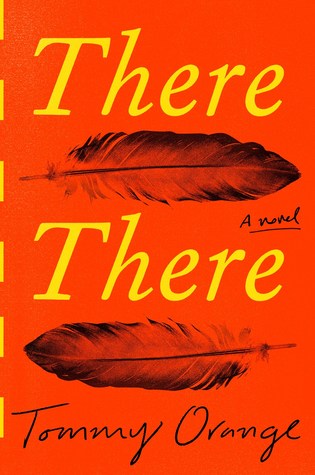
In the late 1930s Gertrude Stein wrote of Oakland, Calif., “… there, there is no there there.” It’s apt, then, that Tommy Orange has co-opted part of the quote as the title of his novel. Orange introduces readers to several Native Americans whose lives intersect in the city on the East Bay.
Never as glamourous, wealthy or viewed in as positive a light as San Francisco, Oakland is, nonetheless, the focal point for Orange with different perspectives provided by the 12 characters he introduces. Their stories, told in separate chapters, are shaped by the urban environment and the upcoming Big Oakland Pow Wow.
Violence, alcoholism, out-of-wedlock pregnancies, traditions, estranged families and more are contributing factors to the scenarios Orange creates. Most are heart-breaking, yet humor and joy are also evident.
Opal Viola Violet Bear is first introduced as an 11-year-old in 1970 when her mother brings her and her older sister, Jacqui, to Alcatraz as part of the all-tribe occupation. She re-enters the story through the eyes of her grandson, Orvil Red Feather. Except, technically, Opal is Orvil’s and his two younger brothers aunt. Although his name clearly identifies his heritage, he knows little about it. He discovers dance regalia in Opal’s closet. He learns what he can about Indian dance and culture online. The Pow Wow is his chance to be part of something he knows very little about.
Reasons for the others to attend the Pow Wow range from dark to hopeful, which makes the narrative so engaging.
There There
Four Bookmarks
Alfred A. Knoph, 2018
290 pages

Kent Haruf’s slow moving, methodical novels immediately embrace readers. Eventide is no exception. The setting is rural Colorado, where seasons dictate life’s pace.
Haruf reintroduces several characters from his bestselling Plainsong, including brothers Harold and Raymond McPheron, Victoria Robideaux and Colorado’s eastern plains. The McPherons, who have spent their entire lives working side by side on the family farm, have never married. Victoria, the unwed teenage mother they took in in the previous novel, is ready to leave for college with her young daughter. The impact the mother and child have had on the McPherons is tangible; their reaction to the pair leaving is parental.
Yet theirs is only part of the narrative. Holt is a small town, where, it seems, everyone is acquainted, whether personally or indirectly, with everyone else – or at least knows of their business. There’s Luther and Betty, with their two children, living on food stamps who meet regularly with a social worker, Rose. Despite her best efforts, the parents have no parenting skills and the children suffer.
Haruf describes relationships in the sparsest of terms, yet they’re vivid. Some are painful, others humorous, many loving, but all are real. For example, Betty and Luther don’t intentionally put their kids in harm’s way, but neither do they know how to protect them.
Even with the subplots involving other residents of Holt, the focus always returns to the McPherons, particularly Raymond after tragedy strikes.
Haruf uses no quotation marks and terse dialog, yet the conversations speak volumes.
Eventide
Four Bookmarks
Alfred A. Knopf, 2004
300 pages

The late Henning Mankell was best known for the Kurt Wallander series. I was curious about his other works, which led me to After the Fire. This first-person account follows retired physician Fredrik Welin and his experience after his home is lost in a fire.
The 70-year-old Fredrik, asleep and wearing only his pajamas, barely makes it out alive. The house, the solitary one on a small island in the Sweden archipelago, had been in his family for generations. Evidence of arson raises suspicion that Fredrik is responsible.
References to a backstory surface but are never fully explained. His only friend, Jansson, is a retired postal carrier who made his deliveries by boat from one island to another. Fredrik is often dismissive of Jansson’s good intentions and offers of help. Fredrik’s estranged daughter arrives; it’s unclear whether she’s meant to help or annoy her father.
Fredrik is not a likeable, engaging character, which often makes it difficult to sympathize with his loss. He is impatient and selfish. When he meets Lisa Modin, a local journalist who is much younger than he is, Fredrik imagines a relationship could develop.
Mankell crafted a storyline focusing more on Fredrik, his loss and his outlook on life than on the mystery of who started the fire. In fact, when that is eventually revealed, it’s anticlimactic. Fredrik does undergo a mild transformation from an island recluse to someone who looks beyond himself. Yet, this offers little in the way of a satisfying outcome to the narrative.
After the Fire
Henning Mankell
Three bookmarks
Vintage Books, 2017
399 pages
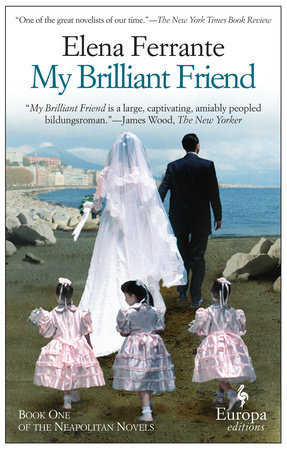
It’s a rare movie that’s better than a book, so I didn’t want to gamble by watching My Brilliant Friend before reading the first in Elena Ferrante’s series known as the Neapolitan Novels. Although initially slow moving, the book didn’t disappoint. After watching the first episode on HBO, I can attest that it closely, beautifully follows the story of friendship, love and life in the outskirts of Naples, Italy.
Narrated by Elena, the plot follows her ties with her friend Lila, their families and community. Elena is the “good” girl of the two. Lila is fearless, tough. Both are exceptionally bright, although Lila doesn’t expend as much energy and concern into feeding her intellect; hers is an innate intelligence.
Ferrante deftly describes the poverty, the over-crowding, the classroom, the apartment buildings, the local businesses and the people who inhabit them. The reader can feel the dust from the dirt streets and smell the imagined cooking that must be emanating from the Italian kitchens. (Scant attention is paid to food, so it’s an assumption that meals are prepared; it’s Italy, after all.)
The girls are competitive and caring. Like many friendships, it waxes and wanes. Yet, Elena knows no else is capable of such meaningful conversation and exchange of ideas as Lila. Elena pursues her education from elementary to middle school and finally high school, but her friend’s parents don’t allow their daughter to continue. Still, the girls remain intellectual equals.
Against this backdrop are subplots of honor, superstitions and long-held societal traditions.
My Brilliant Friend
Four Bookmarks
Europa, 2012
331 pages
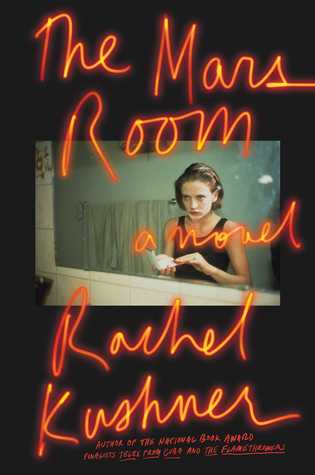
Author Rachel Kushner’s The Mars Room is a strip joint in San Francisco, where Romy Hall once gave lap dances to support herself and her young son, Jackson. That’s before she’s sent to prison in California’s desolate Central Valley, where she’s sentenced to two consecutive life sentences for a crime that’s not immediately explained.
Most of the narration is Romy’s as she recounts her childhood, teenage years and life working as a stripper. These reflections are interspersed with her confinement. It may be almost impossible to think about women in prison without Orange is the New Black coming to mind. However, Kushner’s cell scenes are harsh, unsympathetic and dismal. Nonetheless, Romy is befriended by Sammy, a veteran inmate, Conan, a transsexual who’s very convincing as a male, and Gordon Hauser, a teacher who recognizes Romy’s intelligence and beauty.
A few of the chapters are narrated by these friends. Doc, a crooked cop, imprisoned miles away, also provides a voice. Yet, it’s Romy with her sense of humor, dismay and maternal instincts who commands the pages. She has had to leave Jackson, in the care of her mother, which causes a number of complications for Romy.
Kushner blends pathos with the harsh reality of prison life. As one of the guards states, not just to Romy, but others, “… your situation is due one hundred percent to choices you made and action you took.” As we learn more about Romy and the other characters, it’s evident this is not entirely true.
The Mars Room
Four Bookmarks
Scribner, 2018
338 pages
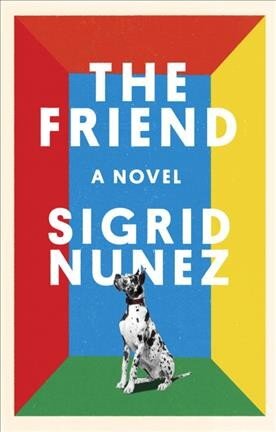
The Friend by Sigrid Nunez comes across as a letter to an intimate, erudite companion and also a series of journal entries about grief. Yet, it’s a story, in fact a novel, a work of fiction.
The nameless female narrator mourns the death of a dear friend, a relatively successful (male) writer, who has committed suicide. He, too, is unnamed, as are many of the characters, who are mostly peripheral, such as Wife One, Wife Three and Grumpy Vet. Some of the narrator’s graduate students are identified as someone “I’ll call …,” but only the super of her New York City apartment and a Great Dane are ascribed monikers.
Reluctantly, she takes the deceased man’s dog, Apollo, since no one else wants him; he’s old and massive. Like her, the dog also grieves. Apollo’s presence brings changes and not just to her lifestyle — despite her small apartment in a building that doesn’t allow pets. Previously, she’d only had cats. This is no immediate transformation. She recognizes he is a tie to her friend and she is not alone in her sorrow.
Nunez’s novel is also about writing. The narrator is a college English teacher. She cites writer after writer on death, grief, dogs, teaching, love and writing. Just as the woman recounts her memories of her close bond with the writer, her connection with Apollo transforms. She no longer sees him as a burden, so the question remains who is the friend: the dead writer, the narrator or the dog?
The Friend
Almost four bookmarks
Riverhead Books, 2018
212 pages

Period novels usually aren’t my thing. It could be the often flowery language, the popular use of first person narrative, the topic, the je ne sais pas. Little by Edward Carey, while guilty of the above, including the French, is captivating. The story, based on the early life of Madame Tussaud known for her wax sculptures of celebrities, is rich with humor, pathos, historical references and lively characters.
Born Anne Marie Grosholtz in 1761, Marie, as she was generally called until her diminutive size warranted the nickname “Little,” recounts her family background. She literally begins with her birth. Interspersed among the details of her life are drawings. The first identified as “Drawn by herself. In graphite, charcoal, and black chalk. (This being a likeness of her pencil.)” It’s difficult not to smile, although not all of the subsequent illustrations are humorous.
As a child, her life circumstances dramatically change following the death of her parents when she’s relegated to becoming a servant. Yet, Little is witty, intelligent and has a sharp power of observation: Traits that serve her well as her creativity and talents expand.
Little learns the craft of waxwork from the odd Dr. Curtius, who at first sculpted body parts and organs out of wax. Initially, he treats her as a ward. When the pair moves to Paris from Switzerland, her station is reduced to kitchen maid.
Carey’s epic follows the French Revolution with Little’s indomitable spirit whose name bears no reflection on her inner strength and kindness.
Little
Four-and-a-half Bookmarks
Riverhead Books, 2018
435 pages
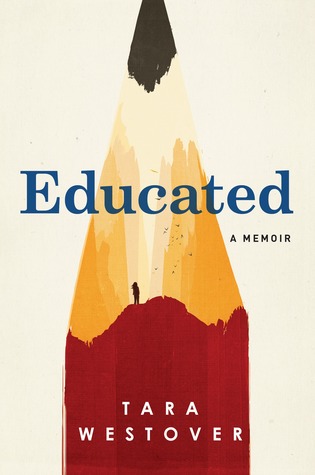
Educated by Tara Westover is one of the most emotionally difficult books I’ve read, but I couldn’t put it down.
The memoir recounts Westover’s journey as the daughter of survivalists in rural Idaho. The government was never to be trusted, neither were doctors or teachers. She never attended school; to say her mother’s efforts at homeschooling fell short is, at best, an understatement. Although hospital care was necessary a few times, the family relied on her mother’s knowledge of herbs.
For much of her life, Westover never questioned her family’s lifestyle. She had no basis for comparison. This isn’t the only aspect making this a challenging book. It was the physical and verbal abuse at the hands of her brother, Shawn. Her parents offered no protection.
Yet, Westover teaches herself how to study and pass the ACT with a score high enough to get accepted into Brigham Young University. From there she studies at Cambridge and Harvard universities, eventually earning a doctorate degree in history from Cambridge.
This is a gritty, heart-breaking narrative and Westover’s self-realization comes with a high price: she must either renounce her education or her family. When she refuses to give in to her parents demands, she is disowned, shunned by her most of her family. Her father’s fervent interpretation of the Bible doesn’t include anything close to acceptance or unconditional love.
Westover’s education extends beyond books and lectures. Her story reflects how much she gained once out of her family’s shadow and what she lost.
Educated
Four-and-a-half Bookmarks
Random House, 2018
322 pages

The Atomic Weight of Love begs the question: how heavy is love? Elizabeth J.Church’s novel has war as its bookends: World War II and Vietnam. The passage of time reflects changes in attitudes toward conflict and women.
Meridian Wallace is a brilliant, young student interested in pursuing not only a college education, but an advanced degree in ornithology. This is unusual in 1940s Chicago. While at university she meets and falls in love with professor Alden Whetstone, who is secretly involved with the Manhattan Project in Los Alamos, N.M. Although he can’t reveal his research, he convinces Meridian to postpone her studies, move across the country and marry him. There will be plenty of time later to pick up where she left off academically. Ha!
Alden’s commitment to his work and the slow disintegration of a loving relationship could seem a cliché. Yet, Meridian manages to flourish even when the attitudes of the day bear down on her. On her own, she continues to study birds without the benefit of academic resources, she makes a few friends despite being ostracized for not having a doctoral degree like most of the wives in her community. Although they are well-educated they do nothing with their education.
Meridian falls in love with a much younger man but maintains the façade of her marriage with Alden, who becomes increasingly narrow-minded and unlikable as the novel progresses.
The author is masterful in the transformation she ascribes to Meridian and the world around her.
The Atomic Weight of Love
Five Bookmarks
Algonquin Books, 2016
352 pages