Archive for the ‘relationships’ Tag
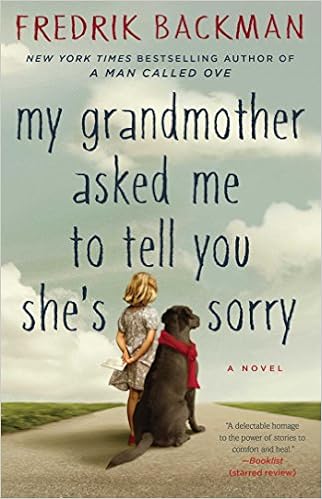
Fredrik Backman author of the acclaimed A Man Called Ove has found a successful formula, which once again emerges in My Grandmother Asked Me To Tell You She’s Sorry. The title is a successful attention-getter – certainly more so than the earlier book. Like Ove, My Grandmother Asked Me assembles diverse characters who are, initially, only tenuously connected.
The major difference between the two novels, though, lies in the main protagonist. Here it’s seven-year-old-soon-to-be-eight Elsa. Although there are plenty of explanations for her being so precocious, Elsa’s behavior, vocabulary and thought-processes, at times, leans more to incredulity than not. Her grandmother is partly to blame and mostly to be celebrated for the young girl’s sense of curiosity, intellect and strong sense of self. But, and this is no spoiler alert since the book cover reveals as much, the grandmother dies leaving Elsa to navigate a world where being different is difficult.
Elsa is charged with delivering a series of letters written by her grandmother. They’re for tenants in the building where Elsa lives but whom she barely knows. Wanna guess what happens?
Humor and pathos move hand-in-hand throughout the narrative, which also includes fairy tales of secret lands. Again, this is thanks to Elsa’s grandmother.
I found My Grandmother Asked Me to be less engaging that Ove, but nonetheless satisfying by its conclusion. Tying up loose ends isn’t always a bad thing. It certainly fits with Backman’s storytelling technique and his ability to create interesting characters full of foibles and heart.
My Grandmother Asked Me To Tell You She’s Sorry
Four Bookmarks
Washington Square Press, 2015
372 pages

The heroics/horrors of war, tests of familial love and loyalty to one’s country merge in Kristin Hannah’s The Nightingale.
In Oregon 1995 an unnamed elderly woman prepares to move from her home at the insistence of her adult son. This sets in motion her recollection of life in France during World War II. At its heart, the novel is about the relationship between sisters Vianne and Isabelle, ten years her junior. Following the death of their mother, their father leaves them with a stranger. Despite their shared grief and sense of abandonment, the two have nothing else in common.
The war years show how, as adults, the sisters remain at odds. Vianne struggles to keep her daughter safe and maintain the family home after her husband goes to fight. Meanwhile, Isabelle wants a role in her helping her country overcome German authority.
The sisters’ personality differences are repeatedly described, yet the strained relationship doesn’t always ring true. Vianne acknowledges that she failed in her responsibility as the older sibling to help Isabelle; she attributes this failure to dealing with her own sorrow at the time. Isabelle has an air of entitlement – at least when it comes to emotions; this sense of privilege doesn’t follow her as she works with the French Resistance.
The novel progresses with the war; occasional interruptions remind the reader of the elderly woman. This becomes a guess-who exercise: who is it and how did she end up in Oregon. Only one of the questions is answered.
The Nightingale
Three-and-a-half Bookmarks
St. Martin’s Press, 2015
438 pages

Who’d imagine that an uninvited guest who shows up at a baby’s christening with a bottle of gin could divide, then fuse, two families over a span of 50 years? Ann Patchett, of course. Humor, tragedy, quirky, yet believable characters result in a compelling story.
In Commonwealth, Patchett creates a novel within a novel – of sorts. She deftly illustrates the Rube Goldberg effect initiated by one man’s attraction to another man’s wife. The havoc it inflicts is expected, the alliances it forms aren’t.
The Cousins and Keating families are brought together when Beverly Keating divorces her husband to marry Bert Cousins. Beverly is a beauty with two young daughters; Bert, the gin-carrying party crasher, is egocentric and the father of two girls and two boys. The Keating girls move with Beverly and Bert to Virginia, while his kids stay with their mother in southern California during the school year.
The six children spend summers together in Virginia. Their combined disdain for their parents and unrestricted activities form bonds that continue into adulthood. The novel begins in the early ‘60s long before the concept of helicopter parenting took flight. Bert hastily retreats when his kids arrive, leaving Beverly, who’s emotionally detached, to manage alone.
Much of the narrative follows Franny, Beverly’s younger daughter. Franny’s relationship with her sister and step-siblings is told in flashbacks moving from childhood to young adult to middle age. In Patchett’s hands, Franny is optimistic; she looks for the best– even when it’s unlikely to surface.
Commonwealth
Four-and-a-half Bookmarks
HarperCollins, 2016
322 pages

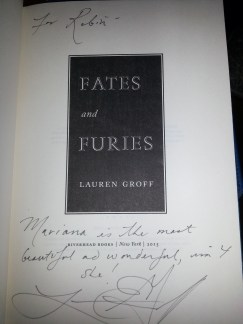
My favorite passage by Lauren Groff is where she signed my copy of Fates and Furies at the request of my son Tim’s girlfriend. Groff wrote: “Robin – Mariana is the most beautiful and wonderful, isn’t she!” The answer is yes. It is such a stark contrast to the tenor of the novel; I’m led to believe that Groff doesn’t have it out for everyone, which is a comforting thought.
The novel is divided into two categories: fates and furies. The first section begins with newlyweds, Lotto and Mathilde, consummating their marriage on the beach, but he is the focus here. It’s all about him: childhood, banishment from his family to boarding school, college days and efforts to succeed as an actor are portrayed in detail; but not too much as to squelch the imagination. Little is revealed about Mathilde – until furies, which is aptly named.
In an effort to avoid the need for spoiler alerts, suffice it to say there are elements of Gone Girl meets Claire Underwood.
Groff’s writing is clever, humorous and rich in detail. The references to various plays and Greek tragedies, however, are distracting metaphors.
Full of unlikable characters, the book, nonetheless, was appealing. Lotto’s a selfish man who exudes charm. Real charm, not something he turns on and off at will. Mathilde is mysterious and bitchy. They are flawed thanks to the characteristics Groff imbues in them. Neither is someone I want to meet, but I was more than content to know them through the distance of fiction.
Fates and Furies
Four Bookmarks
Riverhead Books, 2015
391 pages

To say A Little Life is a big book is an understatement. At slightly more than 800 pages it’s, in the words of my greatest presidential fear: Huge, very, very huge. Hanya Yanagihara has crafted a novel that traverses several lives, particularly Jude St. Francis’s. The name is not insignificant. St. Jude is the patron saint of lost causes.
Jude is one of a quartet of friends, Willem, Malcomb and JB, who meet in college. Although the friendships among the four are always part of the story, most of the narrative revolves around Jude and Willem. Their backstories, their lives before college, define them. In fact, Jude’s past is what drives the novel.
From the onset, it’s clear that Jude has secrets. His inability to reveal them is a compelling, and often frustrating, element. It is also evident that Jude is the physically weakest of the foursome. He walks with a limp, which he reluctantly and vaguely attributes to a car accident. He has no family or past connections. He’s awed by the care and companionship of his friends.
Yet, little by little Jude’s history is divulged. As the four men grow older their friendship is often tested. They each pursue different careers, but Jude and Willem remain particularly close throughout.
The power of Yanagihara’s work lies in the personalities and the situations she creates. The author illustrates the definition of friendship through the actions of the characters and shows that the strongest bonds are made of trust. Then love.
A Little Life
Four-and-a-half Bookmarks
Anchor Books, 2016
816 pages

Dinner with Edward is Isabel Vincent’s poignant tribute to an unlikely friendship that evolved for several years over elegantly-prepared meals.
Edward is the 93-year-old father of one of Vincent’s friends; his wife of 69 years has recently died. Vincent is in the midst of a rocky marriage. She is initially reluctant to meet Edward, after all he’s of another generation and she isn’t interested in taking on the role of caretaker. However, once they meet she comes to learn as much about herself as she does about cooking, dining, relationships and manners of a bygone era.
They begin to meet weekly at Edward’s apartment where he always has a martini glass waiting for her in the freezer and a gourmet meal to serve. Their conversations touch on recipes, Edward’s sweet memories of his deceased wife, Vincent’s job as an investigative reporter for The New York Post, her husband and daughter – among many other subjects.
Such a memoir has the potential to be sappy, but Vincent avoids this pitfall through the honest, albeit terse, descriptions of her own emotions and the imagery she creates based on the memories Edward shares with her. This is not a romance in the physical sense, but in an emotional one.
Each chapter begins with a menu Edward prepared. It always includes a dessert and the wine served. It isn’t a good idea to read this on an empty stomach.
More than anything, Vincent shows that the sustenance food provides goes well beyond what’s on a plate.
Dinner With Edward
Four Bookmarks
Algonquin Books of Chapel Hills, 2016
213 pages

One house, 13 siblings, ghosts and the city of Detroit provide the foundation for The Turner House by Angela Flournoy. Thank goodness she provides a family tree to keep track of Francis and Viola Turner’s offspring. It helps that much of the present-day story focuses on Cha Cha, the eldest of the Turner children, and Lelah, the youngest. They’re separated by 23 years; their issues are familiar but not quite cliches.
Flournoy also takes the reader back to 1944 when Francis leaves Viola and young son in his rural Arkansas hometown to seek a better life in Detroit. Francis plans to send for his family once he’s settled. He stays away for more than a year, leaving Viola to consider other options.
This backdrop is interspersed with how the family has coped through the years. Francis is dead, Cha Cha has grandchildren of his own; even Lelah is a grandmother. Few have intact marriages or relationships, yet the family is close-knit. The house, the one in which all 13 Turners grew up, is empty and fallen into disrepair. Viola is no longer well enough to live on her own; she lives with Cha Cha and his wife in the suburbs.
The house, vividly described with Pepto Bismo pink bedroom walls, narrow stairs and large porch reflects the rise and fall of Detroit. Once alive with the large family’s comings and goings, its monetary worth is practically non-existent. The brothers and sisters, though, are mixed in their assessment of its sentimental value.
The Turner House
Four Bookmarks
Houghton Mifflin Harcourt, 2015
338 pages

Hive-Mind by Gabrielle Myers is labeled a memoir, but it’s slightly more than that. Written in diary-like form, Myers describes her summer of 2006 on a farm in Northern California. This is no kiddie account, though. While it’s the focus of her narrative, Myers alternates the chronicle with a look back to her relationship with her mother and growing up in Virginia. As if this isn’t enough, she also includes poetry.
It’s evident that sharing the earlier memories is cathartic; this is true of the latter ones, but is less obvious until the end. Myers’s descriptions of life on the farm, from early spring to late September, are vivid and stunning. I can practically feel dirt stuck in my fingernails as she, Baker (also working on the farm) and Farmer (the woman who owns the land and decides the daily chores) sow and weed and sweat and harvest. The author is also impressive in describing meals prepared from food on the farm.
Farmer is an enigma. This may be Myers’s point: Farmer never reveals enough about herself to know who she is. Myers shares her own thoughts and reactions, but that isn’t enough to make Farmer compelling. Baker is an open book and, consequently, is more interesting.
Myers isn’t writing about coming of age, but of becoming aware. This is evident as she connects the different phases in her life following a 1995 conversation with her mother: “… how I feel can become how someone else feels.”
Hive-Mind
Three and three-quarter Bookmarks
Lisa Hagen books, 2015
299 pages
Our Souls at Night by Kent Haruf is best described as sweet. This terse novel was published posthumously, and its content makes me imagine that the author was in his final days when he penned it. This is a story of finding a way out of loneliness while believing that the opinions of others have little value or impact.
Addie Moore and Lewis Waters are widowed and living in the fictional town of Holt on Colorado’s eastern plains. This is Haruf’s preferred setting as many of his previous works have centered around this small communityand its residents. Anyone familiar with his writing will recognize names and places.
One day, Addie calls Lewis. They have known each other for years, but only peripherally. She wonders if he would like to spend the night. This is no brazen, immoral solicitation. It is one lonely heart reaching out to another.
Addie’s son and grandson figure into the narrative as does Lewis’s daughter. The townspeople make sure these adult children are aware of what their parents are doing.
Haruf provides a lot of detail such as teeth brushing and lawn care for someone trading in a scarcity of words (after all, the book is less than 200 pages long).
Unfortunately, the premise, which is touching and somewhat whimsical, overshadows the writing, which is too mundane to be enchanting. Anyone who has experienced a meaningful relationship (be it lover or friend) will appreciate the warmth drawn from conversations that happen just before sleep.
Our Souls at Night
Three bookmarks
Alfred A. Knopf, 2015
179 pages

For a minute forget that Elizabeth Gilbert wrote Eat, Pray, Love. It may take a little longer, but the idea is to not let this dissuade you from reading The Signature of All Things. Gilbert’s novel is as different from her memoir as ice milk is from ice cream. The latter is much richer and nuanced; it’s worth every moment of guilty pleasure spent under its grip.
Gilbert transports the reader from London, across the seas (on multiple occasions), and to Tahiti and Amsterdam. Philadelphia provides the lengthiest setting where the brilliant, unattractive Alma Whitaker is introduced to the world: her birth is literally the first sentence of this epic narrative. In Gilbert’s words, Alma’s childhood “was not yet noble, nor was it particularly interesting …” Thus, the focus turns, albeit temporarily, to Alma’s father, Henry Whitaker.
Henry stole his way out of poverty. He didn’t just acquire wealth, he attained knowledge and became a leading botanist and businessman. Alma’s mother, a stoic and harsh parent intent on fortifying her daughter’s intellect, also possessed a great mind and interest in botany.
Through humor, interesting botanical descriptions and strong, insightful characters, Gilbert creates a story that not only spans continents, but also scientific ideas along with notions regarding love and relationships. The vivid imagery of the various landscapes is a bonus.
Alma is a passionate character rich in curiosity (and foibles). Yet, despite the limits placed on her gender, she explores life in miniscule proportions and unexpectedly reveals its grand scale.
The Signature of All Things
Four-and-a-half Bookmarks
Viking, 2013
499 pages

 The Blue Page Special