Archive for the ‘friendship’ Tag

I was baffled by Emma Hooper’s Etta and Otto and Russell and James. It’s sweet but confusing. It’s a love story that considers lost chances and perhaps poor decisions. It’s also surprisingly descriptive in its brevity.
Etta is 83 years old when she embarks on a trek across Canada to the ocean. The five-sentence letter she leaves as explanation to her husband sets the tone for the novel: “Otto, I’ve gone. I’ve never seen the water, so I’ve gone there. Don’t worry, I’ve left you the truck. I can walk. I will try to remember to come back.”
This isn’t the kind of thing she’s planned, she simply leaves to see the coast. Briefly, Otto considers trying to find her. Ultimately, it’s Russell who does so, while Otto remains on the farm.
Along her trek, Etta gains unwanted attention from the media and towns people she encounters. She also acquires a companion in James, a source of bewilderment.
The relationships among the four title characters are complex. Otto and Russell have known each other since childhood. Both love Etta. Hooper develops the bond between Etta and Otto through letters the pair exchanged during the war. Their correspondence evolves from the mundane to the heartfelt.
Hooper intersperses the characters’ backstories with their present day adventures: Etta bound for the sea, Russell in search of Etta and Otto discovering daily rhythms on his own. Meanwhile, there’s James, who’s difficult to describe. Hooper has crafted a terse novel unpredictably rich with humor and longing.
Etta and Otto and Russell and James
Almost Four Bookmarks
Simon & Schuster, 2015
305 pages

Isabel Allende is among my favorite authors. I am reminded of how I feel about my kids: I love them even though they sometimes do things I don’t always like. Allende’s most recent novel, The Japanese Lover, is like that.
The story involves too many secrets, predictable plot lines and cardboard characters. Alma Belasco, a woman of means in her 80s, moves into Lark House, an unconventional nursing home. There she meets 23-year-old care-giver, Irina Bazili. The two bond, and soon Irina is helping Alma’s grandson, Seth, work on a book about Alma and the Belasco family history.
Of course, Irina has a past about which little is revealed, but Alma has secrets, too. As Seth and Irina learn more about Alma, it’s apparent there’s a lost love. Yawn. The younger couple believes the romance is still going strong, although this is all based on speculation.
There was, in fact, a lover. He started out as the youngest son of the Belasco family’s Japanese gardener and Alma’s childhood best friend. One of the most interesting aspects of the narrative is when Ichimei and his family are uprooted from their San Francisco home and relocated, with thousands of other Japanese-Americans, to an internment camp.
Given his role as title character, Ichimei is one-dimensional. Even Alma could have been so much more – especially in Allende’s hands. Alas, this is one of those books I didn’t like much; nonetheless, I look forward to the author’s next work.
The Japanese Lover
Two-and-a-half Bookmarks
Atria Books, 2015
322 pages

If you remember 1984 and Animal Farm from high school or college reading requirements, The Circle by Dave Eggers will sound familiar. It’s just that Eggers, who has nothing on George Orwell, offers a contemporary setting in a Googlesque-complex in Northern California. The concepts of Big Brother and following the pack are nearly the same.
Mae, short for Maybelline, has just been hired by the prestigious organization thanks to Annie, beloved by her work colleagues and Mae’s former college roommate. Landing a position not only gets Mae out of a dead-end job, it provides an opportunity to be on the cutting edge of social change.
The Circle, the company’s name, thrives on numbers in the form of clicks, responses to surveys, extracurricular activities and tracking followers that makes Twitter and Facebook look like make-believe social media.
Mae’s initial job is in customer service. Her employers, from lower management to the triumvirate who founded the Circle, manipulate through passive-aggression and let the numbers speak for themselves: the higher the percentage or score, the better – no matter at what cost.
The trouble is that Mae is not all that likeable. Annie is far more interesting, but it turns out that her role is not much than that of a door opener. A former boyfriend, Mercer, provides a dissenting voice, but he’s one-dimensional with little chance of being heard.
Privacy, transparency, friendship and trust are all addressed here. While these are important themes, the characters are not strong enough to bear their weight.
The Circle
Three Bookmarks
Alfred A. Knopf, 2013
491 pages

I’m usually not drawn to apocalyptic novels, but Emily St. John Mandel’s Station Eleven is so much more than a foreboding tale about a small group of people who survive a pandemic. It’s also about getting through the trials of what we might consider the normal elements of life: existence before the disaster. She blends the backstory of the half dozen characters she masterfully introduces with their lives following the devastation; and it works!
The story follows the characters whose lives shared parallel paths with Arthur Leander, a famous actor, and which orbit around the fall of society. Unrelated to the flu that kills most of the world’s population, Arthur dies of a heart attack. Nonetheless, he remains a substantial character as viewed by those who knew him: one of his ex-wives, his best friend, a young girl who watches him die and the man who tries to save him. Another ex-wife and Arthur’s son have important, albeit tangential, roles. Each character is connected to Arthur, although they don’t all intersect with one another.
St. John Mandel creates a bleak, but not black and white picture, which is often the case in similarly-themed novels. Cormac McCarthy’s The Road comes to mind as a portrayal of a dismal post-catastrophe world. Sure, there is plenty of anarchy and death in Station Eleven, but somehow they don’t overshadow the power of friendship, love and art.
The author deftly illustrates that fear and loss exist before and after the collapse of civilization – as does hope.
http://www.emilymandel.com/bio.html
Station Eleven
Five Bookmarks
Alfred A. Knopf, 2014
352 pages

Anthony Marra’s A Constellation of Vial Phenomena demonstrates that families are often created by need, proximity and shared experiences – sometimes more than bloodlines.
Marra writes of worn-torn Chechnya. More accurately, his story involves the newly-formed family of Akhmed, Havaa and Sonja, three genetically-unrelated characters whose lives intersect because of friendship, obligation and fate.
Moving back and forth between 1994 and 2004, Marra details the poverty and fear of those living in a small Chechen village. Eight-year-old Havaa is rescued by Akhmed, a long-time family friend, when the girl’s father is “disappeared” by military authorities.
Akhmed, a third-rate physician, takes the child to the city hospital 11 kilometers away. There, he convinces Sonja, a surgeon, in charge of the facility to keep Havaa. In exchange, Akhmed offers his medical services, which prove to be lacking.
The novel’s beauty is Marra’s writing. The people and landscape are bleak, and are vividly portrayed. Yet hope surfaces in spite of the harsh conditions. Havaa is optimistic about her father returning; Akhmed hopes he can keep the child safe; and Sonja needs to believe that her younger sister, Natasha, is still alive. Hope also makes cameo appearances when Marra foretells characters’ futures. At first this is done with incidental players, then minor ones and finally those about whom the reader cares most.
Trying to understand the historical context of Chechnya is confusing. Fortunately, Marra’s emphasis is on a handful of characters, each who do what it takes to survive while trying to remain true to themselves.
A Constellation of Vital Phenomena
Four Bookmarks
Hogarth, 2013
384 pages
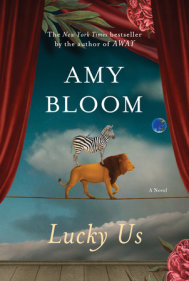
Lucky Us by Amy Bloom is a great title, because it can be uttered in different ways: with a note of sarcasm or with an emphasis on appreciation. Thanks to Bloom’s strength as a story teller, the reader is the lucky one.
From the onset, this is a captivating story of how families get by, not in a financial way but emotionally. It’s a look at the way we create families when those we’re born into cause disappointment and pain. This is the case for all of the main characters. Twelve-year-old Eva, abandoned by her unmarried mother, is left to live with her father and his daughter, Iris. Iris’s own mother has recently died and the girls are motherless, but now each has a sister. The two are as different as salt and pepper, but together they add zest to what could otherwise be uneventful lives.
The book has a surprisingly large number of significant characters who appear like traffic cops signaling directions. Bloom moves her characters from Ohio to Hollywood to Brooklyn – and points beyond. Yet, no one is superfluous.
Love, both carnal and platonic, is a major force, but the strongest elements are familial connections. Eva and Iris support each other’s strengths: Eva has brains, Iris has beauty. Both have limited common sense. The appeal of Bloom’s writing escalates as the friends/family they add to their circle grows. At times it seems far-fetched, but mostly it’s a matter of luck, the kind we all know: good and bad.
Lucky Us
Four Bookmarks
Random House, 2014
240 pages
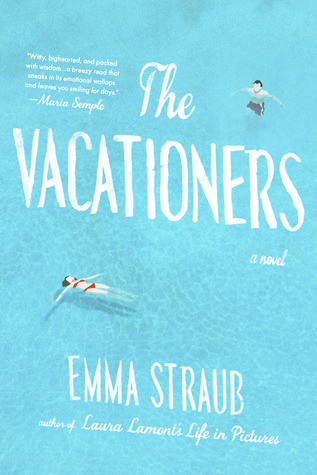
The Vacationers by Emma Straub is as bright as a day on the beach and also as gritty. Full of poignant, laugh-out-loud descriptions, Straub masterfully portrays a family in crisis.
Jim and Franny Post, with their teenage-daughter, thirty-something son, his girlfriend, and Franny’s best friend Charles and his partner are slated to spend two weeks together in a large rented house on Mallorca. Each chapter represents one day of the vacation and every day includes various perspectives provided by the connected tourists. These are separate views more than distinct voices. Each character hopes to project, or better yet protect, a certain image, because everyone has a secret – some known to a few, others hidden.
The Posts, married 35 years, are financially well-off, privileged. Their daughter, Sylvia, is set to start at Brown in the fall, and the trip was planned as a family celebration. However, in the interim from when the trip was conceived and actually occurs, Jim has had an affair and lost his job. Some know this; others don’t.
As the emotional baggage is shuffled around, the Posts direct their own disappointments to Carmen, the girlfriend. She’s perhaps the most honest among the group, but she is also subjected to the family’s rude behavior. Only Sylvia demonstrates fleeting moments of kindness and understanding.
Yet, the novel isn’t about being mean to others. It’s focused on what people do to live with themselves, even when they’re basking in the sun and have been out too long without sunscreen.
The Vacationers
Four Bookmarks
Riverhead Books, 2014
292 pages

The Storied Life of A.J. Fikry by Gabrielle Zevin is the literary equivalent of a triple chocolate dessert. It’s rich, nuanced and meant for those who love chocolate, or in this case, books.
A.J. is an ill-tempered man running a bookstore on an Atlantic coastal island. The store does a brisk summer tourist business. Otherwise it’s a slow, quiet livelihood for A.J., whose wife has been dead for almost two years. But, he’s not old. He’s not even middle-aged. He is, however, a snob, particularly when it comes to literature, and he’s set in his ways, such as they are, as a lonely and often rude man.
Parts of this novel are entirely predictable, but in all the right spots. A.J. meets someone, actually three someones, who change his life: Amy, a publisher’s sales rep; Lambiase, the local police chief; and Maya, the two-year-old child abandoned in his shop. Despite some unsurprising turns, Zevin writes with humor and poignancy. She also displays a knowledge of books.
The relationships also allow A.J. to accept the greater world around him, for better and worse. It helps that the three persons who share his life are book nerds. Lambiase, who is only ever referred to by his last name, is the last to jump on board as a reader. His evolution from a by-the-rules cop is fun and warm. It’s A.J.’s connections to Amy and Maya that resonate the loudest through their shared passion for pages that need to be turned by hand.
The Storied Life of A.J. Fikry
Four-and-a-half Bookmarks
Algonquin Books, 2014
260 pages

Titles, like first lines, can make or break a novel’s appeal. Certainly, if Meg Wolitzer had called her most recent book The Borings, instead of The Interestings, it might not have garnered much attention (which it has). Yet, there’s something pretentious about it, which is just the tone – along with some irony – the author instills in this contemporary epic about friendship, love, human potential and disappointment.
Wolitzer’s account moves back and forth through time, but it all pivots around the beginning which occurs at a camp for the arts in the summer of 1974. “The Interestings” is the name six teenagers give themselves; it’s meant to separate them from everyone else in camp. They’re talented, to varying degrees, mostly privileged and self-absorbed. Even as they move through adulthood, they carry those same qualities. Yes, they mature and Wolitzer is at her best illustrating their personal struggles and triumphs, but they can’t quite shake idea of their old moniker.
The power of friendship, particularly among four of the six, is an underlying theme and it, more than anything else, drives the novel. The characters’ ability to fit in and accept themselves also delivers some impact.
The exhaustive story spans more than five decades in a way that’s reminiscent of Forest Gump. Instead of a sound track to identify the passage of time, Wolitzer relies largely on political events. Although the characters are interesting, it’s not as much as they think – or as much as we want them to be.
The Interestings
Four Bookmarks
Riverhead Books, 2013
468 pages

Easy to visualize characters, plots driven by class conflict, issues of the heart (or both) and a very proper sense of, well, what’s proper are what make English Lit so appealing to me. Yes, the above could easily refer to classic British literature, but it also applies to Helen Simonson’s Major Pettigrew’s Last Stand – a very contemporary work.
Simonson’s novel begins with a chance meeting between the Major (his first name is Ernest, while apt doesn’t fit him as snugly as his military title) and Mrs. Jasmina Ali, a Pakistani shopkeeper. Although their paths have crossed in the past, this encounter comes at a vulnerable point in the Major’s life: he’s just learned of his brother’s death. What follows is the evolution of a friendship based on a passion for books and widowhood.
Both characters are thoroughly engaging. The Major in his stilted, decorous yet sensitive manner has appeal, and Mrs. Ali is an exceptionally intelligent woman burdened by a certain sadness associated with being considered an outsider in her home country. Simonson portrays people we know or would like to; they’re well-defined individuals with foibles, principles and dreams. The cast of lesser characters, including Roger, the Major’s obnoxious status-seeking son, enhance the story.
The novel moves at a leisurely pace as the Major and Mrs. Ali embark on a relationship that puts a spark in their step and ultimately has tongues wagging throughout the village. Simonson clearly enjoys thumbing her nose at what’s considered suitable or not.
Major Pettigrew’s Last Stand
Four Bookmarks
Random House Trade Paperbacks, 2011
358 pages (not including the Reader’s Guide)