Archive for the ‘friendship’ Tag
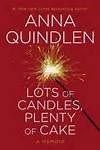
Anna Quindlen’s Lots of Candles, Plenty of Cake is a poignant, yet cheerful perspective on getting older. This is the kind of book to share with friends, particularly if they’re around the age of what is now considered to be the new-40s.
As in most of her writing, Quindlen relies on personal experience to make her points. Her writing career includes several stints as a columnist (at the New York Times and later Newsweek) as well as authoring several works of fiction, nonfiction and children’s books. She has a keen sense of observation. Better still, she’s an extraordinary wordsmith. Those two skills result in crafting pieces readers can easily make connections with. Of control, she writes: “I thought I had a handle on my future. But the future, it turns out, is not a tote bag.”
Quindlen examines the important aspects of life, which can be applied to most people, women in particular: friendship, family, love, parenting, and more. She’s humorous and honest. She writes of near-misses, both good and bad. She reflects on how much her younger self was sure she knew and how her older self readily acknowledges what she doesn’t. Without citing the tired phrase that youth is squandered on the young, it’s a major thread. Quindlen puts a new spin on it.
Yes, this is a memoir, but it is much more. It’s a guidebook to accepting that each morning we wake up is a gift – even if we’re older than we were the day before.
Lots of Candles, Plenty of Cake
Four Bookmarks
Random House 2012
182 pages

I’m probably not alone in my preference to read the book before I see its film adaptation. The Perks of Being a Wallflower was no exception. I am now anxious to watch the movie.
Stephen Chbosky’s novel is told through letters written by Charlie, an insecure 15-year-old, to an unknown recipient. Charlie’s letters are brutally honest in their reflection of his life as the youngest of three children in a traditional family. It’s clear from the outset, though, that he is far more sensitive than most teenage boys. Sure, he faces teen angst like most kids, but his sensitivity and intelligence set him apart from his peers. Through what can only best be described as chutzpah, he introduces himself to Patrick and Sam (Samantha) – step-siblings in their senior year. Charlie is a freshman, but his new friends don’t seem to mind and welcome him into their circle.
As Charlie becomes more involved with his new friends, he discovers that he is not the only teenager with problems. His letters reveal more and more about himself and those around him. It’s evident that his issues are intense: misplaced guilt and an ability to keep a family secret he shouldn’t be burdened with. Lingering in the background are topics of sexuality, identity, and perceptions.
Charlie may never be a popular boy, but he has friends and family who care deeply about him. Even for those of us long removed from school days, it’s still possible to appreciate the value of those intangibles.
The Perks of Being a Wallflower
Four Bookmarks
Gallery Books, 1999
213 pages

Any number of factors figure into how I, or anyone for that matter, respond to a book. Experience, age, education, even mood, come quickly to mind. I was struck by these considerations as I read Sheila Heti’s How Should A Person Be? because the novel makes me feel that whatever I bring to this particular reading experience is a negative: my experience, my age, and yes, my mood.
Sheila is the narrator, a young writer in Toronto struggling to finish a long-overdue play; she is easily distracted by life, specifically people in her life. She is so caught up with what others think and do that she lacks focus. Sheila stretched my patience as a reader. She has a wonderful friend in Margaux, an unhealthy but lively sex relationship with a man named Israel, and an undiguised inability to recognize or accept what is good and positive in her life. She is not quite a loser, but teeters awfully close to becoming one.
Perhaps the issue lies in Heti’s attempt to fictionalize her autobiography, for she is clearly the narrator and there is little reason not to believe that the other characters comprise her circle of friends. Frankly, Sheila is not that interesting. That honor goes to Margaux who comes across as honest, talented and a good friend, but it’s hard to explain what she sees in Sheila. Israel is depicted as a depraved man who uses Sheila to fulfill his debased sexual fantasies. Unfortunately, it’s too easy to see he’s attracted to her.
How Should A Person Be?
Two-and-a-half Bookmarks
Henry Holt and Co., 2012
306 pages
I took last week off; I read, I hiked, I ate too much, I slept some, I wrote a bit, but mostly I decided to take a break from the Blue Page Special. In the process, I discovered that I missed it.

I just finished reading Tell the Wolves I’m Home by Carol Rifka Brunt and can’t stop thinking about it. Although the writing doesn’t fall into the take-your-breath-away category, the story certainly does. I still want to spend time with the characters: June, a 14-year-old misfit; Greta, her super-achieving sister; Finn, their deceased uncle; and Toby, Finn’s lover.
June is devastated when Finn, her best friend, dies of AIDS. She struggles, then Toby enters her life, and she continues to flounder. Except now she has someone to help her keep Finn’s memory alive. Toby and Finn lived together and, even though she spent a lot of time in their apartment, June never knew about Toby. This aspect has the potential to be implausible; instead, it enhances June’s character as a naïve teenager. Another potentially hard-to-believe feature is the bond that develops between the young girl and the thirty-something Toby. Remarkably, there is never anything creepy or uncomfortable about it. This is largely due to their love for Finn, and the tentative manner in which their friendship evolves. Equally important is the sisters’ relationship.
Brunt masterfully creates relationships that are rich, painful, and grow before our very eyes. The novel is about friendship, first loves, misplaced jealousy and sibling relationships. Set in the mid 1980s, AIDS has just begun to make itself felt in American culture. Yet, that is simply a background element. This is a coming-of-age story that considers the way people change based on age, interests, opportunities, and circumstances.
Tell the Wolves I’m Home
Four-and-a-half Bookmarks
The Dial Press, 2012
355 pages

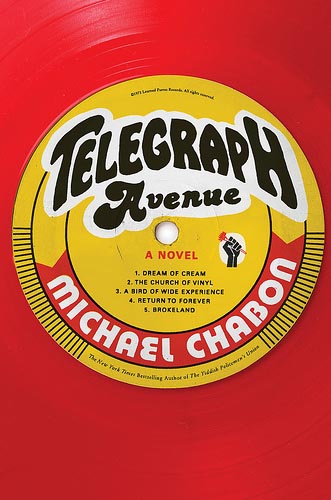
While wondering at the necessity, I marvel at the kind of concentration and craftsmanship it takes to write a single sentence that makes sense and holds interest as it spans 12 pages rife with characters, each distinctly different, who share a common struggle against fate, karma, some elusive and nebulous hand manipulating a game board with varying designs and obstacles; yet this engaging contest in Michael Chabon’s most recent novel, Telegraph Avenue, is played with swagger and fear by men, women and teenage boys fighting to hold onto dreams while desperately needing to relinquish the realities of their colorful lives.
I lack the skill, and inclination, to take a 100+ word sentence any further. Chabon can, but that’s the least of his mastery. Set in Oakland, his story about two men who run a (old school vinyl) record store in danger of being razed to accommodate a mega urban renewal project is a tribute to friendship, music and, oddly, especially family.
The novel is drunk with sensory images. Consider: “At 9:45 a.m. the first batch of chicken parts sank, to the sound of applause, into the pig fat.” Or: “… the loose weather stripping that peeped like a gang banger’s drawers from the seams around the back door.”
The major flaw lies in the glut of characters; initially, it’s difficult keeping track of who’s who. Nonetheless, it’s clear everyone, from actors to midwives, is just trying to get by in life while a poor economy, outdated technology and children get in the way.
Telegraph Avenue
Four Bookmarks
HarperCollins, 2012
465 pages

Labeled as a “novel about food and friendship,” The Recipe Club by
Andrea Israel and Nancy Garfinkel chronicles a long-time friendship
through emails, letters and recipes. The latter are the real stars. From
appetizers such as, “Good Karma Veggie Samosas,” to desserts includ-
ing, “Wash-Away the Blues Berry Cobbler,” each recipe is named to
coincide with the events in the characters’ lives.
Roughly ninety percent of the book is written as correspondence. I
suspect each author assumed the role of one of the two main charact-
ers, friends Val and Lily, who weather every imaginable squall as
young girls/teenagers. The distinct voices reflect their contrary per-
sonalities, which add weight to the opposites-attract-theory of re-
lationships.
With two narrators, it’s easy to provide both sides to every story. It
is also not difficult to see how misinterpretations occur. The novel
begins with an email exchange between the two women as they try
to bridge a 28-year rift in their friendship. It’s no spoiler to say the
attempts prove fruitless. This is followed by the main section of the
book: letters written between 1964 and 1973, and nearly all are
accompanied by a recipe for their recipe club. Everything leads to-
ward their falling out.
The result of the book’s structure is a “Forest Gump” approach to
showing the times as they were a changin’ for Val and Lily. The for-
mat was an uncomplicated way to introduce others who impacted
their lives. Friendship and food are important connections; the
authors show sometimes they aren’t always stress-free.
The Recipe Club
Three Bookmarks (thanks to the recipes)
HarperCollins, 2009
337 pages