Archive for the ‘families’ Tag
Our Souls at Night by Kent Haruf is best described as sweet. This terse novel was published posthumously, and its content makes me imagine that the author was in his final days when he penned it. This is a story of finding a way out of loneliness while believing that the opinions of others have little value or impact.
Addie Moore and Lewis Waters are widowed and living in the fictional town of Holt on Colorado’s eastern plains. This is Haruf’s preferred setting as many of his previous works have centered around this small communityand its residents. Anyone familiar with his writing will recognize names and places.
One day, Addie calls Lewis. They have known each other for years, but only peripherally. She wonders if he would like to spend the night. This is no brazen, immoral solicitation. It is one lonely heart reaching out to another.
Addie’s son and grandson figure into the narrative as does Lewis’s daughter. The townspeople make sure these adult children are aware of what their parents are doing.
Haruf provides a lot of detail such as teeth brushing and lawn care for someone trading in a scarcity of words (after all, the book is less than 200 pages long).
Unfortunately, the premise, which is touching and somewhat whimsical, overshadows the writing, which is too mundane to be enchanting. Anyone who has experienced a meaningful relationship (be it lover or friend) will appreciate the warmth drawn from conversations that happen just before sleep.
Our Souls at Night
Three bookmarks
Alfred A. Knopf, 2015
179 pages

For a minute forget that Elizabeth Gilbert wrote Eat, Pray, Love. It may take a little longer, but the idea is to not let this dissuade you from reading The Signature of All Things. Gilbert’s novel is as different from her memoir as ice milk is from ice cream. The latter is much richer and nuanced; it’s worth every moment of guilty pleasure spent under its grip.
Gilbert transports the reader from London, across the seas (on multiple occasions), and to Tahiti and Amsterdam. Philadelphia provides the lengthiest setting where the brilliant, unattractive Alma Whitaker is introduced to the world: her birth is literally the first sentence of this epic narrative. In Gilbert’s words, Alma’s childhood “was not yet noble, nor was it particularly interesting …” Thus, the focus turns, albeit temporarily, to Alma’s father, Henry Whitaker.
Henry stole his way out of poverty. He didn’t just acquire wealth, he attained knowledge and became a leading botanist and businessman. Alma’s mother, a stoic and harsh parent intent on fortifying her daughter’s intellect, also possessed a great mind and interest in botany.
Through humor, interesting botanical descriptions and strong, insightful characters, Gilbert creates a story that not only spans continents, but also scientific ideas along with notions regarding love and relationships. The vivid imagery of the various landscapes is a bonus.
Alma is a passionate character rich in curiosity (and foibles). Yet, despite the limits placed on her gender, she explores life in miniscule proportions and unexpectedly reveals its grand scale.
The Signature of All Things
Four-and-a-half Bookmarks
Viking, 2013
499 pages

The Book of Unknown Americans by Cristina Henriquez is a timely read with the issue of immigration never far beneath the political surface. Yet, the novel isn’t about politics, but people.
Arturo and Alma leave Mexico for Delaware because they want to do more for their teen-aged daughter, Maribel, who suffered a brain injury. They believe she’ll benefit in a better school. They’re not illegals; they have work visas. Each chapter is told from one of the character’s perspectives, some in greater detail than others; only never Maribel’s.
Woven in with the challenges of living in a new land with a new language is the relationship that develops between Maribel and Mayor.
Sixteen-year-old Mayor Toro lives in Maribel’s apartment building; his parents left Panama when he was less than a year old, but he’s never fit in. From Mayor’s perspective, Henriquez writes: “The truth was that I didn’t know which I was. I wasn’t allowed to claim the thing I felt and I didn’t feel the thing I was supposed to claim (Panamanian).”
This sums up the experience of those introduced in the book. Henriquez has created a montage of immigrants: from Mexico, Panama, Puerto Rico, Guatemala, Nicaragua, even Venezuela and Paraguay. These places are all part of the Americas, which is what makes the title so appropriate with its double entendre. In brief, compelling chapters, among those told in Alma and Mayor’s voices, the neighbors share their pasts explaining why they left their native countries for the U.S.A.
The Book of Unknown Americans
Four Bookmarks
Alfred A, Knopf, 2014
286 pages

Although I read a lot, it’s been a while since I held a book I didn’t want to put down. Even at 500-plus pages, I hated to turn the final one of Anthony Doerr’s All the Light We Cannot See. Doerr is garnering a lot of well-deserved attention including being named a finalist for the 2014 National Book Award and #1 New York Times bestseller.
This story is about hope and connections, those that are tangible and those we simply know exist. Marie-Laure, a young girl in Paris, is blind. Her story is told in turns with that of Werner, a German mining town orphan with an aptitude for science and gadgets. The novel jumps around the years just before WWII and during the August 1944 bombing of Saint-Malo on the French coast.
From the onset, there’s a sense the two youths will meet, but how and when leave much to the imagination. Werner builds a small, crude radio from scrap parts. This ability ultimately earns him a spot in Hitler’s army. Marie-Laure relies on her father who builds small models to recreate, first, their Parisian neighborhood and later Saint-Malo where they flee. The hand-crafted items are meant to aid communication with good intentions in a world rife with evil.
Doerr’s work is easy to embrace for its vivid descriptions of the kindness and fear individuals extended or induced during the war. Mostly, though, the characters are so finely fashioned that they come alive in the mind’s eye.
Five Bookmarks
All the Light We Cannot See
Scribner, 2014
530 pages

The Family Fang by Kevin Wilson is exasperating and slightly intriguing. Camille and Caleb Fang are performance artists in the extreme. Their definition of art is to create irresponsible chaos amidst the realities of daily routines. The Fangs have children, Annie and Buster, who are used as props and/or unwilling co-conspirators. The kids, also known as A and B, have no interest in being part of their parents’ far-fetched ideas. Once old enough they leave home to pursue more traditional artistic endeavors: Annie is a film actress and Buster writes novels.
When the novel begins, however, both Annie and Buster are experiencing low points in their lives. Though resistant, they return to the family home. Wilson creates a palpable sense of anger and frustration on A and B’s part. This spills onto the reader. In a way Camille and Caleb are like the king who wears no clothes when they create their exaggerated scenarios, most of which are ill-conceived. It’s their children who wonder why no one else can see what they do.
Wilson combines a fair amount of humor, elements of a low-key mystery and the pathos associated with children who have been psychologically harmed and become adults who haven’t outgrown the affliction.
Unfortunately, the narrative doesn’t work. Too many questions arise making suspension of disbelief impossible. For example, if the Fangs are so successful as performance artists why aren’t they recognized? More importantly, why didn’t anyone call social services to keep Annie and Buster out of the fray?
The Family Fang
Three Bookmarks
Ecco, 2011
309 pages
The Vacationers by Emma Straub is as bright as a day on the beach and also as gritty. Full of poignant, laugh-out-loud descriptions, Straub masterfully portrays a family in crisis.
Jim and Franny Post, with their teenage-daughter, thirty-something son, his girlfriend, and Franny’s best friend Charles and his partner are slated to spend two weeks together in a large rented house on Mallorca. Each chapter represents one day of the vacation and every day includes various perspectives provided by the connected tourists. These are separate views more than distinct voices. Each character hopes to project, or better yet protect, a certain image, because everyone has a secret – some known to a few, others hidden.
The Posts, married 35 years, are financially well-off, privileged. Their daughter, Sylvia, is set to start at Brown in the fall, and the trip was planned as a family celebration. However, in the interim from when the trip was conceived and actually occurs, Jim has had an affair and lost his job. Some know this; others don’t.
As the emotional baggage is shuffled around, the Posts direct their own disappointments to Carmen, the girlfriend. She’s perhaps the most honest among the group, but she is also subjected to the family’s rude behavior. Only Sylvia demonstrates fleeting moments of kindness and understanding.
Yet, the novel isn’t about being mean to others. It’s focused on what people do to live with themselves, even when they’re basking in the sun and have been out too long without sunscreen.
The Vacationers
Four Bookmarks
Riverhead Books, 2014
292 pages
Anyone planning a wedding in the next few months, or ever, might consider avoiding Seating Arrangements by Maggie Shipstead; but they would be missing a fun, albeit satirical, and poignant look at families under stress.
Shipstead’s debut novel focuses on Winn Van Meter, father of the bride-to-be, in the three days prior to the ceremony. Winn is a banker, a Harvard man whose greatest disappointments are that he didn’t have sons and has yet to be granted membership in a private golf club. His daughter Daphne, seven months pregnant, is marrying Greyson Duff. That name alone suggests privilege, which is an apt description for the entire wedding party.
The nuptials are taking place on a fashionable island off the New England coast. The Van Meters have long had a vacation home there, although, as it turns out, the Duffs have their own island. Yet, the only character concerned with one-upmanship is Winn. And, perhaps, his younger daughter, Livia, who was recently dumped by her boyfriend, Teddy Fenn – whose father, Winn surmises, is responsible for obstructing admittance to the private club.
Shipstead’s multiple talents lie in her ability to create distinct voices and flaws for each of her characters. The cast of which include friends, family, and the Fenns. Biddy Van Meter, Winn’s wife, is the voice of reason while humoring her husband. However, her patience and fortitude wane as his attraction to one of the bridesmaids waxes.
In Shipstead’s hands, humor and heartache are worn with the ease of a properly fitted cummerbund.
Seating Arrangements
Four Bookmarks
Alfred A. Knopf, 2012
302 pages
Bread & Butter is bound to appeal to foodies. Author Michelle Wildgen combines her talents as a writer with her past restaurant experience to tell the story of three brothers with two competing eateries in their hometown.
Leo and Britt have been running Winesap, their fashionable restaurant for more than a decade. When their younger brother, Harry, returns home they find it difficult to be enthusiastic about his plans to open another upscale establishment in a weak economy. Yet, it’s not just the competition that has the older two apprehensive. Harry has bounced around from educational pursuits to various jobs in the years since he’s been gone. Leo and Britt are certain Harry lacks the stamina, knowledge and commitment to run a successful business. They see him as a neophyte, and Harry, who wants their support, is driven to prove them wrong.
Wildgen has created likeable, sometimes exasperating, characters whose voices and situations ring true. Eventually, Britt signs on as Harry’s partner while maintaining his front-of-house role at Winesap. Tensions mount as expectations, many unfounded, lead to several surprises when Harry’s place opens for business.
Descriptions of food, prepping for dinner service and the relationships among the employees (and owners) are vivid and realistic.
Ultimately, the siblings have credible culinary chops; they also have difficulty relinquishing family issues precipitated by birth order. This tends to bog things down a bit. Wildgen emphasizes that sometimes family members are often seen as what we want them to be, rather than who they truly are.
Bread & Butter
Three-and-a-half Bookmarks
Doubleday, 2014
314 pages

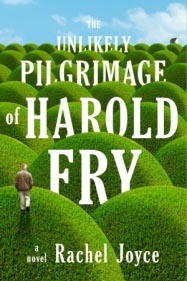
The Unlikely Pilgrimage of Harold Fry begins as a slow, methodical, unexpected journey – for the main character and the reader. Rachel Joyce’s novel practically crawls through the first few chapters. Then, like Harold, it picks up the pace only to falter on occasion like most adventures.
This poignant tale shares qualities of a love story and mystery, but is more the former than latter. And, it’s about different types of love: romantic, familial and companionable.
After receiving a letter from Queenie, a work colleague with whom he’s lost touch, Harold sets out to mail a response. Despite the fact that he left the house without his cell phone and is dressed somewhat formally, he decides to embark on a 600+ mile trek from one end of England to the other to talk to Queenie in person. He has no backpack, water bottle, map or other equipment. In fact, he walks in boating shoes.
The elements of a mystery come in the form of questioning the relationship between Harold and Queenie, as well as between Harold and his estranged son, David. There’s also the fact that Harold is married, although he and his wife, Maureen, do little more than share a past and the same house.
The characters’ imperfections are what make the story work, albeit inconsistently. As personalities evolve, foibles become more defined, but so do strengths. Harold loses his way in more than one manner, but he, like the reader, gains perspective even if it is not particularly satisfying.
The Unlikely Pilgrimage of Harold Fry
Three Bookmarks
Random House, 2012
320 pages

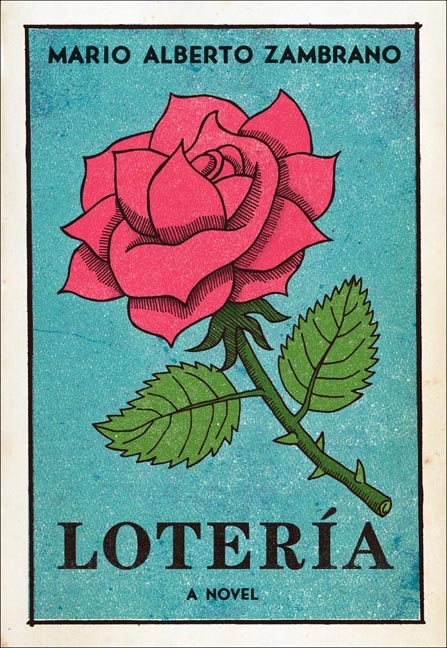
Eleven-year-old Luz Maria Costilla has a gut-wrenching way of storytelling. She’s a lot like Scout, daughter of Atticus Finch. Unfortunately, Luz’s father is nothing like Harper Lee’s heroic character. Nonetheless, in Mario Alberto Zambrano’s debut novel, Loteria, Luz is full of grit and independence.
Loteria is a game of chance, popular in Mexico, designed around cards each of which features an image rather than a number. The images, through riddles, are called out by the game’s dealer. The novel of the same name is built around the cards as Luz recounts the disintegration of her family and how she became a ward of the state of California. It’s rich with humor, sorrow and vivid imagery thanks to the game. The irony is that Luz isn’t talking; she has a journal and the cards to speak for her. Some knowledge of Spanish is helpful.
Luz loves her father. She sees past his many faults: he’s violent, he drinks, and has questionable parenting skills. In his own way, he loves his wife, his elder daughter Estrella and Luz. A few other relatives come in and out of the narrative, but the focus is on this nuclear family. For the El Borracho card, Luz recounts, “When Papi sang in the backyard I’d dance to whatever song he sang. He’d be a little drunk under the light of the porch, and for every four sips he took, I took one.” Not every card is as obvious in its intent, but as Luz puts them together they come to life.
Loteria
Four Bookmarks
HarperCollins, 2013
270 pages




 The Blue Page Special