Archive for the ‘families’ Tag

Who’d imagine that an uninvited guest who shows up at a baby’s christening with a bottle of gin could divide, then fuse, two families over a span of 50 years? Ann Patchett, of course. Humor, tragedy, quirky, yet believable characters result in a compelling story.
In Commonwealth, Patchett creates a novel within a novel – of sorts. She deftly illustrates the Rube Goldberg effect initiated by one man’s attraction to another man’s wife. The havoc it inflicts is expected, the alliances it forms aren’t.
The Cousins and Keating families are brought together when Beverly Keating divorces her husband to marry Bert Cousins. Beverly is a beauty with two young daughters; Bert, the gin-carrying party crasher, is egocentric and the father of two girls and two boys. The Keating girls move with Beverly and Bert to Virginia, while his kids stay with their mother in southern California during the school year.
The six children spend summers together in Virginia. Their combined disdain for their parents and unrestricted activities form bonds that continue into adulthood. The novel begins in the early ‘60s long before the concept of helicopter parenting took flight. Bert hastily retreats when his kids arrive, leaving Beverly, who’s emotionally detached, to manage alone.
Much of the narrative follows Franny, Beverly’s younger daughter. Franny’s relationship with her sister and step-siblings is told in flashbacks moving from childhood to young adult to middle age. In Patchett’s hands, Franny is optimistic; she looks for the best– even when it’s unlikely to surface.
Commonwealth
Four-and-a-half Bookmarks
HarperCollins, 2016
322 pages

I planned on not reading Being Mortal, but plans have a way of changing. My reservations about author Atul Gawande’s best seller were linked to the subtitle: Medicine and What Matters in the End. This year I faced a milestone birthday and some health issues affected my family. All in all it seemed as if the good doctor’s book wasn’t for me. Yet, it was and it wasn’t; the best audience might be millennials. Of course, they’re not the only ones who will be, or are, impacted by their parents’ declining health and well being.
Gawande’s a surgeon who questions the way American culture treats the elderly. He offers several stark contrasts to the situation experienced by his 110-year-old grandfather in India who was respected, even revered, because of his age. He was acknowledged by anyone who entered the family home and consulted on major family issues.
Initially, Gawande focuses on nursing homes and retirement communities. He finds little to celebrate in this area despite efforts by a few individuals seeking better solutions. The author then turns to medical situations and the efforts people go through to extend their lives despite poor odds – odds often encouraged by physicians with the best intentions, albeit not necessary with the most honest answers.
Through encounters with caregivers including family members, Hospice personnel and the elderly, Gawande nudges readers to consider the ways to live life while growing older (or dealing with illness) as the best way to face the inevitable: mortality.
Being Mortal: Medicine and What Matters in the End
Three-and-a-half bookmarks
Metropolitan Press, 2014
282 pages

I hate to admit it, but I’m not as shocked as I once was by the barrage of images in the media revealing the plight of refugees from war-torn countries. The accounts of horror, squalor and multitudes are now commonplace. Thankfully, Nadia Hashimi’s fictional When the Moon is Low has shaken me from complacency in a way the reality no longer does.
This beautifully written novel follows Fereiba from her birth in Kabul to motherhood as she flees from Afghanistan with three children in tow.
Much of the narrative is first person voice as Fereiba recounts her life which begins when her mother dies giving birth. Her father remarries, but Fereiba is a motherless daughter in a country with little regard for women. She’s initially denied the opportunity to attend school, but eventually pursues an education and ultimately becomes a teacher. An arranged marriage provides her with the love, support and friendship she never experiences growing up.
With the rise of the Taliban, Fereiba fears for her family’s lives. What follows is an arduous journey, the kindness of strangers and the heartbreaking separation that occurs when she is forced to choose between waiting for her missing adolescent son, Saleem, and seeking care for sickly infant Aziz.
Midway through, Fereiba’s voice gives way to Saleem’s perspective as he tries to find his family. The goal is England where Fereiba’s sister lives. Saleem’s experiences are harrowing, but his determination is heroic in his efforts to reunite with his mother, sister and brother.
When the Moon is Low
Four-and-a-half Bookmarks
William Morrow, 2015
382 pages

Dinner with Edward is Isabel Vincent’s poignant tribute to an unlikely friendship that evolved for several years over elegantly-prepared meals.
Edward is the 93-year-old father of one of Vincent’s friends; his wife of 69 years has recently died. Vincent is in the midst of a rocky marriage. She is initially reluctant to meet Edward, after all he’s of another generation and she isn’t interested in taking on the role of caretaker. However, once they meet she comes to learn as much about herself as she does about cooking, dining, relationships and manners of a bygone era.
They begin to meet weekly at Edward’s apartment where he always has a martini glass waiting for her in the freezer and a gourmet meal to serve. Their conversations touch on recipes, Edward’s sweet memories of his deceased wife, Vincent’s job as an investigative reporter for The New York Post, her husband and daughter – among many other subjects.
Such a memoir has the potential to be sappy, but Vincent avoids this pitfall through the honest, albeit terse, descriptions of her own emotions and the imagery she creates based on the memories Edward shares with her. This is not a romance in the physical sense, but in an emotional one.
Each chapter begins with a menu Edward prepared. It always includes a dessert and the wine served. It isn’t a good idea to read this on an empty stomach.
More than anything, Vincent shows that the sustenance food provides goes well beyond what’s on a plate.
Dinner With Edward
Four Bookmarks
Algonquin Books of Chapel Hills, 2016
213 pages

One house, 13 siblings, ghosts and the city of Detroit provide the foundation for The Turner House by Angela Flournoy. Thank goodness she provides a family tree to keep track of Francis and Viola Turner’s offspring. It helps that much of the present-day story focuses on Cha Cha, the eldest of the Turner children, and Lelah, the youngest. They’re separated by 23 years; their issues are familiar but not quite cliches.
Flournoy also takes the reader back to 1944 when Francis leaves Viola and young son in his rural Arkansas hometown to seek a better life in Detroit. Francis plans to send for his family once he’s settled. He stays away for more than a year, leaving Viola to consider other options.
This backdrop is interspersed with how the family has coped through the years. Francis is dead, Cha Cha has grandchildren of his own; even Lelah is a grandmother. Few have intact marriages or relationships, yet the family is close-knit. The house, the one in which all 13 Turners grew up, is empty and fallen into disrepair. Viola is no longer well enough to live on her own; she lives with Cha Cha and his wife in the suburbs.
The house, vividly described with Pepto Bismo pink bedroom walls, narrow stairs and large porch reflects the rise and fall of Detroit. Once alive with the large family’s comings and goings, its monetary worth is practically non-existent. The brothers and sisters, though, are mixed in their assessment of its sentimental value.
The Turner House
Four Bookmarks
Houghton Mifflin Harcourt, 2015
338 pages

Anthony Marra is the master of foreshadowing. At times he’s subtle, then he’s as obvious as an agitated teenager reeking of cigarettes claiming he doesn’t smoke. This was true of his first novel, A Constellation of Vital Phenomena, and follows suit in his most recent: The Tsar of Love and Techno.
Marra has chosen a similar setting in Russia with another interesting cast of characters; however, he spans more time, beginning in 1937 continuing to present day. He expands the setting from Siberia to Leningrad/St. Petersburg to Chechnya: landscape is a crucial element.
The narrative begins with an artist in the propaganda department whose job is to erase enemies of the state whose images appear in paintings and photographs. He does this by blotting out faces with ink or by painting something new, which is often his dead brother’s face. It appears in a myriad of scenes representing various phases of his life: child, teenager, middle age and old age.
With each chapter comes a new narrator, in a different setting providing a singular element to the overall novel. The stories are a progression. It’s no spoiler alert to note that the pieces do eventually fit together (very well). Even if they didn’t, Marra’s writing is full of wit and pathos. The images of the pollution-wreaked mining community in Siberia are stark and frigid; just as a Chechnyan hillside is pastoral and warm. The men and women introduced by the author are so human their breath practically turns the pages.
The Tzar of Love and Techno
Four bookmarks
Hogarth, 2015
365 pages
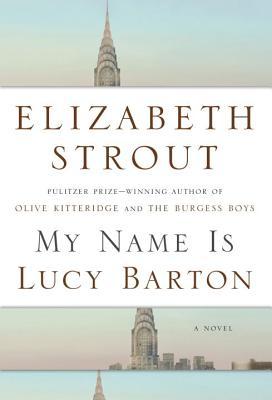
My Name is Lucy Barton is a statement and not only the title of Elizabeth Strout’s new novel. It’s an affirmation as Lucy reflects on the relationship with her mother, which is like a faulty wire: occasionally there’s no connection.
Lucy is from a rural Illinois town where growing up her family lived so far below the poverty line as to make it seem something to attain. Lucy’s life is revealed as she lies in a hospital bed with a view of the Chrysler Building in New York City talking with her mother whom she hasn’t seen or spoken with in years. Strout is methodical as she merges Lucy’s past with the present.
The rich, stark pacing and imagery serve to expose family dynamics in the narrative. That is, Strout’s writing provides enough detail to shape a situation or character, but not so much that there is little left to the imagination. In fact, this is what makes some aspects harrowing: imagining what life was like for young Lucy. She lived with her older siblings and parents in a garage until age 11.
Her mother’s brief presence provides the vehicle to see Lucy’s past; the extended hospitalization gives Lucy time to consider her adult life as a mother, wife and writer.
Lucy should despise her parents and her past, yet she doesn’t. Her family was shunned and her parents were apparently abusive in their neglect. Lucy is grateful for her mother’s presence. The mother-daughter bond, at least from Lucy’s perspective, overrides past sins.
My Name is Lucy Barton
Four and a half Bookmarks
Random House, 2016
191 pages

Families can be so complicated and Anne Tyler has banked on this fact in all of her novels. Her most recent, A Spool of Blue Thread, is no exception.
Abby and Red Whitshank are the kind of folks that raise their four kids, go to work every day, are regarded favorably, pay their bills, have a peripheral connection to a church and know little about either each other or their family history. At one point, in a jesting tone, the omniscient narrator notes there are two family stories: one about the family home on Bouton Road in a respectable, comfortable Baltimore neighborhood, and the other about Red’s sister’s marriage.
Of course, there are more, many more. And Tyler slowly, almost teasingly, reveals them. There’s a good reason why she spends so much time describing the Bouton Road house built by Red’s father.
Initially, the novel appears to focus on Denny, the ne’er-do-well son who floats in and out of the family’s vision. Once he’s clearly established as unreliable and secretive, the focus shifts. Multiple times. Denny has two sisters, but they are the least developed characters. Stem, the youngest son, soon becomes a focal point, as do Red’s parents. Though separated by a generation, the secrets and pasts associated with these three are what move the narrative.
Tyler is not afraid to throw in surprises, which in retrospect were actually subtly foreshadowed. Her ability to show the strengths and foibles of family life are engaging, occasionally humorous and always insightful.
A Spool of Blue Thread
Four Bookmarks
Alfred A. Knopf, 2015
368 pages

I was baffled by Emma Hooper’s Etta and Otto and Russell and James. It’s sweet but confusing. It’s a love story that considers lost chances and perhaps poor decisions. It’s also surprisingly descriptive in its brevity.
Etta is 83 years old when she embarks on a trek across Canada to the ocean. The five-sentence letter she leaves as explanation to her husband sets the tone for the novel: “Otto, I’ve gone. I’ve never seen the water, so I’ve gone there. Don’t worry, I’ve left you the truck. I can walk. I will try to remember to come back.”
This isn’t the kind of thing she’s planned, she simply leaves to see the coast. Briefly, Otto considers trying to find her. Ultimately, it’s Russell who does so, while Otto remains on the farm.
Along her trek, Etta gains unwanted attention from the media and towns people she encounters. She also acquires a companion in James, a source of bewilderment.
The relationships among the four title characters are complex. Otto and Russell have known each other since childhood. Both love Etta. Hooper develops the bond between Etta and Otto through letters the pair exchanged during the war. Their correspondence evolves from the mundane to the heartfelt.
Hooper intersperses the characters’ backstories with their present day adventures: Etta bound for the sea, Russell in search of Etta and Otto discovering daily rhythms on his own. Meanwhile, there’s James, who’s difficult to describe. Hooper has crafted a terse novel unpredictably rich with humor and longing.
Etta and Otto and Russell and James
Almost Four Bookmarks
Simon & Schuster, 2015
305 pages

Disturbing and lyrical are the best words to describe Lida Yuknavitch’s The Small Backs of Children. Graphic and violent could also be added to the list.
Set initially in an unnamed Eastern European village, the narrative involves characters known by single-word descriptions: photographer, writer, playwright, filmmaker, poet, performance artist, widow and girl. Everything centers on the girl.
It is her image as she flees the bombing of her home that is captured by the photographer. The girl has already been victimized by soldiers long before she loses her parents and brother in the explosion. Yuknavitch’s writing is as vivid as the photo that eventually earns the photographer critical acclaim.
The girl runs into the forest and finds her way to the widow’s home where she learns about art and more about survival. Theirs is a quiet, comfortable relationship. Their pasts are always near, but their focus is on the moment.
Meanwhile, on the other side of the world the artists believe they must bring the girl to the United States. The hitch is they don’t know who she is or where to find her. As often happens, money solves most problems and here it comes to the rescue in a round-about way. Even with resources the task isn’t easy.
The realistic descriptions of physical and sexual violence make this a difficult book to read. Fortunately, this is overshadowed by demonstrations of humanity and the author’s powerful writing. At its core, it questions the extremes endured to appease consciences.
The Small Backs of Children
Lidia Yuknavitch
Four Bookmarks
HarperCollins 2015
222 pages


 The Blue Page Special