Archive for the ‘Books’ Category
I took last week off; I read, I hiked, I ate too much, I slept some, I wrote a bit, but mostly I decided to take a break from the Blue Page Special. In the process, I discovered that I missed it.

I just finished reading Tell the Wolves I’m Home by Carol Rifka Brunt and can’t stop thinking about it. Although the writing doesn’t fall into the take-your-breath-away category, the story certainly does. I still want to spend time with the characters: June, a 14-year-old misfit; Greta, her super-achieving sister; Finn, their deceased uncle; and Toby, Finn’s lover.
June is devastated when Finn, her best friend, dies of AIDS. She struggles, then Toby enters her life, and she continues to flounder. Except now she has someone to help her keep Finn’s memory alive. Toby and Finn lived together and, even though she spent a lot of time in their apartment, June never knew about Toby. This aspect has the potential to be implausible; instead, it enhances June’s character as a naïve teenager. Another potentially hard-to-believe feature is the bond that develops between the young girl and the thirty-something Toby. Remarkably, there is never anything creepy or uncomfortable about it. This is largely due to their love for Finn, and the tentative manner in which their friendship evolves. Equally important is the sisters’ relationship.
Brunt masterfully creates relationships that are rich, painful, and grow before our very eyes. The novel is about friendship, first loves, misplaced jealousy and sibling relationships. Set in the mid 1980s, AIDS has just begun to make itself felt in American culture. Yet, that is simply a background element. This is a coming-of-age story that considers the way people change based on age, interests, opportunities, and circumstances.
Tell the Wolves I’m Home
Four-and-a-half Bookmarks
The Dial Press, 2012
355 pages

Where’d You Go, Bernadette by Maria Semple is engaging, funny, poignant, and even a bit silly. Set primarily in Seattle, the story also includes a few situations in Los Angeles and the Antarctic as Bernadette Fox tries to ward off a nervous breakdown in an environment seemingly designed to push her over the edge.
Bernadette is a semi-misanthrope; she dislikes nearly everyone except her husband, Elgie, and their daughter, Bee. Bernadette doesn’t make it easy to like her. She refuses to get involved with the parent groups at Bee’s school, and she avoids interaction – no matter how casual – with others to such an extreme that she relies on a virtual personal assistant who lives in India.
Semple has created an appealing dysfunctional family that has trouble meshing with an often-dysfunctional world. Bernadette, a one-time architect, is, in fact, a genius; she’s a past recipient of a McArthur Foundation Genius Grant. But she responds to stressful situations through radical reactions, including disappearing. Bernadette’s story is told through emails, letters and mostly Bee’s eyes. Bee is no intellectual slouch herself. She’s convinced there’s a logical explanation for her mother’s absence. And here’s where the real adventure begins as Bee sets off to find Bernadette.
Russian spies, potential identity thieves, private school students, and parents blind to their children’s excesses and foibles are just a few of the extras populating Semple’s novel. There are plenty of laugh-out-loud situations as well as a few shoulder-shrugging moments as Bee, who has a very good understanding of her mother, refuses to stop looking.
Where’d You Go, Bernadette
Four-and-a-half Bookmarks
Little, Brown and Co., 2012
326 pages
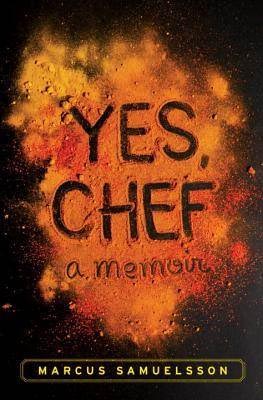
I know a few local chefs by name; I know a lot about others from different places, thanks to the books they write – and the Food Network or Bravo. The latter is where Marcus Samuelsson’s name surfaced on my radar. His memoir, Yes, Chef, provides a detailed, honest look at how he emerged onto the contemporary food scene.
Samuelsson begins his story with a powerful sentence that has nothing to do with food, but everything to do with who he is: “I have never seen a picture of my mother.” He shares how he and his sister made their way from Ethiopia to Goteborg (Gothenburg), Sweden, where they were adopted by Lennart and Anne Marie Samuelsson. He learned to cook by watching his grandmother. He learned technique by apprenticing in Switzerland, France and the United States.
As much as the memoir is about his progression through various kitchens, Yes, Chef is also about finding passion, experiencing prejudice and learning how these disparate aspects can be powerful motivators. Samuelsson reveals his flaws, his quirks as well as his strengths in a straightforward voice.
Ethiopian by birth, Swedish through adoption, and now a naturalized U.S. citizen, Samuelsson might seem an unlikely poster boy in the food world. Yet, it is his internationality that makes him so appealing. His quest as a chef, as he says, was to “chase flavors.” So far, it appears to be quite a pursuit.
Yes, Chef
Three-and-a-half Bookmarks
Random House, 2012
315 pages

Often, stories within stories are enchanting, muddled, lopsided or boring. Fortunately, Winter Garden by Kristin Hannah is captivating without any confusion. One narrative is not more interesting than the other; both have equal appeal.
Much of what makes Hannah’s novel so successful is the clever way in which her characters evolve. Sisters Meredith and Nina are grown women who have always basked in the light of their father’s love. Meredith is the older sister, pragmatic and harried; Nina lives the adventurous life of a freelance photographer. Theirs is not a close a relationship. If not for Evan, their father, there would be little for anyone in the family to hold dear.
Unlike Evan, their mother is a cold, distant woman incapable of showing or articulating affection. This could be a black and white story, but Hannah has enough sense, and talent, to show the nuances. A secret past, painful memories and the harsh reality of war culminate in a fairy tale the sisters’ mother is ultimately compelled to tell. The story moves from the idyllic, contemporary life on the family’s apple orchard to cold, war-torn Russia. Like any good fairy tale, this one begins with a handsome prince, an evil overseer, and a young girl who falls in love.
As the fairy tale evolves, it’s clear this the only way the mother can explain herself and for her daughters to recognize their own strengths, weaknesses and connections. There’s nothing jumbled in either side of Hannah’s engaging account.
Winter Garden
Four Bookmarks
St. Martin’s Griffin, 2010
391 pages

Shilpi Somaya Gowda’s first novel, Secret Daughter, is about families – especially mother-daughter relationships. Two women, one unable to have a child and the other unable to keep hers, are the primary focus – along with Asha, the daughter given up by one and adopted by the other.
Somer, a pediatrician in the San Francisco Bay area is married to Kris, a surgeon originally from Mumbai. Across the world in an Indian village, Kavita gives birth to a daughter she knows her husband does not want, and will not let her keep. Although the women never meet their lives are unwittingly bound when Kavita leaves her child at an orphanage. Through a series of coincidences that often only occur in fiction, the girl, Asha, is adopted by Somer and Kris.
Gowda’s narrative moves from the Bay Area to Mumbai, as it shifts from one woman’s perspective to the other, before, thankfully, settling on Asha. Somer‘s character is whiney and distant; Kavita is mostly sad and compliant. Despite environment and genetics working against her, Asha grows up to be an intelligent, inquisitive young woman. That’s not to say, she is flawless. At her worse, as a teenager, she is rude and insensitive; at her best, as a college student interning at a Mumbai newspaper, she is empathetic and appreciative. Of course, it takes time for the latter qualities to evolve.
Gowda’s writing is strongest describing the contrasts between India’s wealthy and the destitute. The colors, sights, and smells are vivid – even when the reader might prefer otherwise.
Secret Daughter
Three Bookmarks
William Morrow, 2010
339 pages

Any foodie worth his or her cookware will want to read Bob Spitz’s Dearie: The Remarkable Life of Julie Child. Even if you’ve already savored your way through other biographies, memoirs or the film Julie and Julia, this is a must-read. At 500+ pages the book may seem daunting, but Spitz’s writing is conversational and personal; his respect for his subject is clear.
And why not? Her contribution to food culture notwithstanding, Julia Child was an intelligent, loving, enthusiastic woman. For much of her early life, food was just sustenance. She didn’t start cooking, or truly enjoying meals, until she was in her late 30s; once she did, she never stopped.
The biography is told chronologically, except for the prologue. Here the author describes the scene at WGBH in Boston just before Child makes her first television appearance where she cooked an omelet using a hot plate. From there, Spitz tracks everything including her privileged childhood in Pasadena, Calif., life in the Office of Strategic Services outposts, her marriage to Paul Child, and her almost-accidental love affair with food. The most interesting aspects are those that show her as a woman filled with a joie de vie and the ability to change with the times.
Spitz did extensive research to tell Child’s story. The result is a portrait of an unlikely leader in the early days of the food awakening in the United States. Her television shows, her cookbooks, even the parodies of her, contributed to the word “foodie” becoming part of our everyday vernacular.
Dearie: The Remarkable Life of Julie Child
Four-and-a-half bookmarks
A.A. Knopf, 2012
534 pages

A journalism background isn’t necessary to appreciate the points made by Bill Kovach and Tom Rosenstiel in their book entitled Blur: How to Know What’s True in the Age of Information Overload. Anyone who reads or listens to the news should find this interesting. The authors examine the speed at which information, specifically news, reaches consumers/viewers/readers. Demand for attention from various media is overwhelming in its volume and content.
Plus, since news is disseminated via multiple outlets including Twitter, blogs, newspapers, television, and Facebook — among others — it’s often difficult to know who or what to believe. Consequently, the authors say a healthy dose of skepticism is not a bad trait to possess. The pair outlines a six-step process to help sift through the excessive information to discern fair and accurate reports about the world around us. They suggest asking: “What kind of content am I encountering; Is the information complete, and if not, what is missing; Who or what are the sources, and why should I believe them; What evidence is presented, and how was it tested or vetted; What might be an alternative explanation or understanding; Am I learning what I need to?”
Media literacy is nothing original among journalism scholars, but taking it to the public is. It’s something that benefits the general population. A camera and access to the Internet are all the tools necessary to record and distribute news stories. However, just because everyone can play the game, doesn’t mean everyone plays it well, accurately or fairly.
Blur: How to Know What’s True in the Age of Information Overload
Bloomsbury, 2010
203 pages, plus notes and appendix

The images of a very pregnant police investigator and the frozen tundra evoked the movie Fargo. However, these are the only similarities with Asa Larsson’s Sun Storm. Larsson, no relation to Steig of the Dragon Tattoo mysteries, has crafted a novel rich with imagery but lacking in true suspense.
Rebecka Martinsson is a tax attorney in Stockholm called home to Kiruna, in northernmost Sweden, to help a friend suspected of murder. The gruesome, ritualistic crime takes place in a church run by the pastors who long ago banished Rebecka from their community. The back story, including the strained relationship between Rebecka and Sanna, more a former friend than a true one, fill most of the pages. What’s noteworthy is how compelling this is. In fact, at several points it’s easy to forget a murder investigation is underway, or that a threat has been made against Rebecka.
Larsson’s writing is stark, like the landscape of which she writes. Yet, it is easy to imagine the corrupt church leaders, their disappointed wives, the aggrieved Sanna, and a friendly neighbor. Rebecka is both insecure and confident. She tries hard to maintain an emotional distance from the area she was forced to leave. These very efforts make her interesting, but not altogether warm and engaging.
The only completely likeable character in the bunch is Anna-Maria Mella, the female investigator. It turns out, she actually is somewhat like the Frances McDormand role in the Coen Brothers’ film: intelligent, caring and ready to give birth.
Sun Storm
Three-and-a-half Bookmarks
Delta Trade Paperbacks, 2007
310 pages

The title alone, Cocktail Hour Under the Tree of Forgetfulness, is sufficient to lure the imagination, and Alexandra Fuller’s colorful, poignant memoir of her mother is enough to keep it willingly ensnared. This is a sequel to Fuller’s Don’t Let’s Go to the Dogs Tonight: An African Childhood, which I did not read. But then I didn’t read Cocktail Hour either. Instead, I listened to it.
Conditions have to be just right for me to turn to an audiobook. Usually, it means a road trip, but in this case I wasn’t going anywhere. In fact, I was stuck painting the downstairs bathroom.
Fuller’s mother, “Nicola Fuller of Central Africa,” is a character full of flaws, passion and imagination. The author makes it clear it was not easy being her daughter. Nicola is exuberant to the point of embarrassment of all around her. While Fuller does not hold back in detailing her mother’s domineering persona, neither does she waffle in showing the occasional moments Nicola allowed an approachable, sensitive side to appear. This is not a daughter-as-victim tell all memoir. It is a daughter recognizing who she is thanks to, and in spite of, her mother.
One of the joys of listening to this, rather than having read the book is that Nicola loves to sing. Like Nicola Fuller of Central Africa, the narrator breaks into song. Sure, I can imagine a tune in my head as I read, but here it was treat hearing this aspect of Nicola’s personality.
Cocktail Hour Under the Tree of Forgetfulness
Four Stars
Alexandra Fuller
Recorded Books, LLC, 2011

It’s difficult to imagine a more unlikely, unqualified person to serve as the U.S. ambassador to Germany as William E. Dodd during Hitler’s rise to power. It’s equally hard to visualize that his daughter’s scandalous behavior never, well, caused a scandal.
Erik Larson’s In the Garden of Beasts chronicles one of the four years Dodd spent in Germany first trying to ignore the problems, later attempting to convince others of the threats, fear and destruction caused by the Third Reich. He was equally inept at recognizing the potential dangerous behavior exhibited by his daughter Martha, who was attracted, it seemed, to any man who looked in her direction.
Larson relies on numerous letters, memoirs, newspaper articles, personal diaries and other accounts to piece together his narrative. The result is a well-constructed look at a fascinating time in world history. Beginning with Dodd as a professor at the University of Chicago, Larson tracks his path to Berlin, with brief stops through his backstory as a son of a poor North Carolina farming family. Although Dodd’s wife and son also moved to Germany, Larson’s focus is on the senior Dodd and Martha. He because of his position and his eventual, ineffective efforts to share his concerns/fears to greater powers; she because of the disreputable manner in which she socialized.
Larson’s descriptions of pre-World War II Berlin are riveting, as are his references to Dodd’s frugality. For example, Dodd insisted on shipping the family Chevrolet to Germany to save costs. Even in the face of the ensuing events, this is endearing.
In the Garden of Beasts
Three-and-a-half Bookmarks
Crown Books, 2011
488 pages, including end notes, bibliography and index