Archive for the ‘Books’ Category
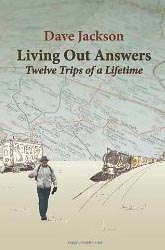
Living Out Answers – Twelve Trips of a Lifetime by Dave Jackson, is one of two indie books I recently read for pleasure (others I read for one of my few paid writing gigs). In the interest of full disclosure: I almost know the author. We’ve never met, but Jackson’s the father of a good friend who gave me the book as a gift.
This is a memoir based on trips, yup 12 of them, that he began taking when he turned 50 in 1979. He kept journals of the adventures which are the book’s foundation supplemented by recent afterthoughts. The trips include finding a way to spend time on the Mississippi River, to working for a circus, to learning about coal mines in West Virginia, along with nine others. He hitchhiked, hopped trains, hiked, rode in the cabs of big rigs and developed sea legs on boats.
Nearly as interesting is how the book evolved: Jackson’s granddaughter was prompted by a photo which led to discussions about the travels. Others entered the picture offering advice and encouragement. Although the book became a family endeavor of sorts, the stories are Jackson’s.
Jackson embraced the new opportunities and experiences no matter how exciting, frustrating or unpleasant, but there was always the safety net of a comfortable lifestyle awaiting him after each exploit. What’s most impressive is that Jackson made these journeys at a point in his life where many think self-reflection is either unnecessary or inconvenient. He demonstrates neither is the case.
Living Out Answers – Twelve Trips of a Lifetime
Three and a half bookmarks
Brokey’s, 2012
281 pages

Easy to visualize characters, plots driven by class conflict, issues of the heart (or both) and a very proper sense of, well, what’s proper are what make English Lit so appealing to me. Yes, the above could easily refer to classic British literature, but it also applies to Helen Simonson’s Major Pettigrew’s Last Stand – a very contemporary work.
Simonson’s novel begins with a chance meeting between the Major (his first name is Ernest, while apt doesn’t fit him as snugly as his military title) and Mrs. Jasmina Ali, a Pakistani shopkeeper. Although their paths have crossed in the past, this encounter comes at a vulnerable point in the Major’s life: he’s just learned of his brother’s death. What follows is the evolution of a friendship based on a passion for books and widowhood.
Both characters are thoroughly engaging. The Major in his stilted, decorous yet sensitive manner has appeal, and Mrs. Ali is an exceptionally intelligent woman burdened by a certain sadness associated with being considered an outsider in her home country. Simonson portrays people we know or would like to; they’re well-defined individuals with foibles, principles and dreams. The cast of lesser characters, including Roger, the Major’s obnoxious status-seeking son, enhance the story.
The novel moves at a leisurely pace as the Major and Mrs. Ali embark on a relationship that puts a spark in their step and ultimately has tongues wagging throughout the village. Simonson clearly enjoys thumbing her nose at what’s considered suitable or not.
Major Pettigrew’s Last Stand
Four Bookmarks
Random House Trade Paperbacks, 2011
358 pages (not including the Reader’s Guide)
Anna Quindlen’s Lots of Candles, Plenty of Cake is a poignant, yet cheerful perspective on getting older. This is the kind of book to share with friends, particularly if they’re around the age of what is now considered to be the new-40s.
As in most of her writing, Quindlen relies on personal experience to make her points. Her writing career includes several stints as a columnist (at the New York Times and later Newsweek) as well as authoring several works of fiction, nonfiction and children’s books. She has a keen sense of observation. Better still, she’s an extraordinary wordsmith. Those two skills result in crafting pieces readers can easily make connections with. Of control, she writes: “I thought I had a handle on my future. But the future, it turns out, is not a tote bag.”
Quindlen examines the important aspects of life, which can be applied to most people, women in particular: friendship, family, love, parenting, and more. She’s humorous and honest. She writes of near-misses, both good and bad. She reflects on how much her younger self was sure she knew and how her older self readily acknowledges what she doesn’t. Without citing the tired phrase that youth is squandered on the young, it’s a major thread. Quindlen puts a new spin on it.
Yes, this is a memoir, but it is much more. It’s a guidebook to accepting that each morning we wake up is a gift – even if we’re older than we were the day before.
Lots of Candles, Plenty of Cake
Four Bookmarks
Random House 2012
182 pages
I’ve read a few books by Louise Erdrich, but none has captivated me as much as The Round House. I was hooked from the opening sentence, which in retrospect isn’t much: “Small trees had attacked my parents’ house at the foundation.” Yet, this simple statement reveals much about the narrator whose life is shaken at its roots by a violent crime against his family.
Thirteen-year-old Joe Coutts lives on a reservation in North Dakota. On an ordinary Sunday afternoon, his life is changed forever after his mother is brutally assaulted and refuses to reveal the identity of her attacker. Joe, his friends, and several family members do what they can to help each other heal, but at the core of that process is naming the man responsible.
Erdrich writes with a sense of determination, there is a need for this story to be told. The crime is complicated by the fact the location of the crime determines which law enforcement jurisdiction oversees the investigation: tribal police, state patrol or local police – entities not known for working together.
The story is full of wonderful characters, each richly developed, particularly Joe and his pals. Within the parameters of the novel are several sub-stories, Indian lore and personal histories, that strengthen those portrayed.
In her afterword, Erdrich notes, “1 in 3 Native women will be raped in her lifetime (and that figure is certainly higher as Native women often do not report rape).” This sobering statistic adds another dimension to an exceptionally well-crafted story.
The Round House
Four-and-a-half Bookmarks
Harper, 2012
321 pages

The title of Laurent Binet’s debut novel, HHhH, is troublesome. Not so much what it means, which is “Himmlers Hirn heiBt Heydrich” or “Himmler’s brain is called Heydrich,” but how to say it. The quartet of Hs is baffling. Fortunately, Binet’s writing is not. While it is not entirely comfortable being amused by Hitler and one of his main henchmen, Reinhard Heydrich, Binet provides a work that is rich with historical perspective and editorial comments interjected in a humorous and sarcastic voice.
The narrator’s purpose is to tell the story of Jozef Gabcik, a Slovak, and Jam Kubis, a Czech, who were primarily responsible for Heydrich’s assassination in Prague. The pair was part of a scheme concocted by the British secret service, and, in the narrator’s opinion, nothing short of heroes.
Binet’s approach is to blend historical fact with conjecture. Occasionally, after describing an incident in vivid detail, he writes, “That scene, like the one before it, is perfectly believable and totally made up.” He even apologizes for spending much of the novel detailing Heydrich’s background and rise through the Nazi ranks. He writes, “Heydrich is the target, not the protagonist.” In fact, the heroes do not even appear until one-third through the book. Even then, it’s hard to avoid returning to Heydrich, the man known as “the Butcher of Prague,” among other monstrous adjectives.
Heydrich’s fate, like that of his assassins, is fodder for the history books. Nonetheless, Binet’s strong storytelling ability creates suspense and satisfaction as the events unfold.
HHhH
Four Bookmarks
Farrar, Straus and Giroux 2012
327 pages

When I first picked up Faith by Jennifer Haigh, I almost immediately put it down. I was afraid it was going to further magnify the bull’s eye on the back on the Catholic church, which is already too easy a target for many. Yes, Haigh’s book is framed by the possibility of a priest molesting a young boy, but it’s much more than that. It is, indeed, about faith in its many manifestations: belief, conviction, trust, reliance and loyalty.
Old school Catholics, priests, families and perceptions are all deftly portrayed by Haigh as she tells the story of Father Art Breen, a quiet, unassuming parish priest whose primary vice is that he smokes like a steam engine. Father Art’s story is told through his sister’s eyes. Sheila begins with her step-brother’s progression through school, details his seminary years, his parish assignments and how he came to be accused of molesting a second-grader. Sheila also shares details about her family background: her mother who is a staunch Catholic unable to find fault with her church; her younger brother, Mike, who immediately believes Art is guilty; and her own conflicted thoughts as she discovers she is unsure who and what to believe.
The setting is Boston in the spring of 2002, just as the news of numerous molestation cases begin to emerge. The reader is asked to consider Art’s innocence or guilt just as his family struggles with this question. It seems so unlikely, and that is exactly what makes the possibility real.
Faith
Four Bookmarks
Harper, 2011
318 pages

I’m probably not alone in my preference to read the book before I see its film adaptation. The Perks of Being a Wallflower was no exception. I am now anxious to watch the movie.
Stephen Chbosky’s novel is told through letters written by Charlie, an insecure 15-year-old, to an unknown recipient. Charlie’s letters are brutally honest in their reflection of his life as the youngest of three children in a traditional family. It’s clear from the outset, though, that he is far more sensitive than most teenage boys. Sure, he faces teen angst like most kids, but his sensitivity and intelligence set him apart from his peers. Through what can only best be described as chutzpah, he introduces himself to Patrick and Sam (Samantha) – step-siblings in their senior year. Charlie is a freshman, but his new friends don’t seem to mind and welcome him into their circle.
As Charlie becomes more involved with his new friends, he discovers that he is not the only teenager with problems. His letters reveal more and more about himself and those around him. It’s evident that his issues are intense: misplaced guilt and an ability to keep a family secret he shouldn’t be burdened with. Lingering in the background are topics of sexuality, identity, and perceptions.
Charlie may never be a popular boy, but he has friends and family who care deeply about him. Even for those of us long removed from school days, it’s still possible to appreciate the value of those intangibles.
The Perks of Being a Wallflower
Four Bookmarks
Gallery Books, 1999
213 pages

Beautiful Ruins is a cinematic novel. It’s easy to imagine this story playing on the silver screen. It spans years and continents, relies heavily on the relationship between Elizabeth Taylor and Richard Burton, and features a strong connection to the movie industry. At its core, this is a love story, and a beautiful one at that.
Jess Walter’s tale involves a young actress, Dee, who arrives in an isolated Italian fishing village on the Ligurian Sea, where she meets Pasquale the owner of the Adequate View Hotel. Dee has been sent from Rome, where she had a bit part in the filming of Cleopatra. Dee is also pregnant with Burton’s child. Although it may sound like a blurb from People magazine, Walter imbues his narrative with deep feelings, humor, interesting characters and a clear passion for romance.
However, just when it seems the story will settle in the fishing village (the most interesting place) or even Los Angeles (because of the Hollywood scene), several miscellaneous locales are introduced: Seattle, London, Spokane, Florence, even Donner Pass in Northern California. Walter includes an assortment of characters, none of whom, surprisingly, are superfluous. Added, to this mix are different time periods: the early 1960s, the 1800s, and something more contemporary. The myriad of people, places and eras at first seems disparate, but they actually are essential what makes this such an engaging work.
Ruins are most often associated with architecture. Here Walter incorporates them into the erosion, but not extinction, of human emotions.
Beautiful Ruins
Four Bookmarks
Harper, 2012
337 pages

Any number of factors figure into how I, or anyone for that matter, respond to a book. Experience, age, education, even mood, come quickly to mind. I was struck by these considerations as I read Sheila Heti’s How Should A Person Be? because the novel makes me feel that whatever I bring to this particular reading experience is a negative: my experience, my age, and yes, my mood.
Sheila is the narrator, a young writer in Toronto struggling to finish a long-overdue play; she is easily distracted by life, specifically people in her life. She is so caught up with what others think and do that she lacks focus. Sheila stretched my patience as a reader. She has a wonderful friend in Margaux, an unhealthy but lively sex relationship with a man named Israel, and an undiguised inability to recognize or accept what is good and positive in her life. She is not quite a loser, but teeters awfully close to becoming one.
Perhaps the issue lies in Heti’s attempt to fictionalize her autobiography, for she is clearly the narrator and there is little reason not to believe that the other characters comprise her circle of friends. Frankly, Sheila is not that interesting. That honor goes to Margaux who comes across as honest, talented and a good friend, but it’s hard to explain what she sees in Sheila. Israel is depicted as a depraved man who uses Sheila to fulfill his debased sexual fantasies. Unfortunately, it’s too easy to see he’s attracted to her.
How Should A Person Be?
Two-and-a-half Bookmarks
Henry Holt and Co., 2012
306 pages
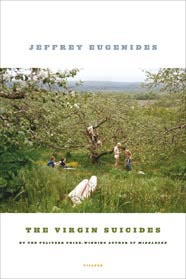
First published twenty years ago, The Virgin Suicides by Jeffrey Eugenides remains poignant and rich with dark humor. The account of the Lisbon sisters, whose mere existence – and ultimate demise – captured the attention of their entire community, is told in a plural form of the third person voice representing the neighborhood’s teenage boys. It’s not quite the “royal we” but is an interesting technique nonetheless.
Eugenides’s narrative takes place in a quiet Detroit suburb. Seasons are noted by references to fish-flies, fallen leaves and holiday lights. For the Lisbons, however, there are complications. The narrator(s) rely on observation and references to interviews conducted with other neighbors, teachers and clergy. Mention is also made of several “exhibits” which include medical reports and photographs.
The five sisters range in age from 13 to 17, and the youngest is the first to kill herself. It’s clear not just from this suicide which takes place early in the novel, but also from the title, that the others will follow suit. The narrators share this sense of the girls’ impending self-destruction. Eugenides masterfully creates tension, and toys with the reader suggesting the possibility that, perhaps, the girls will be unsuccessful.
However, this is not a work simply about teen angst with no way out. It is a coming of age chronicle and a love story. The narrator(s) are forever changed by their connection to the Lisbon family, but the impression is that would have been true even without suicide as part of the tale.
The Virgin Suicides
Four Bookmarks
Picador, 1993
243 pages