Archive for the ‘Books’ Category

Like other Harry Hole mysteries by Norwegian author Jo Nesbo, Phantom accelerates from zero to 120 in no time flat. The quick-pace, heart-thumping action alternates voices between a third-person omniscient narrator and a recently-murdered drug dealer. The latter isn’t as disturbing as it sounds. In fact, it’s a powerful device, identified by italics, having the deceased Gusto reveal a lot about his wasted life and elements of his demise, without divulging who dunnit.
Harry returns to Oslo from his self-imposed exile in Bangkok to help exonerate Oleg, the son of the woman he’s never stopped loving. Although they are not flesh and blood, Harry has strong paternal feelings for Oleg. Consequently, Harry finds it unlikely the young man could be guilty. Harry relies on former connections within the police force to help in his unofficial investigation, as well as employing his own brand of whatever-it-takes approach to solve a crime.
Russian drug lords, crooked politicians and policemen, and Harry’s own demons help propel the story beyond drug deals gone bad. Nesbo is impressive in his ability to create black and white characters with nuance; that is, even the bad guys have a few redeeming qualities, while the good ones can’t help but disappoint from time to time. In the process, it’s difficult to determine the guilty person before Nesbo spells it out.
It is not necessary to have read any of the previous Harry Hole mysteries before jumping into Phantom, the only question is why would you not want to?
Phantom
Four-and-a-half Bookmarks
Alfred A. Knopf, 2012
378 pages
http://jonesbo.com/
(The University of Tennessee College of Communications and Information, where I attended graduate school, was in the shadow of the football stadium. At the time, the Volunteers were the nearest thing in the state to a pro team. Close as I was to the gridiron, I never attended a game. Instead, my attention was drawn to the Lady Vols basketball team because the coach, then in her fifth year, and I shared a name. I’ve followed Tennessee women’s basketball ever since.)

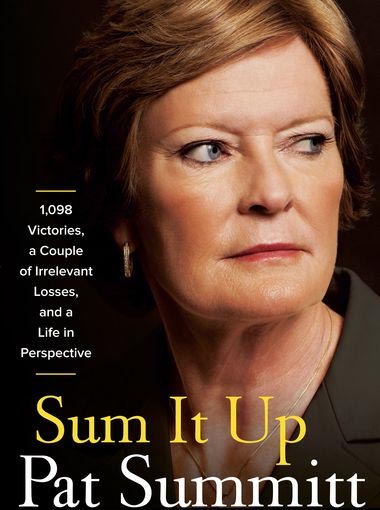
Nearly two years ago, Pat Summitt who coached the Lady Vols for 38 years, announced that she had been diagnosed with early onset dementia. She continued to coach for a year, but last season handed over the reins to an assistant. Although still involved in the program, Summitt spent a large portion of the past year writing her memoir, Sum It Up with Sally Jenkins. It’s subtitled “1,098 Victories, a Couple of Irrelevant Losses, and a Life in Perspective.”
Her records aside, what is particularly noteworthy is that when she began coaching, Tennessee high school girls were still relegated to playing half-court ball. Summitt recounts growing up on a farm in rural Tennessee, and after graduating from college initially being offered an assistance coaching job at UT. That never happened. Instead, she became head coach where, in the beginning, she did everything except sell tickets. Ultimately, she was instrumental in drawing national attention to women’s basketball.
Summitt’s accolades include Olympic medals, as a player and coach, national college championships, and the fact that 100 percent of all of her athletes graduated from college – many of whom went into teaching or coaching.
The latter and her love for her son are what fuel her passion for life. Anyone who’s seen Summitt pace the sidelines during games knows her as a no-nonsense, disciplined and demanding coach. What many don’t know is the depth of her compassion for her players, colleagues, and women’s sports. In an honest, unsentimental voice, this is what comes through in her book.
Sum It Up
Four Bookmarks
Crown Archtype, 2013
385 pages, including appendices
A wholesome, but fiercely independent, young woman in rural Minnesota isn’t exactly who comes to mind when a murder needs to be solved. Yet, author Joanne Fluke has developed quite the following with her Hannah Swensen mysteries. The only explanation I can surmise lies in the fact that Hannah, who fits the above depiction, is also a baker extraordinaire and it’s worth the easy reading to get some new recipes.
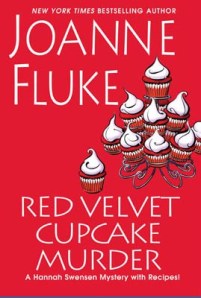
Fluke’s most recent addition to the Hannah Swensen oeuvre is Red Velvet Cupcake Murder, which had been on The New York Times Best Seller’s List for several weeks. That, along with my own penchant for cupcakes, is what drew me to the book. Nonetheless, my expectations, fortunately, were not high, so I was not disappointed.
Hannah lives in Lake Eden, a small town, where she owns the Cookie Jar, a bakery and coffee shop. The story begins with her catering the opening of a renovated hotel. The cupcakes are a featured attraction, along with several delicious-sounding baked goods. Readers are immediately introduced (or for those Hannah followers re-introduced) to Hannah’s mother, sister, love interests (yes, plural) and friends. Hannah’s nemesis from an earlier book reappears on the scene.
It doesn’t take long for an accident to occur, which requires a lot of cooking on Hannah’s part to help make people feel better. Soon thereafter someone is murdered, and instead of being part of the unofficial investigation, Hannah becomes a suspect. Somehow, thanks to friends and family, the bakery continues to serve the delicious sweets it is known for, and readers can continue to drool over their descriptions.
All of the delectables include clever names to fit the situation. Among them are Razzle Dazzle Brownies, Tickled Pink Lemonade Cookies, Snappy Turtle Pie and the Red Velvet Cupcakes with a Surprise Filling — the storyline is so predictable it’s nice there is at least one revelation that truly unfolds.
Red Velvet Cupcake Murder
Three Bookmarks
Kenninsgton Books, 2013
323 pages, including recipes
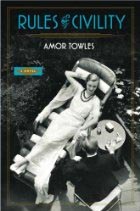
Rules of Civility might sound like an oxymoron today, but author Amor Towles has crafted an engaging novel set in 1938 about social mores that provides plenty to contemplate now.
Katey Kontent (as in the adjective, not the noun) is the narrator whose memory is jarred at an art exhibit in 1966 which takes her back to that one eventful year and the cast of characters who filled it. Katey is a lively, intelligent 25-year-old trying to survive in New York City. A chance encounter on New Year’s Eve 1937 sets the stage for her friendships, romantic relationships, disappointments and her career.
Towles evokes a lively, and noir-ish, portrait of New York City where martinis, jazz and social status dictate. He does so with humor and emotion. Katey works in a secretarial pool in a large financial firm, but her interests lie elsewhere. No sooner is she promoted then she quits to work for an editor past his prime: “He stopped taking on projects and watched with quiet reserve as his authors died off one by one – at peace with the notion that he would join them soon enough in that circle of Elysium reserved for plot and substance and the judicious use of the semicolon.”
Plot and substance are the stuff of Towles writing, which focuses on Katey’s relationship with Tinker Grey, a dashing banker of means. Through Tinker, she has access to upper society, although, as is often the case, appearances in any circle aren’t always what they appear.
Rules of Civility
Four-and-a-half Bookmarks
Penguin Books, 2011
335 pages, which includes The Young George Washington’s Rules of Civility and Decent Behavior in Company and Conversation
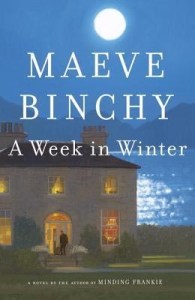
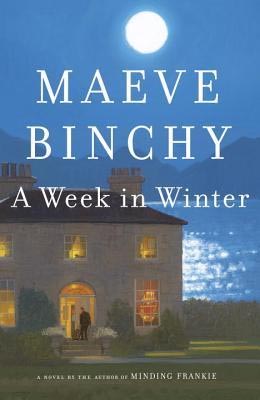
I’m a sucker for a Maeve Binchy novel. Yeah, I know her books are predictable, mushy and fast reads, but she gets me every time. Say what you will, Binchy is a marvelous story teller, and I was saddened to learn she died last summer. A Week in Winter was published posthumously.
Her last work has the requisite characters: independent women who are misled by handsome but unreliable men; ne’er do well young men who, despite the odds, turn their lives around; well-meaning parents who misunderstand their adult children; and, well, many more. For the most part, they are all quite lovely — young and old alike.
Chicky Starr left her family home on Ireland’s west coast as a young twenty-something, only to return some 20-plus years later to renovate an old mansion overlooking the sea as a hotel. Each of the book’s chapters focuses on a different character, while continuing the thread established in getting the hotel ready for guests. Of course, the guests figure prominently in the story. A few names from some of Binchy’s other works find their way into A Week in Winter, which only makes sense: Ireland is not that large a country.
Family relationships, friendships and learning to navigate life are the themes Binchy weaves into her novels; and the Irish landscape is always as important as its inhabitants in her hands.
Binchy has authored 22 books, of which two are nonfiction; I’m glad there are still several I have yet to read.
A Week in Winter
Three-and-a-half Bookmarks
Alfred A. Knopf, 2013
326 pages
I’m not entirely sure how I feel about The Twelve Tribes of Hattie by Ayana Mathis. Mathis has created a family, beginning in 1925 continuing through 1980, of which Hattie is the matriarch. The tribes, her 11 children and one grandchild, are revealed in single, captured episodes (chapters) reflecting a lifetime of longing and emotional neglect. On one hand Hattie is a mother who loves her children too much; yet, she doesn’t love them well.
Parents are not always infallible, and Hattie makes no apologies for her shortcomings. The first chapter, about her twins, and later that of her daughter, Rosie, are told through Hattie’s eyes; the rest of the stories are shared from her children’s perspectives. These include looks back on their childhoods and a glimpse of them as adults. No one fares well, and the question surfaces: how much is a parent’s responsibility? Except that’s not the only issue here.
Hattie and her husband, August, share the burden of poverty and heartache. Their relationship, however, is grounded more in the physical than sentimental realm. Consequently, her nine offspring struggle with everything from sexuality to religion, from addiction to mental illness. How would life had been different if Hattie’s first two children, twins Philadelphia and Jubilee, not died in infancy? It’s possible they would have grown up to be just as miserable as their siblings.
Mathis’s writing is the redeeming element: evocative and haunting. What she writes may be difficult to read, but how she does it is memorable.
The Twelve Tribes of Hattie
Probably Four Bookmarks
Alfred A. Knopf, 2012
243 pages
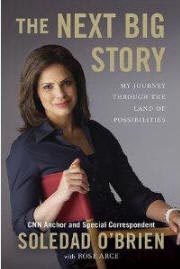
Broadcast journalist Soledad O’Brien’s voice is honest, moving and completely engaging in her memoir, The Next Big Story. I’d expected nothing less than an accurate and fair narrative. It’s also a celebration of opportunities, not just for her as the daughter of a mixed-race marriage, but everyone willing to work hard for the prize. O’Brien acknowledges that for many the ability to make that reach is often riddled with obstacles.
Thanks to the values instilled by her family, O’Brien admits she wasn’t always aware of any impediments. Yes, she is bi-racial, and yes, she grew up in a predominantly white community, but she was never beaten down. This was largely due to her drive to keep up with family expectations.
Much of O’Brien’s story focuses on her journey to become a respected reporter. It wasn’t something she anticipated, but once she discovered journalism she was hooked. She shares her early days of trying, often unsuccessfully, to get meaningful stories on the air. Through hard work, strong friendships and tenacity, she worked her way to anchor weekend news programs locally then nationally. Along the way she married, had children, but continued her quest to share other people’s stories. CNN’s Black in America and Latino in America documentaries are hers, both award-winning works, although she never mentions the accolades.
Most riveting are O’Brien’s accounts of covering such catastrophic events as the tsunami in Indonesia, Hurricane Katrina and the earthquake in Haiti. These are all familiar, but O’Brien’s insider retrospective evokes emotion and suspense.
The Next Big Story
Four Bookmarks
Celebra Books, 2010
321 pages
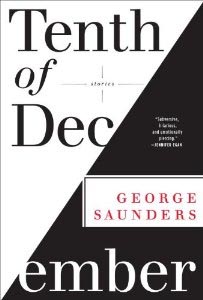
Satirical, dark, contemporary and poignant are apt descriptions of the 10 short stories by George Saunders, in a collection entitled Tenth of December. Consistent and pleasing, on the other hand, don’t make my list.
Writing in multiple voices, Saunders’s edge dulls by the end of the collection: too much anguish, disappointment and loss. However, “Victory Lap” and “Puppy” tug at the soul. The narrators are very aware of what is missing in their lives. Saunders nails the internal struggles of the main characters. “Victory Lap” features two teens whose inner voices are imaginative, rebellious and forthright – unlike their true personalities. Kyle is a teenage boy grappling with whether or not to come to the aid of his next door neighbor as she’s being abducted. Before the inner struggle ensues, he cops an attitude toward his parents, extreme control freaks. This explains Kyle’s reluctance: his parents are likely to be disappointed at what others will perceive as heroism. Although it may not seem like a likely place for humor to reside, this is a laugh-out loud story. Saunders creates tension and humor effortlessly.
“Puppy” carries that same unlikely combination, but this time with a mother as narrator trying to appease her overindulged children. Spoiled kids, grown kids who make poor choices, parents who make bad decisions and adults knowing they need to do better with their lives are among the characters Saunders creates. They’re not people I want to know. Perhaps therein lies the problem: they are, in fact, all around us.
Tenth of December
Not-quite Four Bookmarks
Random House, 2013
251 pages
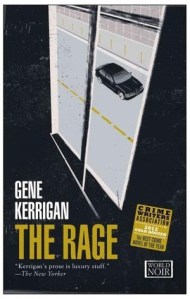
There’s a difference between mysteries and crime novels, which is evident in Gene Kerrigan’s The Rage – and not just because the Crime Writer’s Association Award for the Best Crime Novel of the Year is advertised on the cover.
Kerrigan is a master storyteller whose characters, good and bad, aren’t black and white. The cops have a lot of gray areas, and the less-than-desirables do, too. Even, a nun falls somewhere in the middle, which has nothing to do with her habit.
Detective Sergeant Bob Tidey is part of the Dublin Garda (police), but not one of those strictly-by-the- rules kind of cops. He’s mostly driven by common sense, which tends to create some heartache for him and his superiors. At the other end of the law-and-order spectrum is Vincent Naylor, recently released from prison where he’d served time for a brutal assault, now in the midst of planning a major heist. Ironically, Tidey and Naylor never encounter one another, but their paths cross frequently –thanks to Maura Coady, a retired nun. Make no mistake, she’s no Saint.
Fraud, drugs, murder and misguided romance fill Kerrigan’s novel. Tidey is assigned to investigate a case that, ultimately, has only the thinnest a connection to Naylor. In fact, the robbery Naylor plans is gripping in its detail, but has nothing to do with Tidey; that is, until Maura Coady notices an unknown car parked on her quiet street. This is no mystery, but seeing the pieces of the story come together is captivating.
The Rage
Four Bookmarks
Europa Editions, 2012
313 pages
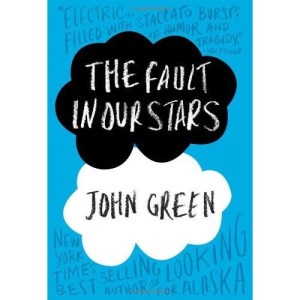
Hazel, the insightful narrator of John Green’s The Fault in Our Stars, is a 17-year-old who’s fought cancer most of her life. While talking about another book, she could just as easily be talking about this one: “But it’s not a cancer book, because cancer books suck.” Green has written much more than that, and it comes nowhere close to sucking.
This is about living with the knowledge of death’s inevitability loitering closer than it does for most, especially the young. Hazel meets Augustus at a cancer survivor’s support group. Eyes meeting across a semi-circle of young adults in varying degrees of bad health may not sound romantic, yet it’s the beginning of a beautiful relationship between two young adults who teeter alarmingly near to death’s grasp.
Hazel is an endearing character: intelligent, witty and aware of what she has in life, versus what she might be missing. She does not want to be defined by her diagnosis. Although Augustus might be a little too good to be true, he is fun and expands Hazel’s world.
Through a shared passion for the book that is “not a cancer book,” which simply stops with no real ending, the pair find a way to look toward the future. They want to know what happens. Yes, this may be a metaphor for their lives, but it’s far less dismal than that.
A few plot twists help overshadow the novel’s predictability. The story’s beauty is based not on what’s lost, but is grounded on what’s gained.
The Fault in Our Stars
Four Bookmarks
Dutton Books, 2012
313 pages