Archive for the ‘Books’ Category

Denise Kiernan’s The Girls of Atomic City: The Untold Story of the Women Who Helped Win World War II made me wonder if it would appeal to anyone unfamiliar with Oak Ridge, Tenn. I lived in Oak Ridge for five years after college. It was a beautiful, fascinating place thanks to its population of highly educated people from all over the world and its impressive, albeit once-clandestine, past. Kiernan writes about how, and why, the town came into existence by focusing on the role of the thousands of women (and men) who did their part to help end WWII. Most had no idea what they were doing or why.
In 1943, people from major metropolitan areas and rural communities were recruited to relocate to a town which didn’t even exist on a map. Kiernan conducted interviews with many of the women, now in their 80s and 90s, to recreate the conditions they endured knowing only that their work contributed to the war effort. Friendships formed, romances ensued and construction progressed at a rapid rate. All the while no one could talk about their jobs. Yet, this was an integral part of American history.
Uranium, referred to as Tubealloy, was, in fact, being enriched for its ultimate use in the atomic bomb. Oak Ridgers learned about the secret the same time as the rest of the world when Hiroshima was bombed.
The advantage to knowing Oak Ridge is that it’s easy to envision Kiernan’s descriptions, but the book’s fascination is far-reaching.
The Girls of Atomic City: The Untold Story of the Women Who Helped Win World War II
Four Bookmarks
Simon & Schuster, 2013
371 pages with notes and index
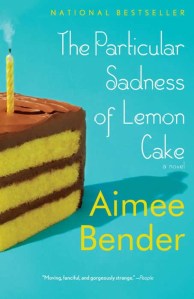
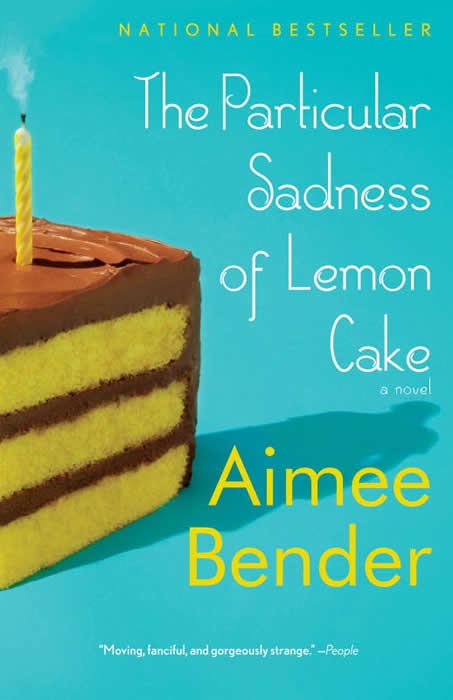
Aimee Bender’s second novel, The Particular Sadness of Lemon Cake, is quirky but glum. The premise follows Rose, the young narrator, and her ability to discern people’s emotions through the food they prepare. This is in stark contrast to the concept that cooking and eating meals are meant to be enjoyed and shared. Poor Rose must develop a strategy to avoid knowing more than she cares or wants, but, of course, she also has to eat.
It doesn’t help that Rose’s family is on the eccentric side to begin with. Lane, her mother, is flighty. And, as Rose deduces from her mother’s cooking, Lane is also very unhappy. Rose’s father is distant and professional. Her brother, Joe, is a genius void of social skills, with an enigma of his own. Despite the food affliction, Rose is pretty much the clan’s anchor with Joe’s friend, George.
Bender deftly portrays the efforts young Rose endures to, at first, keep her disorder a secret and, eventually, live with it. Rose is wise and perceptive; she is smart enough not to reveal too much. Although there are a few light moments, it’s more than a slice of cake that’s particularly sad. Rose and most everyone around her are all woefully unhappy.
The story’s saving grace is Bender’s writing which blends melancholy with the bizarre, while throwing sensitivity and a bit of wry humor into the mix. She’s also excellent at describing a Los Angeles neighborhood that doesn’t rely on tired landmarks.
The Particular Sadness of Lemon Cake
Three-and-and-half Bookmarks
Doubleday, 2010
292 pages

Writers who pay to have their books published often go through the wringer when it comes to perceptions. Such efforts were once identified as vanity-pressed or self-published. Now the preferred term is indie, or independent, publishing. Some indies are poorly constructed, rife with grammatical errors and simply uninteresting; yet many are well-written including Summoning the Strength by Stephanie Briggs. She manages to avoid those most frequent missteps. In fact, she’s really only guilty of not calling on her own strengths, which are plentiful, when it comes to writing.
At 169 pages, Briggs’s novel is all-too brief to accommodate the numerous characters. The account follows Katherine, a small-town girl who endures a disastrous marriage to a wealthy man. She’s interesting and has an especially strong relationship with her mother, which unfortunately, just withers.
Katherine’s unhappiness is tangible because Briggs tells the story in retrospect. However, the explanation for the discontent is one-dimensional. The husband’s a jerk and Katherine’s an intelligent woman too blind to see the obvious.
One problem is the large number of long-lasting friendships Katherine has from her childhood and college days. It’s clear the author appreciates the importance of women’s friendships. However, here’s an instance when having more isn’t necessarily a good thing.
Briggs’s prose is engaging and descriptive, but she could have easily created fuller (and fewer) characters for a richer story. I’ve come to enjoy Briggs’s writing through her blog, Honie Briggs. It’s smart, humorous and meaningful. I suspect her next book will be, too.
Summoning the Strength
Three bookmarks
Briggs& Briggs, 2011
169 pages

I learned about The Healer from a link sent by a friend featuring book doppelgangers. Antti Tuomainen’s novel was identified as the literary twin to The Girl With the Dragon Tattoo. That’s all I needed to know – or so I thought. Unfortunately, it’s more a fraternal connection than identical.
Yes, it’s set in Scandinavia but from there the similarities are tenuous at best. The Healer is compact but can’t quite settle on a specific genre. It’s crime fiction, without the thrill of trying to determine whodunit before it’s spelled out. It’s an apocalyptic tale, without an explanation of what actually took place – except for references to global warming. It’s a love story, told only from Tapani the narrator’s perspective, which is unreliable.
Tapani recounts his frantic search for his missing wife, Johanna, a journalist working on a story about a series of murders. The couple has never gone more than a few hours without communicating with one another. Her editor is disinterested, the police are over-worked, and friends are not forthcoming. Tapani is on his own left to retrace his wife’s steps. Along the way he is befriended by a helpful yet mysterious cab driver. And, Tapani uncovers a few secrets from Johanna’s past, which make him question how well he truly knows her.
Tuomaninen’s description of Helsinki is stark; it’s a city of constant rain, poverty and crowds. None of which, like Tapani’s search for Johanna, is very engaging. Nonetheless, I found myself thinking about the ending long after finishing this terse novel.
The Healer
Three Bookmarks
Henry Holt and Co., 2010
211 pages
Barbara Kingsolver and Joni Mitchell have a lot in common – at least to me. I’m especially drawn to their early works. They’re prolific and both know the beauty of language. Even though they’re favorites of mine, it doesn’t mean I don’t see their foibles.
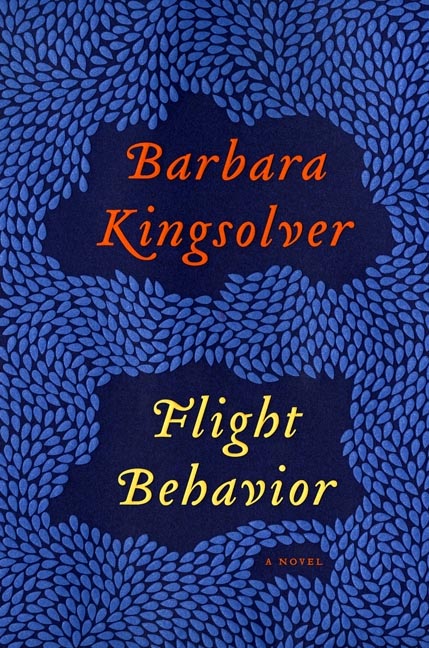
Admittedly, it’s been a while since I’ve listened to anything by Mitchell, but I did just finish Kingsolver’s Flight Behavior. I pretty much read anything and everything she writes. Unfortunately, it didn’t wow me. It has plenty of descriptive images and the characters are interesting, but the story itself is just too predictable.
Climate change is the driving issue with the theme of understanding the world around us. Dellarobia is a young mother of two in a lackluster marriage. Just as she is about to embark on an affair, she discovers monarch butterflies have blanketed the woods on the family land in rural Tennessee. This introduces her to scientists, the media, family secrets, and herself.
Dellarobia’s an appealing character. She’s a good mother, but isn’t thrilled by being a wife thanks to her easy-going husband, Cub, and his willful, demanding parents. To counter the country folk, Kingsolver brings in the intellectual Ovid Byron, a researcher.
The gist of the story can be found in the first and last chapters. The downside to only turning those pages is that you’d miss the imagery, sarcasm ascribed to some of the characters, and the magic Kingsolver has with words. Then again, you’d get to skip the preachy tone and predictability. It might be time to listen to Joni Mitchell again.
Flight Behavior
Three-and-a-half Bookmarks
HarperCollins 2012
433 pages
Anyone worth his or her salt in the kitchen has drawers and cabinets full of wonderfully useful and incredibly useless gadgets. Bee Wilson’s Consider the Fork: A History of How We Cook and Eat provides historical and cultural perspectives on how most of them came into our lives. The book is divided into eight sections, each addressing a specific element of cooking under such headings as “Knife,” “Fire,” “Eat,” among others. Yes, the fork gets plenty of attention, but so do other implements that impact not just how food is prepared, but what’s eaten.
Wilson examines the technology behind cooking tools, using the purest definition of the word: “Techne means an art, skill or craft, and logia means the study of something.” Occasionally, she gets bogged down by too much detail, such as the various types of fuels, or the dangers inherent in knives. But who knew about the egg beater boom in the late 1800s? How about that “Kitchen Debate” between the U.S. and Russia at the time of the Cold War?
Nonetheless, reflecting on why we use certain implements versus others, or why some are no longer to be found, is pretty interesting stuff. Wilson has done her homework. If nothing else, I gained insight into the evolution of pots and pans, and now know that the fork was initially not well-received. It took the Italians and pasta to demonstrate its usefulness.
Besides, having read the book I discovered a few new Scrabble words: quern, trifid and ulu.
Consider the Fork: A History of How We Cook and Eat
Three-and-a-half Bookmarks
Basic Books, 2012
310 pages, including notes and bibliography
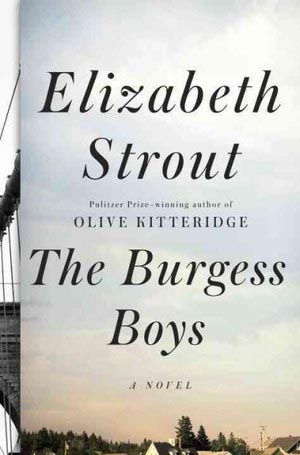
My sons are in their twenties and I still refer to them as the boys. It’s not so unusual, then, that Elizabeth Strout’s latest novel since her Pulitzer Prize-winning Olive Kittridge identifies the 50-something protagonist brothers as The Burgess Boys. Yet, it’s unsettling that they are such poorly matured men.
The backstory of Bob being accidently responsible for his father’s death is almost a character unto itself. This aspect of the novel emerges slowly and evolves, just as everyone else does, providing an especially interesting angle.
Jim is the older brother, the successful, high-achieving one. Bob, on the other hand, is less driven, and far more endearing. He rarely grows weary of Jim’s disparagements toward him, although reading them is tiresome. The boys left their childhood home in Maine years ago to pursue their lives in New York City. Jim is a hot-shot lawyer and Bob, also a lawyer, serves a different clientele. They receive word from their perpetually-unhappy sister (Bob’s twin) in rural Maine that her son is charged with a hate crime. This is the driving narrative, but that backstory is never far behind.
Strout has created a novel full of multiple layers, but not different versions. She provides snapshots of what happens in real life. Some are faded, some in black and white. The characters are heartbreaking in their deception, confusions and naiveté. Unlike Olive Kittridge which was a collection of connections among its characters, The Burgess Boys focuses on a family’s past and present, along with its shortcomings.
The Burgess Boys
Three-and-a-half Bookmarks
Random House, 2013
337 pages
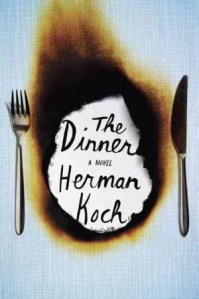
Most parents, whether with young children or those who remember when their kids were small, are familiar with meals being a time for whining and dining. Herman Koch’s The Dinner applies the concept at a very different level.
In Amsterdam, where the story takes place, two couples meet one evening at an upscale restaurant. The novel is narrated by Paul who is unhappy about the location, the companionship and, ultimately, the reason for getting together. Paul whines, a lot. He, with his wife, is joined by his brother and sister-in-law. The dining establishment is pretentious and so is his brother, Serge. Paul’s lack of enthusiasm is understandable, although none of Koch’s characters are worth embracing.
Initially, Paul’s attitude seems justified. Serge comes across as shallow, and the food does sound haughty: “The ‘grapes’ were lying beside a deep-purple piece of lettuce, a full two inches of empty plate away from the actual main course — ‘filet of guinea fowl wrapped in paper-thin German bacon.’”
As the novel and meal progress, it’s evident that the story is less about the five courses than about Paul, in addition to his son and nephew. The latter are the impetus for the couple getting together; the parents share a lot of responsibility when it comes to dealing with a criminal act committed by their boys.
By meal’s end, what has been served are layers of rationale that demonstrate how far some parents go to protect their children. Thankfully, there’s no to-go box for this repast.
The Dinner
Three-and-a-half Bookmarks
Hogarth, 2012
292 pages

Isabel Allende is a master storyteller. Her characters have depth; their lives are full of mystery, love and befuddlement. Her most recent novel, Maya’s Notebook, is no exception. Well, it is, because it’s exceptional – even for Allende.
Maya is a 19-year-old girl on the lam on a remote island off the coast of Chile, her grandmother’s homeland. Maya was raised in Berkeley by her grandparents, a couple remarkable in their differences and their passion for life. Maya’s father floats in and out in a minor role; her mother doesn’t even rate that distinction. Several stories are told through Maya’s journal. She recounts her magical childhood, her arrival in Chiloe’ and counters these almost idyllic recollections with the explanation of why she is in hiding. The book’s first sentence, while seemingly melodramatic, creates suspense: “… if I valued my life at all, I should not get in touch with anyone I knew until we could be sure my enemies were no longer looking for me.”
Maya writes of her past and present in chronological order until the two eventually intersect. She begins with how her grandparents met and moves into how, as an infant, she came to live with them. Allende builds tension through Maya’s descriptions of her avalanche of mistakes made as an adolescent. Grief and environment contributed to one bad decision after another. Yet, a sense of calm surfaces as Maya relates her life in Chiloe’ while learning to appreciate the world around her and her place in it.
Maya’s Notebook
Five Bookmarks
Harper Collins, 2013
387 pages

Gillian Flynn writes books that are hard to put down filled with characters that are even harder to enjoy – or forget. Like her wildly popular recent work Gone Girl, Flynn’s 2006 debut novel, Sharp Objects, is full of dysfunctional relationships and twisted back stories; imagine Mommie Dearest meets Mean Girls.
Sharp Objects is immediately engaging: Camille Preaker, a third-rate newspaper reporter at an equally-lackluster Chicago newspaper, is sent to her hometown in rural Missouri to investigate the murder of two preteen girls. Camille’s self-deprecating manner initially creates empathy. It’s enhanced, for a short time, by the strained connection she has with her cold, distant mother, Adora. Slowly, the murders become background material as Camille’s childhood, and how she relates to them, comes to the forefront.
Adora lacks maternal instinct, and Camille’s approach to dealing with the emotional damage inflicted by her mother is as far from healthy as Neptune is from earth. In fact, Adora, unapologetically voices her disdain for Camille. In addition to Adora and Camille, the novel features a range of characters affected by the murders, and no one emerges kindly. The degree to which they are disturbed is varied and this is what helps make the book so compelling.
This who-dunnit is very creepy. The list of possibilities is short, so when the culprit is revealed, it’s not surprising just jarring. What’s most unexpected is the number of clues Flynn provides about Camille’s and the town’s secrets; those are much more difficult to anticipate.
Sharp Objects
Four Bookmarks
Three Rivers Press, 2006
254 pages