Archive for the ‘Books’ Category
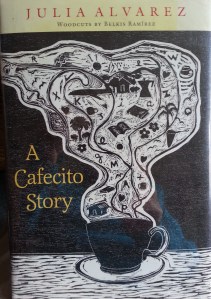
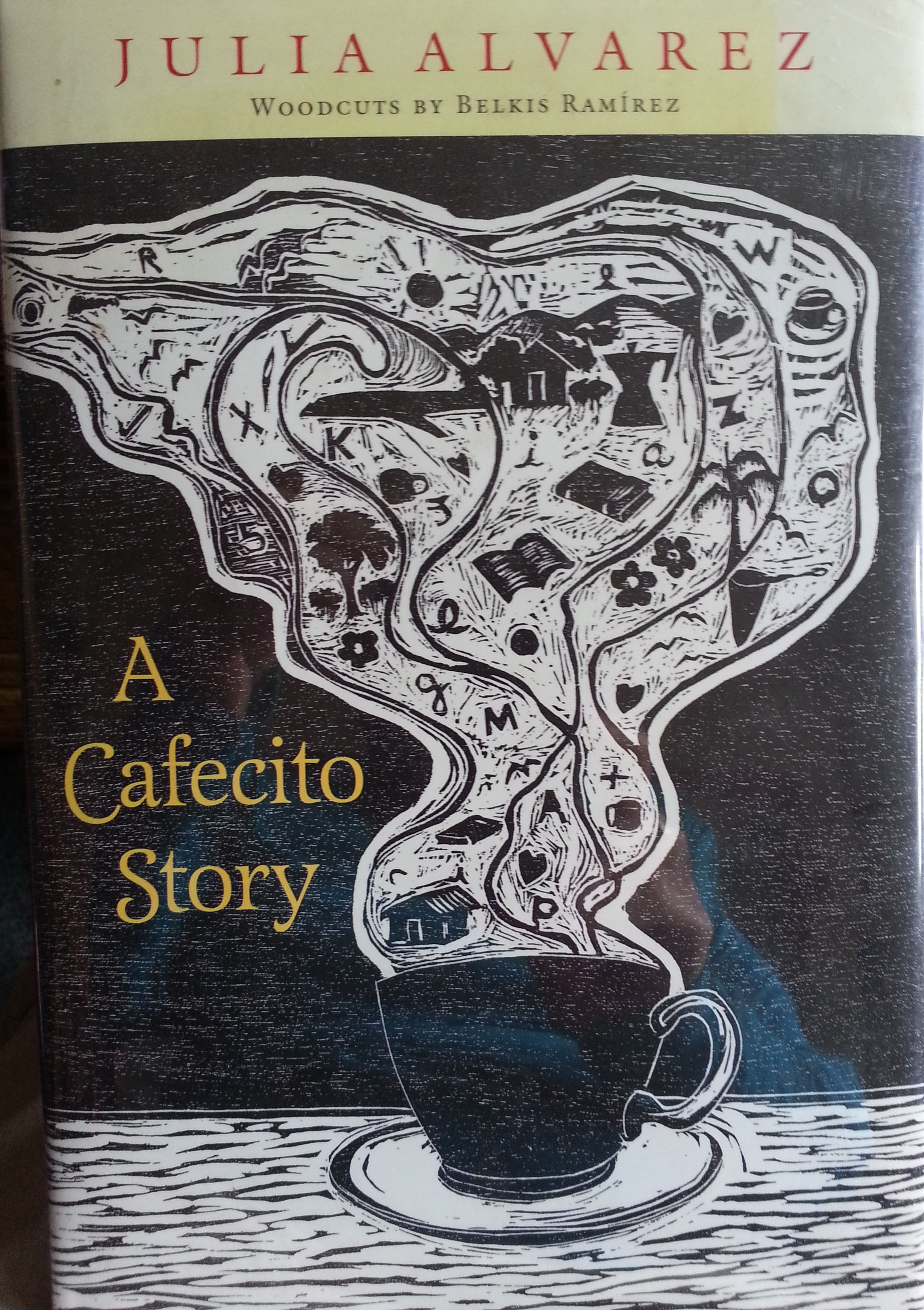
Much to my husband and mother’s chagrin, I don’t drink coffee. I still enjoyed A Cafecito Story by Julia Alvarez. Although to be honest, I might have skipped past it on the shelf had it not been for her name.
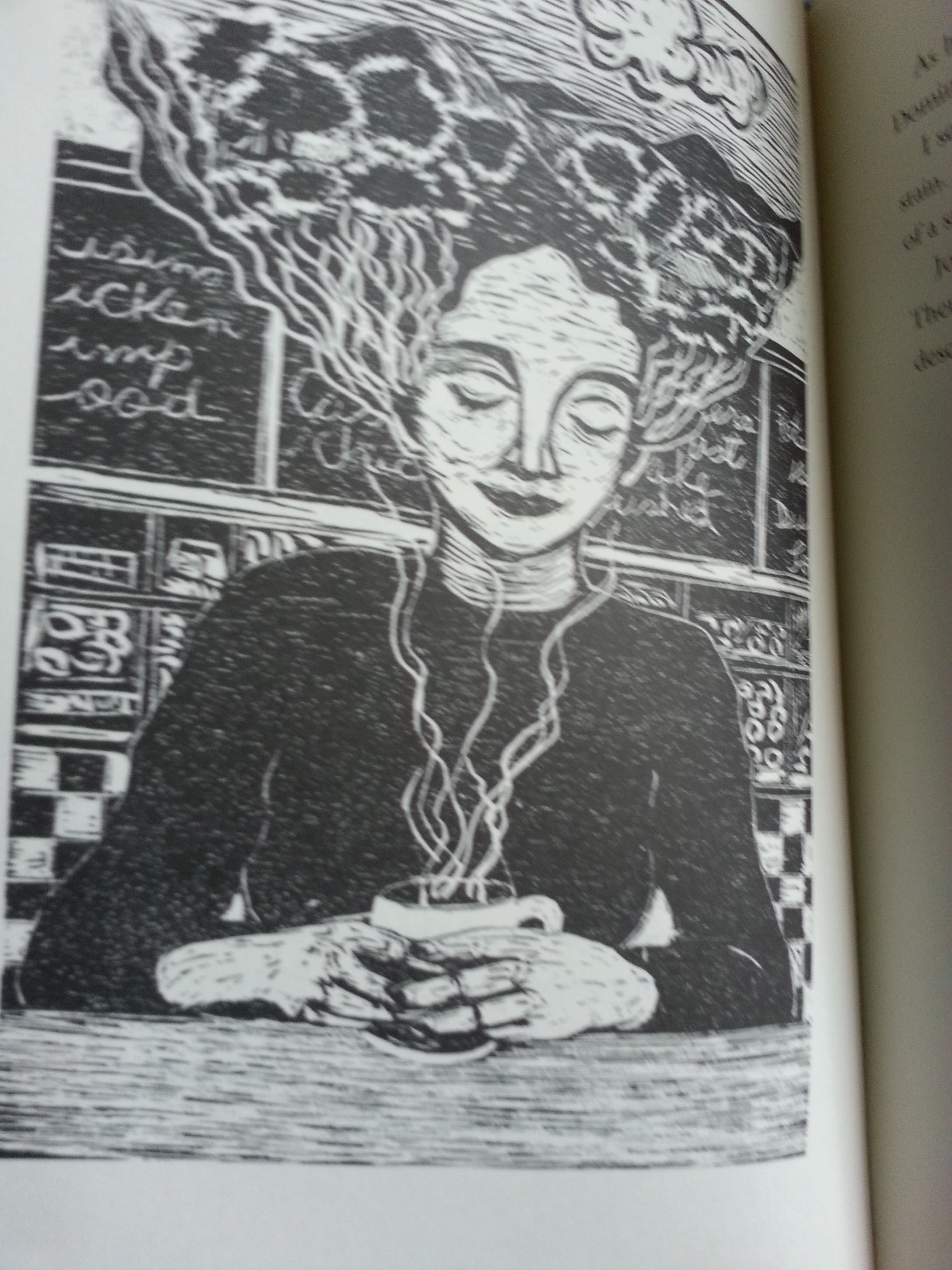
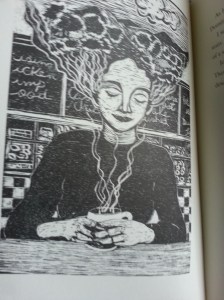
This slim hardback contains a 37-page novella; several pages of beautiful, often haunting, woodcuts by artist Belkis Ramierez; a seven-page afterward by Bill Eichner, Alvarez’s husband; and 11 pages of information about resources for fair trade items, co-ops and good business models. A Cafecito Story is a call to arms; it’s a quiet protest against big businesses that have the potential to eliminate people’s livelihoods, ways of life and quality coffee.
Coffee is more than a metaphor, but it does take center stage in the story about Joe, a disenchanted teacher, who leaves the Midwest to travel to the Dominican Republic. He’s not interested in seeing the tourist sites. Instead he is enamored with the coffee farmers who struggle to make a living while producing the best possible coffee.
The little cups of coffee, cafecitos, Joe is offered everywhere he goes intrigue him. Soon, he is befriended by Miguel who, with his family, has a sustainable coffee farm. Miguel teaches Joe about the slow, methodical practices necessary being threatened, while Joe teaches Miguel and his family how to read.
Summarizing a short work without revealing too much is challenging. The woodcuts alone are mesmerising, and Alavarez’s writing is descriptively rich. I imagine it’d go great with a cup of java.
A Cafecito Story
Three-and-a-half Bookmarks
Chelsea Green Publishing Co., 2001
58 pages

The blind date set up by the Pikes Peak Library District was okay. I might go out again with another Ray Bradbury book, but for now the novellas in Now and Forever are enough.
The stories blend a sense of otherworldliness with the familiar. First in Somewhere a Band is Playing, Bradbury plays with the themes of life and the afterlife. The story begins abruptly when a writer practically falls off a train near an isolated Arizona town. It’s beautifully described and seems an ideal place to live, at least until the writer begins to wonder what’s beneath the surface beauty. It’s an enjoyable story, but predictable. I was hoping for something other than a “Twilight Zone” twist.
In Leviathan ’99, Bradbury, by his own admission in the preface, has created a sci-fi version of Herman Melville’s Moby Dick, right down to the main character: Ishmael. Set in 2099, the beast is a big white comet pursued by a spaceship and its blind captain. It’s actually fun making the jump from being at sea to out in space. And, it’s not to be as big a leap as one might initially imagine.

It’s been years since I’ve read anything by Bradbury. Although I have long been intrigued by the titles of his numerous works, I am not a reader who’s made it through much of his literary oeuvre. I can certainly appreciate his imaginative approach and accessible tone, but the bottom line is that he’s not really my type.
Now and Forever
Three Bookmarks
HarperCollins, 2007
177 pages

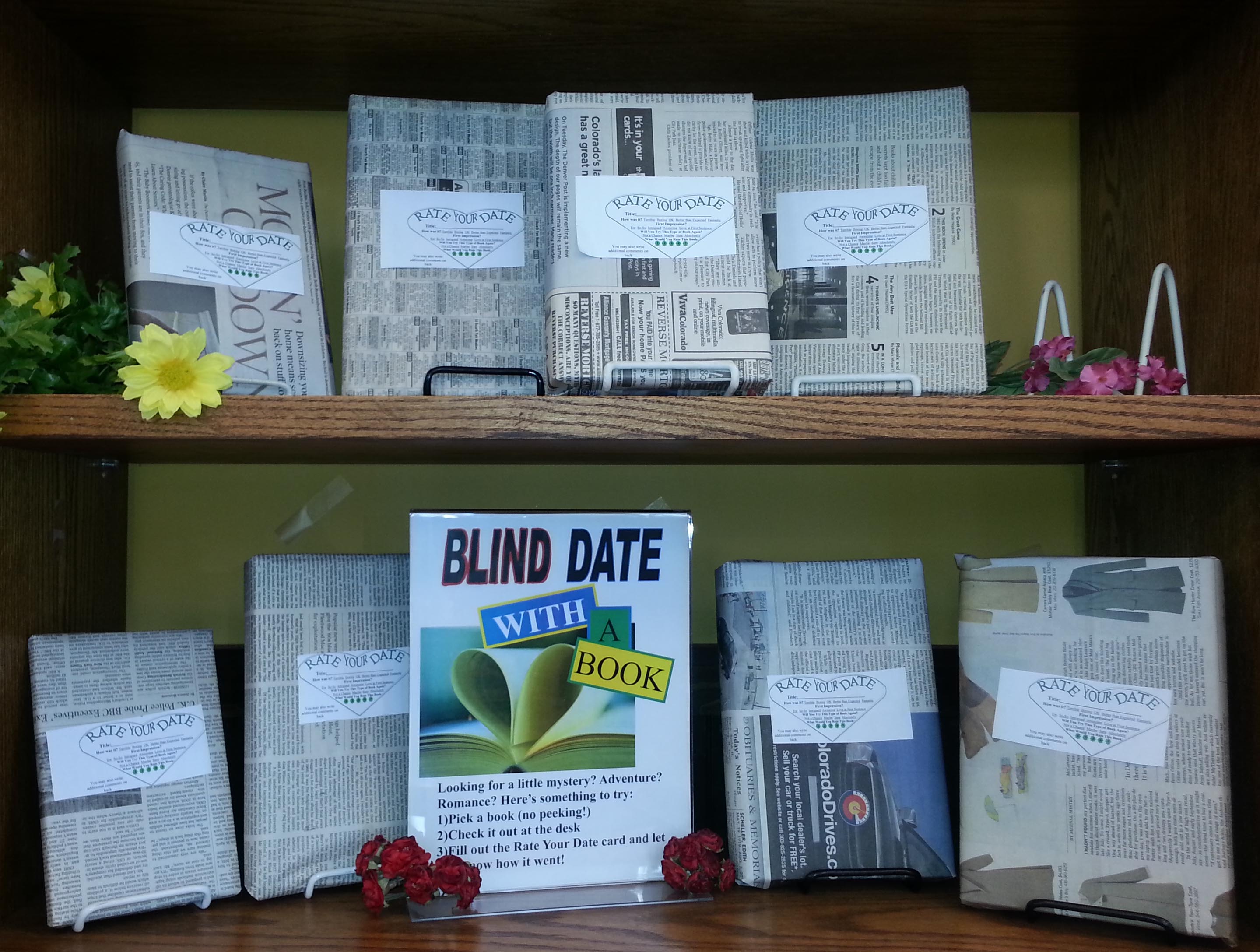
As I was leaving my neighborhood library, the Old Colorado City Branch of the Pikes Peak Library District, two shelves with books wrapped in newspaper caught my eye. They were near the backdoor in what seemed an out of the way location for a holiday display, although I realized it’s far too early to be in that mindset. Then I saw the sign: “Blind Date With A Book.”

The concept is to check out a wrapped book without knowing its title. I was intrigued. I picked up a couple of books/packages in much the same way I’d consider which gift to open first on my birthday or Christmas. Did I really want to commit to something I knew absolutely nothing about? What if it was one I’d already read? Yet, in a way, starting a book is very similar to a blind date anyway; there’s always a sense of the unknown, of possibilities and disappointments.
I considered another blind date. It’s how I met my husband, and that’s turned out very well. So, I decided to take my chances. I was paired with Now and Forever by Ray Bradbury. I haven’t read anything by Bradbury since my high school days, but this book contains two previously unpublished novellas: Somewhere a Band is Playing and Leviathian ’99.
I laughed when I opened book. It was dedicated to two women, which didn’t strike me as a very auspicious way to begin a date.
I’ll review the date, I mean, the novellas in a separate post.

Bacon. It’s one of those foods that evoke smiles and salivation no matter when it’s served. Bacon Nation by Peter Laminsky and Marie Rama illustrates that bacon isn’t just for breakfast – as if.
In addition to 125 recipes, from the obvious Bacon-Wrapped Shrimp to the creative Bacon Jam – and that’s just among the appetizers, side dishes, salads, desserts, even poultry, featuring the favored pork product are included.
Last Christmas a friend shared her recipe for what she called “Bacon Crack” due to its addictive qualities. It featured a sweet and savory rub. Bacon Nation doesn’t contain this particular tasty treat, but has several others in the same category, such as Peanut Butter Bacon Cookies. Although not as sinful as Bacon Crack, they are easy to eat.
As with most well-executed cookbooks, Laminsky and Rama don’t rely on recipes alone, even though they could. The authors’ first chapter is dedicated to tips for purchasing and cooking bacon. They recommend thick cut for most of the recipes, and explain the difference between dry and wet cured. The former is rubbed with salt (often pepper, occasionally salt;) and the latter is brined.
Each section, or chapter, features a brief prologue, and individual recipes are accompanied by an also-brief introduction. These range from explanations of how the recipes came about or what was done to modify them for the home cook.
Chapter 12, by the way, is entitled “Breakfast Means Bacon.” Since it comes near the end, I really don’t believe the authors/chefs.
Bacon Nation
Four Bookmarks
Workman Publishing, 2013
310 pages, including photos and index

In a twist on the what-did-you-bring-me refrain from my kids’ childhood reactions to out-of-town trips, my oldest son brought me a book. I appreciate that it made him think of me. Shaggy Muses by Maureen Adams examines the relationships between five female writers and their dogs. I’ve had several dogs in my life and all hold special places in my heart. My dog Jackson and I have a strong bond; although I’m not sure I consider him my muse, he might prove me wrong.

Adams’s book is subtitled The Dogs Who Inspired Virginia Woolf, Emily Dickinson, Elizabeth Barrett Browning, Edith Wharton and Emily Bronte. It’s part academic, largely anecdotal, and for dog lovers who happen to enjoy literature it’s particularly enjoyable. The book started as a series in scholarly journals on the bond between dogs and their humans.
The relationships between these writers and their dogs were strong to the point of distraction. In fact, the dogs served as buffers making it possible to limit expressing real emotion. Adams writes, “Elizabeth and Robert [Browning] used Flush as a symbolic go-between to help them express their feelings in conversations and letters.” The other women did the same.
Some of the writers had numerous dogs, other just a single source of inspiration. One narrative involving Bronte and Keeper, her large, intimidating part-Mastiff, is exceptionally disturbing. Bronte beat her dog, and then comforted him, which suggests the love-hate relationship often evident in abusive relationships. Fortunately, the other stories Adams provides are more endearing.
Shaggy Muses: The Dogs Who Inspired Virginia Woolf, Emily Dickinson, Elizabeth Barrett Browning, Edith Wharton and Emily Bronte
Three-and-a-half Bookmarks
The University of Chicago Press, 2007
299 pages, with notes and index

Rainbow Rowell’s story of young love overshadowed by harsh realities is humorous, haunting, and hopeful. Alliteration aside, Rowell’s Eleanor & Park is a study in contrasts and seems to prove that opposites do attract.
The omniscient narrator alternates between the couple. Although this approach doesn’t establish distinct voices, the characters are well-defined. Bits and pieces of Eleanor’s unhappy home life are slowly revealed while suggesting impending misfortune. Park, on the other hand, has two loving parents and lives next door to his grandparents. Eleanor is the new girl in school. She’s overweight, has bright red, unruly hair and dresses in a way that only the addition of neon could attract more attention. Park isn’t Mr. Popularity, but he does straddle the line between acceptance and rebuff. He’s part Asian, dresses all in black, but has known the kids in his high school all his life. When Eleanor sits next to him on the bus, he’s embarrassed, but friendship, then romance slowly, oh so slowly, begins to emerge.
Among Rowell’s themes are bullying and abuse; these create tension in the novel. The sense of something going awry is palpable. Yet, so are the more positive aspects of emerging love and parental concern. References to Shakespearean tragedy add a sense of foreboding; nonetheless, this is a tale dependent on hope. The title characters are different, likeable, and prove that appearances aren’t everything. It’s unfortunate they live in world where extreme differences aren’t always appreciated and where it’s easy to hide dangerous secrets.
Eleanor & Park
Four Bookmarks
St. Martin’s Griffin, 2013
325 pages

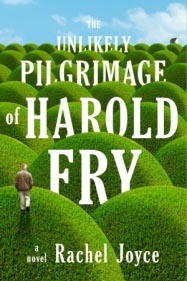
The Unlikely Pilgrimage of Harold Fry begins as a slow, methodical, unexpected journey – for the main character and the reader. Rachel Joyce’s novel practically crawls through the first few chapters. Then, like Harold, it picks up the pace only to falter on occasion like most adventures.
This poignant tale shares qualities of a love story and mystery, but is more the former than latter. And, it’s about different types of love: romantic, familial and companionable.
After receiving a letter from Queenie, a work colleague with whom he’s lost touch, Harold sets out to mail a response. Despite the fact that he left the house without his cell phone and is dressed somewhat formally, he decides to embark on a 600+ mile trek from one end of England to the other to talk to Queenie in person. He has no backpack, water bottle, map or other equipment. In fact, he walks in boating shoes.
The elements of a mystery come in the form of questioning the relationship between Harold and Queenie, as well as between Harold and his estranged son, David. There’s also the fact that Harold is married, although he and his wife, Maureen, do little more than share a past and the same house.
The characters’ imperfections are what make the story work, albeit inconsistently. As personalities evolve, foibles become more defined, but so do strengths. Harold loses his way in more than one manner, but he, like the reader, gains perspective even if it is not particularly satisfying.
The Unlikely Pilgrimage of Harold Fry
Three Bookmarks
Random House, 2012
320 pages

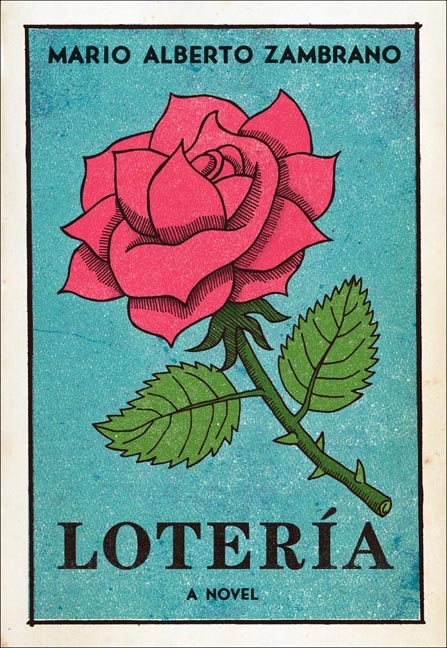
Eleven-year-old Luz Maria Costilla has a gut-wrenching way of storytelling. She’s a lot like Scout, daughter of Atticus Finch. Unfortunately, Luz’s father is nothing like Harper Lee’s heroic character. Nonetheless, in Mario Alberto Zambrano’s debut novel, Loteria, Luz is full of grit and independence.
Loteria is a game of chance, popular in Mexico, designed around cards each of which features an image rather than a number. The images, through riddles, are called out by the game’s dealer. The novel of the same name is built around the cards as Luz recounts the disintegration of her family and how she became a ward of the state of California. It’s rich with humor, sorrow and vivid imagery thanks to the game. The irony is that Luz isn’t talking; she has a journal and the cards to speak for her. Some knowledge of Spanish is helpful.
Luz loves her father. She sees past his many faults: he’s violent, he drinks, and has questionable parenting skills. In his own way, he loves his wife, his elder daughter Estrella and Luz. A few other relatives come in and out of the narrative, but the focus is on this nuclear family. For the El Borracho card, Luz recounts, “When Papi sang in the backyard I’d dance to whatever song he sang. He’d be a little drunk under the light of the porch, and for every four sips he took, I took one.” Not every card is as obvious in its intent, but as Luz puts them together they come to life.
Loteria
Four Bookmarks
HarperCollins, 2013
270 pages
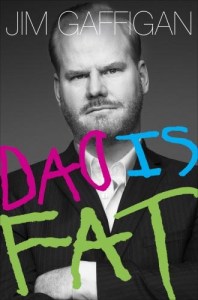
I hadn’t heard of Jim Gaffigan before his appearance on “Late Night With Jimmy Fallon” this past spring. Then I saw his name as an author on the library’s list of most requested books. I thought he was funny and decided to get in line for Dad is Fat. It was actually a long line. Although I enjoyed the book, I have to wonder if the library only ordered one copy.
Gaffigan writes about his life as the father of five young children. He, his wife and their brood live in a two-bedroom apartment in New York City. It’s a small space full of chaos, fun and lots of love. No aspect of parenting is off limits. He addresses everything from attending church to going to the park, from getting babysitters to sleeping — at least trying to. He writes, “I love the fact that if my children wake up scared or are feeling lonely, they can come in our bed. I just wish each and every one of them didn’t do it every single night.”
His humor blends sarcasm with self-deprecation. He considers his wife a saint, albeit a fertile one. Gaffigan is in the right career as a comedian, and his voice adjusts well to the page.
The book provides several laugh-out-loud moments, but after a while they start to wear thin. For people of a certain age, his family may sound reminiscent of sit-coms from the 1960s. Perhaps someday it will be the basis of one on a cable channel.
Dad is Fat
Three Bookmarks
Crown Archetype, 2013
274 pages

Titles, like first lines, can make or break a novel’s appeal. Certainly, if Meg Wolitzer had called her most recent book The Borings, instead of The Interestings, it might not have garnered much attention (which it has). Yet, there’s something pretentious about it, which is just the tone – along with some irony – the author instills in this contemporary epic about friendship, love, human potential and disappointment.
Wolitzer’s account moves back and forth through time, but it all pivots around the beginning which occurs at a camp for the arts in the summer of 1974. “The Interestings” is the name six teenagers give themselves; it’s meant to separate them from everyone else in camp. They’re talented, to varying degrees, mostly privileged and self-absorbed. Even as they move through adulthood, they carry those same qualities. Yes, they mature and Wolitzer is at her best illustrating their personal struggles and triumphs, but they can’t quite shake idea of their old moniker.
The power of friendship, particularly among four of the six, is an underlying theme and it, more than anything else, drives the novel. The characters’ ability to fit in and accept themselves also delivers some impact.
The exhaustive story spans more than five decades in a way that’s reminiscent of Forest Gump. Instead of a sound track to identify the passage of time, Wolitzer relies largely on political events. Although the characters are interesting, it’s not as much as they think – or as much as we want them to be.
The Interestings
Four Bookmarks
Riverhead Books, 2013
468 pages