Archive for the ‘Books’ Category

In The Hollow Man, British author Oliver Harris presents one of those multi-flawed detectives that have become so popular in recent crime fiction. Okay, maybe it’s not necessarily a recent trend, but his protagonist Nick Belsey is one ambiguous cop who seems to be nearly invisible to those around him given what he gets away with in plain view.
Belsey is a Detective Constable with the London Police and the hefty catalog of his indiscretions, mostly involving gambling, drinking and abuse of position, overshadows his negligible good qualities. Yet, as Harris provides more and more insight into his character’s personality, it’s clear that even though Belsey wears the good guy’s white hat, it is set exceptionally askew.
It appears that Belsey has hit rock bottom in his personal life, consisting primarily of self-destructive behaviors, which has caught up with his career. He’s facing a formal inquiry with a forced leave of absence looming over his head. Despite this, he becomes embroiled in a murder investigation which he links to a major financial crime and sees as an opportunity to (illegally) change his life.
The novel is engaging and full of dark humor. In spite of Belsey’s conduct, it’s impossible not to wonder if he’ll continue on his path to ruin or see the error of his ways. The major flaw comes in the form of Belsey simply flashing his badge to get near crime scenes and restricted information given that he should have either restricted or no access due to his own transgressions.
The Hollow Man
Three-and-a-half Bookmarks
Bourbon Street Books (HarperCollins), 2012
470 pages

It’s interesting that I’ve recently read two nonfiction books that both include the word betrayal in their subtitles. After all, it’s a powerful assertion. Michael Paterniti shares his in The Telling Room: A Tale of Love, Betrayal, Revenge, and the World’s Greatest Piece of Cheese. Initially the last word, the cheese, is what caught my attention more than the previous three. Those are experiences most of us know on some level, but the best cheese in the world? That’s something outside my realm.
Paterniti tells three stories: that of Ambrosio Molinos, a Spanish farmer turned cheesemaker; of life in rural Spain; and of the author’s own infatuation with the subject of his book, which isn’t the cheese at all, but the man behind it. Although Paterniti’s self-revelations are the least interesting, they’re fun to ride along with since he does such a magnificent job of bringing the larger-than-grand Ambrosio to life off the pages. It’s easy to see how he became so enmeshed in Ambroiso’s world, which is described in rich and vivid detail.
A combination of greed, poor business decisions and, ultimately, different versions of the same story result in Ambrosio’s fall from grace as a gentleman farmer to a man plagued with debt who is no longer able to produce the cheese that garnered worldwide attention.
The Telling Room could easily have been subtitled the power of friendship. It is power that comes from the beauty of reliance, fun and sharing to the more destructive and sad aspects that emerge when friendships fail.
The Telling Room: A Tale of Love, Betrayal, Revenge, and the World’s Greatest Piece of Cheese
Four Bookmarks
The Dial Press, 2013
349 pages

Several years ago, I interviewed Richard Betts for a freelance piece I was writing. It came about because he lives in Boulder, had his own wine label (Betts & Scholl) and, at the time, was one of only 170 master sommeliers worldwide. Since then the number has grown to 214 and Betts has written a humorous, albeit basic, book: The Essential Scratch & Sniff Guide to Becoming a Wine Expert.
Betts is personable, knowledgeable and not at all condescending – qualities that shine in the book. He wants wine to be accessible, not limited to a certain class or clientele. In fact his approach is included on the book’s cover: “Wine is a grocery, not a luxury.”
In less than two dozen cardboard-like pages, all of which have simple drawings like the content of a children’s book, Betts admonishes readers to simply use their noses to help identify their wine likes and dislikes. He even goes so far as to single out the smells most often found in wines as a way to understand why one wine might be more appealing than another. He writes, “Know that tasting is actually smelling.”
The book, indeed, has scratch and sniff spots, but not all the aromas shine. Still, the point is well taken. Most of us know what vanilla smells like, and if we like it or not. The bottom line, Betts emphasizes, is to drink wine you like. He is just helping readers understand why some might be more appealing than others.
The Essential Scratch & Sniff Guide to Becoming A Wine Expert
Four Bookmarks
Hougton Mifflin Harcourt, 2013
21 pages

I have a Twitter account, but don’t tweet. Reading Hatching Twitter: A True Story of Money, Power, Friendship, and Betrayal by Nick Bilton did nothing to encourage me to embrace this social media leviathan. I was curious about Bilton’s book because I teach an Internet Media class. Undeniably, Twitter has a huge role in how society communicates. Journalists around the world demonstrate its use as a significant tool to report news. I appreciate that. However, it’s disconcerting that stories, whether personal or professional, can be condensed to 140 characters or less.
Nonetheless, Bilton’s book, while not as objective as expected from a New York Times reporter, provides insight into Twitter’s short history. All of the major players and how they became part of the little blue bird’s universe are introduced. Although many others are featured, the focus is on the four identified as Twitter’s co-founders: Evan “Ev” Williams, Jack Dorsey, Christopher “Biz” Stone, and Noah Glass. Bilton is sympathetic in his account of Glass’s involvement, which was short lived. Williams and Stone are profiled in a positive light compared to Dorsey who’s mocked for his Steve Jobs-wanna-be approach and his alone-at-the-end-of-the-day consequences.
The manner in which the story’s told is appealing. Starting in 2010 with Williams about to announce his departure as Twitter’s CEO, Bilton then offers the true beginning in 1997. The account is similar to a mystery without the murder, but plenty of intrigue and backstabbing. The reader knows what’s going to happen, but not necessarily how.
Hatching Twitter: A True Story of Money, Power, Friendship, and Betrayal
Almost Four Bookmarks
Portfolio/Penguin, 2013
302 Pages

I’ve probably read half of Diane Mott Davidson’s opus of culinary mystery-lites. It’s been some time since I read the last one; I should have stopped when I was more amused by the style and content, and more tantalized by the recipes interwoven with the plot. The Whole Enchilada, the most recent adventure of Goldy Schultz the Colorado caterer, left me hungry for something of more substance.
Once again, Goldy finds herself in the midst of a murder investigation in the small, mountain community where she lives just west of Denver. The number of murders, through the years, in the small, fictional town of Aspen Meadow is impressive – but not in a good way. If I lived there, I’d consider moving. Thank goodness Goldy is there to assist the local sheriff’s department solve the crime(s).
What I’ve found entertaining in the past is Mott Davidson’s humor and the suspense she has been able to create. The who-dunit was always fun to try to name before it was ever revealed in the book, but this time the element of intrigue is absent. Perhaps this is because there are two murders, one attempted murder and several attacks on Goldy herself. It’s too much strain on the suspension of disbelief.
The recipes featured are not ones I am interested in trying myself – again, this is unlike my experience with Mott Davidson’s earlier works. If the food had been more enticing, I might have had a better appetite for what she served here.
The Whole Enchilada
Three Bookmarks
William Morrow, 2013
369 pages, including recipes

I’m very close to my mother, so I’m usually drawn to novels with strong, happy mother/daughter relationships. Carolyn Wall’s Sweeping Up Glass doesn’t fit this description, at least not the happy part. Nonetheless, this is an engaging, albeit flawed, story about family, community and racism in rural Kentucky.
Narrator Olivia Harker Cross has lived in Pope County all her life. She recounts her seemingly-idyllic childhood where her best friends are Pap, her beloved father, and Love Alice, a child-bride of color. Olivia’s mother is in a mental hospital for much of Olivia’s early life. But, tranquil accounts can get boring, which is why Wall provides conflict just when things seem to be just a little too blissful.
Ida, Olivia’s mother, returns home from the mental institute and life for the young girl loses much of its carefree charm. This single event slowly instigates an avalanche of challenges. Mother and daughter have a hellish relationship that continues into Olivia’s adulthood.
The narrative moves from Olivia’s youth to her life as a grown woman, left to care for the mother she despises and for Will’m, the grandson she cherishes. The poverty Wall describes is tangible, as is the harsh winter weather. Less, this sound completely joyless, be assured there are moments of hope and happiness. There are also vivid images of hatred and bigotry. These play against a long-held secret that once revealed shatters everything Olivia thought she knew about herself and those she loves. The problem is that all the pieces don’t quite fit.
The few missteps raise questions that trip up an otherwise compelling tale.
Sweeping Up Glass
Almost Four Bookmarks
Delta Trade Paperbacks, 2009
319 pages
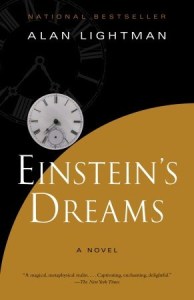
A physics background isn’t necessary to appreciate Einstein’s Dreams by Alan Lightman. This terse, yet philosophical, novel offers poetic vignettes, the dreams, based on what Albert Einstein might have wrestled with in his subconscious while developing his theory of relativity.
Each dream examines an altered way of experiencing time. Some are nightmarish, some sweet, others poignant, but all are interesting possibilities that, perhaps, other people have also considered, but never articulated. For example, time standing still, literally; or the opportunity to replay time for different outcomes. A variety of perspectives toward time also fill the dreams: parents who have lost children, lovers who grow apart, a baker who grows weary of extending credit. These are fleeting moments that haunt Einstein in his waking hours.
The dreams are offset by several “interludes” in which Einstein is awake. He meets with a colleague, seemingly his only friend, from the Swiss patent office. Although there’s a sense that Einstein wants to share his dreams, he always holds back. What is most obvious in the conscious interims is Einstein’s unhappiness. He feels a sense of drowning in his job and marriage. His desire to understand time buoys him.
Lightman’s writing is imaginative yet concise. It’s easy to imagine the vivid dreams with specific street names and recurring characters. From the very first dream, which begins “Suppose time is a circle, bending back on itself. The world repeats itself, precisely, endlessly,” it’s clear the author will explore the rhythms, pain and joy that comprise life.
Einstein’s Dreams
Four Bookmarks
Vintage Contemporaries, 1993
140 pages
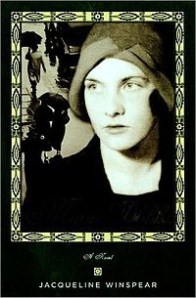
The more I read Jacqueline Winspear’s Maisie Dobbs, the more I wondered if it’s been a BBC or Masterpiece Theatre series. It’s familiar in the same way as Downton Abbey and Miss Marple: easy-to-like characters, strong spirit of place and impeccable English sensibilities.
A friend recommended Maisie Dobbs several months ago. I am thrilled that, unlike past initial encounters with mystery (in this case mystery-lite) writers, I was steered to the first in the series. Winspear’s Maisie is an exceptionally intelligent, caring young woman. Although I am sure subsequent books will provide the necessary backstory, I enjoyed meeting Maisie in the inaugural. Maisie is a private investigator in post-war London. Thanks to a benefactor, a mentor and her own gifts of curiosity and intellect, Maisie is given the opportunity to leave a life of service and pursue her education. She is out of her league on the social ladder, but is several rungs higher than most others she encounters in areas that truly matter.

Winspear begins with a small case for Maisie to investigate, which leads to a much larger issue that has the potential to impact her benefactor. Yes, it’s a fluke, but, as the author writes, “Coincidence was a messenger sent by truth.”
The distinction between classes, as indicated through the use of cockney dialect, is distracting. Winspear could easily rely on her descriptive talents to show the differences. Nonetheless, I look forward to the next adventure of Maisie Dobbs – and looking for it as a masterpiece classic.
Maisie Dobbs
Four Bookmarks
Soho Press, 2003
292 pages
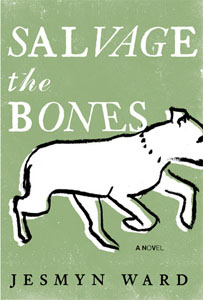
Salvage the Bones by Jesmyn Ward is one of those books that once it comes in the front door, makes itself right at home. At first, I was reluctant to let it in. The cover isn’t intriguing and I don’t always appreciate the same books as the friend who recommended this one. Ward’s book, however, is a winning guest. Literally: it’s the 2011 National Book Award Winner.
Fifteen-year-old Esch, her three brothers and frequently-drunk father live in rural coastal Mississippi. The story follows the 12 days leading up to, and including, Hurricane Katrina’s arrival. Despite what appears to be laissez faire parenting, Esch’s father is increasingly concerned about a possible powerful storm making land. In between drinking binges, he tries to ready the family’s ramshackle home.
Told from Esch’s point of view, Ward has crafted a beautifully poetic, heartbreaking story of family love, loyalty and misdirected affection. Esch is an intelligent young woman, but she lives without benefit of another woman’s perspective; her mother died seven years earlier. The only other female around is her brother Skeetah’s pit bull, China.
The impending hurricane and Skeetah’s concern for China are told as parallel accounts. China, bred for fighting, has just given birth to her first litter. Despite their father’s appeals for help to make the house secure, the kids go about their lives as usual: basketball, swimming and hanging out with friends. Even without the storm’s threat, it becomes quickly evident that all is not as carefree as it appears.
Salvage the Bones
Four Bookmarks
Bloomsbury, 2011
258 pages
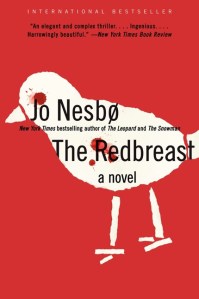
The Redbreast is the third of the Harry Hole series by Norwegian crime writer Jo Nesbo. It’s also the fifth one I’ve read. Clearly, I haven’t read them in order. Initially, it was difficult to find translations of Nesbo’s books, so I savored them as I found them. He is apparently so in vogue now, that all ten, including a newly released novel, are readily available. At this point, I don’t mind the leap frogging. Nesbo has always provided enough backstory that I never felt I missed anything. However, what’s particularly appealing about The Redbreast is the introduction of the love of his life: Rakel, and her son, Oleg. Both figure significantly in the later books. But I’m jumping ahead of myself, literally.
Unlike others in the Hole series, The Redbreast is slow to build momentum. Initially, it was like being a passenger on a local train, with lots of stops, before finally getting on the express.
Nesbo’s story travels effortlessly between modern-day Oslo and World War II. The latter sets the stage for the underlying threat of neo-Nazism, which becomes the focus of an investigation Hole pursues. His efforts to discover how, and why, a rare sniper rifle was brought into the country lead him to several men who were Nazi sympathizers during the war.
Several parallel love stories emerge, as does a particularly sad one about friendship. All demonstrate Nesbo’s ability to evoke emotion while wanting to make sure all the doors in the house are securely locked.
The Redbreast
Four Bookmarks
Harper, 2000
520 pages