Archive for the ‘Books’ Category

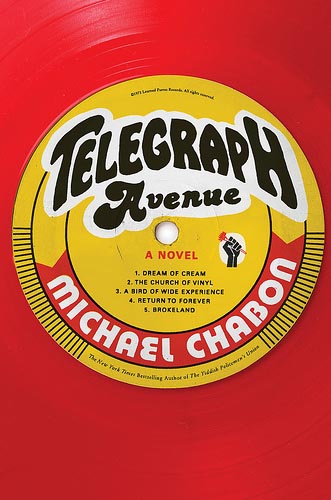
While wondering at the necessity, I marvel at the kind of concentration and craftsmanship it takes to write a single sentence that makes sense and holds interest as it spans 12 pages rife with characters, each distinctly different, who share a common struggle against fate, karma, some elusive and nebulous hand manipulating a game board with varying designs and obstacles; yet this engaging contest in Michael Chabon’s most recent novel, Telegraph Avenue, is played with swagger and fear by men, women and teenage boys fighting to hold onto dreams while desperately needing to relinquish the realities of their colorful lives.
I lack the skill, and inclination, to take a 100+ word sentence any further. Chabon can, but that’s the least of his mastery. Set in Oakland, his story about two men who run a (old school vinyl) record store in danger of being razed to accommodate a mega urban renewal project is a tribute to friendship, music and, oddly, especially family.
The novel is drunk with sensory images. Consider: “At 9:45 a.m. the first batch of chicken parts sank, to the sound of applause, into the pig fat.” Or: “… the loose weather stripping that peeped like a gang banger’s drawers from the seams around the back door.”
The major flaw lies in the glut of characters; initially, it’s difficult keeping track of who’s who. Nonetheless, it’s clear everyone, from actors to midwives, is just trying to get by in life while a poor economy, outdated technology and children get in the way.
Telegraph Avenue
Four Bookmarks
HarperCollins, 2012
465 pages

When I was growing up my brothers and I had to finish everything on our plates before we could leave the dinner table. Some nights I was there for hours. As I struggle to finish a book that is neither well-written, interesting, nor can compete with the demands of daily life, I feel as if I am stuck at the table again.
Years ago I gave myself permission to try the 50-page test with books. If I wasn’t hooked within the first 50 pages, it was time to find something new. That worked for a while, but then I regressed. Recently, I found myself struggling with a book recommended by a friend whose reading list I respect. I made it through 10 pages, but it took a lot of time. I crawled through another 20 pages, put the book down, gave myself a few days and tried again. I actually reached page 118, but I didn’t enjoy a word of it: it felt like punishment. I’m returning the book to the library.

I obviously have the if-you-start-something-see-it-through ethic. I began to consider things I have no reservations walking away from: bad service in a restaurant, bad attitudes from clerks in stores, bad food that appears in front of me. With my kids, the rule was to at least try what was on the plate. I’m going to make a better effort at following that same advice when it comes to books, and not be so reluctant to move on.

I was on the library’s waiting list for Gillian Flynn’s Gone Girl for months. When it was finally ready for me to check out, I was impatient to start reading. After mentioning this to a friend, her reaction was less than exuberant, it was baffling. After all, the novel was so popular there’d been hundreds ahead of me waiting for a library copy. It’s been on Publisher Weekly’s list of Best Hardcover Fiction for 15 weeks – and appears pretty comfortable there. I pressed my friend for more, but she held fast: we’d talk when I finished.
Gone Girl is a mystery on several levels, including how I spent time living with such unlikeable characters for the past week? The story follows the disappearance of Amy on her fifth wedding anniversary. By all indications, her husband, Nick, is responsible. Amy and Nick alternate as narrators. The book is divided into three sections. The first focuses on the disappearance, possibly abduction or possibly murder. Nick comes across as shallow and surprised, not upset, at his wife’s unexplained absence. He seems guilty, which is reinforced by Amy-as-victim told through diary entries.
The second and third sections of the book reveal much more about Amy’s ability to weave complicated webs of deceit. It’s not that Nick is suddenly less appalling, but Amy is more so. Flynn is a craftswoman. Her characters are fully developed as repulsive and intriguing. They’re also scary, always a good thing for a mystery, and I couldn’t look away. I need to talk to my friend.
Gone Girl
Four Bookmarks
Crown Publishers, 2012
415 pages
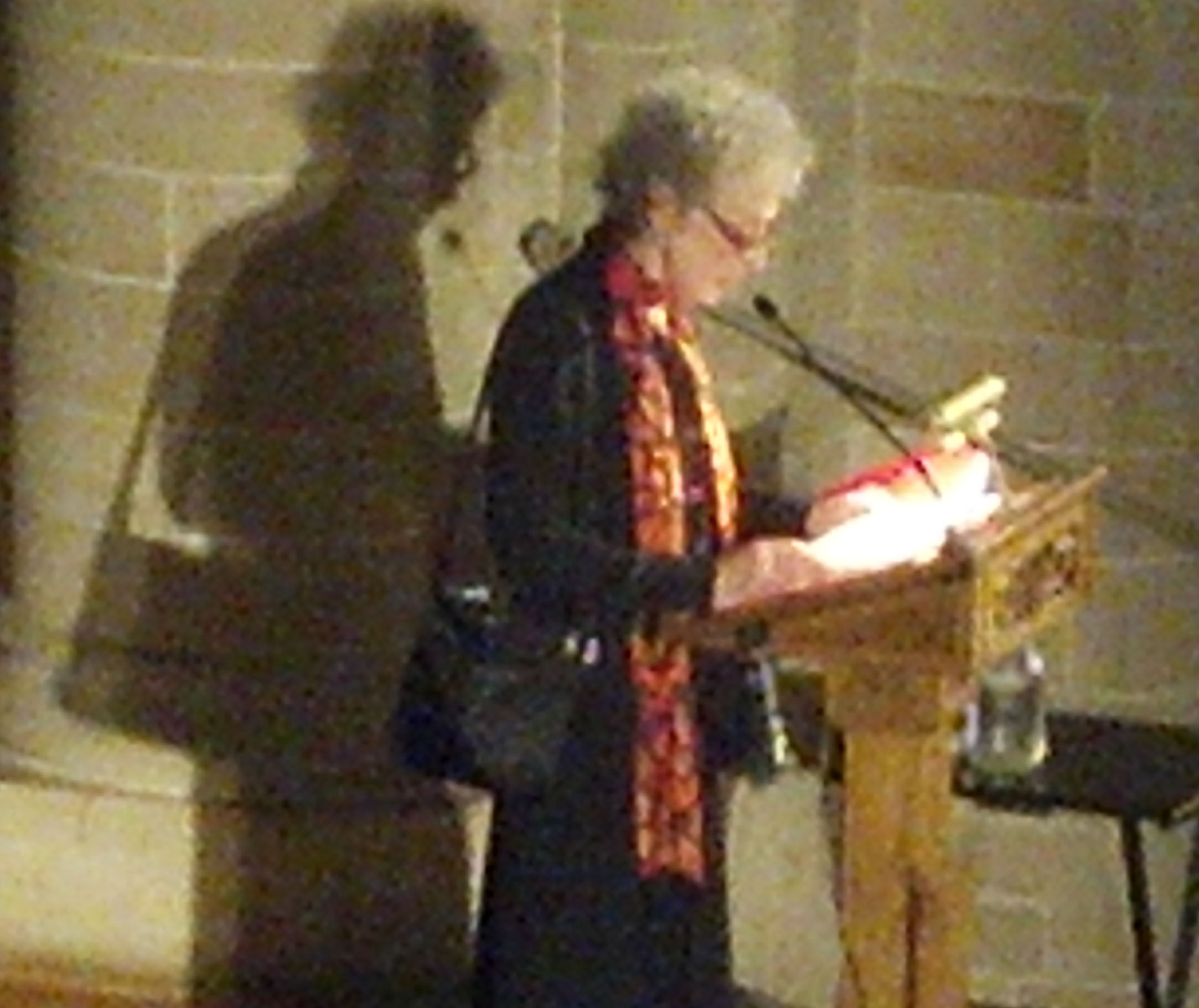
Usually, I’m not a Margaret Atwood fan. She makes it so difficult, through depressing stories and odd characterizations, to appreciate her wit, imagery and intellect. Reluctantly, I read The Year of the Flood. It was the choice for my book group, and the All Pikes Peak Reads 2012 selection. As part of the APPR festivities, Atwood spoke about sustainability and survival: two prevalent themes in her works.
Surprisingly, once I started reading I was anxious to continue. Although Atwood dismisses claims The Year of the Flood is a post-apocalyptic tale, nothing better describes it. The story takes place in a time when mutations, genetic engineering and an order of fear prevail. The flood refers to an unknown deluge caused by man’s errors and destructive predispositions. It is not a natural phenomenon; it’s a “waterless flood.”

God’s Gardeners is a small cult with a foundation in Christianity that celebrates the lives of such people as Rachel Carson and Euell Gibbons, among others, for the contributions they made to saving the environment. The Gardeners strive to protect nature and prepare for (and later survive) the flood. Within the cult, Toby and Ren, represent maturity and youth, respectively. Their narratives move the story forward. Atwood said she purposely incorporates multiple voices in her works because “I don’t like everyone to sound the same.” Toby is represented in third person, while Ren offers a first person perspective. The sermons of Adam One, the Gardeners’ leader, begin each chapter using second person voice.
I’m glad I read this and even more pleased to have heard Atwood speak. It provided insight into her work, but mostly served to demonstrate her keen sense of humor, which fortunately surfaces in this novel. A novel, by the way, which has, as Atwood stated, “A ray of hope.”
The Year of the Flood
Four Bookmarks
Anchor Books, 2009
431 pages

Me, Who Dove into the Heart of the World is the cumbersome and complex title of Sabina Berman’s debut novel. Yet, it turns out to be just about perfect. The me refers to the first word narrator Karen Nieto learns. She is 10 years old when her mother dies and her aunt moves into the family home in Mazatlan. It’s her aunt who teaches her to speak, loves her and later defers to her in business matters. Her aunt also identifies Karen as an autistic savant.
The family operates a tuna fishery, which has a profound impact on Karen’s education and sensitivities. If this is beginning to sound vaguely similar to Temple Grandlin’s story, it should. It’s about overcoming perceptions and obstacles. It’s about the ability to be so focused, to the exclusion of everything else including social norms, that success can’t help but surface. Karen evolves from a gangly girl with matted hair to a gangly woman with a buzzcut; along the way she develops a humane fishery.
The story spans 32 years including Karen’s schooling, business developments and interactions with others. After being tested, and self-identifying as “Different Abilities,” Karen learns “… in 90% of standard measures of intelligence (she is) somewhere between imbecile and idiot, but in 10% (she is) on top of the world.”
The most poignant moments are those between Karen and her aunt. Although Karen goes on to do great things, the most moving and inspirational are the leaps she makes in this relationship.
Me, Who Dove into the Heart of the World
Four Bookmarks
Henry Holt and Co., 2012
242 pages
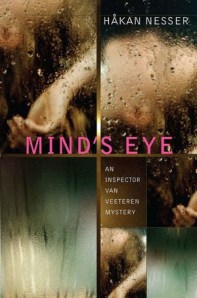
I don’t know what it is that makes me crave Scandinavian crime fiction, but I’m addicted. Sweden’s Hakan Nesser’s Mind’s Eye fed my habit, but I know I’ll need more soon. Nesser is a master storyteller whose pacing is neither rushed nor sluggish. The crime scenes aren’t too gruesome and the clues are well hidden. He even manages to throw humor into the mix.
The story begins with Janek Mitter awakening from a drunken stupor only to find his wife drowned in the bathtub. Mitter’s too easy a suspect, but is, nonetheless, tried and convicted before things take a turn and get exciting: Mitter, too, becomes a victim. That’s where Chief Inspector Van Veeteren, a middle-aged investigator with an attitude, comes in. His success rate at solving crimes is impressive. He had early doubts about Mitter’s guilt, but not soon enough.
I had a fairly good idea about who the actual killer was, but was not prepared for why. Van Veeteren knows who but won’t name names because, as he tells a subordinate, “… there has to be a story,” in other words a reason. Nesser’s characters develop slowly, and in an interesting manner. Many chapters begin with stream of consciousness narration and it is unclear who’s doing the thinking. This only enhances the element of suspense. Eventually, it gives way to very clear identities and perspectives.
This is the first of Nesser’s Van Veeteren mysteries. I can’t wait for my next fix, I mean the next installment. Fortunately, Nesser has several.
Mind’s Eye
Four Bookmarks
Pantheon Books, 2008
278 pages

Even if you aren’t necessarily a fan of Patti Smith or Robert Mapplethorpe, Smith’s memoir, Just Kids, is more than an autobiographical look at the relationship between the two artists. It also examines life and culture in the late 1960s and 1970s.
I’m just young enough that Smith was never on my radar when I was growing up. And, I’m just old enough to be aware of the controversy caused by a retrospective of Mapplethorpe’s work with the National Endowment for the Arts – long after his death. I might have skipped this book if not for a friend’s recommendation. I read it, and I’m glad.
Smith and Mapplethorpe met and lived together in New York City when they were kids (twenty-year-olds) at a time when the underground music and art scenes were beginning to materialize. Their timing was perfect: she became part of the former and he part of the latter. Their paths crossed with the likes of Jimi Hendrix, Janis Joplin, Todd Rundgren, Sam Shepard, Andy Warhol and many others.
Just Kids reflects the impressive strength of friendship Smith and Mapplethorpe created with one another. This is a love story, even though each went on to have different partners; it’s also Smith’s homage to her late friend and the era in which they emerged. Her voice is honest and unrestrained. It’s easy to imagine the romance of their early lives as they lived hand-to-mouth, meeting other up-and-coming artists all while discovering their own artistic personas.
Just Kids
Three-and-a-half Bookmarks
HarperCollins, 2010
283 pages

Mark Haddon’s The Red House is a metaphor for the definition of family; the meaning can be obscured by comfort or serve as boundaries through which no one should cross. Haddon emphasizes the latter. Estranged brother and sister, Richard and Angela, meet for a family vacation shortly after their mother’s death. Richard’s a doctor and newly married to his second wife. Her 16-year-old daughter is part of the package. Angela and her husband have three children, but she mourns the still-born daughter she lost 18 years ago. These eight family members spend a week together in the English countryside as they tentatively reveal themselves to each other – some with better results than others.
Haddon’s approach is interesting. Each chapter represents one day of the vacation, and everyone’s perspective is provided to set the scene. Initially, it’s difficult, even confusing, keeping track of who’s who. However, as the storyline evolves, more about Angela’s grief is explained, not just from her viewpoint but her husband’s, too. Also, Richard is not as professionally secure as he projects, this from his wife.
Haddon blends the familiar (sulky teenagers) with the uncomfortable (sulky parents). Slowly, observations and experiences round out each character. Jumping from one person to another becomes less awkward. Mostly, the time together leads to everyone’s better understanding of him or herself. Haddon writes, “Behind everything there is a house … compared to which every other house is larger or colder or more luxurious.” Sounds a lot like the way all families are perceived.
The Red House
Three-and-a-half Bookmarks
Doubleday, 2012
264 pages

Similar themes, character types and unusual situations find their way to John Irving novels. His latest, In One Person, is no exception. Despite these commonalities, it’s an original look at acceptance and the secrets families hide in plain view, particularly when it comes to sex. The most covert issue is the sexuality of young Billy Abbott, the protagonist/narrator. Billy struggles with this; it’s also something family members have insight into but refuse to reveal – hoping they’re wrong. Yet all around him are mixed messages, from Billy’s loveable cross-dressing grandfather to the cruel teenage wrestling superstar. Billy’s story spans more than 50 years, and it’s clear his family’s hopes were dashed. Billy isn’t gay, he’s bi-sexual, but that’s not what they’re hiding.
Among the characters populating Irving’s novel are angry mothers (several), wrestlers (many), and transgenders (numerous, although Billy’s generation used the term transsexuals). A residential boys school in rural Vermont – another typical Irving element – is among the settings. Perhaps the strongest of the similarities is the power of friendship. Billy’s true friends are an eccentric bunch with shared worries. The complicated town librarian (my favorite character) probably knows Billy best.
The novel is like a one-sided conversation Billy has with the reader. Billy repeats some details, tells some things out of sequence and offers a few teasers. As in his other work, Irving’s irony and descriptive writing prevail.
A Prayer for Owen Meany is not just my favorite book by Irving, it’s one of my favorite books by anyone. In One Person is not on that pedestal, but it’s close.
In One Person
Four-and-a-half Bookmarks
Simon & Schuster, 2012
425 pages

James W. Hall writes crime thrillers and teaches college-level courses about popular
fiction, specifically bestsellers. Although it’s interesting, his recent nonfiction endeav-
or, Hit Lit subtitled Cracking the Code of the Twentieth Century’s Biggest
Bestsellers, reads like a textbook, but one likely to end up on the bargain table in a
bookstore.
The concept is intriguing: analyze 12 novels and identify the characteristics that
make them bestsellers. Included in the list is To Kill a Mockingbird, Gone
with the Wind, The DaVinci Code, The Exorcist, Valley of the Dolls,
The Godfather, The Dead Zone, The Firm, The Hunt for Red October,
The Bridges of Madison County, Peyton Place and, Jaws. I admit I’ve
only read six. Interestingly, the dozen were also made into popular movies – but
that’s another story. Hall, apparently stuck on the number 12, establishes that same
quantity of criteria to examine and actually makes a good case for why, say, Valley
of the Dolls struck a chord with so many readers. What might be even more worth-
while would be to compare these with less popular tomes. to me, the titles selected
by Hall are the equivalent of white bread. It’s easy enough to slap together a sand-
wich between two pieces of nutrition-lacking, tasteless slices, but there are so many
other varieties that go well beyond mere basic sustenance.
I can easily envision using Hall’s work in the classroom, with the caveat that the num-
ber twelve, both in the book selections and the characteristics reviewed, is not neces-
sarily a magic number.
Hit Lit
Two-and-a-Half Bookmarks
Random House, 2012
287 pages (includes index)