Archive for the ‘Books’ Category

I’m probably not alone in my preference to read the book before I see its film adaptation. The Perks of Being a Wallflower was no exception. I am now anxious to watch the movie.
Stephen Chbosky’s novel is told through letters written by Charlie, an insecure 15-year-old, to an unknown recipient. Charlie’s letters are brutally honest in their reflection of his life as the youngest of three children in a traditional family. It’s clear from the outset, though, that he is far more sensitive than most teenage boys. Sure, he faces teen angst like most kids, but his sensitivity and intelligence set him apart from his peers. Through what can only best be described as chutzpah, he introduces himself to Patrick and Sam (Samantha) – step-siblings in their senior year. Charlie is a freshman, but his new friends don’t seem to mind and welcome him into their circle.
As Charlie becomes more involved with his new friends, he discovers that he is not the only teenager with problems. His letters reveal more and more about himself and those around him. It’s evident that his issues are intense: misplaced guilt and an ability to keep a family secret he shouldn’t be burdened with. Lingering in the background are topics of sexuality, identity, and perceptions.
Charlie may never be a popular boy, but he has friends and family who care deeply about him. Even for those of us long removed from school days, it’s still possible to appreciate the value of those intangibles.
The Perks of Being a Wallflower
Four Bookmarks
Gallery Books, 1999
213 pages

Beautiful Ruins is a cinematic novel. It’s easy to imagine this story playing on the silver screen. It spans years and continents, relies heavily on the relationship between Elizabeth Taylor and Richard Burton, and features a strong connection to the movie industry. At its core, this is a love story, and a beautiful one at that.
Jess Walter’s tale involves a young actress, Dee, who arrives in an isolated Italian fishing village on the Ligurian Sea, where she meets Pasquale the owner of the Adequate View Hotel. Dee has been sent from Rome, where she had a bit part in the filming of Cleopatra. Dee is also pregnant with Burton’s child. Although it may sound like a blurb from People magazine, Walter imbues his narrative with deep feelings, humor, interesting characters and a clear passion for romance.
However, just when it seems the story will settle in the fishing village (the most interesting place) or even Los Angeles (because of the Hollywood scene), several miscellaneous locales are introduced: Seattle, London, Spokane, Florence, even Donner Pass in Northern California. Walter includes an assortment of characters, none of whom, surprisingly, are superfluous. Added, to this mix are different time periods: the early 1960s, the 1800s, and something more contemporary. The myriad of people, places and eras at first seems disparate, but they actually are essential what makes this such an engaging work.
Ruins are most often associated with architecture. Here Walter incorporates them into the erosion, but not extinction, of human emotions.
Beautiful Ruins
Four Bookmarks
Harper, 2012
337 pages

Any number of factors figure into how I, or anyone for that matter, respond to a book. Experience, age, education, even mood, come quickly to mind. I was struck by these considerations as I read Sheila Heti’s How Should A Person Be? because the novel makes me feel that whatever I bring to this particular reading experience is a negative: my experience, my age, and yes, my mood.
Sheila is the narrator, a young writer in Toronto struggling to finish a long-overdue play; she is easily distracted by life, specifically people in her life. She is so caught up with what others think and do that she lacks focus. Sheila stretched my patience as a reader. She has a wonderful friend in Margaux, an unhealthy but lively sex relationship with a man named Israel, and an undiguised inability to recognize or accept what is good and positive in her life. She is not quite a loser, but teeters awfully close to becoming one.
Perhaps the issue lies in Heti’s attempt to fictionalize her autobiography, for she is clearly the narrator and there is little reason not to believe that the other characters comprise her circle of friends. Frankly, Sheila is not that interesting. That honor goes to Margaux who comes across as honest, talented and a good friend, but it’s hard to explain what she sees in Sheila. Israel is depicted as a depraved man who uses Sheila to fulfill his debased sexual fantasies. Unfortunately, it’s too easy to see he’s attracted to her.
How Should A Person Be?
Two-and-a-half Bookmarks
Henry Holt and Co., 2012
306 pages
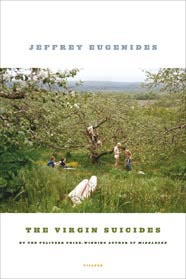
First published twenty years ago, The Virgin Suicides by Jeffrey Eugenides remains poignant and rich with dark humor. The account of the Lisbon sisters, whose mere existence – and ultimate demise – captured the attention of their entire community, is told in a plural form of the third person voice representing the neighborhood’s teenage boys. It’s not quite the “royal we” but is an interesting technique nonetheless.
Eugenides’s narrative takes place in a quiet Detroit suburb. Seasons are noted by references to fish-flies, fallen leaves and holiday lights. For the Lisbons, however, there are complications. The narrator(s) rely on observation and references to interviews conducted with other neighbors, teachers and clergy. Mention is also made of several “exhibits” which include medical reports and photographs.
The five sisters range in age from 13 to 17, and the youngest is the first to kill herself. It’s clear not just from this suicide which takes place early in the novel, but also from the title, that the others will follow suit. The narrators share this sense of the girls’ impending self-destruction. Eugenides masterfully creates tension, and toys with the reader suggesting the possibility that, perhaps, the girls will be unsuccessful.
However, this is not a work simply about teen angst with no way out. It is a coming of age chronicle and a love story. The narrator(s) are forever changed by their connection to the Lisbon family, but the impression is that would have been true even without suicide as part of the tale.
The Virgin Suicides
Four Bookmarks
Picador, 1993
243 pages
I took last week off; I read, I hiked, I ate too much, I slept some, I wrote a bit, but mostly I decided to take a break from the Blue Page Special. In the process, I discovered that I missed it.

I just finished reading Tell the Wolves I’m Home by Carol Rifka Brunt and can’t stop thinking about it. Although the writing doesn’t fall into the take-your-breath-away category, the story certainly does. I still want to spend time with the characters: June, a 14-year-old misfit; Greta, her super-achieving sister; Finn, their deceased uncle; and Toby, Finn’s lover.
June is devastated when Finn, her best friend, dies of AIDS. She struggles, then Toby enters her life, and she continues to flounder. Except now she has someone to help her keep Finn’s memory alive. Toby and Finn lived together and, even though she spent a lot of time in their apartment, June never knew about Toby. This aspect has the potential to be implausible; instead, it enhances June’s character as a naïve teenager. Another potentially hard-to-believe feature is the bond that develops between the young girl and the thirty-something Toby. Remarkably, there is never anything creepy or uncomfortable about it. This is largely due to their love for Finn, and the tentative manner in which their friendship evolves. Equally important is the sisters’ relationship.
Brunt masterfully creates relationships that are rich, painful, and grow before our very eyes. The novel is about friendship, first loves, misplaced jealousy and sibling relationships. Set in the mid 1980s, AIDS has just begun to make itself felt in American culture. Yet, that is simply a background element. This is a coming-of-age story that considers the way people change based on age, interests, opportunities, and circumstances.
Tell the Wolves I’m Home
Four-and-a-half Bookmarks
The Dial Press, 2012
355 pages
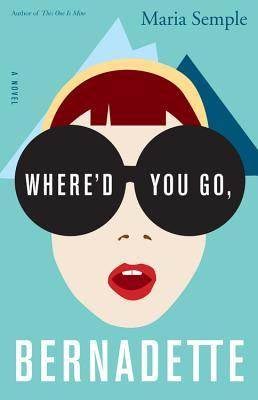
Where’d You Go, Bernadette by Maria Semple is engaging, funny, poignant, and even a bit silly. Set primarily in Seattle, the story also includes a few situations in Los Angeles and the Antarctic as Bernadette Fox tries to ward off a nervous breakdown in an environment seemingly designed to push her over the edge.
Bernadette is a semi-misanthrope; she dislikes nearly everyone except her husband, Elgie, and their daughter, Bee. Bernadette doesn’t make it easy to like her. She refuses to get involved with the parent groups at Bee’s school, and she avoids interaction – no matter how casual – with others to such an extreme that she relies on a virtual personal assistant who lives in India.
Semple has created an appealing dysfunctional family that has trouble meshing with an often-dysfunctional world. Bernadette, a one-time architect, is, in fact, a genius; she’s a past recipient of a McArthur Foundation Genius Grant. But she responds to stressful situations through radical reactions, including disappearing. Bernadette’s story is told through emails, letters and mostly Bee’s eyes. Bee is no intellectual slouch herself. She’s convinced there’s a logical explanation for her mother’s absence. And here’s where the real adventure begins as Bee sets off to find Bernadette.
Russian spies, potential identity thieves, private school students, and parents blind to their children’s excesses and foibles are just a few of the extras populating Semple’s novel. There are plenty of laugh-out-loud situations as well as a few shoulder-shrugging moments as Bee, who has a very good understanding of her mother, refuses to stop looking.
Where’d You Go, Bernadette
Four-and-a-half Bookmarks
Little, Brown and Co., 2012
326 pages
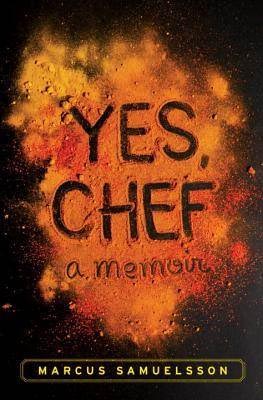
I know a few local chefs by name; I know a lot about others from different places, thanks to the books they write – and the Food Network or Bravo. The latter is where Marcus Samuelsson’s name surfaced on my radar. His memoir, Yes, Chef, provides a detailed, honest look at how he emerged onto the contemporary food scene.
Samuelsson begins his story with a powerful sentence that has nothing to do with food, but everything to do with who he is: “I have never seen a picture of my mother.” He shares how he and his sister made their way from Ethiopia to Goteborg (Gothenburg), Sweden, where they were adopted by Lennart and Anne Marie Samuelsson. He learned to cook by watching his grandmother. He learned technique by apprenticing in Switzerland, France and the United States.
As much as the memoir is about his progression through various kitchens, Yes, Chef is also about finding passion, experiencing prejudice and learning how these disparate aspects can be powerful motivators. Samuelsson reveals his flaws, his quirks as well as his strengths in a straightforward voice.
Ethiopian by birth, Swedish through adoption, and now a naturalized U.S. citizen, Samuelsson might seem an unlikely poster boy in the food world. Yet, it is his internationality that makes him so appealing. His quest as a chef, as he says, was to “chase flavors.” So far, it appears to be quite a pursuit.
Yes, Chef
Three-and-a-half Bookmarks
Random House, 2012
315 pages

Often, stories within stories are enchanting, muddled, lopsided or boring. Fortunately, Winter Garden by Kristin Hannah is captivating without any confusion. One narrative is not more interesting than the other; both have equal appeal.
Much of what makes Hannah’s novel so successful is the clever way in which her characters evolve. Sisters Meredith and Nina are grown women who have always basked in the light of their father’s love. Meredith is the older sister, pragmatic and harried; Nina lives the adventurous life of a freelance photographer. Theirs is not a close a relationship. If not for Evan, their father, there would be little for anyone in the family to hold dear.
Unlike Evan, their mother is a cold, distant woman incapable of showing or articulating affection. This could be a black and white story, but Hannah has enough sense, and talent, to show the nuances. A secret past, painful memories and the harsh reality of war culminate in a fairy tale the sisters’ mother is ultimately compelled to tell. The story moves from the idyllic, contemporary life on the family’s apple orchard to cold, war-torn Russia. Like any good fairy tale, this one begins with a handsome prince, an evil overseer, and a young girl who falls in love.
As the fairy tale evolves, it’s clear this the only way the mother can explain herself and for her daughters to recognize their own strengths, weaknesses and connections. There’s nothing jumbled in either side of Hannah’s engaging account.
Winter Garden
Four Bookmarks
St. Martin’s Griffin, 2010
391 pages

Shilpi Somaya Gowda’s first novel, Secret Daughter, is about families – especially mother-daughter relationships. Two women, one unable to have a child and the other unable to keep hers, are the primary focus – along with Asha, the daughter given up by one and adopted by the other.
Somer, a pediatrician in the San Francisco Bay area is married to Kris, a surgeon originally from Mumbai. Across the world in an Indian village, Kavita gives birth to a daughter she knows her husband does not want, and will not let her keep. Although the women never meet their lives are unwittingly bound when Kavita leaves her child at an orphanage. Through a series of coincidences that often only occur in fiction, the girl, Asha, is adopted by Somer and Kris.
Gowda’s narrative moves from the Bay Area to Mumbai, as it shifts from one woman’s perspective to the other, before, thankfully, settling on Asha. Somer‘s character is whiney and distant; Kavita is mostly sad and compliant. Despite environment and genetics working against her, Asha grows up to be an intelligent, inquisitive young woman. That’s not to say, she is flawless. At her worse, as a teenager, she is rude and insensitive; at her best, as a college student interning at a Mumbai newspaper, she is empathetic and appreciative. Of course, it takes time for the latter qualities to evolve.
Gowda’s writing is strongest describing the contrasts between India’s wealthy and the destitute. The colors, sights, and smells are vivid – even when the reader might prefer otherwise.
Secret Daughter
Three Bookmarks
William Morrow, 2010
339 pages
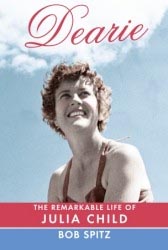
Any foodie worth his or her cookware will want to read Bob Spitz’s Dearie: The Remarkable Life of Julie Child. Even if you’ve already savored your way through other biographies, memoirs or the film Julie and Julia, this is a must-read. At 500+ pages the book may seem daunting, but Spitz’s writing is conversational and personal; his respect for his subject is clear.
And why not? Her contribution to food culture notwithstanding, Julia Child was an intelligent, loving, enthusiastic woman. For much of her early life, food was just sustenance. She didn’t start cooking, or truly enjoying meals, until she was in her late 30s; once she did, she never stopped.
The biography is told chronologically, except for the prologue. Here the author describes the scene at WGBH in Boston just before Child makes her first television appearance where she cooked an omelet using a hot plate. From there, Spitz tracks everything including her privileged childhood in Pasadena, Calif., life in the Office of Strategic Services outposts, her marriage to Paul Child, and her almost-accidental love affair with food. The most interesting aspects are those that show her as a woman filled with a joie de vie and the ability to change with the times.
Spitz did extensive research to tell Child’s story. The result is a portrait of an unlikely leader in the early days of the food awakening in the United States. Her television shows, her cookbooks, even the parodies of her, contributed to the word “foodie” becoming part of our everyday vernacular.
Dearie: The Remarkable Life of Julie Child
Four-and-a-half bookmarks
A.A. Knopf, 2012
534 pages



 The Blue Page Special