Archive for the ‘Books’ Category
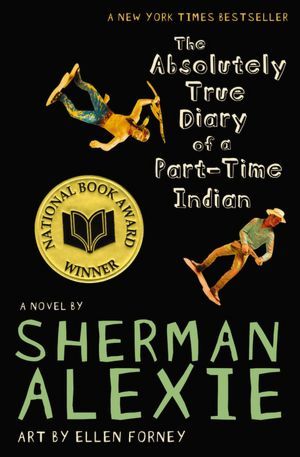
When I worked as a writing tutor at the local community college, I saw enough rhetorical and critical analyses on Sherman Alexis’s “Superman and Me” to fill a classroom – floor to ceiling. I knew his essay inside and out. Until now I was unfamiliar with his other writings. The Absolutely True Diary of a Part-Time Indian is a fictional account (complete with cartoon illustrations by Ellen Forney) of Arnold Spirit Jr., aka Junior, aka Arnold.
Certainly, similarities exist to Alexis’s life growing up on the Spokane Indian reservation in eastern Washington, but the diary entries are fiction. They follow Junior/Arnold in his freshman year of high school. Plenty of back story is provided, beginning with Arnold/Junior’s birth defects that physically, socially and intellectually isolate him from most others on the reservation. He’s suspended on the first day of school and decides to transfer to the “white” school 22 miles away. On the reservation he’s known as Junior; at the new school he’s Arnold.
He changes schools in hopes of opening new doors while learning to accept that old ones are slammed in the process. His life is a dichotomy. He’s always struggled to fit in and expects to endure the same at the new school. It’s clear from the onset that Junior/Arnold is an underdog, so the outcome is predictable. The transformation of other characters is what’s most heartening; it shows that tribes can be of our own creation. This is evident through the diary reflecting its author’s humor, perception and emotion.
Four Bookmarks
The Absolutely True Diary of a Part-Time Indian
Little, Brown & Co., 2007
230 pages

In a way I’d love to frequent a place often enough that I’d be known, if not by name, perhaps by where I liked to sit or what I ordered. Colman Andrews recounts the numerous places around the world where this is the norm for his dining experiences. In My Usual Table: A life in Restaurants, Andrews shares his earliest recollections as a child dining in many of the landmark eating establishments in the Los Angeles area. As a kid he, with his family, was a regular at Chasen’s, the Brown Derby and Musso & Frank Grill (only the latter remains today).
Where does one go from there? Apparently, everywhere. Andrews grew up to be a wine connoisseur, dining critic and co-founder of Saveur magazine. He’s also authored several cookbooks.
My Usual Table is an eat and tell memoir with casual and not-so-casual name dropping: Wolfgang Puck, Ruth Reichl, Alice Waters, among others. Some meals are described vividly, some barely mentioned while he focuses on those associated with the meals. What’s most fun is following Andrews’ time line, which precedes, for example, the farm-to-table concept to the present.
Andrews is a fine story teller, but his voice begins to wear thin about 2/3 through. It’s difficult consuming and digesting such rich, often heavy fare for too long. I enjoy dining out, but there’s nothing like a home cooked meal or an occasional burger for basic sustenance. I’m happy, afterall, to have my usual table be in my own dining room.
My Usual Table: My Life in Restaurants
Three-and-a-half Bookmarks
Ecco, 2014
311 pages

The Boys in the Boat isn’t compelling as a title until considering the subtitle: Nine Americans and Their Epic Quest for Gold at the 1936 Berlin Olympics. That, believe it or not, provides just the amount of spark to pick up the book. Once in hand, Daniel James Brown’s account is riveting. Sure there are a few spots where it catches a crab, in rowing vernacular where an oar doesn’t completely come out of the water and slows the pace of the shell (boat). Fortunately, Brown keeps a mostly steady tempo.
The narrative follows the unlikely evolution of nine young men who find their way to the University of Washington rowing crew. Much of the story follows Joe Rantz, a particularly poor young man with a heartbreaking past: his stepmother convinced his father to essentially abandon Joe. His history, along with that of his crewmates and their coaches, provide the book’s heart, literally and figuratively. Each chapter begins with a quote from George Yeoman Pocock the boat builder who served as a mentor to Joe and others.
Interspersed with descriptions of the men’s pasts, their grueling training and the exciting races — particularly those against California – Brown describes events in Germany before the world fully understood the atrocities occurring there.
Even though the outcome of the race is known from the start, how the American crew made it to Berlin is fascinating. It’s a story of indomitable spirit that demonstrates the power of hard work, friendship and the American dream.
The Boys in the Boat
Four Bookmarks
Viking Adult, 2013
416 pages
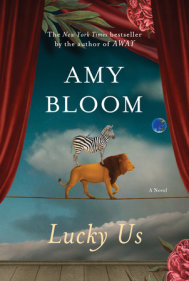
Lucky Us by Amy Bloom is a great title, because it can be uttered in different ways: with a note of sarcasm or with an emphasis on appreciation. Thanks to Bloom’s strength as a story teller, the reader is the lucky one.
From the onset, this is a captivating story of how families get by, not in a financial way but emotionally. It’s a look at the way we create families when those we’re born into cause disappointment and pain. This is the case for all of the main characters. Twelve-year-old Eva, abandoned by her unmarried mother, is left to live with her father and his daughter, Iris. Iris’s own mother has recently died and the girls are motherless, but now each has a sister. The two are as different as salt and pepper, but together they add zest to what could otherwise be uneventful lives.
The book has a surprisingly large number of significant characters who appear like traffic cops signaling directions. Bloom moves her characters from Ohio to Hollywood to Brooklyn – and points beyond. Yet, no one is superfluous.
Love, both carnal and platonic, is a major force, but the strongest elements are familial connections. Eva and Iris support each other’s strengths: Eva has brains, Iris has beauty. Both have limited common sense. The appeal of Bloom’s writing escalates as the friends/family they add to their circle grows. At times it seems far-fetched, but mostly it’s a matter of luck, the kind we all know: good and bad.
Lucky Us
Four Bookmarks
Random House, 2014
240 pages

Eat Your Words by Charlotte Foltz Jones (and illustrated by John O’Brien) is an entertaining look at the evolution of idioms associated with food. Although written as a children’s book, this should appeal to anyone with an interest in sustenance and words. It has nothing to do with nutrition and diets.
Foltz’s conversational, easy-to-read history of food and the language associated with it is immediately engaging because of its emphasis on fun. She shares how certain dishes or snacks came to exist. I suspect we all know about sandwiches and their debt to the Fourth Earl of Sandwich, but new to me, at least, is Sylvester Graham and his role in the cracker that bears his name.
Fun, often obscure, facts related to food are shared, including a section on what Foltz justifiably identifies as “silly food laws.” Who knew that in Lexington, Ky., for example, that “it is against the law to carry an ice cream cone in your pocket”? Of course, the larger question is who would want to? Food-related events are also listed, including the Berrien Springs, Mich., annual Christmas Pickle Festival. This suggests mistletoe isn’t the only reason to pucker up.
The book is written in an amusing tone, but it also contains interesting facts associated with the foods we consume every day. Get the book for a kid, but be sure to read it, too.
Eat Your Words
Four Bookmarks
Delacorte Press, 1999
85 pages including bibliography

The Family Fang by Kevin Wilson is exasperating and slightly intriguing. Camille and Caleb Fang are performance artists in the extreme. Their definition of art is to create irresponsible chaos amidst the realities of daily routines. The Fangs have children, Annie and Buster, who are used as props and/or unwilling co-conspirators. The kids, also known as A and B, have no interest in being part of their parents’ far-fetched ideas. Once old enough they leave home to pursue more traditional artistic endeavors: Annie is a film actress and Buster writes novels.
When the novel begins, however, both Annie and Buster are experiencing low points in their lives. Though resistant, they return to the family home. Wilson creates a palpable sense of anger and frustration on A and B’s part. This spills onto the reader. In a way Camille and Caleb are like the king who wears no clothes when they create their exaggerated scenarios, most of which are ill-conceived. It’s their children who wonder why no one else can see what they do.
Wilson combines a fair amount of humor, elements of a low-key mystery and the pathos associated with children who have been psychologically harmed and become adults who haven’t outgrown the affliction.
Unfortunately, the narrative doesn’t work. Too many questions arise making suspension of disbelief impossible. For example, if the Fangs are so successful as performance artists why aren’t they recognized? More importantly, why didn’t anyone call social services to keep Annie and Buster out of the fray?
The Family Fang
Three Bookmarks
Ecco, 2011
309 pages
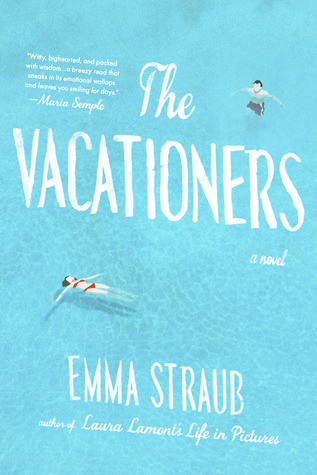
The Vacationers by Emma Straub is as bright as a day on the beach and also as gritty. Full of poignant, laugh-out-loud descriptions, Straub masterfully portrays a family in crisis.
Jim and Franny Post, with their teenage-daughter, thirty-something son, his girlfriend, and Franny’s best friend Charles and his partner are slated to spend two weeks together in a large rented house on Mallorca. Each chapter represents one day of the vacation and every day includes various perspectives provided by the connected tourists. These are separate views more than distinct voices. Each character hopes to project, or better yet protect, a certain image, because everyone has a secret – some known to a few, others hidden.
The Posts, married 35 years, are financially well-off, privileged. Their daughter, Sylvia, is set to start at Brown in the fall, and the trip was planned as a family celebration. However, in the interim from when the trip was conceived and actually occurs, Jim has had an affair and lost his job. Some know this; others don’t.
As the emotional baggage is shuffled around, the Posts direct their own disappointments to Carmen, the girlfriend. She’s perhaps the most honest among the group, but she is also subjected to the family’s rude behavior. Only Sylvia demonstrates fleeting moments of kindness and understanding.
Yet, the novel isn’t about being mean to others. It’s focused on what people do to live with themselves, even when they’re basking in the sun and have been out too long without sunscreen.
The Vacationers
Four Bookmarks
Riverhead Books, 2014
292 pages
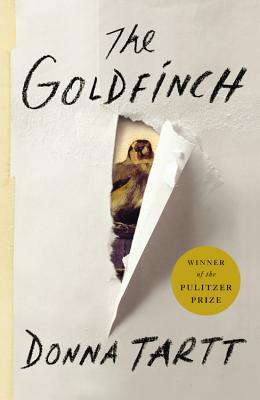
After talking to a friend who had just completed a marathon, I saw a similarity to reading Donna Tartt’s The Goldfinch. At times I wondered if I would ever finish. Occasionally I was completely engrossed and enjoyed the scenery, so to speak. Ultimately, I kept returning to the question of completion, could I do it? The answer is yes. However, unlike my runner friend who was euphoric after crossing the finish line, I was simply relieved: just glad to be done.
I know Tartt has received numerous accolades (including the Pulitzer Prize) for her 771-page novel about Theo Decker and the rare painting that, at the request of a dying man in a museum explosion, he takes and has overshadowing his adolescence and young adulthood. Yet, I had an extremely hard time allowing for my suspension of disbelief to fully be in the driver’s seat.
Theo’s mother is killed in that explosion and Theo, who is 13 years old at the time, walks out of the museum practically unnoticed, certainly not unscathed emotionally, but unnoticed. Don’t bother trying to forget that he had an irreplaceable piece of art in his backpack. Through a series of temporary living situations – some better than others, drug abuse and unrealized potential, Theo doesn’t undergo too much transformation through the years. Tartt offers an interesting premise, with Theo narrating, but the story gets bogged down with too many inattentive adults and too many far-fetched situations.
Mostly, I was tired after putting the book down for good.
The Goldfinch
Three-and-a-half Bookmarks
Little, Brown Co., 2013
771 pages

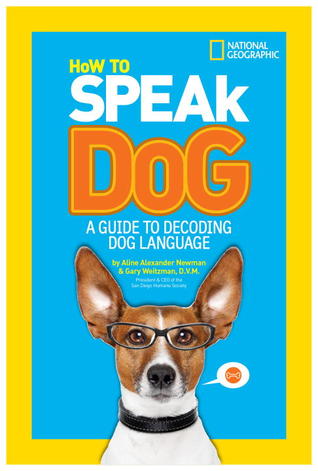
A few weeks before my birthday one of my sons asked what I’d like as a gift. I gave him a very specific idea, which he pointedly ignored. Instead he gave me How to Speak Dog: A Guide to Decoding Dog Language. Written by Aline Alexander Newman and Gary Weitzman, a vet and president of the San Diego Humane Society, this fun, informative manual actually helps me to better understand my dog.
I spend a lot of time with my dog, Jackson, so I have always felt in tune with his actions. After reading this guide, I realize I was off-base on some points, but on the mark for others. For example, tail wagging. I erroneously thought all wagging tails were signs of dogs’ playfulness and excitement. This isn’t necessarily true, according to the authors. Occasionally it indicates fear. The way to tell is if only the end of an otherwise high stiff tail wags. The happy wag, on the other hand, is rapid and usually a large sweeping arc-like motion.
History of dogs, attributes of a variety of breeds, different types of barks, movement of ears, yawning and other forms of nonverbal communication are all addressed. Photos, illustrations, scenarios and resources help round out the content. This is a fun, easy-to-read book that most dog owners should find useful.

This probably is not a book I would have chosen on my own, but this time I appreciate that my son decided to ignore me – please notice that caveat: this time.
How to Speak Dog: A Guide to Decoding Dog Language
Three Bookmarks
National Geographic, 2013
176 pages

The Storied Life of A.J. Fikry by Gabrielle Zevin is the literary equivalent of a triple chocolate dessert. It’s rich, nuanced and meant for those who love chocolate, or in this case, books.
A.J. is an ill-tempered man running a bookstore on an Atlantic coastal island. The store does a brisk summer tourist business. Otherwise it’s a slow, quiet livelihood for A.J., whose wife has been dead for almost two years. But, he’s not old. He’s not even middle-aged. He is, however, a snob, particularly when it comes to literature, and he’s set in his ways, such as they are, as a lonely and often rude man.
Parts of this novel are entirely predictable, but in all the right spots. A.J. meets someone, actually three someones, who change his life: Amy, a publisher’s sales rep; Lambiase, the local police chief; and Maya, the two-year-old child abandoned in his shop. Despite some unsurprising turns, Zevin writes with humor and poignancy. She also displays a knowledge of books.
The relationships also allow A.J. to accept the greater world around him, for better and worse. It helps that the three persons who share his life are book nerds. Lambiase, who is only ever referred to by his last name, is the last to jump on board as a reader. His evolution from a by-the-rules cop is fun and warm. It’s A.J.’s connections to Amy and Maya that resonate the loudest through their shared passion for pages that need to be turned by hand.
The Storied Life of A.J. Fikry
Four-and-a-half Bookmarks
Algonquin Books, 2014
260 pages


 The Blue Page Special