Archive for the ‘Books’ Category

This is a good time of year for a heartwarming story, even a predictable one. A Man Called Ove by Fredrik Backman fits the bill.
Ove is a Saab man. He’s not employed by the Swedish automaker, he’s loyal to it. It’s his gauge of measuring a person’s character (in Ove’s world it usually applies to men). Ove is all about character. He raises his eyebrows at those who drive BMWs or Audis; he tolerates Volvos.
Set in his ways like a train on a track, Ove only cares about his route. Except, anyone sharing his path must abide by the same rules he does. He doesn’t necessarily set the directives only that he follows them to an extreme.
At times funny and sad, Ove’s story is initially about his decision that it’s time for his life to end. Of course, this is no laughing matter, but humor surfaces as life intervenes in his efforts to take action. Distractions get in the way. He must contend with neighbors, a stray cat, being in the wrong place at the wrong time, and his wife Sonja.
Set in Sweden, Backman alternates chapters to reveal Ove’s past and its impact on the present. It’s easy to visualize Ove as a grumpy old man, although he’s only 59; it’s also not difficult to see, or at least initially suspect, there’s more than meets the eye. It’s most evident in his love for Sonja. What happens comes as a surprise to Ove and the reader.
A Man Called Ove
Three and three-quarters Bookmarks
Fredrik Backman
Atria Books, 2014
337 pages

Epic Russian novels have long appealed to me for many reasons: the history, the descriptions of stark landscapes and lively urban settings, the storytelling, and the names. Ah, the names.
Author Amor Towles ties all these elements together in A Gentleman in Moscow.
Count Alexander Ilyich Rostov, known as Sasha among a few and as the Count among many, is sentenced to house arrest at Moscow’s grand Metropol Hotel in 1922. This is an engrossing tale about a man who grew up with every comfort and advantage during tsarist Russia. Although his lifestyle changes, it unexpectedly expands.
At the beginning of his confinement, the mother country is in the early stages of political and economic changes that continue for decades. The Count is undeterred by his reversal of fortunes. Towles presents a contented man, knowledgeable, kind, charismatic, happy with routines, yet imaginative. As the Count’s story moves through the years he faces challenges greater than the restrictions of his movements, but always with a good attitude.
Towles injects humor and history with a hotel guestbook of intriguing characters. Interestingly, each chapter begins with the letter A, like the count’s (and author’s) first name.
Here is a novel of the never-wanting-it-to-end variety. The Count’s humanity, his relationships/friendships, and the rich memories of his childhood overshadow his loss of freedom. At times it’s easy to forget that he is a captive in a majestic hotel. He can’t actually check out any time he wants, but why would he want to leave?
A Gentleman in Moscow
Five Bookmarks
Amor Towles
Viking, 2016
462 pages

In Emma Cline’s novel, The Girls, narrator Evie Boyd recalls her involvement as a 14-year-old with a Charles Manson-like cult. The names are changed, the location is different, but Evie’s perspective still provides enough nuanced similarities to the Helter Skelter summer of 1969.
The setting is northern California. Evie’s parents are divorced and after falling out with her childhood friend, Evie meets Suzanne who’s a few years old. Suzanne introduces Evie to Mitch and others at a commune on a nearby ranch. He is meant to be charismatic and profound, but it’s Suzanne that Evie is drawn to. She ingratiates herself into life at the ranch to be with Suzanne. Her interest is occasionally reciprocated by the older girl.
Cline imbues Evie with all the pathos associated with a young teenager. Her obsession with Suzanne is puzzling: is it sexual or is it her need for an involved maternal figure?
When Evie returns to the ranch after a brief absence, its allure has begun to fade. She can sense there’s an itch to scratch, but isn’t sure of its source. It’s at this point that a few inconsistencies surface in the narrative.
Years later, reflecting on that summer, Evie wonders what kept her from participating in the violence carried out by Suzanne and others under Mitch’s directive. If she hadn’t been told to leave, would she/could she have acted as they did? This raises the question of how we think we might respond in certain situations and how we actually do.
The Girls
Three-and-a-half Bookmarks
Random House, 2016
455 pages

Who’d imagine that an uninvited guest who shows up at a baby’s christening with a bottle of gin could divide, then fuse, two families over a span of 50 years? Ann Patchett, of course. Humor, tragedy, quirky, yet believable characters result in a compelling story.
In Commonwealth, Patchett creates a novel within a novel – of sorts. She deftly illustrates the Rube Goldberg effect initiated by one man’s attraction to another man’s wife. The havoc it inflicts is expected, the alliances it forms aren’t.
The Cousins and Keating families are brought together when Beverly Keating divorces her husband to marry Bert Cousins. Beverly is a beauty with two young daughters; Bert, the gin-carrying party crasher, is egocentric and the father of two girls and two boys. The Keating girls move with Beverly and Bert to Virginia, while his kids stay with their mother in southern California during the school year.
The six children spend summers together in Virginia. Their combined disdain for their parents and unrestricted activities form bonds that continue into adulthood. The novel begins in the early ‘60s long before the concept of helicopter parenting took flight. Bert hastily retreats when his kids arrive, leaving Beverly, who’s emotionally detached, to manage alone.
Much of the narrative follows Franny, Beverly’s younger daughter. Franny’s relationship with her sister and step-siblings is told in flashbacks moving from childhood to young adult to middle age. In Patchett’s hands, Franny is optimistic; she looks for the best– even when it’s unlikely to surface.
Commonwealth
Four-and-a-half Bookmarks
HarperCollins, 2016
322 pages

My favorite passage by Lauren Groff is where she signed my copy of Fates and Furies at the request of my son Tim’s girlfriend. Groff wrote: “Robin – Mariana is the most beautiful and wonderful, isn’t she!” The answer is yes. It is such a stark contrast to the tenor of the novel; I’m led to believe that Groff doesn’t have it out for everyone, which is a comforting thought.
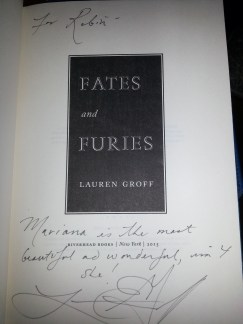
The novel is divided into two categories: fates and furies. The first section begins with newlyweds, Lotto and Mathilde, consummating their marriage on the beach, but he is the focus here. It’s all about him: childhood, banishment from his family to boarding school, college days and efforts to succeed as an actor are portrayed in detail; but not too much as to squelch the imagination. Little is revealed about Mathilde – until furies, which is aptly named.
In an effort to avoid the need for spoiler alerts, suffice it to say there are elements of Gone Girl meets Claire Underwood.
Groff’s writing is clever, humorous and rich in detail. The references to various plays and Greek tragedies, however, are distracting metaphors.
Full of unlikable characters, the book, nonetheless, was appealing. Lotto’s a selfish man who exudes charm. Real charm, not something he turns on and off at will. Mathilde is mysterious and bitchy. They are flawed thanks to the characteristics Groff imbues in them. Neither is someone I want to meet, but I was more than content to know them through the distance of fiction.
Fates and Furies
Four Bookmarks
Riverhead Books, 2015
391 pages

Foodies and artists, often one in the same, should enjoy Lucy Knisley’s comic book memoir, Relish: My Life in the Kitchen. It’s humorous, educational and a quick read.
At an early age her parents instilled an appreciation of gourmet food. I’d like to think I did, too, with my own kids, but I never considered serving my toddler children poached salmon. I did, however, insist that they at least try new things even if they only took one bite. The result – years later – is they all have fine palates and enjoy a good meal.
But back to Knisley.
She shares stories about leaving the City for upstate New York following her parents’ divorce. She relates her initial displeasure at having to be around farms, chickens and seed stores. Eventually, her text and accompanying illustrations reflect a tone of gratitude. It’s clear she has good relationships with both parents, but she does include some of the rough spots they endured. These were, no surprise, Knisley’s teenage years. She makes no effort to (literally) draw herself in a better light; this is a highlight.
Humor underlies these chronicles of coming-of-age, food cravings, travel and love for her parents. Knisely also includes illustrated recipes, cooking tips and explanations of cooking techniques.
Among my favorite chapters is the account of her efforts to recreate the croissants she so enjoyed in Italy. Her determination is as evident as her failure, but her humor saves the day. This is always the best ingredient no matter the endeavor.
Relish: My Life in the Kitchen
Five Bookmarks
First Second Books, 2013
173 pages

To say A Little Life is a big book is an understatement. At slightly more than 800 pages it’s, in the words of my greatest presidential fear: Huge, very, very huge. Hanya Yanagihara has crafted a novel that traverses several lives, particularly Jude St. Francis’s. The name is not insignificant. St. Jude is the patron saint of lost causes.
Jude is one of a quartet of friends, Willem, Malcomb and JB, who meet in college. Although the friendships among the four are always part of the story, most of the narrative revolves around Jude and Willem. Their backstories, their lives before college, define them. In fact, Jude’s past is what drives the novel.
From the onset, it’s clear that Jude has secrets. His inability to reveal them is a compelling, and often frustrating, element. It is also evident that Jude is the physically weakest of the foursome. He walks with a limp, which he reluctantly and vaguely attributes to a car accident. He has no family or past connections. He’s awed by the care and companionship of his friends.
Yet, little by little Jude’s history is divulged. As the four men grow older their friendship is often tested. They each pursue different careers, but Jude and Willem remain particularly close throughout.
The power of Yanagihara’s work lies in the personalities and the situations she creates. The author illustrates the definition of friendship through the actions of the characters and shows that the strongest bonds are made of trust. Then love.
A Little Life
Four-and-a-half Bookmarks
Anchor Books, 2016
816 pages
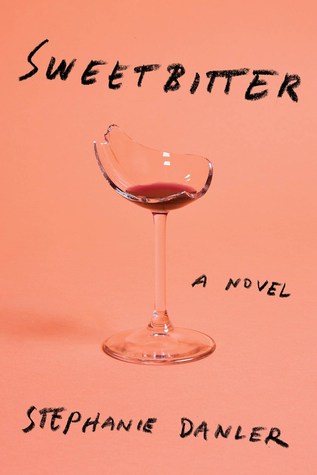
Sweetbitter is a combination love story and homage to restaurant life, particularly servers. It’s far from reverent and certainly doesn’t offer a warm-hearted view of the front and back of house scenes. It demonstrates that working in a restaurant is often a lifestyle and not just a job.
Told from 22-year-old Tess’s point of view, Stephanie Danler’s novel is unflinching when it comes to sex, drugs and ego trips. Tess arrives in New York City from the Midwest. With only limited diner experience, she lands a job as a back waiter in an upscale Manhattan restaurant. She’s unsure of herself, has no true motivation, but still simply seems ready to get on with her life, whatever it may be.
The novel’s four sections are broken down by seasons beginning with a sweltering summer. As each progresses I was increasingly disappointed. Summer and fall had my full attention as I expected Tess to develop interests and become more confident. By the winter and spring segments, I was disappointed. Yes, Tess makes some self-discoveries, but they’re minor in the scheme of things.
Part of the problem is that Danler never makes Tess’s obsessive fixation on Jake, the bartender, tangible or credible enough. His relationship with Simone, an older server who, inexplicably, fascinates Tess, is a mystery waiting to be solved; but it lacks tension. Instead, predictability takes control, which is far more bitter than anything sweet Danler has to offer.
Sweetbitter
(Barely) Three bookmarks
Alfred A. Knopf, 2016
352 pages

For some reason it seems the stack of books on my nightstand never, ever shrinks. Some titles have been there for longer than I care to confess. When I saw that The Light Between Oceans has been made into a movie, it was time for me to rescue it from the mountain of titles. (If I decide to see the film I need to read the book first.)
Written in 2012, this is M.L. Stedman’s debut novel set off the rocky coast of Australia following World War I. The author provides lyrical descriptions of the harsh life of a lighthouse keeper, Tom, made more comfortable by the love and vibrant personality of his wife, Isabel.
Tom has returned from the war surprised and guilt-ridden by his survival. He is well suited to the solitary life on an isolated thread of land. It isn’t until he meets Isabel while waiting for his next lighthouse assignment that he realizes what’s been missing from his life. They marry, and after Isabel miscarries multiple times, they believe their hopes of having a family will elude them. That is until a small boat washes ashore with an infant child and a drowned man.
Tom wants to turn the baby over to authorities; Isabel does not. What follows is a succession of heartache and lies borne of love. Stedman’s characters are real, full of faults. She raises poignant questions for all involved and readers are left to consider what they might do in a similar situation.
The Light Between Oceans
Four Bookmarks
Scribner, 2012
343 pages

I planned on not reading Being Mortal, but plans have a way of changing. My reservations about author Atul Gawande’s best seller were linked to the subtitle: Medicine and What Matters in the End. This year I faced a milestone birthday and some health issues affected my family. All in all it seemed as if the good doctor’s book wasn’t for me. Yet, it was and it wasn’t; the best audience might be millennials. Of course, they’re not the only ones who will be, or are, impacted by their parents’ declining health and well being.
Gawande’s a surgeon who questions the way American culture treats the elderly. He offers several stark contrasts to the situation experienced by his 110-year-old grandfather in India who was respected, even revered, because of his age. He was acknowledged by anyone who entered the family home and consulted on major family issues.
Initially, Gawande focuses on nursing homes and retirement communities. He finds little to celebrate in this area despite efforts by a few individuals seeking better solutions. The author then turns to medical situations and the efforts people go through to extend their lives despite poor odds – odds often encouraged by physicians with the best intentions, albeit not necessary with the most honest answers.
Through encounters with caregivers including family members, Hospice personnel and the elderly, Gawande nudges readers to consider the ways to live life while growing older (or dealing with illness) as the best way to face the inevitable: mortality.
Being Mortal: Medicine and What Matters in the End
Three-and-a-half bookmarks
Metropolitan Press, 2014
282 pages