Archive for the ‘Books’ Category

Although Colson Whitehead’s Pulitzer Prize-winning novel, The Underground Railroad, is about slavery in the pre-Civil War era, it remains timely. Timely in the unfortunate way that malice and marginalization still exist.
The narrative follows Cora, a slave on a Georgia cotton plantation. She’s ostracized by the other slaves and hated in particular by the plantation owner, Terrance Randall, who embodies cruelty. Cora was abandoned by her mother who escaped years earlier.
Following a brutal beating, Cora agrees to flee with Caesar, an educated slave. Whitehead’s railroad is the real thing, complete with underground tracks, conductors and station masters.
Randall hires Ridgeway, a tenacious slave catcher, whose only blemish on his otherwise perfect record of returning slaves to their owners is Cora’s mother. Whitehead’s descriptions of the brutality, fear and first taste of freedom are gripping. They hold the reader throughout as Cora moves in her new world. Nonetheless, the horrors of what await her if caught cast long shadows.
Cora and Caesar arrive in South Carolina where they find paying jobs. Eventually, complacency, missteps, and a relentless Ridgeway force Cora back to the railroad. Her journey takes her to North Carolina and, later, Indiana where she encounters kindness, fear, deceit and Ridgeway.
Whitehead begins each section with an advertisement posted by a slaveholder offering a reward for the return of his property: runaway girls. The novel is often harrowing, but rousing. It’s also disappointing to consider that American society hasn’t necessarily progressed as much as we’d like to believe.
The Underground Railroad
Four Bookmarks
Doubleday, 2016
306 pages

I admit I decided to read Villette by Charlotte Bronte because of the Masterpiece Theatre program “To Walk Invisible The Bronte Sisters.” I knew some background about the women who had to first write under male pseudonyms; the show whetted my appetite for more. I thought I should read something new-to-me.
It was difficult reading for many reasons — primarily the language and perspectives. I wasn’t surprised that reading the story written in 1853 might prove a little formidable, but I expected to eventually find my groove. I didn’t.
Villette is a fictional Belgian village. Consequently, Bronte incorporated a lot of French into the dialogue, as if things weren’t difficult enough. Translations are provided among the notes in the back of the book. But who wants to keep turning pages back and forth all the time?
The novel follows Lucy Snow, a young English woman without means. She leaves England, and finds work as a nanny and then a teacher at a private girls’ school in Villette.
Lucy is an introvert and at times also appears misanthropic. She does allow a few to enter into her world. She’s reconnected with her godmother, whose son is now a doctor. He and Paul Emmanuel, also a teacher at the school, stir Lucy’s interest. The relationships with the two take many twists. Yet, none are particularly captivating. This may be due, in large part, to the era in which the novel was written: relationships moved at an aggravatingly slow pace.
Villette
Three bookmarks
First published in 1853; Penguin Books Classic Edition, 2004
611 pages, this edition includes a chronology of the author’s life; a brief history of the Bronte family, an introduction, suggested additional reading, notes and glossary.

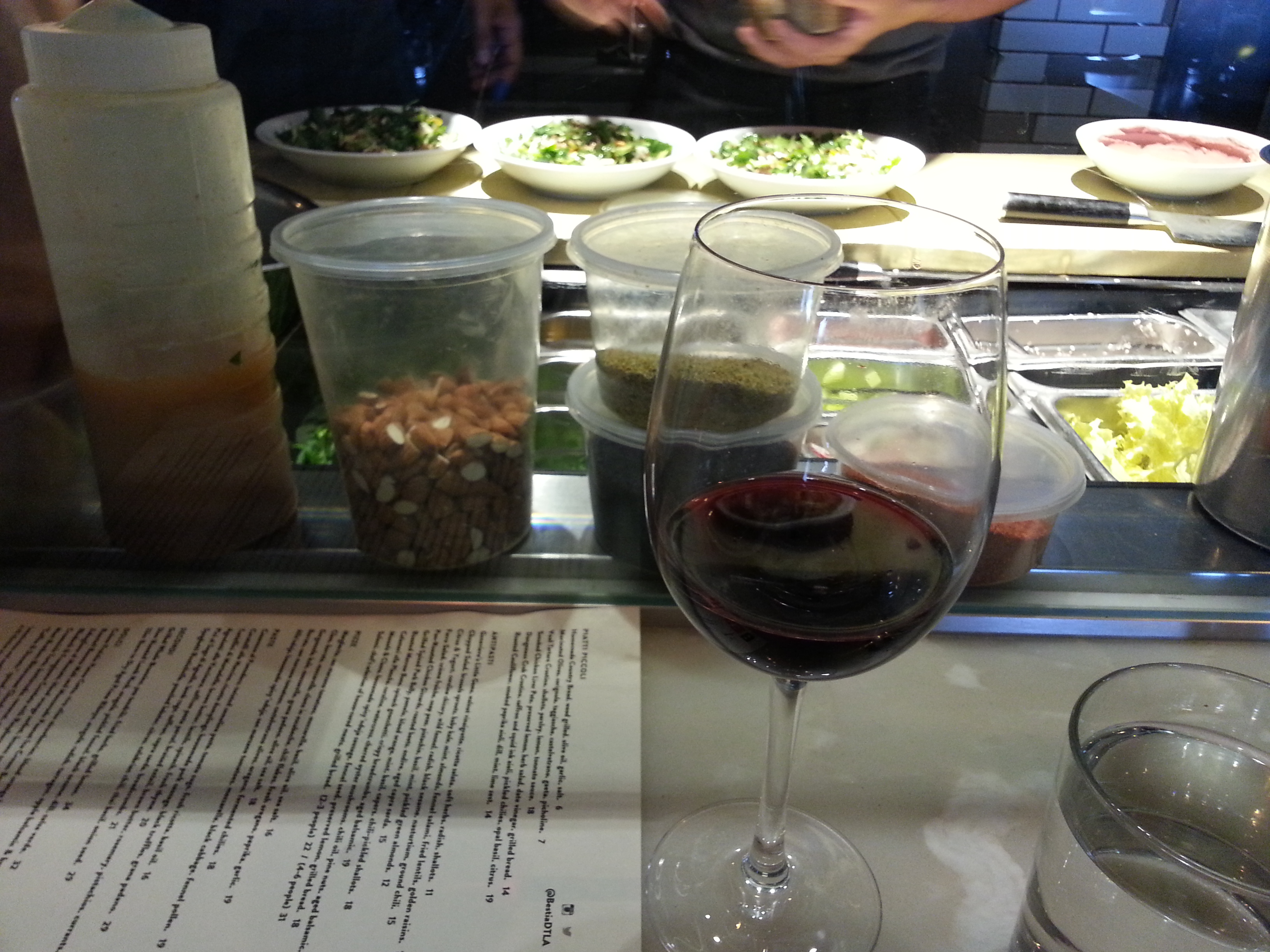
Reservations at the highly-rated Bestia in industrial Los Angeles are hard to snare. Although unable to reserve a table, we did, nonetheless, get two seats at the chef’s counter. (Thanks to my brother.)

Some people might not have appreciated the view. However, we were thrilled to have our line of vision occupied by the well-orchestrated crew preparing colorful, creative salads. Interestingly, we didn’t begin our meal with a salad. We ordered one later.

Our well-versed server suggested sharing several small plates. His subtle nod of approval when we decided on the crab crostino suggested we were off to a great start. Ordinarily, squid ink aoili, crab and Thai basil might vie as the leading flavor. Instead they all win.
I can’t resist bone marrow. It’s served here with spinach gnocchetti that we scraped it into.

Next, agnolotti, one of six pasta offerings; house-made, of course. The mini ravioli-like “parcels” were light and savory. Coated with brown butter and filled with braised oxtail, it was silky and surprisingly light. Toasted pistachios and currants added texture and sweetness.

Finally, the chopped salad, a combination of Brussels sprouts, endive, mint, salami, and fried lentils — all thinly sliced, er chopped.
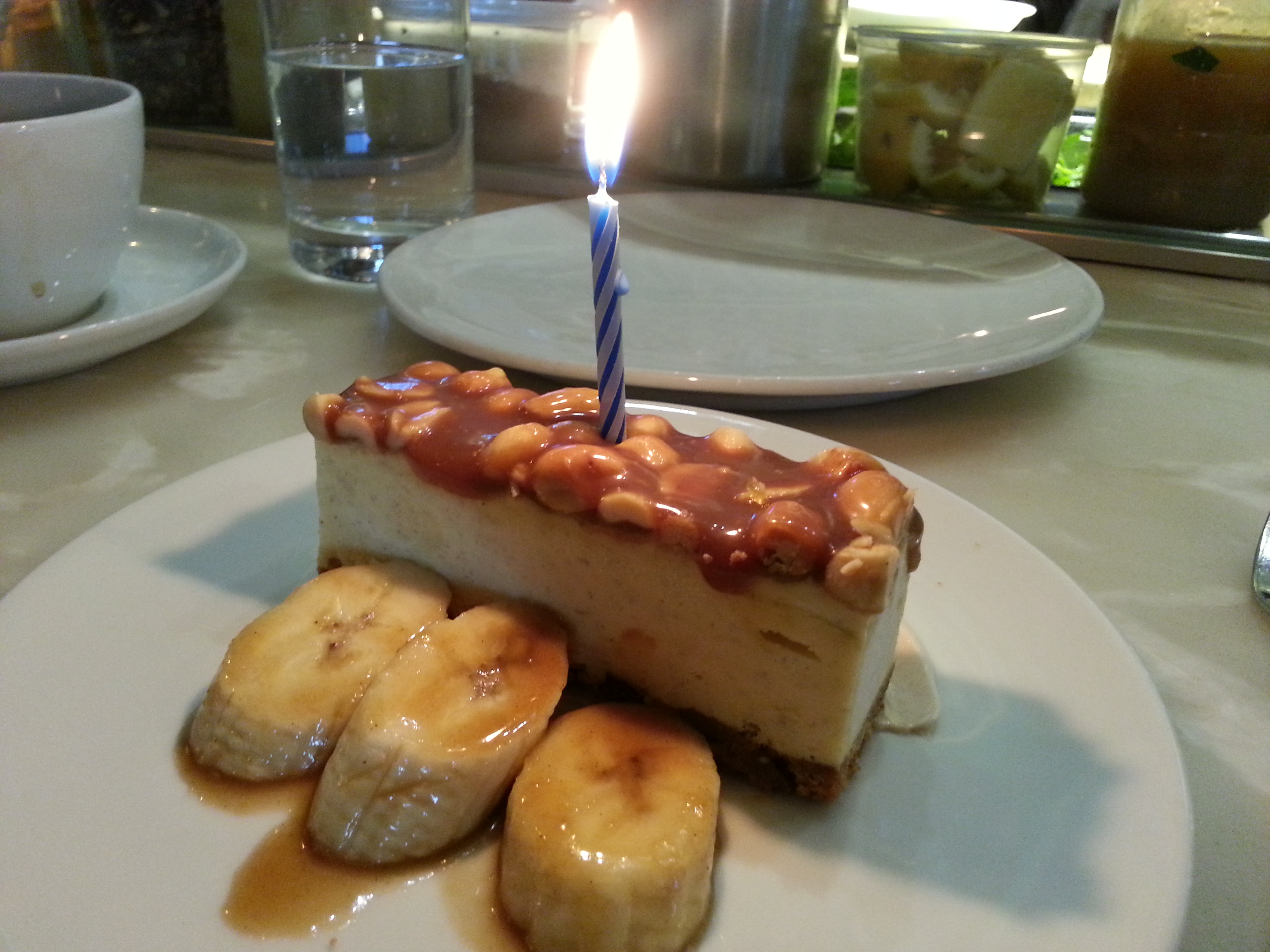
We had to have dessert. Really! Imagine bananas Foster with peanut butter ice cream. I couldn’t. The ingredients, only a playful mind could conjure, was childlike in the best possible way: fun, crunchy, salty and sweet. The ice cream is made in-house.
Bestia is in a reclaimed warehouse. It’s loud, lively and its accolades are well deserved. I can’t wait to return.
Bestia
Five Plates
2121 7th Place
Los Angeles
 Somebody get Nathan Hill an editor! The author of The Nix is creative, daring and has a good – no excellent – story to tell. The problem is that it’s about 250 pages too long, including an 11-page sentence. Really?!
Moving back an fourth between a tumultuous Chicago in 1968 just before the Democratic national convention and a calmer 2011, the novel ‘s focus is on the relationship between Samuel Andresen-Anderson and his estranged mother, Faye. It’s been decades since he last saw her. When Samuel was a child, Faye abandoned him and her husband.
Samuel teaches literature at a Chicago university. His heart isn’t in his work; his students are neither inspired, nor inspiring. After hours, on his faculty computer, he plays an immersive video game. He is also 10 years behind on a book that he’s been contracted to write. Samuel is a likeable guy and it’s painful to consider him a loser. But.
Hill is at his best in his descriptions of Samuel’s childhood, before his mother left. It’s vivid, engaging and explains so much about this character. Equally engrossing are the sections about Faye’s youth in a rural town in Iowa.
Less appealing are some of the other characters and situations, if only because the depth of their portrayal is extraneous. Take the sentence that is a chapter unto itself. It chronicles the symptom-by-symptom, reaction-by-reaction experience of a compulsive gamer as his body shuts down.
Ultimately, all the reader, like Samuel, wants is to understand why Faye left.
The Nix
Almost Four Bookmarks
Alfred A. Knopf, 2016
620 pages

Magic and love are complimentary notions, but author Charlie Jane Anders adds more to the mix: science. Strangely, the menage a trois of genres works well in All the Birds in the Sky.
The novel evolves into an apocalyptic tale from what initially seems like something in the realm of young adult fiction. A lot of sci-fi elements also are thrown in along the way. Nonetheless, it’s consistently a love story.
Laurence and Patricia meet in junior high school as social outcasts. Laurence is a science nerd; no one can quite figure out Patricia. At first their inability to fit in attracts them, ultimately it’s what drives them apart. Laurence views the world through scientific theories/applications. He builds a super-computer in his bedroom closet. Patricia talks to birds and relies on magic. Circumstances separate them until they are reunited as adults in a world soon to face mass destruction.
The development of the major characters is like watching children grow. Sometimes it’s very fast and other times not so much. Still, it’s always interesting.
Anders injects the narrative with humor, which in the face of an apocalypse is impressive. The escalation of events that lead to power outages, water scarcity and death is gradual; Anders creates a sense of urgency, but isn’t heavy handed about it. There’s empathy with fear.
To say the main characters are star-crossed is too much of a cliché, yet … when love, magic and science are thrown into the same dystopia it’s the perfect description.
All the Birds in the Sky
Four Bookmarks
Tom Doherty Associates, 2016
313 pages
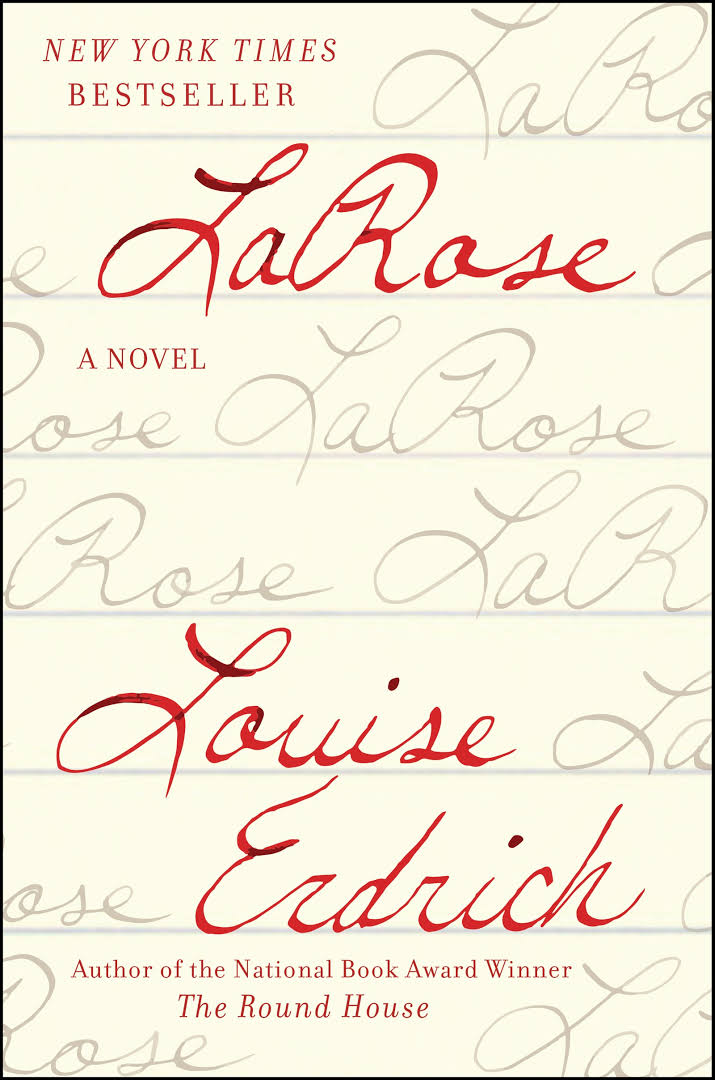
Grief, atonement and tradition are all bound together in LaRose by Louise Erdrich. The title refers not only to the young boy shuttled back and forth between two families, but also previous ancestors, all women, with the same name.
LaRose’s father accidently shoots his young son’s best friend, the child of neighbors. As part of Ojibwe custom of retribution, La Rose’s parents give him to the grieving parents. Interspersed with the adjustments this entails are stories of the original LaRose, a strong, intelligent woman able to see more than others with knowledge others don’t possess. Her traits, that include tribal medicine and a keen awareness of others, are passed down through four generations. Even the youngest of the namesakes has special, insightful characteristics.
This is more than an account about two families who lose a son. Although, the descriptions of the two sets of parents and siblings are full of depth and richness. It is also a narrative that examines the personal histories of many of the reservation’s residents, including the parish priest and a ne’er-do-well.
Erdrich blends the traditional Indian ways with modern life; the novel begins in 1999. Humor, rich descriptions of the landscape and dynamic characters make this an engaging work. It is sad, even heartbreakingly so; yet there are also moments of joy and revelation of life’s beauty.
Ultimately, this is a love story – in fact, many love stories: parental love and sacrifice; husband and wife love (and sacrifice); the relationships among siblings; and new relationships.
La Rose
Four Bookmarks
HarperCollins, 2016
373 pages
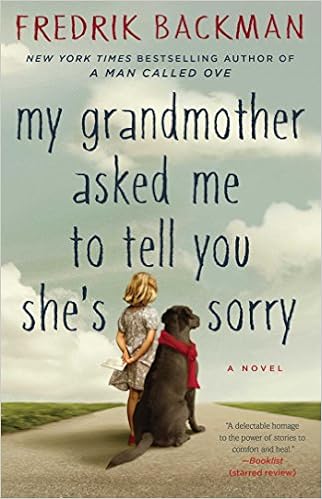
Fredrik Backman author of the acclaimed A Man Called Ove has found a successful formula, which once again emerges in My Grandmother Asked Me To Tell You She’s Sorry. The title is a successful attention-getter – certainly more so than the earlier book. Like Ove, My Grandmother Asked Me assembles diverse characters who are, initially, only tenuously connected.
The major difference between the two novels, though, lies in the main protagonist. Here it’s seven-year-old-soon-to-be-eight Elsa. Although there are plenty of explanations for her being so precocious, Elsa’s behavior, vocabulary and thought-processes, at times, leans more to incredulity than not. Her grandmother is partly to blame and mostly to be celebrated for the young girl’s sense of curiosity, intellect and strong sense of self. But, and this is no spoiler alert since the book cover reveals as much, the grandmother dies leaving Elsa to navigate a world where being different is difficult.
Elsa is charged with delivering a series of letters written by her grandmother. They’re for tenants in the building where Elsa lives but whom she barely knows. Wanna guess what happens?
Humor and pathos move hand-in-hand throughout the narrative, which also includes fairy tales of secret lands. Again, this is thanks to Elsa’s grandmother.
I found My Grandmother Asked Me to be less engaging that Ove, but nonetheless satisfying by its conclusion. Tying up loose ends isn’t always a bad thing. It certainly fits with Backman’s storytelling technique and his ability to create interesting characters full of foibles and heart.
My Grandmother Asked Me To Tell You She’s Sorry
Four Bookmarks
Washington Square Press, 2015
372 pages

Years ago I gave myself permission to stop reading books that couldn’t hold my interest. Nonetheless, I still struggle with the idea that once I start something I should finish it. As I slogged my way through Amy Bloom’s Away, I wondered when I’d set it down for good. I never did.
Bloom’s slow-paced story is about the determination of a mother’s love and the sacrifices she endures. It’s also a narrative about immigrants and fitting into not just new environments but adjusting to different customs and expectations.
Lillian Leyb is a seamstress living in New York City’s lower east end in 1924. As she becomes romantically entangled with her employer and his son, her past is slowly revealed. She left Russia where her husband and, presumably, her child were killed. Lillian becomes a kept woman until she learns from her cousin, a recent arrival from the homeland, that her daughter is still alive. Thus begins Lillian’s journey across the United States including the expansive Alaskan frontier en route to Siberia to find her daughter.
Lillian experiences both the kindness and cruelty of strangers; she’s befriended and betrayed. Bloom incorporates humor and pathos in Lillian’s trek by explaining what’s in store for those Lillian encounters – from her east end companions to those in a Seattle brothel and later a women’s prison in Alaska. Through it all, Lillian remains determined to find her daughter.
Although Away was no page-turner for me, I’m glad I stuck with it. It just took time.
Away
Three Bookmarks
Random House, 2008
240 pages

The heroics/horrors of war, tests of familial love and loyalty to one’s country merge in Kristin Hannah’s The Nightingale.
In Oregon 1995 an unnamed elderly woman prepares to move from her home at the insistence of her adult son. This sets in motion her recollection of life in France during World War II. At its heart, the novel is about the relationship between sisters Vianne and Isabelle, ten years her junior. Following the death of their mother, their father leaves them with a stranger. Despite their shared grief and sense of abandonment, the two have nothing else in common.
The war years show how, as adults, the sisters remain at odds. Vianne struggles to keep her daughter safe and maintain the family home after her husband goes to fight. Meanwhile, Isabelle wants a role in her helping her country overcome German authority.
The sisters’ personality differences are repeatedly described, yet the strained relationship doesn’t always ring true. Vianne acknowledges that she failed in her responsibility as the older sibling to help Isabelle; she attributes this failure to dealing with her own sorrow at the time. Isabelle has an air of entitlement – at least when it comes to emotions; this sense of privilege doesn’t follow her as she works with the French Resistance.
The novel progresses with the war; occasional interruptions remind the reader of the elderly woman. This becomes a guess-who exercise: who is it and how did she end up in Oregon. Only one of the questions is answered.
The Nightingale
Three-and-a-half Bookmarks
St. Martin’s Press, 2015
438 pages

I nearly quit reading Americanah by Chimanda Ngozi Adichie twice. The first time I thought about setting the book down for good was in the first 50 pages; the second time was 30 pages later. I’m glad I persevered, though.
At its heart, Adichie’s vast novel is a love story. It turns out to be so on several different levels: love for country; love between a man and a woman; love of self.
Perhaps part of my initial disinterest was the difficulty of keeping track of who was who; it wasn’t easy. Eventually, the voices and experiences began to sort themselves out becoming distinct and engaging.
Although the story is not told in chronological order, the narrative focuses on Ifemelu, a young woman who leaves Nigeria for America. This triggers a journey to find herself and to address the issue of race for the first time. In the process she leaves behind Obinze, the love of her life. His experience is briefly addressed, but Americanah is about Ifemelu more than anyone else.
The self-confidence and intelligence she exhibited in Nigeria serve her well in the U.S., despite some setbacks. Eventually, she becomes successful as a blogger writing about race. She also finds romance, but Obinze is never far from her mind or her heart.
Ultimately, Ifemelu returns to Nigeria. Ironically, just as she idealized America before her arrival, she idealizes the country she left behind. Disappointment exists, it seems, on both continents. In Adiche’s hand, hope is also present.
Americanah
Four Bookmarks
Anchor Books, 2014
588 pages