Archive for the ‘Books’ Category

Sweetbitter is a combination love story and homage to restaurant life, particularly servers. It’s far from reverent and certainly doesn’t offer a warm-hearted view of the front and back of house scenes. It demonstrates that working in a restaurant is often a lifestyle and not just a job.
Told from 22-year-old Tess’s point of view, Stephanie Danler’s novel is unflinching when it comes to sex, drugs and ego trips. Tess arrives in New York City from the Midwest. With only limited diner experience, she lands a job as a back waiter in an upscale Manhattan restaurant. She’s unsure of herself, has no true motivation, but still simply seems ready to get on with her life, whatever it may be.
The novel’s four sections are broken down by seasons beginning with a sweltering summer. As each progresses I was increasingly disappointed. Summer and fall had my full attention as I expected Tess to develop interests and become more confident. By the winter and spring segments, I was disappointed. Yes, Tess makes some self-discoveries, but they’re minor in the scheme of things.
Part of the problem is that Danler never makes Tess’s obsessive fixation on Jake, the bartender, tangible or credible enough. His relationship with Simone, an older server who, inexplicably, fascinates Tess, is a mystery waiting to be solved; but it lacks tension. Instead, predictability takes control, which is far more bitter than anything sweet Danler has to offer.
Sweetbitter
(Barely) Three bookmarks
Alfred A. Knopf, 2016
352 pages

For some reason it seems the stack of books on my nightstand never, ever shrinks. Some titles have been there for longer than I care to confess. When I saw that The Light Between Oceans has been made into a movie, it was time for me to rescue it from the mountain of titles. (If I decide to see the film I need to read the book first.)
Written in 2012, this is M.L. Stedman’s debut novel set off the rocky coast of Australia following World War I. The author provides lyrical descriptions of the harsh life of a lighthouse keeper, Tom, made more comfortable by the love and vibrant personality of his wife, Isabel.
Tom has returned from the war surprised and guilt-ridden by his survival. He is well suited to the solitary life on an isolated thread of land. It isn’t until he meets Isabel while waiting for his next lighthouse assignment that he realizes what’s been missing from his life. They marry, and after Isabel miscarries multiple times, they believe their hopes of having a family will elude them. That is until a small boat washes ashore with an infant child and a drowned man.
Tom wants to turn the baby over to authorities; Isabel does not. What follows is a succession of heartache and lies borne of love. Stedman’s characters are real, full of faults. She raises poignant questions for all involved and readers are left to consider what they might do in a similar situation.
The Light Between Oceans
Four Bookmarks
Scribner, 2012
343 pages

I planned on not reading Being Mortal, but plans have a way of changing. My reservations about author Atul Gawande’s best seller were linked to the subtitle: Medicine and What Matters in the End. This year I faced a milestone birthday and some health issues affected my family. All in all it seemed as if the good doctor’s book wasn’t for me. Yet, it was and it wasn’t; the best audience might be millennials. Of course, they’re not the only ones who will be, or are, impacted by their parents’ declining health and well being.
Gawande’s a surgeon who questions the way American culture treats the elderly. He offers several stark contrasts to the situation experienced by his 110-year-old grandfather in India who was respected, even revered, because of his age. He was acknowledged by anyone who entered the family home and consulted on major family issues.
Initially, Gawande focuses on nursing homes and retirement communities. He finds little to celebrate in this area despite efforts by a few individuals seeking better solutions. The author then turns to medical situations and the efforts people go through to extend their lives despite poor odds – odds often encouraged by physicians with the best intentions, albeit not necessary with the most honest answers.
Through encounters with caregivers including family members, Hospice personnel and the elderly, Gawande nudges readers to consider the ways to live life while growing older (or dealing with illness) as the best way to face the inevitable: mortality.
Being Mortal: Medicine and What Matters in the End
Three-and-a-half bookmarks
Metropolitan Press, 2014
282 pages

I hate to admit it, but I’m not as shocked as I once was by the barrage of images in the media revealing the plight of refugees from war-torn countries. The accounts of horror, squalor and multitudes are now commonplace. Thankfully, Nadia Hashimi’s fictional When the Moon is Low has shaken me from complacency in a way the reality no longer does.
This beautifully written novel follows Fereiba from her birth in Kabul to motherhood as she flees from Afghanistan with three children in tow.
Much of the narrative is first person voice as Fereiba recounts her life which begins when her mother dies giving birth. Her father remarries, but Fereiba is a motherless daughter in a country with little regard for women. She’s initially denied the opportunity to attend school, but eventually pursues an education and ultimately becomes a teacher. An arranged marriage provides her with the love, support and friendship she never experiences growing up.
With the rise of the Taliban, Fereiba fears for her family’s lives. What follows is an arduous journey, the kindness of strangers and the heartbreaking separation that occurs when she is forced to choose between waiting for her missing adolescent son, Saleem, and seeking care for sickly infant Aziz.
Midway through, Fereiba’s voice gives way to Saleem’s perspective as he tries to find his family. The goal is England where Fereiba’s sister lives. Saleem’s experiences are harrowing, but his determination is heroic in his efforts to reunite with his mother, sister and brother.
When the Moon is Low
Four-and-a-half Bookmarks
William Morrow, 2015
382 pages

Dinner with Edward is Isabel Vincent’s poignant tribute to an unlikely friendship that evolved for several years over elegantly-prepared meals.
Edward is the 93-year-old father of one of Vincent’s friends; his wife of 69 years has recently died. Vincent is in the midst of a rocky marriage. She is initially reluctant to meet Edward, after all he’s of another generation and she isn’t interested in taking on the role of caretaker. However, once they meet she comes to learn as much about herself as she does about cooking, dining, relationships and manners of a bygone era.
They begin to meet weekly at Edward’s apartment where he always has a martini glass waiting for her in the freezer and a gourmet meal to serve. Their conversations touch on recipes, Edward’s sweet memories of his deceased wife, Vincent’s job as an investigative reporter for The New York Post, her husband and daughter – among many other subjects.
Such a memoir has the potential to be sappy, but Vincent avoids this pitfall through the honest, albeit terse, descriptions of her own emotions and the imagery she creates based on the memories Edward shares with her. This is not a romance in the physical sense, but in an emotional one.
Each chapter begins with a menu Edward prepared. It always includes a dessert and the wine served. It isn’t a good idea to read this on an empty stomach.
More than anything, Vincent shows that the sustenance food provides goes well beyond what’s on a plate.
Dinner With Edward
Four Bookmarks
Algonquin Books of Chapel Hills, 2016
213 pages

One house, 13 siblings, ghosts and the city of Detroit provide the foundation for The Turner House by Angela Flournoy. Thank goodness she provides a family tree to keep track of Francis and Viola Turner’s offspring. It helps that much of the present-day story focuses on Cha Cha, the eldest of the Turner children, and Lelah, the youngest. They’re separated by 23 years; their issues are familiar but not quite cliches.
Flournoy also takes the reader back to 1944 when Francis leaves Viola and young son in his rural Arkansas hometown to seek a better life in Detroit. Francis plans to send for his family once he’s settled. He stays away for more than a year, leaving Viola to consider other options.
This backdrop is interspersed with how the family has coped through the years. Francis is dead, Cha Cha has grandchildren of his own; even Lelah is a grandmother. Few have intact marriages or relationships, yet the family is close-knit. The house, the one in which all 13 Turners grew up, is empty and fallen into disrepair. Viola is no longer well enough to live on her own; she lives with Cha Cha and his wife in the suburbs.
The house, vividly described with Pepto Bismo pink bedroom walls, narrow stairs and large porch reflects the rise and fall of Detroit. Once alive with the large family’s comings and goings, its monetary worth is practically non-existent. The brothers and sisters, though, are mixed in their assessment of its sentimental value.
The Turner House
Four Bookmarks
Houghton Mifflin Harcourt, 2015
338 pages

A friend has talked about Louise Penny whodunits for years. I finally decided to check out the appeal for myself. The real mystery is what took me so long?
Using humor, a strong sense of place and an exceptionally-likeable main character in the form of Inspector Armand Gamache, Penny has a formula for success. In Still Life, her first foray into the genre, Gamache is brought in from Montreal to investigate the murder of a well-liked member of the small community of Three Pines.
There is an abundance of rcharacters for such a small town, which is actually more of a village. The only one I found extraneous was Agent Yvette Nichol, who is part of Garmache’s team. She’s new to investigation and it’s clear the inspector hopes to serve as her mentor. Through a series of misunderstandings and her own stubborn nature, Nichol falls short of everyone’s expectations – including her own.
The murder and subsequent efforts to solve it are intriguing. The victim, Jane Neal, is offed early (as in the first few sentences), yet Penny imbues a strong sense of amiability in her. Neal is later seen through the eyes of her friends, so even though she is not a “living” character, she remains a prominent one throughout the novel.
The pool of possible suspects is large with plenty of nuance and depth. Of course, it’s Gamache whose intelligence, sensitivity and humor are enough to make me want to read more about him and the investigations he leads.
Still Life
Four Bookmarks
Louise Penny
St. Martin’s Paperbacks, 2005
293 pages

Anthony Marra is the master of foreshadowing. At times he’s subtle, then he’s as obvious as an agitated teenager reeking of cigarettes claiming he doesn’t smoke. This was true of his first novel, A Constellation of Vital Phenomena, and follows suit in his most recent: The Tsar of Love and Techno.
Marra has chosen a similar setting in Russia with another interesting cast of characters; however, he spans more time, beginning in 1937 continuing to present day. He expands the setting from Siberia to Leningrad/St. Petersburg to Chechnya: landscape is a crucial element.
The narrative begins with an artist in the propaganda department whose job is to erase enemies of the state whose images appear in paintings and photographs. He does this by blotting out faces with ink or by painting something new, which is often his dead brother’s face. It appears in a myriad of scenes representing various phases of his life: child, teenager, middle age and old age.
With each chapter comes a new narrator, in a different setting providing a singular element to the overall novel. The stories are a progression. It’s no spoiler alert to note that the pieces do eventually fit together (very well). Even if they didn’t, Marra’s writing is full of wit and pathos. The images of the pollution-wreaked mining community in Siberia are stark and frigid; just as a Chechnyan hillside is pastoral and warm. The men and women introduced by the author are so human their breath practically turns the pages.
The Tzar of Love and Techno
Four bookmarks
Hogarth, 2015
365 pages
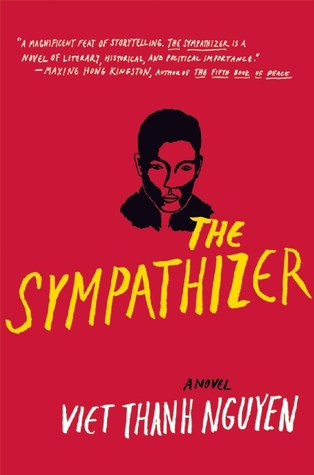
Even with plenty of objectionable characters and situations, it’s easy to empathize with the narrator, known only as the captain, in Viet Thanh Nguyen’s The Sympathizer.
The captain is the sympathizer; he’s an undercover agent in Viet Nam just as the country falls to communist rule in 1975. Nguyen’s writing is of the step-on-the gas and honk-the horn variety. It’s thrilling, witty and poignant. It demands well-deserved attention.
The captain receives orders from his communist handlers to travel with a South Vietnamese general as part of his entourage to the United States. They’re among those on the last planes to leave the war-torn country. It’s in the captain’s nature to consider both sides and see the value and downsides in each. He is the son of a Vietnamese woman and a French Catholic priest. This and his western education make him an outcast. In Nguyen’s hands, the captain is kind, albeit sarcastic, and exceptionally intelligent. It’s not difficult to understand his situation.
It’s clear from the beginning that the captain has been caught. Most chapters begin addressed to the commandant and it eventually becomes clear that the captain is recounting the days that led to his capture. However, this is not before the captain’s loyalty to his friends, his love for his mother and a handful of questionable decisions and actions are detailed.
The aftermath of war, the stigma of not fitting in and the lengths people go through to survive are all addressed by Nguyen in this compelling narrative.
The Sympathizer
Four-and-half Bookmarks
Grove Press, 2015
367 pages
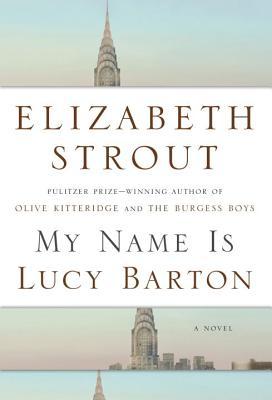
My Name is Lucy Barton is a statement and not only the title of Elizabeth Strout’s new novel. It’s an affirmation as Lucy reflects on the relationship with her mother, which is like a faulty wire: occasionally there’s no connection.
Lucy is from a rural Illinois town where growing up her family lived so far below the poverty line as to make it seem something to attain. Lucy’s life is revealed as she lies in a hospital bed with a view of the Chrysler Building in New York City talking with her mother whom she hasn’t seen or spoken with in years. Strout is methodical as she merges Lucy’s past with the present.
The rich, stark pacing and imagery serve to expose family dynamics in the narrative. That is, Strout’s writing provides enough detail to shape a situation or character, but not so much that there is little left to the imagination. In fact, this is what makes some aspects harrowing: imagining what life was like for young Lucy. She lived with her older siblings and parents in a garage until age 11.
Her mother’s brief presence provides the vehicle to see Lucy’s past; the extended hospitalization gives Lucy time to consider her adult life as a mother, wife and writer.
Lucy should despise her parents and her past, yet she doesn’t. Her family was shunned and her parents were apparently abusive in their neglect. Lucy is grateful for her mother’s presence. The mother-daughter bond, at least from Lucy’s perspective, overrides past sins.
My Name is Lucy Barton
Four and a half Bookmarks
Random House, 2016
191 pages

 The Blue Page Special