Author Archive

I am humbled and surprised when I run into someone who tells me my blog is enjoyable and a good place to learn about books (and restaurants when I write about them). When I started The Blue Page Special nearly three years ago, that’s what I hoped for. What’s even better is when one of my readers shares a book title with me, introducing me to a new author or genre. Such is the case with The Rosie Project by Graeme Simsion.
Simsion presents Don Tillman: a nerd. This renowned genetics professor at a Melbourne, Australia, university has created a life so structured that all of his activities are scheduled to the minute. He finds the slightest deviation unnerving. This, along with his intelligence and inclination to view the world through literal eyes, makes him socially inept.
Nonetheless, he decides it’s time to find a life partner and creates the Wife Project, complete with a multi-point questionnaire which has no place for romance. That is until Rosie Jarman, a graduate student in psychology, unwittingly becomes a candidate in the project. Don quickly dismisses her as a viable contender because of what he perceives as her many (human) faults.
The novel is predictable which might warrant a spoiler alert, but I encourage reading it anyway. Don’s voice and personality quirks are well-developed — complete with a few laugh-out-loud moments. Also, Rosie’s criticism that the Wife Project objectifies women is unarguable. Yet, the premise results in a fun read where transformations occur on several, some even surprising, levels.
The Rosie Project
Four Bookmarks
Simon & Schuster, 2013
292 pages

Coming of age can be a mystery, and Karen Brown has combined the two genres in The Longings of Wayward Girls.
The story begins with a 1974 news clipping about the abduction of a young girl, Laura Loomis, and moves back and forth between 1979 and the early 2000s. Laura remains a mystery throughout, while other secrets surface its place. The narrative instead focuses on Sadie Watkins as a creative, energetic young teenager and later as a married mother of two. It hardly seems possible that the two characters are the same; the adult Sadie lacks imagination. That is, until Ray Filey returns to town.
Set in a rural New England community, Brown’s descriptions of the landscape and close-knit neighborhood are intriguing and easy to visualize. The novel is also evocative of a time when parents thought nothing of letting their children roam nearby woods and streets. Or, when parents (in this case, mostly mothers) chain-smoked and drank their way through summer afternoons and evenings.
Sadie teeters on the edge of being a mean girl with childhood friend, Betty, following her lead. Ray is a few years older than Sadie. As a girl she was aware of his presence, although he was never part of her circle of friends. His interest in her as a woman is intriguing, but Sadie’s response to his appearance doesn’t entirely make sense, nor do her actions. However, Brown’s merging of the two themes does offersenough interest to see the novel to its conclusion.
The Longings of Wayward Girls
Three-and-a-half Bookmarks
Washington Square Press, 2013
337 pages
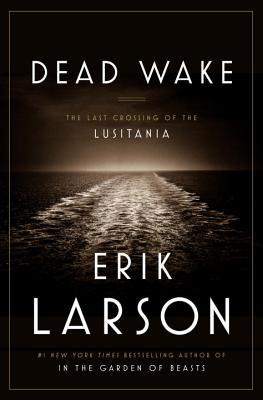
It takes Erik Larson about 100 pages to finally let the Lusitania set sail from New York City in May 1915. Dead Wake, his account of the doomed luxury liner, is exhaustive in detail and detached in its descriptions of the events leading to its historic sinking. No need for a spoiler alert here; many consider the German sinking of the Lusitania is what ultimately led the United States to join the British and French allies in World War I.
Larson’s research on the subject is thorough (there are more than 50 pages of notes). He addresses everything from the backgrounds of the ships’ captains involved, to the weather leading up to the point the ship left sight of land, to how the dining room was decorated for first class passengers. There’s more: brief bios about passengers, history of submarines, how Cunard came to name its fleet, and even Wilson’s love life as he strove to maintain neutrality for the U.S. even as events continued to escalate in Europe.
While it is heartbreaking to know that a record number of families with children were on board, the concise elements Larson provides about the passengers makes it difficult to have a true sense of their characters. This does not mean the event was less tragic, just that the book offers little except a historic narrative.
As with any tragedy, fingers pointing blame are plentiful; Larson offers numerous what ifs, which, of course, do nothing to change the course of history.
Dead Wake
Not-quite-three Bookmarks
Crown Publishers, 2015
430 pages (including notes and index)

In The Sunlit Night by Rebecca Dinerstein, the never-setting sun has such a significant role that it’s practically a character alongside almost-18-year-old Yasha and 21-year-old Frances. These are not star-crossed lovers; in fact, they’re quite lucky. Their story begins with the two in New York City. They don’t meet until circumstances put them on a small island in the Norwegian Sea near the Arctic Circle.
Initially, the chapters alternate between Frances and Yasha’s voices. Eventually, they merge into one. Dinerstein evokes a strong sense of place in the isolated far north as the two find each other. As with any love story, there are obstacles including dysfunctional families, complicated backstories and quirky sub-characters.
Frances leaves Manhattan for a Norwegian artist’s community. Yasha arrives soon after to fulfill his father’s dream. Perhaps the most engaging part of the narrative is the life Yasha and his father have running their bakery in Brighton Beach. This is something they’ve done since immigrating from Russia 10 years earlier. Yasha’s mother, Olyana, was to join them; years pass and the family is never reunited.
Still, Olyana is among those in the quirky classification (it’s actually a long list). She’s an important part of the story, not only because she’s the mother of a protagonist but because of her lengthy absence as such. Meanwhile, Frances has family issues of her own. Among other things, her eccentric parents are separating.
Dinerstein injects humor with captivating prose to create something more than a tale of young love.
The Sunlit Night
Not-quite-four Bookmarks
Bloomsbury, 2015
249 pages

Although it’s only been in the hands of the general public for little more than a month, the reviews for Harper Lee’s Go Set a Watchman have been mixed. Now I see why, it’s difficult to know whether this is because long-standing images have been shattered, if the story is less engaging or if the writing simply isn’t as strong as To Kill a Mockingbird: an integral part of American culture since its publication 55 years ago. The 1961 Pulitzer Prize winning novel is still taught in classrooms, and Gregory Peck’s portrayal of Atticus Finch in the movie adaptation remains iconic.
Jean Louise Finch, aka Scout, returns to Maycomb, Ala., from New York City. Atticus is ailing and many of the familiar characters from Mockingbird reappear to remind Scout, and readers, how some things change and some never do.
Scout’s memories are mixed with her current day events as she begins to see her hometown and, especially, her father in a new, unflattering light.
My take is that the story, albeit worth reading, is less engrossing due to lackluster prose. In fact, I found it easy to put down and had to remind myself of its imminent library due date.
Racism and human imperfection are looming themes. Given what’s happening across the country, the former continues needing to be more openly addressed. Perhaps it takes seeing Atticus Finch as a racist, despite his efforts at justification, for us to see the deep-rooted problem. As for the latter, that’s something we just have to accept.
Go Set a Watchman
Three-and-three-quarter-bookmarks
Harper-Collins, 2015
278 pages

Our youngest son recently graduated from Knox College; I’d been vaguely aware of it years before because of Sixteen Pleasures, a book I enjoyed for its setting (Florence, Italy) and strong female narrator. This same son gave me an autographed copy of Hellenga’s most recent work, The Confessions of Frances Godwin, which had been languishing on my nightstand far too long.
The setting is mostly Galesburg, Ill., with Knox figuring prominently; other locales include Milwaukee, Rome and Verona. With Frances, Hellenga introduces another female narrator. I admit I’m intrigued by his ability to create such true female voices.
It’s 2006 and Frances has retired from a career as a high school Latin teacher. At first, the novel appears to be a vehicle for her to reflect on her past because she soon recounts how she met her husband, Paul, a Shakespeare scholar from whom she took classes (at Knox). She tells of their affair, their eventual marriage and life together in Galesburg. They have a daughter, Stella, who as a grown woman appears to make a series of bad choices when it comes to men.
The story is occasionally heavy handed. Consider, Frances’ name: Godwin. Several times, she converses with God, who, among other things, entreats her to go to confession. By this point it’s clear that she does have more than a few things to own up to.
Love and guilt are not unusual companions; for Frances, they’re a large part of who she is.
The Confessions of Frances Godwin
Four Bookmarks
Bloomsbury, 2014
305 pages

We learned about TIGHT in Copenhagen the last night of our vacation and we wanted the momentum of our fun travels to continue. We were initially told to expect a 45-minute wait – maybe longer. We considered going elsewhere. Instead, our fatigue from a full day of sightseeing compelled us to relax on a nearby bench.
It wasn’t long before Willie, our host and server, had a table ready. Although the place was hopping, he gave us his full attention throughout the evening. Unlike other places we’d dined while in Scandinavia, TIGHT was the first where English was the dominate language. The menu reflected a more international range: from foie gras to barbecue ribs.
We started with potato croquettes. These thick cakes of mashed spuds seasoned with green onions, dill and other spices were served with a tangy remoulade. The plating on slabs of black slate was stunning.

Still in the mood for Danish flavors, I chose salmon with new potatoes, asparagus and a green “mojo” sauce drizzled with a balsamic glaze. The fish was cooked to flakey perfection. I cleaned my plate; even Willie commented on this. My husband selected the half-slab of ribs, which were tangy and smoky.

We should have stopped there, but were so intrigued by the Nanaimo Bar that we couldn’t resist the chocolate-coconut-crumb base layered with rich vanilla cream and topped with a layer of crispy chocolate. House-made pecan-maple ice cream further upped the decadence level.

Our last dinner in Copenhagen did not disappoint.
TIGHT
Four-and-a-half Plates
Hyskenstræde 10, 1207 København K

Hot dogs certainly are considered an all-American food, but they’re equally popular in Scandinavia. And they’re served more creatively.
While in Sweden we never had a chance to try a West Coast Special. This version features mashed potatoes, mustard and shrimp on a mound of mayo. Our timing was always off. We’ll do better on our next visit.
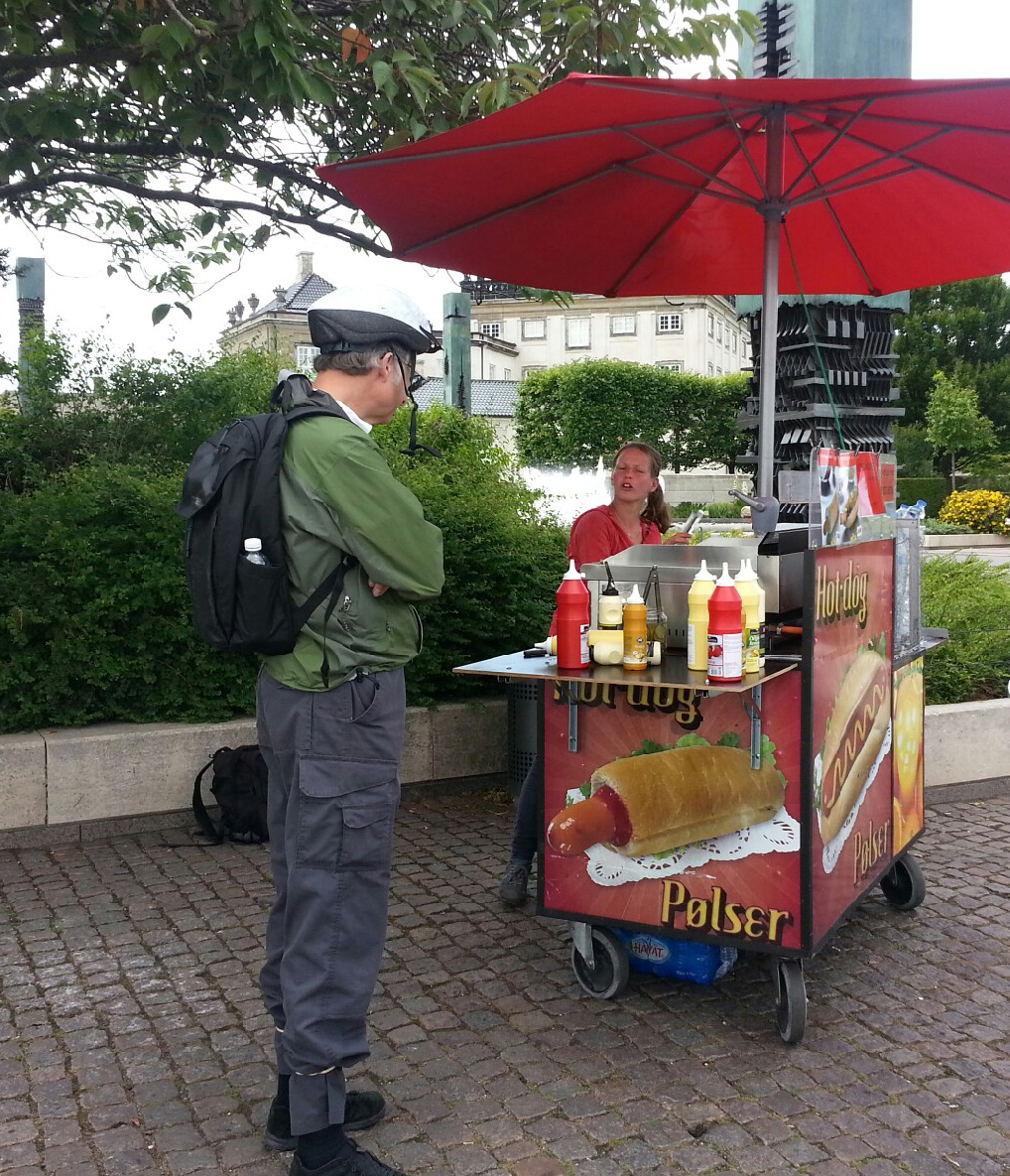
In Copenhagen, we made it a point to have hot dogs, known as polsers. We noticed most of the hot dog carts, found throughout the city, featured two options: the Ristet or the Fransk The former is known as a red frank. It’s topped with sweet pickles (think bread and butters), crispy fried onions and a choice of sauces; I went with remoulade. Ketchup, mustard and mayo are other possibilities.
The Fransk is a long dog that’s inserted into a hallowed out bun and extends a few inches over both ends. I never did figure out how condiments are added.

The fried onions and the pickles provided texture to the Ristet; the remoulade, something I associate more with crab cakes than hot dogs, added a sense of sophistication. The meat itself was juicy and it was too good to worry about possible additives.
At home, I usually only eat hot dogs at baseball games. It seems an appropriate thing to eat at such an all-American sporting event. It was fun in Copenhagen to hop off our bikes and stop for a hot dog. That, apparently, is a typically Danish thing to do.

Our Swedish hosts are practically family; several years ago their son lived with us for a school year as part of an exchange program. He became my Swedish son. We stayed in touch; they’ve visited us twice since Pete was with us. Our trip was a chance to see the places we’d heard about; his parents wanted to treat us to a surprise, in addition to graciously opening their home in Gothenburg and showing us the sites.
The surprise was a two-day trip to Stockholm topped off with a special dinner at Erik’s Gondolen, known for its 33-meter high view of the harbor and fine cuisine. Neither aspect disappointed. As previously noted, dining companions always add much to the experience.

The Pancetta Wrapped Hake was too difficult to resist. The mild, flakey fish wrapped in bacon featured soft-as-butter scallops floating in a pea and parsley cream surrounded by a subtle artichoke foam. It was almost too artistic to eat. Almost.

Gondolen’s Classic Fish and Shellfish Casserole was reminiscent of cioppino, a fish stew. Two orders of the Fried Rack of Lamb with Brisket Sausage completed our order. As much as enjoyed one another’s company, we spoke very little while eating. Our server recommended spot-on wines to pair with our dishes.

We easily could have left after finishing our entrees, but cloudberries called. These amber-colored, raspberry look-alikes were tart and nicely complimented by house-made vanilla ice cream.

The memories include the view, the food and the friendship.

Erik’s Gondolen
Five Plates
Stadsgården 6 (Slussen)
Stockholm 104 65
Sweden

Kent Haruf’s Plainsong is among my favorite books. I haven’t read any of his other works for fear, I think, I’d be disappointed. After reading Benediction, one of the author’s last works before his death in late 2014, I realize I had no cause for worry.
Set in the (fictional) rural town of Holt, Colo., this is an agreeably slow-moving, intimate portrait of the bonds between families and community. The first paragraph sets the tone: Dad Lewis, a long-time resident of Holt and owner of the hardware store, receives the news that he’s dying of cancer. In his dying days, his grown daughter returns home to help; longtime friends and neighbors drop in to visit; and a few flashbacks surface to help tell the story of an imperfect man, beloved by his wife and daughter, estranged from his son, who tried to do his best.
The beauty of Haruf’s writing is that he provides just enough detail to hold the reader’s attention without overwhelming the imagination. That is, situations appear with gaps of information like potholes on a dirt road. Eventually, they get filled.
Interactions with those Dad has known for years intersect with a few new residents to Holt: the preacher and his family, including an angry teenage son and an even angrier wife. The young granddaughter of the woman across the street is another significant character. It would be heavy handed to feature a new-born, but Haruf’s circle of life is gripping, lyrical and not at all mawkish.
Benediction
Four Bookmarks
Knopf, 2013
258 pages