Archive for June 2018

Admittedly, I knew nothing about pachinko before reading the book of the same name by Min Jin Lee. The first mention of the popular Japanese pinball-like game doesn’t surface until halfway through this epic novel spanning four generations.
It begins on a small Korean island in 1910 and progresses rapidly several years later following the birth of Sunja, the only daughter of a poor, disabled innkeeper and his wife. Times passes quickly; soon Sunja is a teenager helping her widowed mother run the inn: a glorified name for a shack with paying guests. Tension between Korea and Japan contributes to the dire economic straits.
Sunja discovers she is pregnant and her lover is married. The arrival of a young man, ill and en route to Japan to serve as a minister, changes the course of her life. They marry, move to Osaka and live with his brother and sister-in-law.
History converges with their story as war, famine and prejudice dictate their lives: Koreans are considered less than third-rate citizens.
The family’s ability to survive depends largely on an unknown benefactor, reminiscent of Great Expectations. Heartache ensues once the identity is revealed.
The novel is rich with characters reflecting both the intolerant attitudes of many Japanese and the cultural constraints of Koreans living on foreign soil.
This is a bulky, albeit well-paced, joyful and heart wrenching story with a historical perspective. The game is an apt title since much of life is left to chance while bouncing around from situation to situation.
Pachinko
Four-and-a-half Bookmarks
Grand Central Publishing, 2017
490 pages

History has already documented the atrocities of World War II at the hands of Adolf Hitler. In addition to the horror, his idiosyncrasies and his death are well detailed. Nonetheless, author V.S. Alexander has one more story to add to the fiction side of the scales: The Taster.
Magda Ritter is adrift in war-torn Berlin. With no job or romantic prospects, her parents send her to Berchtesgarten in the German Alps to escape the bombing – to ensure her safety. Their efforts succeed but not the way Magda imagined. She’s assigned to taste Hitler’s food to ensure it’s safe for him to eat.
Alexander describes the bucolic life at Hitler’s mountain retreat, the Berghof, where much of the novel is set. It’s a stark contrast to other parts of Germany. Initially, Magda is frightened by her responsibilities, but she soon realizes they are keeping her and her family alive. Still, she is repulsed by the knowledge that by tasting Hitler’s food she is keeping him safe.
The focus of Alexander’s narrative is Magda who falls in love with Captain Weber, a conspirator within the SS. The cook, other tasters and Eva Braun, Hitler’s mistress, are among the interesting characters with whom Magda interacts. Feelings of mistrust, a constant cloud of fear and the blind devotion so many had toward the Fuhrer are well developed.
Alexander notes this is a work of fiction, and his research is chillingly thorough. Knowing Hitler’s death is imminent does little to dispel the thriller he creates.
The Taster
Four Bookmarks
Kensington Books, 2018
320 pages
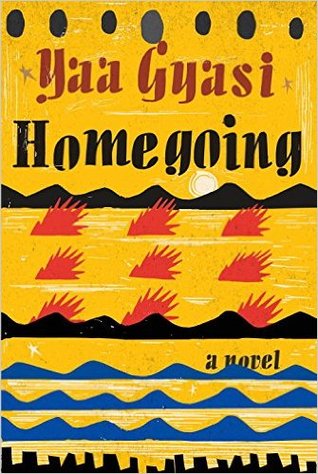
At first, Homegoing by Yaa Gyasi seems more like a collection of short stories than a novel and that, along with the title, is part of its beauty.
Spanning more than 300 years, this is an epic tale of the evolution of a family. Each chapter focuses on a specific character and could be a stand-alone story. Fortunately, a thread connects one to the other, even though there are some knots and loops along the way. These simply enhance the narrative. There is a chronology but not in the traditional sense.
In 18th century Ghana, Effia, the young beautiful daughter of a village chief is married to an Englishman, where she lives in a castle. She’s unaware that her half-sister, Esi, is imprisoned in the castle dungeon as a slave to be sold and sent to America.
The author traces, through the years, the lives of the sisters’ descendants as they experience warfare among Ghanian tribes, plantation slavery, British colonization, the migration from Alabama to Harlem, and more.
Gyasi provides portraits of 14 distinct main characters and a supporting cast of dozens more. Each is nuanced through his or her experience, determination and environment. Almost equally important are the landscapes; the element of place shapes the individuals in ways that can’t be ignored. There are lush and harsh jungles, shorelines, cotton fields, inner-city Baltimore, Alabama coal mines and smoky jazz bars.
Survival and the strength of family ties resonate in every chapter as each character takes a turn in the spotlight.
Homegoing
Four Bookmarks
Alfred A. Knopf, 2016
305 pages

The month-long Los Angeles Times Food Bowl is over. I was there for a week and participated in three and a half (I’ll explain this) events. My clothes are still a little snug even though only one of the activites I attended did not involve eating. That was the Q&A session with cookbook author Nadine Levy Redzepi and LA Times dining critic Jonathan Gold.

She’s married to chef Rene Redzepi of Noma fame. Although she works with her husband at the Copenhagen restaurant, Nadine deserves her own spotlight thanks to her new cookbook, “Downtime.” The recipes, designed as easy-to-prepare, flavorful and for simple at-home dining, are what she serves family and friends.
Nadine’s intelligence, passion for food and humor shone during the hour-long discussion. Gold’s questions and demeanor were less impressive. Clearly he knows food, but his interviewing skills could use some work – along with his wardrobe.

Nadine’s interest in food developed well before meeting her husband. Her parents were buskers and when they had a particularly good day in earnings, the family celebrated by going out to a nice meal. “Food was an adventure for us,” she said. Her talk, and her cookbook, let the audience share in the fun.
Oh, that half event: gelato at Gelateria Uli which participated in the Food Bowl by offering different flavors suggestive of Los Angeles. It was horchata the day we stopped in, but I was too tempted by other flavors: white chocolate banana and peanut chocolate chip, for example.
Gelateria Uli
541 S. Spring St.
Los Angeles, Calif.




 The Blue Page Special