Archive for the ‘fiction’ Tag
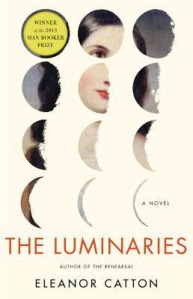
I’ve written once before about giving myself permission not to finish a book. I usually make the decision within the first 50 pages. I just stopped after 360 pages of Eleanor Catton’s 830 page tome, The Luminaries. The strange thing is, I will probably finish. Someday. Not now though; I have too many other books on my nightstand, and the library copy I’m reading is already overdue.
I can’t say it took me more than 300 pages to get into the 2013 Man Booker Prize winner, but it was no easy trek to make it that far, which is not even halfway.
The tale begins in January 1866 when Walter Moody arrives in a New Zealand mining town seeking his fortune. His first night in town finds him among 12 men ready to discuss a series of events to which they are all directly or tenuously connected. Catton pays meticulous attention to detail. Each character is exhaustively described from appearances, mannerisms, likes, dislikes, self-perceptions and reputation. Moody and company aren’t the novel’s only characters: a few women of mystery and ill-repute and several men who have either died or gone missing are also fastidiously introduced. Yet.
The relationships through business, friendship and happenstance actually do make for an interesting story. Hidden gold, lost fortunes, prejudices and the association of the characters is a maze. while easy to follow from one possible explanation only to be thwarted by another, is eventually, and finally, enthralling. I just hate to have library fines.
The Luminaries
Undecided on Bookmarks
Little, Brown and Co., 2013
360 pages of 830

Bread & Butter is bound to appeal to foodies. Author Michelle Wildgen combines her talents as a writer with her past restaurant experience to tell the story of three brothers with two competing eateries in their hometown.
Leo and Britt have been running Winesap, their fashionable restaurant for more than a decade. When their younger brother, Harry, returns home they find it difficult to be enthusiastic about his plans to open another upscale establishment in a weak economy. Yet, it’s not just the competition that has the older two apprehensive. Harry has bounced around from educational pursuits to various jobs in the years since he’s been gone. Leo and Britt are certain Harry lacks the stamina, knowledge and commitment to run a successful business. They see him as a neophyte, and Harry, who wants their support, is driven to prove them wrong.
Wildgen has created likeable, sometimes exasperating, characters whose voices and situations ring true. Eventually, Britt signs on as Harry’s partner while maintaining his front-of-house role at Winesap. Tensions mount as expectations, many unfounded, lead to several surprises when Harry’s place opens for business.
Descriptions of food, prepping for dinner service and the relationships among the employees (and owners) are vivid and realistic.
Ultimately, the siblings have credible culinary chops; they also have difficulty relinquishing family issues precipitated by birth order. This tends to bog things down a bit. Wildgen emphasizes that sometimes family members are often seen as what we want them to be, rather than who they truly are.
Bread & Butter
Three-and-a-half Bookmarks
Doubleday, 2014
314 pages

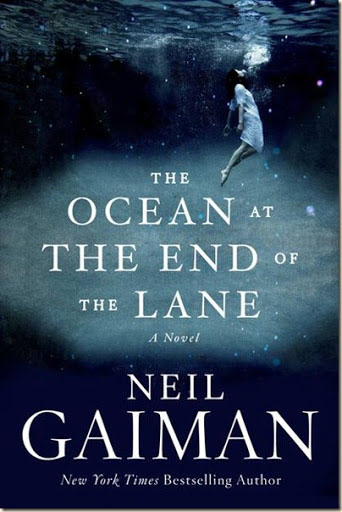
Part Harry Potter, part Alice’s Adventures in Wonderland, The Ocean at the End of the Lane by Neil Gaiman compels the reader’s imagination to relinquish, among other things, fear of the unknown. It’s worth the little effort needed to suspend belief, but Gaiman makes it very easy through his sensitive story telling that mixes memories, nightmares, and hope into one gripping tale.
The story begins as the narrator returns to his hometown for a funeral. He recalls how 40+ years earlier as a shy, reclusive seven-year-old he is befriended by Lettie Hempstock, who lives with her mother and grandmother. The boy has no friends, but Lettie, who is four years his senior, draws him out of himself. It’s Lettie who believes the pond on her family farm is an ocean.
At the same time, a nanny, Ursula Monkton, arrives in the boy’s home. It will come as no surprise that Ursula isn’t what she appears to be. In fact, she appears as many things. Lettie becomes a protector who in the process of caring for her young charge takes on numerous risks – dangers the young boy would never face on his own, but who willingly approaches them with Lettie.
Gaiman blends magic, mystery and the passage of time into a single cauldron where dreams, recollections and reality are hard to distinguish. The now-grown man finds himself at the Hempstock farm with whom he initially believes is Lettie’s mother since it’s unlikely, in his mind, that Grannie Hempstock is still alive. Yet.
The Ocean at the End of the Lane
Four Bookmarks
William Morrow, 2013
181 pages
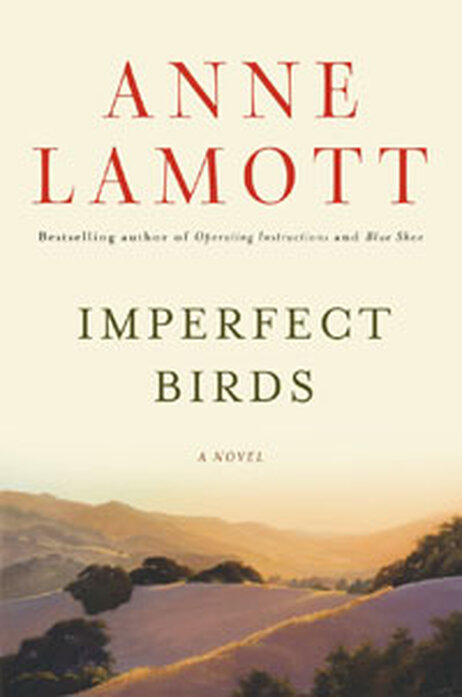
Anne Lamott’s Imperfect Birds is either a wake-up call or a near-miss experience for parents and their kids. Either way, it’s a disheartening look at teenagers, parenting, and community. The first paragraph sets the tone: “… a teenager died nearly every year after a party and kids routinely went from high school to psych wards, halfway houses, or jail.” The first thing I’d do is move, no matter how idyllic the little town, where the story’s set, with its appealing proximity to San Francisco.
Lamott writes with purpose, honesty and humor. Yet her characters are not likeable. Rosie is an entitled high school senior, facing real and difficult situations where peer pressure, availability of drugs, and opportunities for sex are abundant. Elizabeth and James, Rosie’s mother and stepfather, know these dangers exist, but are reluctant to parent. Why should they? Rosie’s a good student and involved at church. Plus, as a consummate liar she successfully overrides her parents’ arbitrary concerns.
It doesn’t help that Elizabeth is a recovering alcoholic – except it should. She shouldn’t be such an easy mark. James doesn’t fare much better, although he tries. Elizabeth’s fault is her desire to be Rosie’s friend first and parent second. The book does lend itself to a discussion about parenting.
If Lamott’s goal is to show how blind loving parents can be, she’s successful. When Elizabeth and James finally see the light, it’s not through their personal epiphanies, rather from Rosie forgetting to keep the wool over her own eyes.
Imperfect Birds
Three Bookmarks
Riverhead Books, 2010
317 pages

Easy to visualize characters, plots driven by class conflict, issues of the heart (or both) and a very proper sense of, well, what’s proper are what make English Lit so appealing to me. Yes, the above could easily refer to classic British literature, but it also applies to Helen Simonson’s Major Pettigrew’s Last Stand – a very contemporary work.
Simonson’s novel begins with a chance meeting between the Major (his first name is Ernest, while apt doesn’t fit him as snugly as his military title) and Mrs. Jasmina Ali, a Pakistani shopkeeper. Although their paths have crossed in the past, this encounter comes at a vulnerable point in the Major’s life: he’s just learned of his brother’s death. What follows is the evolution of a friendship based on a passion for books and widowhood.
Both characters are thoroughly engaging. The Major in his stilted, decorous yet sensitive manner has appeal, and Mrs. Ali is an exceptionally intelligent woman burdened by a certain sadness associated with being considered an outsider in her home country. Simonson portrays people we know or would like to; they’re well-defined individuals with foibles, principles and dreams. The cast of lesser characters, including Roger, the Major’s obnoxious status-seeking son, enhance the story.
The novel moves at a leisurely pace as the Major and Mrs. Ali embark on a relationship that puts a spark in their step and ultimately has tongues wagging throughout the village. Simonson clearly enjoys thumbing her nose at what’s considered suitable or not.
Major Pettigrew’s Last Stand
Four Bookmarks
Random House Trade Paperbacks, 2011
358 pages (not including the Reader’s Guide)
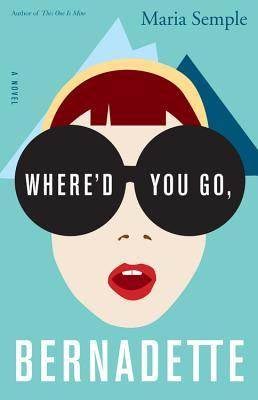
Where’d You Go, Bernadette by Maria Semple is engaging, funny, poignant, and even a bit silly. Set primarily in Seattle, the story also includes a few situations in Los Angeles and the Antarctic as Bernadette Fox tries to ward off a nervous breakdown in an environment seemingly designed to push her over the edge.
Bernadette is a semi-misanthrope; she dislikes nearly everyone except her husband, Elgie, and their daughter, Bee. Bernadette doesn’t make it easy to like her. She refuses to get involved with the parent groups at Bee’s school, and she avoids interaction – no matter how casual – with others to such an extreme that she relies on a virtual personal assistant who lives in India.
Semple has created an appealing dysfunctional family that has trouble meshing with an often-dysfunctional world. Bernadette, a one-time architect, is, in fact, a genius; she’s a past recipient of a McArthur Foundation Genius Grant. But she responds to stressful situations through radical reactions, including disappearing. Bernadette’s story is told through emails, letters and mostly Bee’s eyes. Bee is no intellectual slouch herself. She’s convinced there’s a logical explanation for her mother’s absence. And here’s where the real adventure begins as Bee sets off to find Bernadette.
Russian spies, potential identity thieves, private school students, and parents blind to their children’s excesses and foibles are just a few of the extras populating Semple’s novel. There are plenty of laugh-out-loud situations as well as a few shoulder-shrugging moments as Bee, who has a very good understanding of her mother, refuses to stop looking.
Where’d You Go, Bernadette
Four-and-a-half Bookmarks
Little, Brown and Co., 2012
326 pages

Shilpi Somaya Gowda’s first novel, Secret Daughter, is about families – especially mother-daughter relationships. Two women, one unable to have a child and the other unable to keep hers, are the primary focus – along with Asha, the daughter given up by one and adopted by the other.
Somer, a pediatrician in the San Francisco Bay area is married to Kris, a surgeon originally from Mumbai. Across the world in an Indian village, Kavita gives birth to a daughter she knows her husband does not want, and will not let her keep. Although the women never meet their lives are unwittingly bound when Kavita leaves her child at an orphanage. Through a series of coincidences that often only occur in fiction, the girl, Asha, is adopted by Somer and Kris.
Gowda’s narrative moves from the Bay Area to Mumbai, as it shifts from one woman’s perspective to the other, before, thankfully, settling on Asha. Somer‘s character is whiney and distant; Kavita is mostly sad and compliant. Despite environment and genetics working against her, Asha grows up to be an intelligent, inquisitive young woman. That’s not to say, she is flawless. At her worse, as a teenager, she is rude and insensitive; at her best, as a college student interning at a Mumbai newspaper, she is empathetic and appreciative. Of course, it takes time for the latter qualities to evolve.
Gowda’s writing is strongest describing the contrasts between India’s wealthy and the destitute. The colors, sights, and smells are vivid – even when the reader might prefer otherwise.
Secret Daughter
Three Bookmarks
William Morrow, 2010
339 pages

I was on the library’s waiting list for Gillian Flynn’s Gone Girl for months. When it was finally ready for me to check out, I was impatient to start reading. After mentioning this to a friend, her reaction was less than exuberant, it was baffling. After all, the novel was so popular there’d been hundreds ahead of me waiting for a library copy. It’s been on Publisher Weekly’s list of Best Hardcover Fiction for 15 weeks – and appears pretty comfortable there. I pressed my friend for more, but she held fast: we’d talk when I finished.
Gone Girl is a mystery on several levels, including how I spent time living with such unlikeable characters for the past week? The story follows the disappearance of Amy on her fifth wedding anniversary. By all indications, her husband, Nick, is responsible. Amy and Nick alternate as narrators. The book is divided into three sections. The first focuses on the disappearance, possibly abduction or possibly murder. Nick comes across as shallow and surprised, not upset, at his wife’s unexplained absence. He seems guilty, which is reinforced by Amy-as-victim told through diary entries.
The second and third sections of the book reveal much more about Amy’s ability to weave complicated webs of deceit. It’s not that Nick is suddenly less appalling, but Amy is more so. Flynn is a craftswoman. Her characters are fully developed as repulsive and intriguing. They’re also scary, always a good thing for a mystery, and I couldn’t look away. I need to talk to my friend.
Gone Girl
Four Bookmarks
Crown Publishers, 2012
415 pages
I don’t know what it is that makes me crave Scandinavian crime fiction, but I’m addicted. Sweden’s Hakan Nesser’s Mind’s Eye fed my habit, but I know I’ll need more soon. Nesser is a master storyteller whose pacing is neither rushed nor sluggish. The crime scenes aren’t too gruesome and the clues are well hidden. He even manages to throw humor into the mix.
The story begins with Janek Mitter awakening from a drunken stupor only to find his wife drowned in the bathtub. Mitter’s too easy a suspect, but is, nonetheless, tried and convicted before things take a turn and get exciting: Mitter, too, becomes a victim. That’s where Chief Inspector Van Veeteren, a middle-aged investigator with an attitude, comes in. His success rate at solving crimes is impressive. He had early doubts about Mitter’s guilt, but not soon enough.
I had a fairly good idea about who the actual killer was, but was not prepared for why. Van Veeteren knows who but won’t name names because, as he tells a subordinate, “… there has to be a story,” in other words a reason. Nesser’s characters develop slowly, and in an interesting manner. Many chapters begin with stream of consciousness narration and it is unclear who’s doing the thinking. This only enhances the element of suspense. Eventually, it gives way to very clear identities and perspectives.
This is the first of Nesser’s Van Veeteren mysteries. I can’t wait for my next fix, I mean the next installment. Fortunately, Nesser has several.
Mind’s Eye
Four Bookmarks
Pantheon Books, 2008
278 pages

I am not sure I would have chosen Corinthia Falls off the bookshelf on my own,
but I volunteered to judge a competition. Kim Hutson’s book is what I received in
the mail, along with a list of reading criteria. It was entered in the Fiction Category,
but that should’ve been amended to Christian Fiction. There’s nothing wrong with
that genre, I just think it warrants a heads up. Or maybe I should have paid more
attention to the photo of a church on the cover.
The book gets its name from the small town in Oklahoma where most of the story
takes place. The first two-thirds is narrated by 18-year-old Timber Oaks who has a
strong sense of faith, a group of best friends, loving parents, and an impressive golf
game. The town is full of the requisite eccentric characters, many of whom initially
don’t get along. An itinerant evangelist arrives to help the Corinthia Falls Church,
the townspeople, and Timber fully realize the presence of God in their lives.
The book’s final third begins 30 years after Timber’s narrative ends. Priscilla Luke,
a long-time journalist and, as it turns out, Oaks’ family friend takes over as narra-
tor. This change in voice is interesting. Pris brings the reader up to date on the
major changes many of the characters have experienced, and tells Timber’s story
from the outside looking in.
Some editing and grammar issues distract from what is otherwise a story strong on
faith with occasional lapses in believability.
Corinthia Falls
Three Bookmarks
Outskirts Press, 2011
404 pages
Sorry for the delay in posting, but the wildfire here in Colorado Springs was a major distraction this weekend. We still need some rain.






 The Blue Page Special