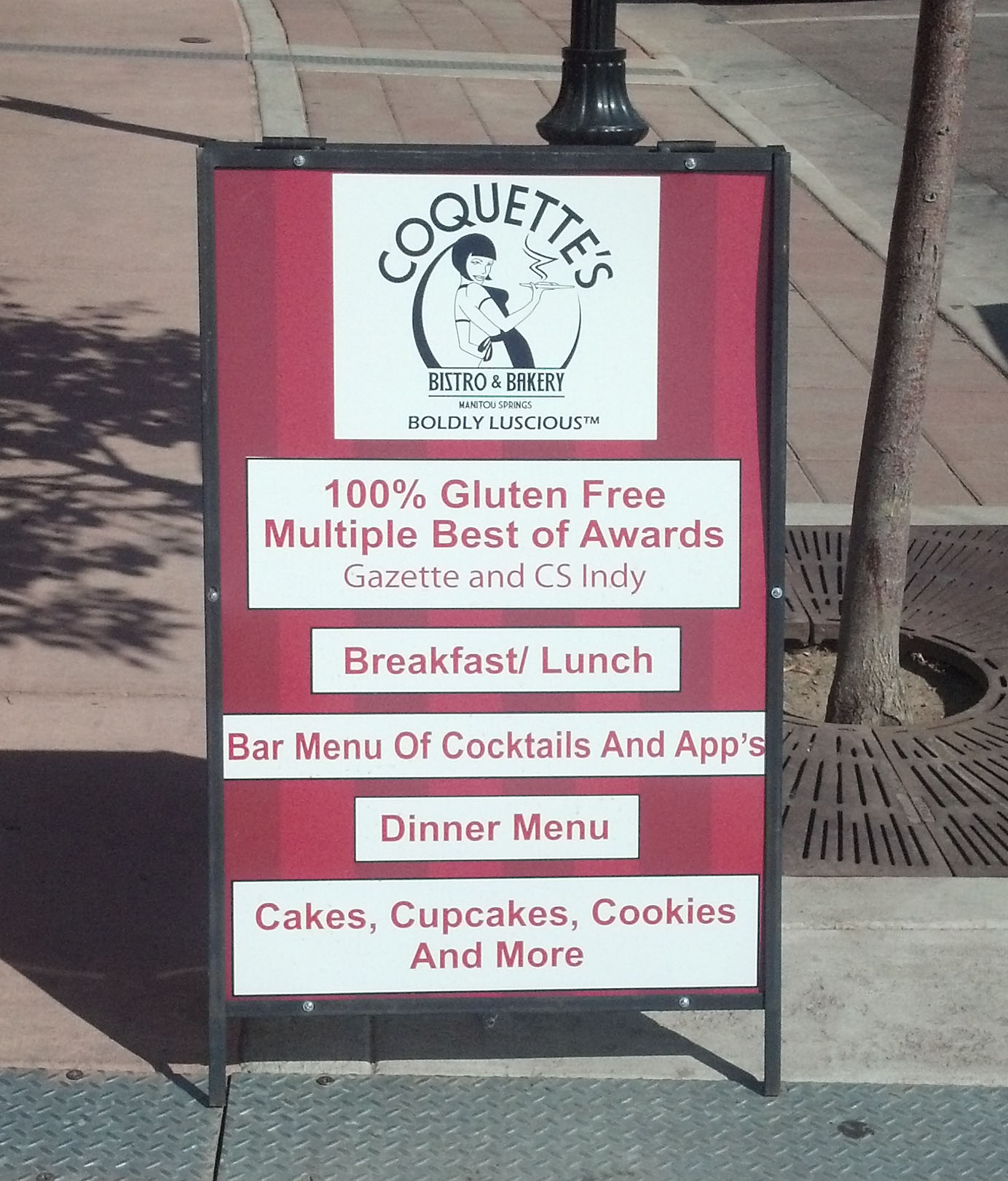
The words “Gluten Free” are a beacon for those who suffer from allergies or dietary intoler-
ance to wheat or other grains. I’m not among that group, but I had lunch recently with a friend
who is. She was thrilled, she said, that she didn’t have to ask any questions about the menu at
Coquette’s Bistro and Bakery. Instead of being limited to a few items she could eat, the
entire menu was at her bidding – as well as mine.
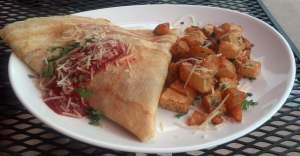
The lunch menu includes a variety of salads, sandwiches, and at least half a dozen crepes – in
addition to many for dessert. We narrowed our choices to two: the Bada Bing, with Italian saus-
age and ricotta cheese, and the Argentinean (although Coquette’s has a far more creative way of
spelling), with chicken, Basmati rice, green olives and chimichurri. Truffle potatoes or salad are
the available sides. If you’re feeling the need to be healthy go for the salad, otherwise indulge in
the country fried potatoes but much more elegant thanks to the truffle oil. The not-quite-paper-
thin crepes, made with sweet rice and brown rice flours, were light with just the right amount of
the inventive fillings.
Lunch prices are standard: around $9 to $12 per entrée, and we each carried a to-go-box when
we left. Unfortunately, we were too full to even consider dessert, either the crepe version or other-
wise. Coquette’s serves, breakfast, lunch and dinner. The bakery case features breads and sweets.
And, everything is Gluten-free!

Coquette’s Bistro and Bakery
Four Plates
915 Manitou Ave.
Manitou Springs, CO

Everyone knows the adage about not watching sausage being made. Get past that
and it’s easy to see good sausage disappear from a plate. Fortunately, Prost
doesn’t make anyone go through the process of witnessing sausage production.
Instead, this small restaurant in the mountain town of Frisco, CO, serves saus-
ages made from an array of meats and ingredients. My friends and I ordered a
sampler with four different types. We selected Boar with Apricot and Cranberry,
Pheasant with Parmesan, Veal Bratwurst and Smoked Beef Bratwurst. Other
options included Buffalo with Green Chile and Chipotle, Chicken and Apple, and
Elk with Jalapeno Cheddar. There’s also a vegetarian alternative, but that seemes
like an oxymoron. A small disclaimer on the menu notes that “Due to the fresh-
ness of our product not all items may be available.”
My first bite was the veal, which melted in my mouth. Its subtleness was intri-
guing. That is until I tasted another sausage. The veal was ultimately oversha-
dowed by the flavors of the other meats which were rich and distinct. The overall
favorite was the Boar. The sweetness of the apricot and cranberry balanced well
with the hearty meat. The Sampler Plates can be ordered with up to four different
types of sausage, and are served with baby gherkins. Bread can be ordered as a
side, and several kinds of mustard are also available.
And, with a name like Prost, there’s plenty of beer choices to help further enjoy
the food.

Prost
Three-and-a half Plates
313 Main St., Frisco, CO

It doesn’t happen often, but occasionally after finishing a book I’m uncertain
how I feel about it. The Lifeboat by Charlotte Rogan leaves me ambivalent.
It’s an interesting premise: a group of 40 adrift after their ocean liner explodes
at sea. The year is 1914, so the event is sandwiched between the (unrelated) sink-
ing of the Titanic and the Lusitania.
Grace, newly married, is the narrator whose story is based on journals she is
asked by her attorneys to prepare after the fact. Perhaps some of my hesitance
to rave or rant lies in Grace. It’s clear as she relates how she came to marry her
her husband that she is a manipulator, if not an all-out gold digger. Few of the
characters act admirably in the adverse conditions, but remember Grace is tell-
ing the story. However, even she admits her memory is faulty, at best, from the
extreme conditions of being lost at sea for an extended period of time (at least
two weeks).
Where Rogan shines is descriptive writing: “The boat pitched and rolled as it
alternately climbed the foamy heights of the waves and then descended into hell-
ish troughs so that we were surrounded on four sides by walls of black water.”
It’s enough to keep me away from a boat of any size let alone one meant to save
lives.
Rogan’s boat is a metaphor for choices made and the motivation behind them.
The question I’m struggling to answer is if the idea’s strong enough to hold water?
Lifeboat
Three Bookmarks
Little, Brown and Co., 2012
278 pages
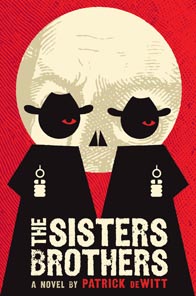
Just to be clear, The Sisters Brothers isn’t missing an apostrophe. The first time I saw
the title by Patrick DeWitt I was certain there was an error. I thought the book was about
the male relatives of sisters. That’s half right: brothers Eli and Charlie Sisters, but no
female siblings.
Set in the Old West, Eli narrates as he and Charlie, both professional gunslingers, embark
on their latest assignment: to find and kill an enigmatic miner. DeWitt’s depictions of time
and place are so strong you can practically smell smoke after the gunfights. Charlie is the
elder and angrier of the two brothers. Eli paints himself as a sensitive man, going so far as
to keep a horse he describes as “portly and low-backed and could not travel more than fifty
miles in a day…” even after he acquires a better, faster one. His reasoning: he felt sorry for
the old one. Strange stuff from a reputed bad guy.
Although his age isn’t mentioned, Eli is going through, if not a midlife crisis, at least a mid-
career one. He’s questioning his line of work. DeWitt injects humor into this western tale
about two men bound by blood and business, but separated by sensitivity and yearning.
Eli realizes he has missed out on many things including, a wife and family, because he has
knowingly ridden alongside Charlie. At one point, this realization even causes Eli to go on
a diet. Yup, mighty strange stuff from a reputed bad guy.
The Sisters Brothers
Four Bookmarks
HarperCollins Books, 2011
325 pages

The Keg Lounge is a bar that’s really a restaurant in disguise. Sure, there’s
lots of beer on tap and liquor bottles filled with every flavor and proof desired.
A jukebox features a range of music genres, TVs placed strategically around the
room are tuned to sports channels. Everything identifies this dark, noisy place
as a drinking establishment; everything, that is, except the food.
Through the years, I’ve ordered burgers, grilled chicken sandwiches and the sig-
nature Keg Berry Salad (greens with an array of colorful, mixed berries dressed
with a creamy raspberry honey vinaigrette). My most recent visit was a special
occasion: to celebrate an anniversary. It was also an opportunity to do our part
to help extinguish the economic burn experienced by Manitou Springs following
the Waldo Canyon Fire. (I encourage everyone to try to shop local where ever
you live.) With this in mind, my husband and I ordered steaks.
When the food arrived, the ambiance somehow changed. It didn’t seem as loud
and the lighting was just right. My perfectly-grilled steak was topped with blue
cheese and walnut oil. Sides of garlic mashers and steamed broccoli were excell-
ent complements to the juicy beef.
After dinner, we wandered down the street to The Cliff House at Pikes Peak.
We sat on the veranda where I enjoyed Crème Brulee, our traditional anniversary
dessert. My husband broke with our marital convention by ordering Raspberry
Souffle with White Chocolate Almond Cream Anglaise. He not only still surprises
me, but he shares.

The Keg Lounge
Nearly Four Plates (dinner)
730 Manitou Ave.
Manitou Springs, CO
The Cliff House at Pikes Peak
Four Plates (dessert)
306 Canon Ave.
Manitou Springs, CO

When my husband and I go to a movie we silently give a thumbs up or down to the trailers
before the main feature. We know that even if it looks promising, it’s entirely possible that
all the good parts are revealed in the preview. The same holds true with book jackets, such
is the case with Coral Glynn by Peter Cameron.
In 1950s rural England, Coral is a home nurse caring for the dying Mrs. Hart, mother of
Clement Hart, a young man disabled in war. Based on Coral’s presence in the family home
and a few shared brandies in front of the fireplace, Clement proposes and she accepts. There
are no sparks; in fact, there is not even any flirtation. There is, however, an unrelated crime.
The couple is getting ready for bed just when a police officer arrives. Minutes after being
interviewed by the constable for a murder Coral did not see, but knew about nonetheless,
Clement suggests she go to London. This is only one of several shrug-your-shoulders and
roll-your-eyes incidents. The marriage is never consummated, and Coral simply flows with
the tides of life in an apparent daze. If this all sounds unusual, it’s because it is.
Cameron has not created characters who elicit emotion, let alone interest. There is neither
humor nor tragedy, or perhaps there is both. With this in mind, I suggest reading the dust
cover. It’s far more interesting than the pages it embraces, and takes a lot less time.
Coral Glynn
Two-and-a-half Bookmarks
Farrar, Straus and Giroux, 2012
210 pages

When food is good, I mean really good, it’s easy to overlook things like long lines, odd
hours, and even Styrofoam containers. Ordinarily, just one of those could off-putting,
but at El Taco Rey all three go hand-in-hand with made-to-order exceptional Mexican
fare.
Once the food arrives (in the environmentally-incorrect containers for dine-in or take-
out) all attention focuses on the flavors: green chili with a kick and tender bits of pork.
The signature dish is the Avocado Pork Burrito. This is spicy enough to wake up the
sinuses, but not so much that watering eyes drown the taste. The burrito is filled with
diced pork and the cool, smooth texture of avocado. This helps offset some of the heat
from the chili, which is a thick gravy smothering the burrito. The sauce has a tendency
to make the large flour tortilla a little gummy and hard to cut – this is not food to eat
with your hands. The plastic fork and knife require a lot of pressure to separate a bite
from the whole. Of course, once that’s achieved, it’s worth the effort.
The menu features traditional Mexican food from enchiladas to tamales, from tacos to
burritos. They may be ordered a la carte or as a combination plate served with rice and
beans, or beans and salad. This family-run business has been drawing diners to the
seven-table eatery (two other tables are available outside) since 1976. People stand in
line for a reason: the food is worth it.
El Taco Rey
Four Plates
330 W. Colorado Ave.
Colorado Springs, CO

The Black Minutes by Martin Solares is a two-tiered crime novel held together by in-
teresting characters and captivating murders over a 20-year time span. The writing is
icing. Solares creates easy to envision situations in a fast-paced style. The only problems
occur in the transitions from reality to dreams and the number of personalities filling the
pages.
Thankfully, Solares includes a three-page Cast of Characters to help keep track of who’s
who. Most are corrupt law enforcement, politicians, clergy, and businessmen; but not
everyone is a bad guy. While there may not be any white knights, there are a few gray
ones. The story begins with the murder of a young journalist investigating a serial kill-
ing spree that took place 20 years ago in his town of Paracuan, a Mexican port and home
of a drug cartel. Ramon Cabrera is the honest police investigator who is removed from the
case shortly after he connects a few dots. Cabrera establishes a relationship between the
journalist’s death, the past murders and a scrupulous detective, Vincente Rangel, who
led the investigation two decades ago. This is where it gets fun.
Solares incorporates different narrators, while maintaining his role as storyteller. Certain
chapters are identified as “testimony” wherein the first person voice of one of the characters
tells his version before the writing reverts to third person. The majority of the book tracks
Rangel’s investigation, followed closely by Cabrera’s. Several surprises surface that make
the past more closely linked than one can imagine.
The Black Minutes
Four Bookmarks
Black Cat, 2010
436 pages

The smoke and flames rose into the sky beginning Saturday afternoon. As the
proverbial crow flies, the fire was probably five miles from my home, and many
friends live in areas of imminent danger. They were evacuated immediately. In
the early hours of Sunday morning the entire town of nearby Manitou Springs
was evacuated. Although residents there were allowed home less than 24 hours
later, it was unsettling for everyone. As neighborhoods around our home received
evacuation notifications, my husband and I discussed what we would take: not
surprisingly, photos and family mementos topped the list. When we got word we
were in a pre-evac area, it was time to really consider what to pack. This difficult
task was made even more daunting by the fact that by this point thousands of people
had been displaced and many had lost their homes.
We have shelves and shelves of books. Looking at them I knew I would not be able
to select just a few to carry away. Only one of our sons is home from college this
summer. He packed a box filled with what he called his “theatre and geek books.”
My husband packed his Bible. I looked at my nightstand stacked high; I searched
the shelves near my desk, in the living room, in the study. I even looked at the titles
my absent sons have in their rooms.
Finally, like a scene from Moonrise Kingdom, I packed the library books in a suit-
case. What books would you take?

I am not sure I would have chosen Corinthia Falls off the bookshelf on my own,
but I volunteered to judge a competition. Kim Hutson’s book is what I received in
the mail, along with a list of reading criteria. It was entered in the Fiction Category,
but that should’ve been amended to Christian Fiction. There’s nothing wrong with
that genre, I just think it warrants a heads up. Or maybe I should have paid more
attention to the photo of a church on the cover.
The book gets its name from the small town in Oklahoma where most of the story
takes place. The first two-thirds is narrated by 18-year-old Timber Oaks who has a
strong sense of faith, a group of best friends, loving parents, and an impressive golf
game. The town is full of the requisite eccentric characters, many of whom initially
don’t get along. An itinerant evangelist arrives to help the Corinthia Falls Church,
the townspeople, and Timber fully realize the presence of God in their lives.
The book’s final third begins 30 years after Timber’s narrative ends. Priscilla Luke,
a long-time journalist and, as it turns out, Oaks’ family friend takes over as narra-
tor. This change in voice is interesting. Pris brings the reader up to date on the
major changes many of the characters have experienced, and tells Timber’s story
from the outside looking in.
Some editing and grammar issues distract from what is otherwise a story strong on
faith with occasional lapses in believability.
Corinthia Falls
Three Bookmarks
Outskirts Press, 2011
404 pages
Sorry for the delay in posting, but the wildfire here in Colorado Springs was a major distraction this weekend. We still need some rain.