A simple, colorful sign on the white clapboard siding indicates Shuga’s is not a residential house. Nonetheless, it’s home to good food and comfort. Celebrating a friend’s birthday, we enjoyed a long, better-than-average lunch outside (a few tables are at the entrance, and a larger patio is in back).
The Brazilian Coconut Shrimp Soup is Shuga’s signature dish. It’s available by the bowl or cup. I wish it were sold by the potful. We each ordered soup with two bruschetta. We both had the fresh tomato and mozzarella, but took different directions with the second. She had the tomato, bacon and goat cheese, and I had smoked salmon.

The range of flavors was like sibling rivalry, each vying to top the other. Parents aren’t supposed to play favorites, but as a diner it was easy to choose: the soup. Plump shrimp, a hit of jalapeno spiciness offset by the rich, smooth coconut milk and the suggestion of peanuts completed the bisque. As my friend said, “It’s a series of flavors.”
Thick slices of hard-crusted bread were the base of the bruschetta. One was slathered with aioli then topped with a generous serving of smoked salmon, capers and red onions. The other was a version of Caprese with olive oil, substantial slices of salty cheese and taste-of-summer tomatoes topped with fresh basil. The soup may have overshadowed, but these sides were not family embarrassments.
It’s been years since I was last at Shuga’s. I won’t make the mistake of waiting so long to return.
Shuga’s
Four-and-a-half Plates
702 S. Cascade Ave.
Colorado Springs, CO.

Even if you aren’t necessarily a fan of Patti Smith or Robert Mapplethorpe, Smith’s memoir, Just Kids, is more than an autobiographical look at the relationship between the two artists. It also examines life and culture in the late 1960s and 1970s.
I’m just young enough that Smith was never on my radar when I was growing up. And, I’m just old enough to be aware of the controversy caused by a retrospective of Mapplethorpe’s work with the National Endowment for the Arts – long after his death. I might have skipped this book if not for a friend’s recommendation. I read it, and I’m glad.
Smith and Mapplethorpe met and lived together in New York City when they were kids (twenty-year-olds) at a time when the underground music and art scenes were beginning to materialize. Their timing was perfect: she became part of the former and he part of the latter. Their paths crossed with the likes of Jimi Hendrix, Janis Joplin, Todd Rundgren, Sam Shepard, Andy Warhol and many others.
Just Kids reflects the impressive strength of friendship Smith and Mapplethorpe created with one another. This is a love story, even though each went on to have different partners; it’s also Smith’s homage to her late friend and the era in which they emerged. Her voice is honest and unrestrained. It’s easy to imagine the romance of their early lives as they lived hand-to-mouth, meeting other up-and-coming artists all while discovering their own artistic personas.
Just Kids
Three-and-a-half Bookmarks
HarperCollins, 2010
283 pages

A brewery should be known for its beer. On that point the Breckenridge Brewery doesn’t disappoint. Even the pub fare is above average. The shortfall is the service. A cold, rainy late summer afternoon found people looking for places to stay warm and dry, so perhaps the lunch crowd was larger than usual. I suspect it wasn’t. Our server started off by asking if we wanted shots. Duh. Beer was the drink of choice. He took our order and that was the last we saw of him until he dropped off the check long after we had finished eating.

I was intrigued by the Green Chile with Andouille Sausage, but I wanted more information. The server’s response was “If you like green chile you’ll probably like this.” Despite his uninspired response, I ordered it. Typically, pork is the meat that has been stewed with tomatoes, green chile and onions. The sausage worked surprisingly well. There was the right amount of kick to help raise my body temperature, but only enough to enjoy the flavors without a chaser. My son ordered a Bacon Cheeseburger topped with crispy onion rings. This two-fisted burger packed a messy punch of juicy flavor.
Although we weren’t in a hurry to go back out in the rain, we waited (and waited) for the check. When the server finally dropped it off, he only had one thing to say: “Do you want any shots?” It wasn’t a question I expected before or after a meal in a brewery.
Breckenridge Brewery
Three-Plates
600 S. Main St.
Breckenridge, CO

Mark Haddon’s The Red House is a metaphor for the definition of family; the meaning can be obscured by comfort or serve as boundaries through which no one should cross. Haddon emphasizes the latter. Estranged brother and sister, Richard and Angela, meet for a family vacation shortly after their mother’s death. Richard’s a doctor and newly married to his second wife. Her 16-year-old daughter is part of the package. Angela and her husband have three children, but she mourns the still-born daughter she lost 18 years ago. These eight family members spend a week together in the English countryside as they tentatively reveal themselves to each other – some with better results than others.
Haddon’s approach is interesting. Each chapter represents one day of the vacation, and everyone’s perspective is provided to set the scene. Initially, it’s difficult, even confusing, keeping track of who’s who. However, as the storyline evolves, more about Angela’s grief is explained, not just from her viewpoint but her husband’s, too. Also, Richard is not as professionally secure as he projects, this from his wife.
Haddon blends the familiar (sulky teenagers) with the uncomfortable (sulky parents). Slowly, observations and experiences round out each character. Jumping from one person to another becomes less awkward. Mostly, the time together leads to everyone’s better understanding of him or herself. Haddon writes, “Behind everything there is a house … compared to which every other house is larger or colder or more luxurious.” Sounds a lot like the way all families are perceived.
The Red House
Three-and-a-half Bookmarks
Doubleday, 2012
264 pages

I’ve long given up trying to get into the Butterhorn Bakery & Café (in Frisco, CO) for breakfast/brunch on the weekend. Yet, this popular eatery attracts locals and tourists in equal numbers for lunch during the week, too. The draw: this is a real bakery and the menu features baked goods. Recently, friends arrived early to get on the list for a table, so it didn’t really seem like much of a wait – for me.
I ordered the Vegie Hummer. For some reason I neglected to register the menu fact it was black bean hummus, rather than traditional chickpea. This was a surprise, not a problem. The dark, thick mash had a depth of flavor, which was nearly lost under the jungle of sprouts and shredded carrots. This, with slices of red onion, tomato and lettuce on a Jalapeno-Cheddar Baguette, made for a pretty bulky, filling sandwich. The cheese was an edible lacquer on the freshly-baked bread. The combination of all the elements was an excellent vegie hoagie.

Other items selected in our group were the Thai Chicken Wrap which inspired no order envy, and the Spicy Chicken Guacamole on a croissant which did. The latter, however, was messy to eat, but melted pepper jack with grilled chicken made it worth the need for extra napkins.
All sandwiches come with a choice of potato salad, pasta salad or chips. Be forewarned, the pasta salad is actually macaroni salad – that old-fashioned kind with a mayonnaise base. It was out of character with the otherwise trendy menu.
Butterhorn Bakery & Café
Not-quite-Four Plates
Breakfast and lunch only
408 Main St.
Frisco, Colorado

Similar themes, character types and unusual situations find their way to John Irving novels. His latest, In One Person, is no exception. Despite these commonalities, it’s an original look at acceptance and the secrets families hide in plain view, particularly when it comes to sex. The most covert issue is the sexuality of young Billy Abbott, the protagonist/narrator. Billy struggles with this; it’s also something family members have insight into but refuse to reveal – hoping they’re wrong. Yet all around him are mixed messages, from Billy’s loveable cross-dressing grandfather to the cruel teenage wrestling superstar. Billy’s story spans more than 50 years, and it’s clear his family’s hopes were dashed. Billy isn’t gay, he’s bi-sexual, but that’s not what they’re hiding.
Among the characters populating Irving’s novel are angry mothers (several), wrestlers (many), and transgenders (numerous, although Billy’s generation used the term transsexuals). A residential boys school in rural Vermont – another typical Irving element – is among the settings. Perhaps the strongest of the similarities is the power of friendship. Billy’s true friends are an eccentric bunch with shared worries. The complicated town librarian (my favorite character) probably knows Billy best.
The novel is like a one-sided conversation Billy has with the reader. Billy repeats some details, tells some things out of sequence and offers a few teasers. As in his other work, Irving’s irony and descriptive writing prevail.
A Prayer for Owen Meany is not just my favorite book by Irving, it’s one of my favorite books by anyone. In One Person is not on that pedestal, but it’s close.
In One Person
Four-and-a-half Bookmarks
Simon & Schuster, 2012
425 pages
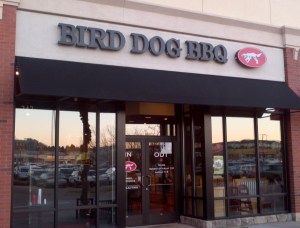
A few years ago, my family and I embarked on a barbecue quest. Our (ongoing) charge was to find
the best place for BBQ in Colorado Springs. We’ve also sampled in California, Wyoming, Denver,
Flagstaff and other locales – including New York City. While we aren’t ready to name a champ-
ion, we all agree that Bird Dog BBQ is among the top three anywhere – not just our hometown.
Our criteria were simple. We wanted the best in flavor, sides, and tender meats. Bird Dog scores
high in everything. Brisket, pulled or sliced, practically falls apart by just looking at it. Bursting
with smokiness that only comes from a low and slow technique, this is the kind of meat to dis-
suade anyone from becoming a vegetarian. Three in-house sauces are made daily. One has a sweet
and sour tanginess, while the other is an upgrade to spicy and tart. Taking it up a notch is one made
with Wasabi, but to be honest I like combing the two traditional sauces. Rumor has it there an ultra-
hot blend kept behind the counter.
Pulled Pork, Pork Sausage, Ribs and Chicken complete the meat offerings. The Pork is fork tender and
moist. Barbecue is nothing without Baked Beans, and the sweetened beans do not disappoint. Potato
Salad and Cole Slaw are other winners.
The decor is another reason Bird Dog scores high with my family. There are lots of photos, brought
in by diners, of dogs of all kinds. We keep meaning to take in a picture of ours: so we’ll get to return.
Bird Dog BBQ
Four Plates
5984 Stetson Hills Blvd. and 1645 Briargate Pkwy.
Colorado Springs
(Another location at 6965 Mesa Ridge
Fountain, CO., has not been visited)

James W. Hall writes crime thrillers and teaches college-level courses about popular
fiction, specifically bestsellers. Although it’s interesting, his recent nonfiction endeav-
or, Hit Lit subtitled Cracking the Code of the Twentieth Century’s Biggest
Bestsellers, reads like a textbook, but one likely to end up on the bargain table in a
bookstore.
The concept is intriguing: analyze 12 novels and identify the characteristics that
make them bestsellers. Included in the list is To Kill a Mockingbird, Gone
with the Wind, The DaVinci Code, The Exorcist, Valley of the Dolls,
The Godfather, The Dead Zone, The Firm, The Hunt for Red October,
The Bridges of Madison County, Peyton Place and, Jaws. I admit I’ve
only read six. Interestingly, the dozen were also made into popular movies – but
that’s another story. Hall, apparently stuck on the number 12, establishes that same
quantity of criteria to examine and actually makes a good case for why, say, Valley
of the Dolls struck a chord with so many readers. What might be even more worth-
while would be to compare these with less popular tomes. to me, the titles selected
by Hall are the equivalent of white bread. It’s easy enough to slap together a sand-
wich between two pieces of nutrition-lacking, tasteless slices, but there are so many
other varieties that go well beyond mere basic sustenance.
I can easily envision using Hall’s work in the classroom, with the caveat that the num-
ber twelve, both in the book selections and the characteristics reviewed, is not neces-
sarily a magic number.
Hit Lit
Two-and-a-Half Bookmarks
Random House, 2012
287 pages (includes index)

With only 10 tables, it’s not unusual for people to lineup outside Giampietro Pasta and Pizzeria.
Don’t be put off by a likely wait; it’s worth it. Everything is made in-house – from thin crust pizza to tra-
ditional Northern Italian entrees to gourmet pastas. There is something for everyone from a picky kid
who will eat only noodles with butter to wanna-be foodies who want to consume every single morsel on
the plate.
My husband and I hit the jackpot recently when we were seated immediately. Of course, we were in tight
quarters and could easily have picked something off a plate at a nearby table (we didn’t). We started with
a Beet and Ricotta Salad served over spinach. Fresh beets had been pickled giving them a pale countenance
that seemed out of character. Instead, they were another version of themselves. We ordered Linguini with
Clams and the Short Rib Ravioli with Fennel and Spinach. Our intent was to share.

Once I took a bite of the ravioli, I reneged; no way was I sharing. The beef had been braising all day.
Its depth of flavor was augmented by Marsala, chicken stock and fennel bulbs. It tasted as if brown sugar
or syrup had been added, but our server said it was the combination of the wine and stock. Fresh pasta
pockets were the perfect foil for the rich filling. The linguini was fine, but not over-the-top like the ravioli.
Although I was completed sated, I really wanted another order to take home (I didn’t).
Giampietro Pasta and Pizzeria
Four-and-a-half Plates
100 N. Main St.
Breckenridge, CO

A Good American is not only an engaging tale about immigrants, it’s also a captivating
account of the power of family and community. Alex George’s novel begins as a love story,
which ultimately becomes a chronicle spanning four generations. George starts with the un-
likely courtship of Frederick Meisenheimer and Jette Furst in Hanover, Germany. The uncon-
ventional Frederick woos Jette, a robust independent woman, by singing Puccini from behind
a privet wall; thus setting a precedent for the importance of music in the Meisenheimer house-
hold. The pair soon relocates to Beatrice, Missouri.
Narrated by James, Frederick and Jette’s grandson, the novel is an absorbing examination
of domestic life. The story is abundant with an eccentric cast of supporting characters, rang-
ing from a giant to a midget. And, as James notes, “While we were growing up, so was America.”
Rural America is the perfect backdrop for the Meisenheimer portrait. This is not a glowing
portrayal because the members have their share of faults. Yet these only to serve to make
everyone more believable. As with any family, dysfunction does exist in the bloodline. Its
manifestation simply, and oddly, makes everyone even more endearing. The beauty, and
strength, of the novel is that it is filled with not just one good American, but many. It may
be easy to overlook the concept of America as a melting pot today, but George’s narrative,
even while acknowledging the negative elements lurking in the shadows, reflects the best
ingredients that make this country what it is.
A Good American
Five Bookmarks
G.P. Putnam’s Sons, 2012
387 pages