The phrase Catch and Kill, the title of Pulitzer Prize winner Ronan Farrow’s account of power brokers’ abuse of women, has its roots in journalism. It refers to a media outlet obtaining the rights to a story and then letting it rot. That is, the public never sees it.
Farrow writes of his efforts to expose Harvey Weinstein who used his power as a Hollywood producer to take advantage of women by promising, or at least suggesting, he would help further their careers in exchange for sexual favors. This isn’t about a singular or a few incidents; there are many, but it took Farrow’s determination to uncover the truth.
Although Weinstein is the focus, Farrow also recounts efforts by other men in similar roles to keep their secrets from surfacing. These included threats of intimidation to keep the victims of abuse silent; spies, financial payouts and efforts to kill the story – not just once but multiple times.
When Farrow began working on the story he was an investigative reporter for NBC News. The more information he obtained, including on-the-record statements from the victims, the more the was thwarted by upper management at the network. He was finally given approval to pitch the story elsewhere, which is how it came to be published by The New Yorker.
Farrow recounts the numerous fact-checking, the uncovering of documents and a general resistance to revealing the facts associated with how the story broke. He imbues the narrative with sensitivity, vulnerability, occasional humor and tenacity.
Catch and Kill
(subtitled: Lies, Spies, and a Conspiracy to protect Predators)
Four-and-a-half Bookmarks
Little, Brown and Co., 2019
448 pages (includes index)

Sandwiched between race riots in 1991 and 2019 is the story of two families, one Korean and one African American, connected through violence. Loosely based on the shooting of Latasha Harlins, author Steph Cha has crafted an important, engaging novel illustrating the prevalence of racism in the form of a who-dun-it in Your House Will Pay.
In 1991 teenager Ava Matthews is shot and killed in a neighborhood convenience store in South Central Los Angeles by the owner Jung-ja Han. Ava had gone with her younger brother, Shawn, to buy milk. Although Jun-ja Han is convicted, she served no jail time.
Fast forward to 2019, Korean immigrant Yvonne Park is shot outside the pharmacy where she works with her husband and daughter, Grace. In the interest of avoiding spoilers, I’ll only say the shooting attracts Shawn’s attention.
Shawn’s cousin Ray has just been released from prison. Shawn, has a decent job and is a father-figure to Ray’s teenage children. The family no longer lives in South Central, but gang activity is never far away.
Cha primarily focuses on Grace Park, a twenty-something living with her parents. Although she’s in touch with her older sister, Miriam is estranged from the family. Grace is the more naïve of the two, while Miriam has a wider life view.
Suspects for Yvonne’s shooting are sought, including Shawn, who has an alibi, and Ray, who doesn’t. It’s impossible for Shawn not to reflect on his sister’s murder and the lack of justice in her death.
Your House Will Pay
Four Bookmarks
Harper Collins, 2019
304 pages
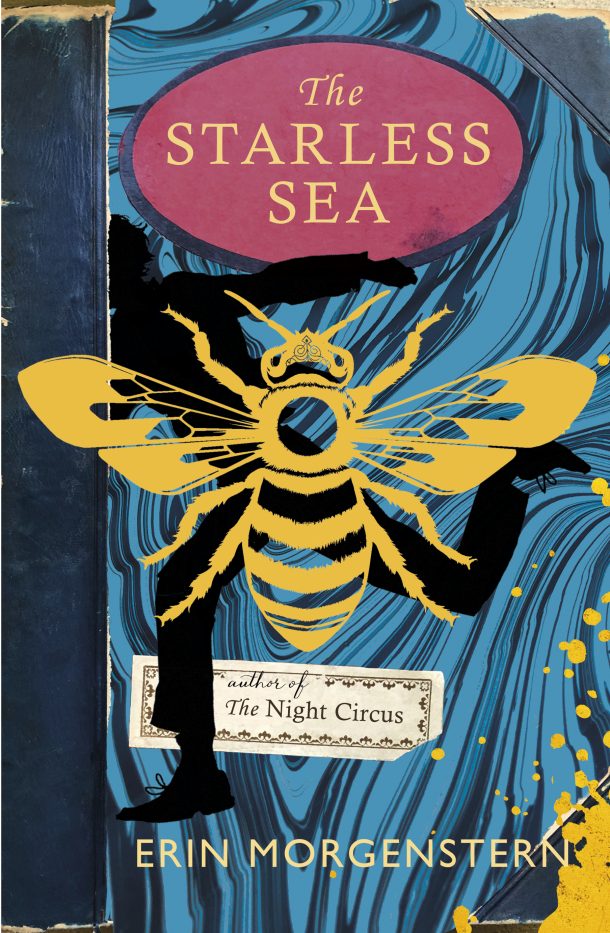
The Starless Sea by Erin Morgenstern is a cross between a fairy tale and a video game, with some magic thrown. This requires the ability to suspend one’s sense of disbelief.
Most chapters begin with the name of Zachary Ezra Rawlins, a graduate student who finds a mysterious, uncatalogued book in his school library. It’s especially baffling since it’s about him. Alternating chapters relate to a particular story within the found book. Confused yet? I’ll back up. A land, beneath ours, contains an ancient library with guardians who protect the books and the stories they contain. Zachary’s efforts to uncover the book’s meaning take him on adventure where bees, cats, doors, books – lots of books – and swords are important symbols.
Morgenstern creates a literary world unlike any other. It’s dependent on imagination and an appreciation of the different realms books take us to when we read. The writing is rich in visual detail, even if, at times, it doesn’t always make sense. This is similar to what Zachary experiences. He encounters multiple choices in his quest; almost as many subplots presented to the reader trying to fit all the pieces together.
Pirates, a sea of honey, searches for lost loves, artists, friends and mysterious passageways also inhabit the novel. The deeper Zachary goes into what is ultimately a search for the starless sea, the less engaging the narrative becomes. Yes, I wanted to know what was going to happen, but at almost 500 pages, it took too long to find out.
The Starless Sea
Three-and-three-quarter bookmarks
Doubleday, 2019
494 pages

Family dynamics, as much as cultural expectations, are at the heart of A Place for Us. Fatima Farheen Mirza’s debut novel follows an Indian-American Muslim family. Years ago, parents Layla and Rafiq left their homes in India to establish a new life in Northern California and raise three children. Their faith determines their lifestyle, much of their social interactions, fashion and appearance.
The story begins the day before Hadia’s wedding. She is the elder sister of Huda and their brother Amar. His presence is both a reason for joy and a cause for concern. He’d been estranged – for reasons which are exhaustively detailed in the subsequent sections/chapters.
Mirza’s narrative moves to the past. First, summarizing Layla and Rafiq’s marriage; then focusing on the children as they grow up. Initially, the focus is on Hadia, but slowly shifts to Amar. Rafiq’s expectations of his daughters are few. Both sisters are obedient, studious and observant of Muslim practices; yet they have dreams and goals beyond what their parents envision.
Amar is intelligent and sensitive, but he struggles in school and questions some Muslim principles. A forbidden romance, a long-troubled relationship with Fariq and more contribute to Amar leaving his family three years prior.
The penultimate chapter returns to the wedding day, which is filled with tension felt by all the characters. In an interesting, and unexpected, change of narrator, the final chapter provides Fariq’s perspective, most notably his love for Amar. Unfortunately, slow pacing and some predictable consequences are the book’s downfall.
A Place for Us
Three Bookmarks
SPJ for Hogarth, 2018
377 pages

A Rule Against Murder is the fourth in Louise Penny’s Inspector Gamache series. I’ve been told to read the canon, comprised of 16, in order. Clearly, I have a ways to go, but what a fun journey to undertake. The problem lies in wanting to pick up the next book immediately after putting down the last.
Armand Gamache is the kind, intelligent, perceptive, chief inspector on vacation with his wife celebrating their anniversary. They are at a luxurious, remote inn where they’ve often stayed. However, this time a death occurs, which isn’t initially clear as accidental or murder, but since he is already on the scene, Gamache oversees the investigation.
Penny writes mysteries, so it’s no surprise there will be something for Gamache and his team to uncover. What’s most engaging is the slow, methodical, yet lyrical, manner the author incorporates to arrive at a possible crime, which isn’t immediate. Instead, the author describes the calm, rustic setting, the inn’s staff, the guests and, most fun of all, the Gamaches’ relationship. The scene unfolds like a travelogue for a get-away to a relaxing resort, complete with vivid, mouthwatering descriptions of the food served.
Also staying at the inn is an extended family, most of whom prove to be as unlikable as Gamache is charming. When a family member is found crushed beneath a newly erected statue commemorating the patriarch, clues are sought to determine the cause. There is no shortage of possible suspects and motives, although deciphering who remains in question.
A Rule Against Murder
Four-and-a-half bookmarks
Minotaur Books, 2008
322 pages
Full disclosure: my husband and I were (unaffiliated/independent) guests at the newly opened Jax. We were treated to small plates, cocktails and the Jax brand pinot noir from the Willamette Valley.
Jax Fish House & Oyster Bar may be new on the block, but this restaurant is no youngster. Downtown Colorado Springs is the newest locale for the Big Red F Restaurant Group, which independently owns and operates Jax.
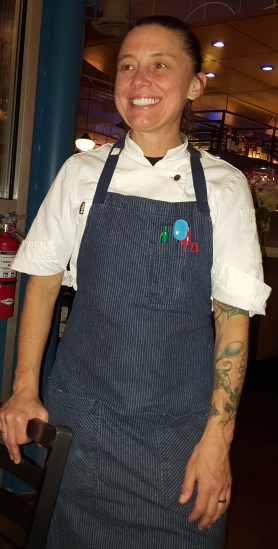
In addition to tasting several Happy Hour dishes, we were introduced to Dana Query, wife of owner Dave Query who opened the first Jax in Boulder in 1995, Sheila Lucero, executive chef/owner, and Alan Henkin, beverage director. All shared insights about Jax. Although this was interesting and appreciated, it was overshadowed by the food, both in taste and plating.
It’d be a shame, or perhaps a sin, not to have oysters at an oyster bar and wanting to avoid regrets, I happily indulged. The two sauces were almost superfluous. Almost.
 The tostada with kimchi, avocado and charred tomatoes on a brittle corn tortilla; calamari with a wake-up-the-sinuses mango chili sauce; meaty crab cake not obscured by breadcrumbs or fillers and ahi tuna poke over rice are exactly the kind of appetizers I would order again and again – even when footing the bill.

The poke was a particular favorite thanks to its fresh flavors augmented by roasted spiced cashews, serrano peppers and avocado. However, the dish we specifically requested may have been my favorite: shrimp and grits. Crispy fried shrimp nestled together on a bed of creamy, cheesy grits was a union of texture and taste.
It wasn’t necessary to do anything special to impress me, the food did that on its own.
Jax Fish House & Oyster Bar
11 S. Tejon St.
Colorado Springs, CO

Killers of the Flower Moon: The Osage Murders and the Birth of the FBI is an exhaustive look at a compelling story. Unfortunately, the narrative is bogged down with too many details. While this has all the makings of an excellent series perfect for streaming, as a book it lacks binge-worthiness.
Author David Grann has certainly done his research. He combines two story lines: how the Osage nation in Oklahoma, once among the wealthiest people in the world, lost its fortune; and the early days of the FBI under J. Edgar Hoover.
New to me was the story of the numerous Osage Indians who were murdered as a means of obtaining their oil rights. Grann focuses on the Burkhart family, although many others are mentioned, whose members were either shot or poisoned. Efforts to identify the murderers and press charges were stymied. Evidence was often conveniently misplaced, coroner’s reports were inaccurate and juries in the 1920s were reluctant to convict a white man of murdering an Indian.
Initially, it was believed the death toll rose to 24, which is when the FBI got involved. Grann’s research indicates the number is much higher. Nonetheless, federal agents at Hoover’s directive began an investigation led by Tom White, a former Texas Ranger.
The story deals with double agents, small town politics and grossly unfair treatment of the Osage. American history buffs are sure to find Grann’s work a gripping true-life account. As much as I wanted to be captivated, it didn’t happen for me.
Killers of the Flower Moon: The Osage Murders and the Birth of the FBI
Three bookmarks
Doubleday, 2017
338 pages, including selected bibliography

Usually it’s the first line of a Barbara Kingsolver book that grabs me; it took much longer with Unsheltered. However, what may have been lacking in initial engagement is negated by the lingering thoughts since closing the pages of her newest novel.
This is a two-in-one story about two families living in the same house but separated by two centuries. Aside from the dilapidated structure, at first it seems there is little else in common. Yet, it’s surprising how much they share. Kingsolver methodically reveals the similarities by alternating chapters between the old and the contemporary. Politics, prejudices, meaning of family and beauty of friendship are portrayed in each time frame. And always, another part of the house is falling apart. Neither family has the wherewithal to make the necessary repairs.
Willa Knox is the matriarch whose family has inherited the home. Her counterpart from the previous century is Thatcher Greenwood, a science teacher, who lived with his wife, mother-in-law and spirited younger sister-in-law.
While researching the history of the house, Willa learns about Mary Treat, a 19th century botanist who corresponded with Darwin and other scientists of her day and becomes a friend of Thatcher’s. Treat is another connection between the past and present.
Kingsolver incorporates several techniques such as the parallels among the characters in each era and ending each chapter with a line that serves as the title of next section. These, and other aspects, kept me turning pages – even if not always at a rapid rate.
Unsheltered
Four Bookmarks
Harper, 2018
464 pages

Lies, lies and more lies are at the heart of Miracle Creek by Angie Kim. This courtroom thriller is rich with possible culprits responsible for two deaths: a mother and an autistic child.
The novel’s first line is only a hint of what’s to come: “My husband asked me to lie.” Young Yoo, referring to her spouse’s request quickly acknowledges that it wasn’t a big lie. Yet as the author deftly illustrates, a series of falsehoods no matter the size, can lead to unexpected consequences.
The narrative begins with an explanation of what’s referred to as “The Incident.” Korean immigrants Young and Pak Yoo run an experimental medical treatment facility: the Miracle Submarine, named for its shape and proximity to Miracle Creek. This pressurized oxygen chamber is used for therapy by two autistic children, a wheelchair-bound teenager all accompanied by theirs mothers and a physician seeking a cure for infertility. A fire erupts leaving two dead thanks to an unknown arsonist.
Jump ahead to the courtroom where the surviving mother is on trial charged with murder, hers was the child killed. Each chapter is told in the voice of those involved: the Yoos, their daughter and the adults in the submarine at the time of fire. The evidence points to the mother, and her indifferent attitude makes it easy to believe she is guilty.
Yet, many lies slowly surface with suspicion clouding every character. Ultimately, readers are left asking themselves how far they would go to protect their loved ones.
Miracle Creek
Four-and-half Bookmarks
Sarah Crichton Books, 2019
351 pages

Mary Beth Keane’s Ask Again, Yes is an unconventional love story: familial and romantic. Human tragedy and honest, important contemporary issues are at its heart when the intersecting lives of two neighboring families are forever changed.
Kate Gleeson and Peter Stanhope are born within weeks of each other. They grow up next door to one another in a suburban town, both of their fathers are with the NYPD. Where the Gleeson home is full of activity with Kate and her two older sisters, Peter is an only child whose mother is reclusive and father stays uninvolved. Nonetheless, Peter and Kate are best friends.
Keane has crafted more than what could simply be a boy/girl next door romance. When they’re not quite 14 years old, a near-catastrophic event takes place involving the parents. Its impact is felt for the next four decades. The kids have no contact with one another for years.
Mental health, abandonment and alcoholism all contribute to the characters’ development and propel the story. The narrative is told with a wide-angle lens with changes in perspectives making for multifaceted and engaging storytelling.
The novel has the potential to languish in despair, but instead it resonates with subtle glimpses of hope and moments of real joy. The past is always close to the surface, but Keane makes it clear the future is also on the horizon. It’s less about second chances and more about acknowledging, if not outright appreciating, life’s goodness and finding the wherewithal to take one day at a time.
Ask Again, Yes
Four Bookmarks
Scribner, 2019
390 pages