Archive for the ‘Reviews’ Category

There is something both intriguing and off-putting about the title of Patricia Lockwood’s memoir, Priestdaddy. Greg, her father was, indeed, a priest in the Catholic Church. This was possible, she writes because her father “snuck past” the rule prohibiting priests from marrying. The real loophole is that a married minister of another denomination can, apparently, seek dispensation from Rome to be ordained as a priest. Pope Benedict XVI approved the request. Father Greg didn’t have to annul his marriage, nor abandon his children. Although, in many ways, as evident in the family stories Lockwood shares, he did.
The author’s tone is humorous and irony is evident throughout. Yet, there is too much cleverness. Her dad’s faith is never depicted as having much depth. Perhaps it is her effort to reveal him as an ordinary, not a holy, man. Even in that regard, he is far from conventional. After all, he lounges around in his boxers and has an extensive (and expensive) guitar collection. In fact he purchases a rare guitar soon after telling his daughter there aren’t funds for her college education.
Despite the title, Lockwood doesn’t focus her attention entirely on her dad. Her mother, her sisters, nieces, nephews and her husband also have prominent places in the narrative. So does a seminarian, who isn’t married and likely does not have kids.
Lockwood is, in fact, a published, award-winning poet. The images and emotions she conveys are vivid, but her often self-mocking tone and airing family laundry quickly wear thin.
Priestdaddy
Three Bookmarks
Riverhead Books, 2017
333 pages

I thought I had Ruth Ware’s The Death of Mrs. Westaway figured out about halfway through. I was close, but close doesn’t count when murder and deceit are involved.
Ware masterfully creates a sympathetic main character in Harriet “Hal” Westaway, a 21-year-old plagued by debt and loneliness with no known relatives. That is, until a letter arrives naming her as a beneficiary in the will of someone identified as her grandmother. Hal knows this isn’t possible but schemes to learn more, even going so far as to concoct a plan to gain some portion of the will by misrepresenting herself. She makes her living as a tarot card reader who has learned how to tell people what they want to hear based on what they reveal about themselves. Hal is certain she can use the same approach with the Westaway family.
Of course, Hal is not the only one keeping secrets. Much of the fun lies in trying to determine the evil player among the deceased’s other living relatives. It’s clear Mrs. Westaway, the grandmother, was not a loving mother and her grown sons, Hal’s uncles, claim they want nothing to do with anything from her will. That is until it’s revealed that Hal is to inherit the bulk.
A short-tempered, intimidating housekeeper and methodically revealed truths add to Hal’s distress.
It’s hard to go wrong with vivid descriptions of the cold, wet landscape surrounding the dark, old mansion. Thus, Ware sets the scene for an engaging mystery.
The Death of Mrs. Westaway
Four Bookmarks
Scott Press, 2018
368 pages

Half of a Yellow Sun by Chimamanda Ngozi Adiche gets off to a slow start in its account of Biafra’s struggle for independence from Nigeria in the 1960s. It gains momentum as the story evolves from more than a glimpse into African history into the lives of the characters experiencing the turmoil.
Sisters Olanna and Kainene are twins by birth only. Olanna is beautiful, warm and relinguishes her privileged lifestyle to live with Odenigbo, a university professor and strong supporter of the revolution against Nigeria. Kainene is distant, not as attractive and lives with Richard, a reserved Englishman. Ugwu is the young servant boy in Odenigbo’s house who becomes part of the family.
A host of other characters, with names hard to pronounce and keep straight, inhabit the narrative, but the above are the ones with whom the reader becomes attached. This is thanks to the author’s early descriptions of their lives before the conflict and how they are changed as a consequence of it.
Talk of a revolution becomes war and the efforts to establish Biafra as a free, independent nation push Olanna and Odenigbo deeper into the inconveniences and dangers of the conflict. Hunger, filth, death and despair surround them in their efforts to survive.
The past real-world events addressing race and class issues, ethnic histories and colonialism in Africa is haunting. As the novel progresses to its frenetic climax, I wanted a return to its earlier, meandering pace if only to spend more time with the characters.
Half of a Yellow Sun
Four-and-half Bookmarks
Alfred A. Knopf, 2006
433 pages
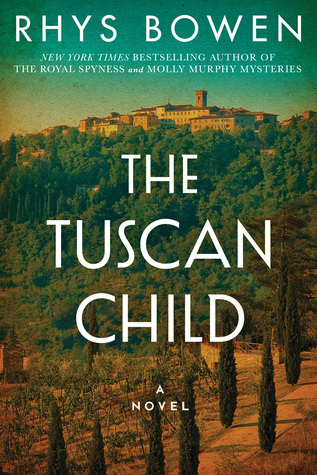
The Tuscan Child is a book that makes you hungry for Italy, especially its food. Rhys Bowen’s story alternates between two different time periods: 1944 and 1973.
The former recounts British pilot Hugo Langley’s efforts to survive after parachuting from his stricken plane over German-occupied Tuscany. The latter, and bulk of the novel, picks up with his daughter, Joanna, following Hugo’s death. She discovers an unopened letter addressed to Sophia in a small Tuscan village. The letter includes a reference to their “beautiful boy.” With little else to go on, Joanna travels to Italy learn more about Sophia and the boy, who could be her brother.
The chapters involving Hugo answer some of the mystery; others are left to Joanna to solve.
Sophia discovers the wounded pilot and helps keep in him hidden in a bombed-out monastery. She’s limited by scarce resources and the inability to leave home without raising suspicion among the townspeople and Germans. Although it is only a month, Hugo and Sophia fall in love.
Joanna is unable to learn anything about Sophia and none of the old timers in the village knew anything of a wounded pilot. Still, shortly after her arrival, one man suggests he has information for Joanna. Before he’s able to share anything, he’s murdered and Joanna becomes a suspect.
Bowen has crafted a double mystery: one involving the boy and the other the murderer. In the process of unearthing secrets, Joanna is treated to meals lovingly prepared by her guest house owner.
The Tuscan Child
Four Bookmarks
Lake Union Publishing, 2018
336 pages

The Dime by Kathleen Kent combines two elements atypical to most mysteries: a lesbian protagonist in a contemporary Dallas, Texas, setting. Betty Rhyzk is a transplant from Brooklyn who moves to the Lone Star State with her partner, Jackie who wants to be nearer her supposedly-ailing mother.
Betty is a no-nonsense detective whose often-sarcastic attitude, above average height and flaming-red hair keep her on everyone’s radar. When a drug bust goes awry, Betty unwittingly becomes a target from an unlikely group for an even more improbable reason.
Betty’s an interesting, smart character. Her sexuality is a minor part of her personality. This adds another dimension of dealing with bias in a nearly all-male police department as well as some instances of close-minded Dallas residents, including most of Jackie’s relatives.
In addition to Betty and her police colleagues, is the ghost of Betty’s Uncle Benny. He’s not so much a specter as a presence in her life. His influence and wisdom is a large part of who she is. She thinks of Benny often and the voice she hears in the back of her mind is attributed to him. She isn’t crazy, she just misses him and the guidance he provided.
Severed body parts, sexism and wayward evangelism converge to threaten Betty and those in her life. An abundance of suspension of disbelief is required as Betty encounters the novel’s real villains. Kent has created a strong, female central character, but at times Betty’s portrayed as much more than a superhero.
The Dime
Three bookmarks
Mulholland Books, 2017
343 pages

I first heard about The Feather Thief by Kirk Wallace Johnson on NPR. It struck me that a nonfiction account of something as seemingly innocuous as bird feathers would warrant the subtitle: Beauty, Obsession and The Natural History Heist of the Century. After all, why would someone rob a museum of feathers?
Johnson provides the answer in great detail. He recounts the efforts by 19th century naturalist Alfred Russell Wallace, a contemporary of Charles Darwin, who trekked through Malaysia on scientific expeditions and amassed, among other things, a collection of birds, many of which are now either extinct or near extinction.
Johnson recounts the feather fashion frenzy at the turn of the 20th century before introducing readers to 22-year-old Edwin Rist, an American flutist studying at London’s Royal Academy of Music. He also happened to be a part of a fly fishing subculture specializing in tying Victorian-era salmon ties. Toward this end, the requisite feathers for the flies to be as authentic as possible were among the ones gathered by Wallace.
It’s no mystery that Rist steals hundreds of birds/feathers from the Tring Museum, an outpost of the British Natural History Museum, to fuel his hobby and to sell to others. The author is drawn to story because Rist essentially gets away with the crime causing Johnson to wonder who ended up with the stolen goods – something he decides to pursue.
This part history/party mystery is a quick read. Although, the idea of stealing feathers to craft flies remains baffling.
The Feather Thief: Beauty, Obsession and The Natural History Heist of the Century
Three-and-a-half bookmarks
Viking 2018
308 pages with notes, bibliography and index
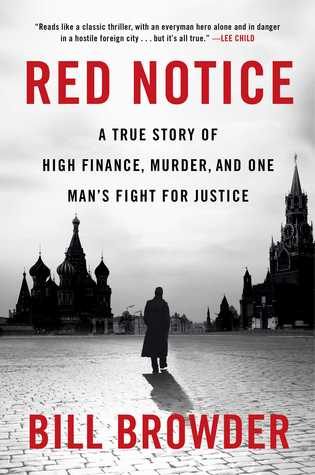
Red Notice by Bill Browder is a true-life tale involving financial investments, conspiracy, Russian intrigue and, ultimately, murder. A look at how U.S. laws are enacted is also included. A red notice is essentially an international arrest warrant. Putin tried, unsuccessfully, to have one placed on the author. The political climate with Russia makes this a timely read.
Browder recounts his experience as a foreign investor in Russia following the breakup of the Soviet Union. He discovers a motherlode, secures investors and founds his own capital management firm. Initially, the focus is on Browder’s financial acumen. Then, things get ugly for him and his associates when he exposes corruption in – surprise! – the Russian government.
Browder’s visa is revoked, but he’s able to covertly move his company’s holdings out of Russia saving his clients’ fortunes in the process. However, this isn’t where the author reveals his valor. That comes in the narrative’s final third as he seeks justice for the abuse and murder of his friend/attorney, Sergei Magnitsky, who revealed a multi-million dollar fraud committed by the Kremlin.
Browder’s efforts, along with assistance from U.S. government officials, helped put in place the Magnitsky Act, which, initially*, blocked Russian officials and business leaders from entering the United States and froze their assets held by U.S. banks.
Guilt motivates Browder’s actions, but the true hero of the story is Magnitsky who steadfastly believed truth and fairness would prevail.
With some exceptions, such as occasional extraneous details, the rapid-fire pacing makes Browder’s story engaging.
Red Notice: A True Story of Finance, Murder, and One Man’s fight for Justice
Four Bookmarks
Simon & Schuster, 2015
396 pages, includes notes and index
*The act was expanded in 2016 and now applies sanctions to human rights abusers worldwide.

Still Waters by Viveca Sten is part of the Sandhamn Murders, a Swedish series set mostly on an island near Stockholm. It’s often safe to assume that when the words murder and Sweden appear in the same sentence a dark, somber mystery is in store – the kind that makes you want to keep a light on at night. Sten’s novel breaks the mold, sort of.
Forget the gloom typically associated with Scandinavian who-dunits: Sandhamn is a coastal resort and in a part of Europe where the sun barely disappears from view.
Thomas Andreasson, a detective in Stockholm, grew up on one of the small islands of the archipelago of which Sandhamn is a part. He’s assigned to investigate what initially appears to be an accidental drowning. However, when the dead man’s cousin also turns up dead on Sandhamn, Thomas – and the reader – know this is no mere coincidence.
Along with the detective is his childhood best friend, Nora; she’s a married lawyer and mother of two young sons. The friendship is platonic, although marital issues between Nora and her husband surface. The characters are likable and engaging, but the deaths of the cousins are less compelling. Sten does little to create tension as Thomas works to solve the case. The single event designed to keep one on edge is, unfortunately, predictable.
The only real grit comes from the constant references to the sand. Nonetheless, Still Waters makes for a good summer read with no worries about locking doors or having a night-light.
Still Waters
Three-and-three-quarter Bookmarks
Amazon Crossing, 2008
434 pages
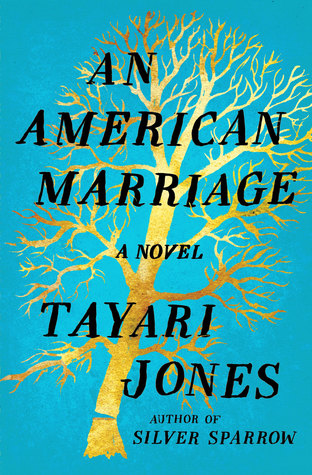
An American Marriage is about the institution of matrimony and race in America. Author Tayari Jones introduces readers to Celestial and Roy as each provides their perspectives on their relationship from its early stages to the circumstances that shake its foundation.
Roy’s a country boy with grand aspirations who left rural Louisiana at his first opportunity; Celestial is an artist born and raised in Atlanta. She could be considered haughty, just as he could be seen as arrogant in his drive to move far beyond his roots. Yet, Celestial is the more appealing character of the two. She’s intelligent, independent and creative. There’s just something about Roy that makes him less sympathetic.
This is true even after he is sentenced to serve a 12-year prison term for a crime he did not commit. During his incarceration, the narrative is told through the couple’s exchange of letters. Initially, their correspondence is warm, loving, a continuation of their previous life together. Slowly, the letters become less personal, more terse and infrequent.
The other significant character is Andre, literally the boy next door; Celestial has known him all her life. They have always been close friends and it was Andre who introduced her to Roy.
One year quickly becomes five. Life moves forward for all concerned through professional success, a death and realizations about the past. Following an early release, Roy hopes the passage of time hasn’t completely removed him from Celestial’s world. All are left to wonder what future their marriage holds.
An American Marriage
Three and three-quarter bookmarks
Algonquin Books, 2018
306 pages

Admittedly, I knew nothing about pachinko before reading the book of the same name by Min Jin Lee. The first mention of the popular Japanese pinball-like game doesn’t surface until halfway through this epic novel spanning four generations.
It begins on a small Korean island in 1910 and progresses rapidly several years later following the birth of Sunja, the only daughter of a poor, disabled innkeeper and his wife. Times passes quickly; soon Sunja is a teenager helping her widowed mother run the inn: a glorified name for a shack with paying guests. Tension between Korea and Japan contributes to the dire economic straits.
Sunja discovers she is pregnant and her lover is married. The arrival of a young man, ill and en route to Japan to serve as a minister, changes the course of her life. They marry, move to Osaka and live with his brother and sister-in-law.
History converges with their story as war, famine and prejudice dictate their lives: Koreans are considered less than third-rate citizens.
The family’s ability to survive depends largely on an unknown benefactor, reminiscent of Great Expectations. Heartache ensues once the identity is revealed.
The novel is rich with characters reflecting both the intolerant attitudes of many Japanese and the cultural constraints of Koreans living on foreign soil.
This is a bulky, albeit well-paced, joyful and heart wrenching story with a historical perspective. The game is an apt title since much of life is left to chance while bouncing around from situation to situation.
Pachinko
Four-and-a-half Bookmarks
Grand Central Publishing, 2017
490 pages


 The Blue Page Special