Archive for the ‘Books’ Category

A journalism background isn’t necessary to appreciate the points made by Bill Kovach and Tom Rosenstiel in their book entitled Blur: How to Know What’s True in the Age of Information Overload. Anyone who reads or listens to the news should find this interesting. The authors examine the speed at which information, specifically news, reaches consumers/viewers/readers. Demand for attention from various media is overwhelming in its volume and content.
Plus, since news is disseminated via multiple outlets including Twitter, blogs, newspapers, television, and Facebook — among others — it’s often difficult to know who or what to believe. Consequently, the authors say a healthy dose of skepticism is not a bad trait to possess. The pair outlines a six-step process to help sift through the excessive information to discern fair and accurate reports about the world around us. They suggest asking: “What kind of content am I encountering; Is the information complete, and if not, what is missing; Who or what are the sources, and why should I believe them; What evidence is presented, and how was it tested or vetted; What might be an alternative explanation or understanding; Am I learning what I need to?”
Media literacy is nothing original among journalism scholars, but taking it to the public is. It’s something that benefits the general population. A camera and access to the Internet are all the tools necessary to record and distribute news stories. However, just because everyone can play the game, doesn’t mean everyone plays it well, accurately or fairly.
Blur: How to Know What’s True in the Age of Information Overload
Bloomsbury, 2010
203 pages, plus notes and appendix

The images of a very pregnant police investigator and the frozen tundra evoked the movie Fargo. However, these are the only similarities with Asa Larsson’s Sun Storm. Larsson, no relation to Steig of the Dragon Tattoo mysteries, has crafted a novel rich with imagery but lacking in true suspense.
Rebecka Martinsson is a tax attorney in Stockholm called home to Kiruna, in northernmost Sweden, to help a friend suspected of murder. The gruesome, ritualistic crime takes place in a church run by the pastors who long ago banished Rebecka from their community. The back story, including the strained relationship between Rebecka and Sanna, more a former friend than a true one, fill most of the pages. What’s noteworthy is how compelling this is. In fact, at several points it’s easy to forget a murder investigation is underway, or that a threat has been made against Rebecka.
Larsson’s writing is stark, like the landscape of which she writes. Yet, it is easy to imagine the corrupt church leaders, their disappointed wives, the aggrieved Sanna, and a friendly neighbor. Rebecka is both insecure and confident. She tries hard to maintain an emotional distance from the area she was forced to leave. These very efforts make her interesting, but not altogether warm and engaging.
The only completely likeable character in the bunch is Anna-Maria Mella, the female investigator. It turns out, she actually is somewhat like the Frances McDormand role in the Coen Brothers’ film: intelligent, caring and ready to give birth.
Sun Storm
Three-and-a-half Bookmarks
Delta Trade Paperbacks, 2007
310 pages

The title alone, Cocktail Hour Under the Tree of Forgetfulness, is sufficient to lure the imagination, and Alexandra Fuller’s colorful, poignant memoir of her mother is enough to keep it willingly ensnared. This is a sequel to Fuller’s Don’t Let’s Go to the Dogs Tonight: An African Childhood, which I did not read. But then I didn’t read Cocktail Hour either. Instead, I listened to it.
Conditions have to be just right for me to turn to an audiobook. Usually, it means a road trip, but in this case I wasn’t going anywhere. In fact, I was stuck painting the downstairs bathroom.
Fuller’s mother, “Nicola Fuller of Central Africa,” is a character full of flaws, passion and imagination. The author makes it clear it was not easy being her daughter. Nicola is exuberant to the point of embarrassment of all around her. While Fuller does not hold back in detailing her mother’s domineering persona, neither does she waffle in showing the occasional moments Nicola allowed an approachable, sensitive side to appear. This is not a daughter-as-victim tell all memoir. It is a daughter recognizing who she is thanks to, and in spite of, her mother.
One of the joys of listening to this, rather than having read the book is that Nicola loves to sing. Like Nicola Fuller of Central Africa, the narrator breaks into song. Sure, I can imagine a tune in my head as I read, but here it was treat hearing this aspect of Nicola’s personality.
Cocktail Hour Under the Tree of Forgetfulness
Four Stars
Alexandra Fuller
Recorded Books, LLC, 2011

It’s difficult to imagine a more unlikely, unqualified person to serve as the U.S. ambassador to Germany as William E. Dodd during Hitler’s rise to power. It’s equally hard to visualize that his daughter’s scandalous behavior never, well, caused a scandal.
Erik Larson’s In the Garden of Beasts chronicles one of the four years Dodd spent in Germany first trying to ignore the problems, later attempting to convince others of the threats, fear and destruction caused by the Third Reich. He was equally inept at recognizing the potential dangerous behavior exhibited by his daughter Martha, who was attracted, it seemed, to any man who looked in her direction.
Larson relies on numerous letters, memoirs, newspaper articles, personal diaries and other accounts to piece together his narrative. The result is a well-constructed look at a fascinating time in world history. Beginning with Dodd as a professor at the University of Chicago, Larson tracks his path to Berlin, with brief stops through his backstory as a son of a poor North Carolina farming family. Although Dodd’s wife and son also moved to Germany, Larson’s focus is on the senior Dodd and Martha. He because of his position and his eventual, ineffective efforts to share his concerns/fears to greater powers; she because of the disreputable manner in which she socialized.
Larson’s descriptions of pre-World War II Berlin are riveting, as are his references to Dodd’s frugality. For example, Dodd insisted on shipping the family Chevrolet to Germany to save costs. Even in the face of the ensuing events, this is endearing.
In the Garden of Beasts
Three-and-a-half Bookmarks
Crown Books, 2011
488 pages, including end notes, bibliography and index

While wondering at the necessity, I marvel at the kind of concentration and craftsmanship it takes to write a single sentence that makes sense and holds interest as it spans 12 pages rife with characters, each distinctly different, who share a common struggle against fate, karma, some elusive and nebulous hand manipulating a game board with varying designs and obstacles; yet this engaging contest in Michael Chabon’s most recent novel, Telegraph Avenue, is played with swagger and fear by men, women and teenage boys fighting to hold onto dreams while desperately needing to relinquish the realities of their colorful lives.
I lack the skill, and inclination, to take a 100+ word sentence any further. Chabon can, but that’s the least of his mastery. Set in Oakland, his story about two men who run a (old school vinyl) record store in danger of being razed to accommodate a mega urban renewal project is a tribute to friendship, music and, oddly, especially family.
The novel is drunk with sensory images. Consider: “At 9:45 a.m. the first batch of chicken parts sank, to the sound of applause, into the pig fat.” Or: “… the loose weather stripping that peeped like a gang banger’s drawers from the seams around the back door.”
The major flaw lies in the glut of characters; initially, it’s difficult keeping track of who’s who. Nonetheless, it’s clear everyone, from actors to midwives, is just trying to get by in life while a poor economy, outdated technology and children get in the way.
Telegraph Avenue
Four Bookmarks
HarperCollins, 2012
465 pages

When I was growing up my brothers and I had to finish everything on our plates before we could leave the dinner table. Some nights I was there for hours. As I struggle to finish a book that is neither well-written, interesting, nor can compete with the demands of daily life, I feel as if I am stuck at the table again.
Years ago I gave myself permission to try the 50-page test with books. If I wasn’t hooked within the first 50 pages, it was time to find something new. That worked for a while, but then I regressed. Recently, I found myself struggling with a book recommended by a friend whose reading list I respect. I made it through 10 pages, but it took a lot of time. I crawled through another 20 pages, put the book down, gave myself a few days and tried again. I actually reached page 118, but I didn’t enjoy a word of it: it felt like punishment. I’m returning the book to the library.

I obviously have the if-you-start-something-see-it-through ethic. I began to consider things I have no reservations walking away from: bad service in a restaurant, bad attitudes from clerks in stores, bad food that appears in front of me. With my kids, the rule was to at least try what was on the plate. I’m going to make a better effort at following that same advice when it comes to books, and not be so reluctant to move on.

I was on the library’s waiting list for Gillian Flynn’s Gone Girl for months. When it was finally ready for me to check out, I was impatient to start reading. After mentioning this to a friend, her reaction was less than exuberant, it was baffling. After all, the novel was so popular there’d been hundreds ahead of me waiting for a library copy. It’s been on Publisher Weekly’s list of Best Hardcover Fiction for 15 weeks – and appears pretty comfortable there. I pressed my friend for more, but she held fast: we’d talk when I finished.
Gone Girl is a mystery on several levels, including how I spent time living with such unlikeable characters for the past week? The story follows the disappearance of Amy on her fifth wedding anniversary. By all indications, her husband, Nick, is responsible. Amy and Nick alternate as narrators. The book is divided into three sections. The first focuses on the disappearance, possibly abduction or possibly murder. Nick comes across as shallow and surprised, not upset, at his wife’s unexplained absence. He seems guilty, which is reinforced by Amy-as-victim told through diary entries.
The second and third sections of the book reveal much more about Amy’s ability to weave complicated webs of deceit. It’s not that Nick is suddenly less appalling, but Amy is more so. Flynn is a craftswoman. Her characters are fully developed as repulsive and intriguing. They’re also scary, always a good thing for a mystery, and I couldn’t look away. I need to talk to my friend.
Gone Girl
Four Bookmarks
Crown Publishers, 2012
415 pages
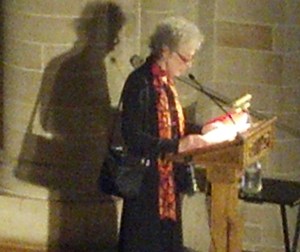
Usually, I’m not a Margaret Atwood fan. She makes it so difficult, through depressing stories and odd characterizations, to appreciate her wit, imagery and intellect. Reluctantly, I read The Year of the Flood. It was the choice for my book group, and the All Pikes Peak Reads 2012 selection. As part of the APPR festivities, Atwood spoke about sustainability and survival: two prevalent themes in her works.
Surprisingly, once I started reading I was anxious to continue. Although Atwood dismisses claims The Year of the Flood is a post-apocalyptic tale, nothing better describes it. The story takes place in a time when mutations, genetic engineering and an order of fear prevail. The flood refers to an unknown deluge caused by man’s errors and destructive predispositions. It is not a natural phenomenon; it’s a “waterless flood.”

God’s Gardeners is a small cult with a foundation in Christianity that celebrates the lives of such people as Rachel Carson and Euell Gibbons, among others, for the contributions they made to saving the environment. The Gardeners strive to protect nature and prepare for (and later survive) the flood. Within the cult, Toby and Ren, represent maturity and youth, respectively. Their narratives move the story forward. Atwood said she purposely incorporates multiple voices in her works because “I don’t like everyone to sound the same.” Toby is represented in third person, while Ren offers a first person perspective. The sermons of Adam One, the Gardeners’ leader, begin each chapter using second person voice.
I’m glad I read this and even more pleased to have heard Atwood speak. It provided insight into her work, but mostly served to demonstrate her keen sense of humor, which fortunately surfaces in this novel. A novel, by the way, which has, as Atwood stated, “A ray of hope.”
The Year of the Flood
Four Bookmarks
Anchor Books, 2009
431 pages

Me, Who Dove into the Heart of the World is the cumbersome and complex title of Sabina Berman’s debut novel. Yet, it turns out to be just about perfect. The me refers to the first word narrator Karen Nieto learns. She is 10 years old when her mother dies and her aunt moves into the family home in Mazatlan. It’s her aunt who teaches her to speak, loves her and later defers to her in business matters. Her aunt also identifies Karen as an autistic savant.
The family operates a tuna fishery, which has a profound impact on Karen’s education and sensitivities. If this is beginning to sound vaguely similar to Temple Grandlin’s story, it should. It’s about overcoming perceptions and obstacles. It’s about the ability to be so focused, to the exclusion of everything else including social norms, that success can’t help but surface. Karen evolves from a gangly girl with matted hair to a gangly woman with a buzzcut; along the way she develops a humane fishery.
The story spans 32 years including Karen’s schooling, business developments and interactions with others. After being tested, and self-identifying as “Different Abilities,” Karen learns “… in 90% of standard measures of intelligence (she is) somewhere between imbecile and idiot, but in 10% (she is) on top of the world.”
The most poignant moments are those between Karen and her aunt. Although Karen goes on to do great things, the most moving and inspirational are the leaps she makes in this relationship.
Me, Who Dove into the Heart of the World
Four Bookmarks
Henry Holt and Co., 2012
242 pages

I don’t know what it is that makes me crave Scandinavian crime fiction, but I’m addicted. Sweden’s Hakan Nesser’s Mind’s Eye fed my habit, but I know I’ll need more soon. Nesser is a master storyteller whose pacing is neither rushed nor sluggish. The crime scenes aren’t too gruesome and the clues are well hidden. He even manages to throw humor into the mix.
The story begins with Janek Mitter awakening from a drunken stupor only to find his wife drowned in the bathtub. Mitter’s too easy a suspect, but is, nonetheless, tried and convicted before things take a turn and get exciting: Mitter, too, becomes a victim. That’s where Chief Inspector Van Veeteren, a middle-aged investigator with an attitude, comes in. His success rate at solving crimes is impressive. He had early doubts about Mitter’s guilt, but not soon enough.
I had a fairly good idea about who the actual killer was, but was not prepared for why. Van Veeteren knows who but won’t name names because, as he tells a subordinate, “… there has to be a story,” in other words a reason. Nesser’s characters develop slowly, and in an interesting manner. Many chapters begin with stream of consciousness narration and it is unclear who’s doing the thinking. This only enhances the element of suspense. Eventually, it gives way to very clear identities and perspectives.
This is the first of Nesser’s Van Veeteren mysteries. I can’t wait for my next fix, I mean the next installment. Fortunately, Nesser has several.
Mind’s Eye
Four Bookmarks
Pantheon Books, 2008
278 pages











 The Blue Page Special