
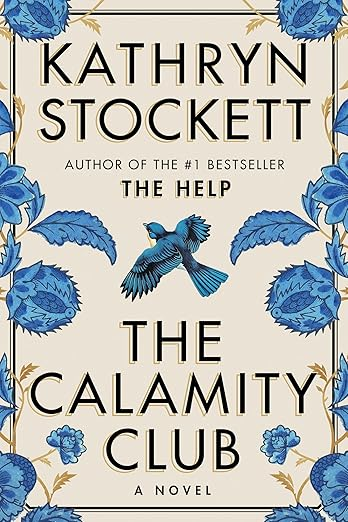
(I’m back. I took a blogging break, but reading continued as usual: a lot. I’m not sure I’ll blog about everything that I read over the past (too many) months since I last posted, but thanks to a friend’s encouragement I’m reigniting my passions of reading and writing.)
When I picked up my copy of The Calamity Club from the library (a book with an exceptionally long wait list), I was thrilled until I realized it was more than 600 pages. Once I started reading, I forgot about the weight — er number of pages — and couldn’t put it down.
Set in the depression in Oxford, Miss., Kathryn Stockett’s novel has multiple intertwining threads, yet none get tangled enough to be confusing. All address some heavy, intense issues in an often amusing, but always poignant manner.
Birdie is a hardworking, intelligent, unmarried woman. She’s perceptive and speaks her mind. She goes to Oxford to learn why Frances, her newly-married, social-climbing sister, hasn’t communicated with anyone in the family. Frances and her husband live with his mother in their well-appointed home.
Eleven-year-old Meg has been abandoned by her mother and is considered “unadoptable” at the county orphanage where the sadistic director is particularly harsh toward her. Meg is witty and resourceful in spite of her situation.
Birdie and Meg are only two of the many, many interesting characters inhabiting the pages. All have distinct voices/personalities. The setting is vividly described and the hardships of the era are palpable.
A myriad of secrets, including some surprising connections, and a unique, actually kind of crazy, solution to solving the problems associated with poverty, racism and abandonment converge in some laugh-out-loud and tear-sniffling moments.
Stockett’s last book (The Help) was published in 2009. It was worth the wait for The Calamity Club.
The Calamity Club
Five bookmarks
Spiegel & Grau, 2026
656 pages