Archive for the ‘Scribner’ Tag
In Creation Lake by Rachel Kushner, “Sadie Smith” is a secret agent for undisclosed clients. She’s adept at manipulation, which she demonstrates while ingratiating herself, first with a Parisian man, and later a counter-culture group in rural France.
As she learns more about the group she becomes intrigued by a hermit, Bruno, who lives in a cave and mentors those in the commune. He does this via emails, which Sadie intercepts; she becomes enthralled by his writing on early man. He wants the group to return to pre-industrial, and even prehistoric lifestyles. But, there’s more to Bruno than his knowledge of prehistory (the recounting of the history of the medieval Cagots is fascinating); Sadie is captivated by his ideas for not just what it means for Bruno’s mentees, but what a less deceptive life could mean for her.
As the narrative expands, it becomes less clear who’s manipulating who. Sadie works with the group to plan a protest against the government’s plan to divert water meant for farming to “megabasins” to be used by agricultural corporations. However, her intent is to have the commune members make it a violent demonstration.
There’s a lot of intrigue and double-crossing, and Kushner’s fast-paced writing makes it difficult to keep up with who are the good guys, or if anyone is. Certainly, Sadie’s ability to disregard and/or exploit others makes her unlikeable, yet, strangely, she’s the character you care about who she trusts, while maintaining her cover, which has a bearing on her safety.
Creation Lake
Three and-a-half bookmarks
Scribner, 2024
404 pages
In Stolen Ann-Helene Laestadius’ coming of age novel, Elsa is nine-years old when she witnesses the murder of her reindeer, part of the family’s herd. Threatened by the killer, Elsa remains silent, despite others’ suspicions regarding his identify.
It’s only one incident endured by the Sami in this far northern region of Sweden. Despite entreaties to authorities, nothing is done to quell tensions endured by the indigenous people whose livelihoods depend on the reindeers.
Ten years later, little has improved for Elsa’s family and the Sami community. Reindeer, which have cultural significance, are still tortured and slaughtered. When Elsa takes it upon herself to speak out, she and others are terrorized. Despite being haunted by her childhood memory and the overhanging threat, Elsa is a strong, intelligent woman with dreams of one day overseeing her own herd. This, however, is yet another battle in her male dominated world.
Disregard by the authorities, xenophobia, personal demons, Sami culture and familial relationships are all addressed. Laestadius is Sami and provides a unique perspective to all the above. She deftly describes the frigid, beautiful landscape as well as the joys and traumas shared by the Sami villagers. The disregard by non-Sami supported by an apathetic police force is heart breaking.
It’s not just the animals that are lost when they’re killed. In Elsa’s case she was also robbed of her childhood. For other characters, beyond what the herds mean as their occupations, their hopes and mental health are also at stake.
Stolen
Four bookmarks
Scribner, 2021
384 pages
Cloud Cuckoo Land may be the looniest book title I’ve heard of. Nonetheless, it’s Anthony Doerr’s most recent, aptly-named novel. This epic work traverses centuries and locales; it’s about five children, books and the importance of libraries in their lives and throughout time.
Anna is an orphan in Constantinople; Omeir is a village boy in the same era. Zeno and Seymour are from Idaho living in the 2000s; and Konstance lives on an interstellar ship. Some them converge, and they’re not the ones readers might expect.
Libraries could, collectively, be a sixth character. They serve as gathering places for four of the five to learn about their individual worlds. A Greek book ties everything together. It’s the namesake of this narrative and a story within the main story.
Each section expands on the ancient tale of Cloud Cuckoo Land wherein a man is turned into an ass. His efforts to regain his human self result in a far-fetched adventure with a potent moral.
At 600+pages, some might consider this to be a daunting undertaking. Yet, it’s worth reading every word. The characters age and not all for the better; the paths they pursue, often driven by information gleaned from their respective library visits or exposure to the Greek story, are ones easily imaginable despite the different settings.
Doerr has crafted a rich and vivid narrative through empathy, tension and curiosity. It’s a given the different eras and places will make sense. How it occurs is captivating.
Cloud Cuckoo Land
Five Bookmarks
Scribner, 2021
626 pages
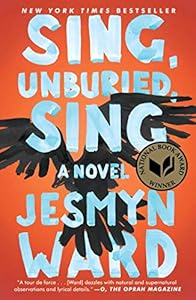
Sing, Unburied, Sing by Jesmyn Ward is a terse novel involving ghosts, survival, and, at its core, familial bonds. All aspects are told from the perspectives of 13-year-old Jojo; his drug-addicted, negligent mother, Leonie; and Richie, the spirit of a young boy imprisoned years ago for stealing food. The three voices are distinct even as their experiences merge.
Jojo lives with his younger sister and grandparents on a rundown farm near the Mississippi delta. His grandmother lies dying, while Riv, his grandfather, tries to maintain an even keel for his grandchildren. Although, Leonie’s inconsistent presence in their lives isn’t appreciated by anyone, she insists on taking the children on a road trip to the state penitentiary where their father is soon to be released.
Richie’s connection is to Riv who did his best to protect the boy when they were imprisoned at the same time years ago. Jojo, the only one who sees Richie, knows part of his story but Riv has never told him the ending. Since it works to have one ghost, why not another? Leonie’s dead brother, shot down in his youth, makes his presence known only to her.
The phantasms are neither spooky, nor superfluous. Their presence propels the narrative focused on the family ties that bind and those that never do. Jojo is an insightful, caring character much older than age. His closeness to Riv compensates for much that’s missing in his life, but Ward ensures the reader never overlooks the loss they shoulder.
Sing, Unburied, Sing
Four Bookmarks
Scribner, 2017
289 pages

Mary Beth Keane’s Ask Again, Yes is an unconventional love story: familial and romantic. Human tragedy and honest, important contemporary issues are at its heart when the intersecting lives of two neighboring families are forever changed.
Kate Gleeson and Peter Stanhope are born within weeks of each other. They grow up next door to one another in a suburban town, both of their fathers are with the NYPD. Where the Gleeson home is full of activity with Kate and her two older sisters, Peter is an only child whose mother is reclusive and father stays uninvolved. Nonetheless, Peter and Kate are best friends.
Keane has crafted more than what could simply be a boy/girl next door romance. When they’re not quite 14 years old, a near-catastrophic event takes place involving the parents. Its impact is felt for the next four decades. The kids have no contact with one another for years.
Mental health, abandonment and alcoholism all contribute to the characters’ development and propel the story. The narrative is told with a wide-angle lens with changes in perspectives making for multifaceted and engaging storytelling.
The novel has the potential to languish in despair, but instead it resonates with subtle glimpses of hope and moments of real joy. The past is always close to the surface, but Keane makes it clear the future is also on the horizon. It’s less about second chances and more about acknowledging, if not outright appreciating, life’s goodness and finding the wherewithal to take one day at a time.
Ask Again, Yes
Four Bookmarks
Scribner, 2019
390 pages

I’m drawn to novels about women’s friendships: the premise of The Island of Sea Women by Lisa See and I was not disappointed.
Set on the Korean Island of Jeju, the author provides an in-depth look at Korean culture involving female sea divers, an ever-changing political climate and the bonds of friendship that beautifully flourish before painfully disintegrating.
The elderly Young-sook narrates this captivating story of her friendship with Mi-ja. They are different in their experiences and backgrounds. Young-sook’s lineage boasts the respected sea women, divers who carefully harvest from the ocean for their livelihood. Mi-ja is the daughter of a Japanese collaborator. They learn to dive together; they share secrets, joys and losses.
As they grow-up their island undergoes numerous political changes beginning with Japanese colonialism to World War II then the Korean War. Poverty is a way of life for the villagers, but the sea women find solace beneath the water’s surface. Through vivid descriptions, See recreates the rural lifestyle of the islanders and the heartbreak they endure in war.
When marriages are arranged for Mi-Ja and Young-sook, they wonder how they’ll survive being apart from one another. Facing the harsh influences of the outside world, their friendship falters until rendered irreparable.
The progression of time is marked through the different regimes, cell phones and indoor plumbing.
Among the novel’s many beauties are the memory of the rich friendship, the presence of Mi-ja’s great granddaughter and, finally, the reader’s awareness of a single perspective being shared.
The Island of Sea Women
Four-and-a-half bookmarks
Scribner, 2019
374 pages

Author Rachel Kushner’s The Mars Room is a strip joint in San Francisco, where Romy Hall once gave lap dances to support herself and her young son, Jackson. That’s before she’s sent to prison in California’s desolate Central Valley, where she’s sentenced to two consecutive life sentences for a crime that’s not immediately explained.
Most of the narration is Romy’s as she recounts her childhood, teenage years and life working as a stripper. These reflections are interspersed with her confinement. It may be almost impossible to think about women in prison without Orange is the New Black coming to mind. However, Kushner’s cell scenes are harsh, unsympathetic and dismal. Nonetheless, Romy is befriended by Sammy, a veteran inmate, Conan, a transsexual who’s very convincing as a male, and Gordon Hauser, a teacher who recognizes Romy’s intelligence and beauty.
A few of the chapters are narrated by these friends. Doc, a crooked cop, imprisoned miles away, also provides a voice. Yet, it’s Romy with her sense of humor, dismay and maternal instincts who commands the pages. She has had to leave Jackson, in the care of her mother, which causes a number of complications for Romy.
Kushner blends pathos with the harsh reality of prison life. As one of the guards states, not just to Romy, but others, “… your situation is due one hundred percent to choices you made and action you took.” As we learn more about Romy and the other characters, it’s evident this is not entirely true.
The Mars Room
Four Bookmarks
Scribner, 2018
338 pages

Jennifer Egan is masterful at setting the scene and evoking another era in Manhattan Beach, her recent novel. Her characters, their emotions and their resolve are captivating. The narrative is part love story, part gangster tale in an historic World War II, (mostly) New York City setting.
As a young girl, Anna Kerrigan tagged along with her father, Eddie, on his errands, presumably for the union. On one such outing, the 11-year-old and Eddie visit Dexter Styles at his mansion-like home on a private beach. It’s evident that the Kerrigans don’t share the same lifestyle as Styles.
By contrast, Anna’s family lives in a small, sixth floor apartment. Her younger sister, Lydia, is severely disabled requiring constant care.
Fast forward and Anna is now the sole provider for her mother and sister thanks to her job at the Brooklyn Naval Yard, where she becomes the first female diver. Her father disappeared years earlier and the country is at war.
The progression of sorrow Anna experiences regarding Eddie begins with anguish which evolves into anger before settling into indifference. For the reader, however, his long absence is hard to ignore. Egan wants it that way. Meanwhile, Styles resurfaces. Anna remembers him; even though she catches his attention, he has no recollection of her as a child.
The interactions of this trio of main characters across time, complete with back stories, hopes and foibles, provide the book’s focus.
Ultimately, it’s about reinventing oneself and the toll it takes to do so.
Manhattan Beach
Four-and-a-quarter Bookmarks
Scribner, 2017
433 pages

For some reason it seems the stack of books on my nightstand never, ever shrinks. Some titles have been there for longer than I care to confess. When I saw that The Light Between Oceans has been made into a movie, it was time for me to rescue it from the mountain of titles. (If I decide to see the film I need to read the book first.)
Written in 2012, this is M.L. Stedman’s debut novel set off the rocky coast of Australia following World War I. The author provides lyrical descriptions of the harsh life of a lighthouse keeper, Tom, made more comfortable by the love and vibrant personality of his wife, Isabel.
Tom has returned from the war surprised and guilt-ridden by his survival. He is well suited to the solitary life on an isolated thread of land. It isn’t until he meets Isabel while waiting for his next lighthouse assignment that he realizes what’s been missing from his life. They marry, and after Isabel miscarries multiple times, they believe their hopes of having a family will elude them. That is until a small boat washes ashore with an infant child and a drowned man.
Tom wants to turn the baby over to authorities; Isabel does not. What follows is a succession of heartache and lies borne of love. Stedman’s characters are real, full of faults. She raises poignant questions for all involved and readers are left to consider what they might do in a similar situation.
The Light Between Oceans
Four Bookmarks
Scribner, 2012
343 pages

I wasn’t aware of the 1983 Glen Canyon Dam crisis, nor of an effort to achieve the fastest ride through the Grand Canyon until reading The Emerald Mile. Keven Fedarko presents an engrossing, at times lyrical (and occasionally overwhelming) account of the events that led to three men hurtling down the Colorado River in a wooden boat.
Fedarko introduces a cast of characters from John Wesley Powell to park rangers, from boat builders to hydrologists, from river rats to tourists – among others. Historic, meteorological, hydrologic and recreational elements – again, to name a few – are all addressed. Fedarko’s writing is based on thorough research that serves the purpose of illustrating the myriad of components that made the river run possible while addressing aspects that threatened its fulfillment.
The author is a master of the backstory. His writing is much like the river he describes: full of excitement and the unknown, then calm. And, he apparently leaves no stone unturned. Although this is a work of fiction, it has the feel of a mystery: how is Kenton Gura, the man who captained the small, hand-built dory named the Emerald Mile, going to pull off the adventure of a lifetime? This same sense of intrigue is evident in the passages concerning the efforts to thwart a dam failure while dealing with the effects of a massive snow melt: the effect of El Nino.
This work makes me not only want to revisit the Grand Canyon, but also to tour the dams at either end.
The Emerald Mile: The Epic Story of the Fastest Ride in history Through the Heart of the Grand Canyon
Four Bookmarks
Scribner, 2013
415 pages (includes notes and index)




 The Blue Page Special