Archive for the ‘Riverhead Books’ Tag
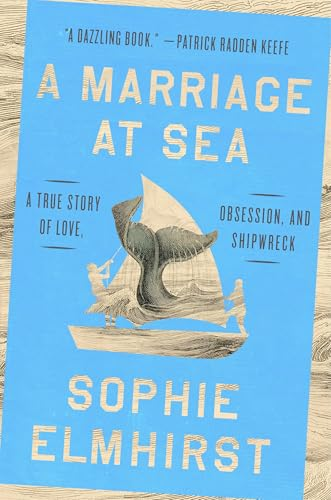
Marriage at Sea: A True Story of Love, Obsession and Shipwreck by Sophie Elmhirst is a gripping account of Maralyn and Maurice Bailey’s* exploits at sea.
The subtitle reveals the main elements of the narrative; yet in no way diminishes the situation upon which Elmhirst’s work is based.
The book focuses on three aspects: the couple’s backgrounds, personalities and how they met; next, sailing, shipwreck and days adrift; finally, life after their rescue (this isn’t a spoiler).
Elmhirst first captures readers’ attention by describing how the two met. Despite have similarly unhappy upbringings, their personalities were very different. Maurice was adventuresome, methodical and obstinate in his ways. Maralyn was more carefree and logical. She readily joined Maurice in his daring undertakings.
They set sail from England for New Zealand in a boat they built themselves. This is, initially, the idyllic part of the story. It all dramatically changed after their boat was hit by a whale in the Pacific Ocean far from shore. They spent 118 days at sea, afloat in a dinghy attached to a life raft. Their rations were in short supply, they had no radio and had to rely on each other to survive. How they did so was a lesson in perseverance; primarily on Maralyn’s part. She became more resolute in surviving as Maurice fell into despair.
Elmhirst relied on Maralyn’s journals, newspaper accounts and interviews with those who knew the couple. This is fascinating look at relationships and adventure; the latter section is tiresome, though.
Marriage at Sea: A True Story of Love, Obsession and Shipwreck
Almost-four bookmarks
Riverhead Books, 2025
256 pages
*Photo from nzherald.co.nz
In The God of the Woods author Liz Moore crafts a fast-paced, engaging mystery that addresses long-held family secrets and the bonds they stretch.
The novel deftly moves between two decades, primarily 1961 and 1975. One August morning of that latter year, at Camp Emerson in rural upstate New York, Barbara, a camper, is discovered missing. What ensues is a search involving local and state authorities.
Although it shouldn’t matter, there’s additional intensity involved in finding the girl: she’s the daughter of the camp’s owner; she’s also the sister of the young boy who disappeared from the same area long ago. The boy’s body was never found creating double intrigue.
Moore’s narrative includes the parents’ histories, how the camp came to exist, vivid descriptions of the environs and several distinct, interesting and strong females. Chief among them are Barbara’s camp counselor, the camp director and a female investigator on her first case. Barbara’s character is also well developed. She comes across as a self-assured teen whose parents give her little attention and is in the shadow of her brother who went missing years before she was born.
Barbara’s family is wealthy and demanding; she’s viewed by her parents, particularly her overbearing father, as a trouble maker. Her mother is easily dismissed by those around her; she’s lost in grief and dependent on pills and alcohol.
There are plenty of theories and possible suspects in both missing persons’ cases, which adds to the whodunit. Yet, Moore’s playbook is far from formulaic.
The God of the Woods
Four Bookmarks
Riverhead Books, 2024
478 pages
I’ve struggled with how to review All Fours by Miranda July about a woman’s search for, well, more particularly when it comes to sex.
The unnamed narrator, an artist, by all accounts has a good, if not completely satisfying life with her husband and child. After receiving a large sum of money for the use of some of her work, she plans a trip to New York City. Rather than flying, she drives.
She stops 30 miles from her Southern California home, briefly meets Davy, learns his wife is an interior decorator stays at a nondescript motel. There she uses the money to hire the young man’s wife to redecorate the room.
While the upscale redecorating takes place our narrator fantasizes about the man, the man and his wife and mostly the man being with her.
Rather than a road trip, the novel becomes a jaunt through sexual fantasies. Once the remodel is complete, the narrator and Davy routinely meet. He’s adamant about not having sex with the narrator, their relationship is a close to being unconsummated as it gets. This is only the first third of the novel.
The remaining thirds feature plenty of sexual escapades that do occur in the posh room, but all involve women. Once home again, the narrator’s marriage becomes a co-living, co-parenting relationship; and she returns weekly to the motel room where she meets other women.
There’s humor and sex so this may be for the faint hearted. There’s also a lot of repetition.
All Fours
Three Bookmarks
Riverhead Books, 2024
326 pages
A book with few likeable characters such as Paula Hawkins’ A Slow Burning Fire, is difficult to recommend. Granted, the mystery element is strong with several suspects, but it almost doesn’t matter who-dunnit if there isn’t one for whom to root.
When the body of a young man, Daniel, is found brutally stabbed on a London houseboat the immediate suspect is Laura who was seen leaving his place covered in blood shortly before the body is discovered. Yet other suspects include Miriam who lived on the neighboring boat, and Carla, Daniel’s once-estranged aunt.
The back stories for these major characters factor into the present-day mystery. Laura was in a serious bicycle accident as a child and has dealt with anger management issues ever since.
Miriam is without friends or family. As a teenager she was abducted, and these many years later she remains a broken, unkind person.
Carla, the deceased man’s aunt, had a tenuous relationship with him based on guilt for how she treated his mother/her sister. Fifteen years earlier, Carla’s three-year-old son died while in the care of her sister. Her nephew discovered the child’s body.
Hawkins offers plenty of credible twists throughout, including several instances where it seems obvious, beyond a reasonable doubt who killed Daniel.
Laura is befriended by Irene, an elderly woman (who interestingly lives next door to Carla’s late sister’s home). For the younger woman, this is significant: Irene genuinely cares about her. Consequently, Irene is finally a character the reader can actually appreciate.
A Slow Burning Fire
Three Bookmarks
Riverhead Books 2021
306 pages
The Age of Vice is a massive novel about inequity, corruption and loyalty. Despite its hefty size (more than 500) pages, Deepti Kapoor has crafted an epic story that is equal measures mystery and love story – my favorite combination.
Ajay is the manservant of Sunny Wadia, the son of one of the wealthiest and most powerful man in India. Ajay is imprisoned when he’s identified as the driver of the speeding Mercedes that kills five people. The narrative then jumps back 13 years when Ajay is a poor, barely-educated child in a rural area of India. When his father is beaten by the village leaders, Ajay is sold to help pay the family’s debts. He’s sent to a mountain farm where his situation is improved, although he’s still looked down upon for his station in life.
How Ajay came to be Sunny’s servant and charged with manslaughter is a circuitous tale of excessive wealth and waste amplified by exploitation. By contrast are Ajay’s strong work ethic and his gradual rise to Sunny’s shadow, something that comes with numerous perks but many strings attached.
Sunny is an addict and womanizer, but falls in love with a journalist. Their relationship is complicated. She’s not what Sunny’s father envisions as the perfect wife for his heir.
Bunty and his brother’s influence span much of the country and little goes unnoticed by either, including how Ajay came to be behind the wheel in the deadly crash.
Kapoor’s characters are vividly depicted as are India’s extremes.
The Age of Vice
Four+ Bookmarks
Riverhead Books, 2023
548 pages
Despite the racism, hardships and wrongs done to the Blacks and Jews who inhabit the landscape of James McBride’s The Heaven and Earth Grocery Store, there is redemption — on numerous levels.
The appropriately-named store is a gathering place for the myriad of immigrants in the Chicken Hill community of Pottstown, Penn. It’s run by Chona, a kind, rabble-rousing Jewess. She’s idolized by her husband Moshe, a Romanian immigrant who runs a successful dance hall. Nate is his Black handyman.
It’s the early-1970s when the remains of a body are found in the neighborhood; the identity keeps readers wondering throughout the novel. The engaging storyline switches to the mid-1920s. The interactions among the Jews, Blacks and whites (who include Klu Klux Klan members) are vividly detailed.
Nate, needs to hide, Dodo, his deaf, orphaned nephew from authorities who want to institutionalize him believing him to be feeble-minded. Chona insists on harboring him in her apartment above the store. While the boy doesn’t hear, he is far from stupid — something Chona recognizes. The two become close and she does what she can to keep safe from the white powers that be.
McBride’s story is rich with characters, although many are one-dimensional; many more — the ones readers will care most about — are multi-faceted. The result is a poignant narrative about people living and working together toward a better life.
Humor and injustice are an odd couple, but here McBride deftly proves them to be a good match here.
The Heaven and Earth Grocery Store
Four-and-a-half Bookmarks
Riverhead Books, 2023
400 pages, includes acknowledgements.
The lies we tell ourselves, and others, to create new lives is the theme of The Vanishing Half. Brit Bennett’s novel addresses several timely issues including racism, sexism, privilege and gender identity. These are daunting points to undertake, but Bennett, without diminishing their importance, imbues the narrative with compassion and wonder.
At its heart, this is about twin sisters, Desiree and Stella, who, as teenagers, ran away from home: a small, rural community of fair-skinned Blacks. The story tracks their lives as they eventually take separate paths, both figuratively and literally. Desiree returns home with Jude, her young, very dark daughter in tow; Stella passes herself as white, marries, moves to an exclusive area in Los Angeles and constantly worries she’ll be exposed.
The emphasis on Jude’s blackness drives the uncommon, perhaps unpopular, notion racism is only something whites project to nonwhites. Within her own, albeit pale, Black town, Jude’s been shunned since the day she arrived. Despite this, she doesn’t see herself as a victim and hers is the most engaging subplot within the novel thanks to those she interacts with most.
Although some stereotypes exist, most of Bennett’s characters are well-defined. This goes beyond physical descriptions, but includes their joys, heartbreaks and deep emotions.
The settings change but the most important action occurs in the rural south and Los Angeles. Incorporating different locales makes it easy to see problems aren’t restricted to geographic regions. And, lies travel easily from one place to another.
The Vanishing Half
Four-and-a-half Bookmarks
Riverhead Books, 2020
343 pages

C Pam Zhang’s How Much of These Hills is Gold can be read as either a question or an exclamation. It depends as much on the characters’ perspectives as the reader’s, which frequently changes but isn’t distracting.
Two siblings, Lucy age 12 and Sam age 11, of Chinese descent are left as orphans. Lucy’s pragmatic whereas Sam, their father’s favorite, is stubborn. Both are intelligent, but in different ways. The first thing they need to do is bury their Ba, something they must do with some semblance of tradition. Memories of him and their Ma, who is already gone, provide the family history: life as outcasts; how Ba and Ma met; Lucy’s passion for education; Sam’s disdain of the status quo; and more. So much more.
The plot unfolds as the Gold Rush has passed its heyday and railroad lines are being set across the west. Zhang’s writing is beautifully descriptive, not only of the northern California inland but the people inhabiting the harsh environment.
Lucy’s the focus of most of the story, although Sam, Ba and Ma are vividly brought to life. Yet, Zhang has crafted a family portrait full of flaws, loyalty, tradition and equal parts optimism and pessimism. Ba was born in California and was abandoned as a child. He’s Chinese, but doesn’t know the language – something he eventually learns from his wife.
Within this poignant adventure of Lucy and Sam on their own are issues of racism, sexual identity and the meaning of family.
How Much of These Hills is Gold
Four-and-a-half Bookmarks
Riverhead Books, 2020
272 pages

City of Girls, by Elizabeth Gilbert, is narrated by 89-year-old Vivian Morris reflecting on her life in response to a question posed by Angela, who writes “…I wonder if you might now feel comfortable telling me what you were to my father?”
The short answer is no. The 400-page response is Vivian revealing her history to ultimately explain what he meant to her. Although Vivian knows who Angela is, it’s evident this isn’t a close relationship. In attempting to answer the question regarding her relationship with Angela’s father, Vivian recounts her lively, scarlet past.
Vivian arrives in 1940’s New York City where she’s been banished for tarnishing the family name. She’s failed all of her classes at Vassar. Being sent to live with her bohemian Aunt Peg, who runs a third-rate theatre, is the best thing to ever happen to Vivian.
Vivian lacks an education but is a creative, innovative seamstress and is soon making costumes. Life is good for Vivian until she makes a grave mistake she carries the rest of her life, as does someone else for a completely reason.
After her fall from grace, Vivian briefly returns to her parents’ home before being summoned back to the City by Peg.
Gilbert provides glimpses of the theatre, war effort and beyond as Vivian eventually lives life on her own terms. Although, Angela is frequently addressed throughout the novel, the unexpected connection to Vivian is not revealed until near the end. Herein lies one of the narrative’s many beauties.
City of Girls
Four-and-half bookmarks
Riverhead Books, 2019
470 pages

The Air You Breathe by Frances De Pontes Peebles gifts readers with an expansive, beautifully-written view of the ebbs and flows of deep friendships.
Dores, whose existence is shaped by her role as an orphan on a Brazilian sugar plantation, narrates the story. Her life changes when Graca, the spoiled, young daughter of the sugar cane baron, arrives. The two are opposites in every way. It is no surprise that their attraction is the impetus for their future endeavors.
Since there are no other children her age, Graca’s parents enlist Dores as playmate and study companion for their daughter. Despite spending much of her life up to this point working in the kitchen, Dores is a good student, much better than her friend. Yet, Garca possesses all of the advantages that will contribute to her success: beauty, a mesmerizing voice, a strong will and privilege.
The narrative begins with Dores looking back on her past, specifically the success of Graca, who becomes legendary Samba singer Sofia Salvador. The trajectory from rural Brazil to Rio de Janeiro to Hollywood is more than a rags-to-riches story. Each chapter begins, or ends depending on perspective, with the lyrics Dores has written and made famous by Sofia/Graca.
The characters are lively, the street scenes vibrant and the pulse of the 1930s and ‘40s sets the rhythm. The connection between the two women is full of joy and anguish, frustration and pride. Dores and Graca need each other, despite often wishing this was not the case.
The Air You Breathe
Five Bookmarks
Riverhead Books, 2018
449 pages






 The Blue Page Special
