Archive for the ‘Random House’ Tag

Easy to visualize characters, plots driven by class conflict, issues of the heart (or both) and a very proper sense of, well, what’s proper are what make English Lit so appealing to me. Yes, the above could easily refer to classic British literature, but it also applies to Helen Simonson’s Major Pettigrew’s Last Stand – a very contemporary work.
Simonson’s novel begins with a chance meeting between the Major (his first name is Ernest, while apt doesn’t fit him as snugly as his military title) and Mrs. Jasmina Ali, a Pakistani shopkeeper. Although their paths have crossed in the past, this encounter comes at a vulnerable point in the Major’s life: he’s just learned of his brother’s death. What follows is the evolution of a friendship based on a passion for books and widowhood.
Both characters are thoroughly engaging. The Major in his stilted, decorous yet sensitive manner has appeal, and Mrs. Ali is an exceptionally intelligent woman burdened by a certain sadness associated with being considered an outsider in her home country. Simonson portrays people we know or would like to; they’re well-defined individuals with foibles, principles and dreams. The cast of lesser characters, including Roger, the Major’s obnoxious status-seeking son, enhance the story.
The novel moves at a leisurely pace as the Major and Mrs. Ali embark on a relationship that puts a spark in their step and ultimately has tongues wagging throughout the village. Simonson clearly enjoys thumbing her nose at what’s considered suitable or not.
Major Pettigrew’s Last Stand
Four Bookmarks
Random House Trade Paperbacks, 2011
358 pages (not including the Reader’s Guide)
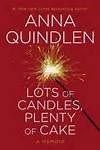
Anna Quindlen’s Lots of Candles, Plenty of Cake is a poignant, yet cheerful perspective on getting older. This is the kind of book to share with friends, particularly if they’re around the age of what is now considered to be the new-40s.
As in most of her writing, Quindlen relies on personal experience to make her points. Her writing career includes several stints as a columnist (at the New York Times and later Newsweek) as well as authoring several works of fiction, nonfiction and children’s books. She has a keen sense of observation. Better still, she’s an extraordinary wordsmith. Those two skills result in crafting pieces readers can easily make connections with. Of control, she writes: “I thought I had a handle on my future. But the future, it turns out, is not a tote bag.”
Quindlen examines the important aspects of life, which can be applied to most people, women in particular: friendship, family, love, parenting, and more. She’s humorous and honest. She writes of near-misses, both good and bad. She reflects on how much her younger self was sure she knew and how her older self readily acknowledges what she doesn’t. Without citing the tired phrase that youth is squandered on the young, it’s a major thread. Quindlen puts a new spin on it.
Yes, this is a memoir, but it is much more. It’s a guidebook to accepting that each morning we wake up is a gift – even if we’re older than we were the day before.
Lots of Candles, Plenty of Cake
Four Bookmarks
Random House 2012
182 pages
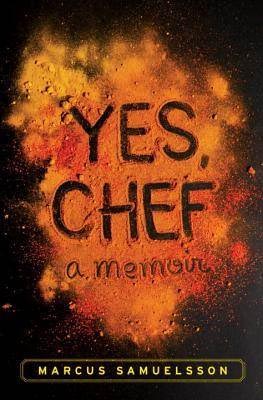
I know a few local chefs by name; I know a lot about others from different places, thanks to the books they write – and the Food Network or Bravo. The latter is where Marcus Samuelsson’s name surfaced on my radar. His memoir, Yes, Chef, provides a detailed, honest look at how he emerged onto the contemporary food scene.
Samuelsson begins his story with a powerful sentence that has nothing to do with food, but everything to do with who he is: “I have never seen a picture of my mother.” He shares how he and his sister made their way from Ethiopia to Goteborg (Gothenburg), Sweden, where they were adopted by Lennart and Anne Marie Samuelsson. He learned to cook by watching his grandmother. He learned technique by apprenticing in Switzerland, France and the United States.
As much as the memoir is about his progression through various kitchens, Yes, Chef is also about finding passion, experiencing prejudice and learning how these disparate aspects can be powerful motivators. Samuelsson reveals his flaws, his quirks as well as his strengths in a straightforward voice.
Ethiopian by birth, Swedish through adoption, and now a naturalized U.S. citizen, Samuelsson might seem an unlikely poster boy in the food world. Yet, it is his internationality that makes him so appealing. His quest as a chef, as he says, was to “chase flavors.” So far, it appears to be quite a pursuit.
Yes, Chef
Three-and-a-half Bookmarks
Random House, 2012
315 pages

James W. Hall writes crime thrillers and teaches college-level courses about popular
fiction, specifically bestsellers. Although it’s interesting, his recent nonfiction endeav-
or, Hit Lit subtitled Cracking the Code of the Twentieth Century’s Biggest
Bestsellers, reads like a textbook, but one likely to end up on the bargain table in a
bookstore.
The concept is intriguing: analyze 12 novels and identify the characteristics that
make them bestsellers. Included in the list is To Kill a Mockingbird, Gone
with the Wind, The DaVinci Code, The Exorcist, Valley of the Dolls,
The Godfather, The Dead Zone, The Firm, The Hunt for Red October,
The Bridges of Madison County, Peyton Place and, Jaws. I admit I’ve
only read six. Interestingly, the dozen were also made into popular movies – but
that’s another story. Hall, apparently stuck on the number 12, establishes that same
quantity of criteria to examine and actually makes a good case for why, say, Valley
of the Dolls struck a chord with so many readers. What might be even more worth-
while would be to compare these with less popular tomes. to me, the titles selected
by Hall are the equivalent of white bread. It’s easy enough to slap together a sand-
wich between two pieces of nutrition-lacking, tasteless slices, but there are so many
other varieties that go well beyond mere basic sustenance.
I can easily envision using Hall’s work in the classroom, with the caveat that the num-
ber twelve, both in the book selections and the characteristics reviewed, is not neces-
sarily a magic number.
Hit Lit
Two-and-a-Half Bookmarks
Random House, 2012
287 pages (includes index)
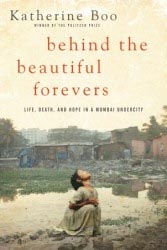
Although I read a fair amount of nonfiction, my preference has always leaned toward fiction. As
I read Katherine Boo’s Behind the Beautiful Forevers, I had to remind myself this is a true
story – in in fact, many true stories; it’s simply written with the smooth, eloquent narrative that
makes it read like a really good novel. But, it’s sad and it’s true.
Boo writes of the Annawadi slum in Mubai, India. For three years she follows the lives of several
families and child-scavengers all trying to survive in an overcrowded, rat-infested community of
makeshift structures that serve as homes. Mubai has numerous slums that fit this decription, but
Annawadi is the one located in the shadow of the international airport with its cosmopolitan hotels.
What makes Boo’s chronicle so intriguing are the people and their efforts to make more of their lives.
As if poverty alone were not enough to keep them down, they face government corruption, lapses of
moral judgment, and fear generated by religious differences. Boo’s account includes the experience
of Abdul who, with his father and older sister, is charged with murder when a vindictive neighbor
lights fire to herself. The family’s efforts to move out of Annawadi are thwarted as income is lost and
bribes must be paid.
This description of trying to exist in Mubai’s slums is much, much more than what most think of as a
hard-knock life. Yet, for their individual and collective foibles, these people continue to dream that
someday they will have more.
Behind the Beautiful Forevers
Four Bookmarks
Random House, 2012
256 pages

I’m a careful driver, but some days I forget having passed a certain roadside
marker, or I have no recollection of having turned left at the light. Based on
Charles Duhigg’s The Power of Habit, it has less to do with a faulty memory
and is more about habit – the consistent recurrence of a deliberate choice.
Duhigg looks at habit from three perspectives: personal, corporate, and socie-
tal. The first two are the most fascinating and well-developed. With thorough
research and a conversational style, Duhigg relates scientific studies about
individuals and the patterns their brains establish to create habits. The author
considers individuals who completely alter their lifestyles by choice, as well
as those whose lives are changed by trauma or illness. He identifies three ne-
cessary elements: cues, routines, and rewards needed to establish habits.
The most interesting, albeit disturbing, aspects are found in the corporate view.
Duhigg reinforces what we already know: our spending habits are not secret.
This loss of privacy is not a new concern, but how we lose it is disconcerting.
Duhigg examines everything from how employees are trained to respond, to how
data is manipulated. The book’s weak link comes as Duhigg combines habitual
actions that evolve into addiction with those resulting from a physical medical
condition when examining societal aspects.
Although the focus of the book is to consider “why we do what we do in life and
business,” Duhigg does offer some suggestions for breaking the triad of habit,
which might be worth a try.
The Power of Habit
Three-and-a-half bookmarks
Random House, 2012
291 pages, plus notes and index


With so many recent literary references to tigers it’s easy to think
The Tiger’s Wife has something to do with Asia. That’s not the
case with Tea Obreht’s lyrical, engaging debut novel. Instead, she
writes about fear, imagination, survival, and war’s shadow – on an-
other continent altogether.
The title’s namesake and the “deathless man” are told like fairytales
along with the narrator’s, Natalia, desire to know the circumstances
of her much-loved grandfather’s death. These tales also figure promi-
nently in how he lived his life; he was a doctor and survived an earlier
war. It’s his demise that propels Natalia, and even though death is a
constant throughout the book, it is not disheartening.
Natalia, too, is a young physician in a devasted eastern European
country, whose story begins with her memories of going to the zoo
with her grandfather: to see the tigers. Other animals are mentioned,
but the tigers drive their visits. As Natalia grows up, the threat of war
is never far removed, yet she is surprised at her cavalier attitude
toward it. Later, when she treats children orphaned by war, she still
never appears to believe it’s real.
Although, she’s preoccupied with her grandfather’s death, the more
she looks for understanding, the more she explains the myths he shar-
ed. There actually was a tiger and a young girl known as its wife in
the grandfather’s childhood village. By contrast, the deathless man
was known only to the grandfather, and Natalia clearly wants to know
more about both men.
Four Bookmarks
Random House, 2011
338 pages



 The Blue Page Special