Archive for the ‘mystery’ Tag
I’m not only a fan of Swedish mysteries, I also have affinity for the Scandinavian country thanks to hosting an exchange student years ago. While that relationship remains strong, it has no connection to the often dark tales involving murder and deceit.
Knock Knock by Anders Roslund reintroduces readers to criminal detective Ewert Grens. Seventeen years earlier Grens found a five-year-old girl as the lone survivor of a mass shooting in the family home that included her parents and two siblings.
Now, nearing retirement age, Grens discovers someone has broken into the same house. He’s convinced someone is looking for the girl, long ago given a new name as part of witness protection, and fears her life may be in danger.
A parallel narrative involves Piet Hoffman, a former police informer, whose life and family are threatened. Eventually the two plotlines intersect as several execution-type murders take place, similar to the one Grens investigated all those years ago.
Grens is an ill-tempered loner and long-time widower. That he has a soft side, albeit one rarely seen, is no surprise. By contrast, Hoffman is a devoted family man despite his past. The two are intelligent and complement one another. Their association goes back years to Hoffman’s informant days, but suggesting Grens is pleased to reconnect is far from the truth.
Knock Knock is just the kind of Swedish mystery that hooks me: vivid descriptions of Sweden, in this case Stockholm, a fast-paced narrative and interesting characters with often-imperfect moral codes.
Knock Knock
Four-and-a-half Bookmarks
G.P. Putnam’s Sons, 2021
438 pages
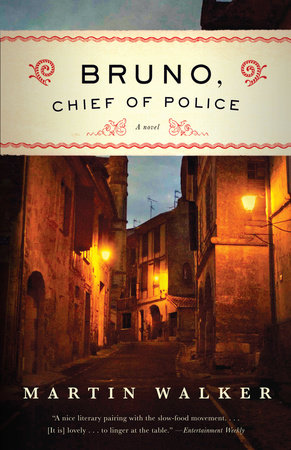
Author Martin Walker introduces readers to Bruno in the first of the Chief of Police series. The title character, whose formal name is Benoit Courreges, is a former soldier who’s drawn to the peaceful existence surrounding the small village of St. Denis in Southern France. This doesn’t mean his life is boring.
The brutal murder of an elderly North African, a veteran who fought with the French army, draws national attention. The novel addresses racism, victims of war, Nazis and more.
Although Bruno is not the point man in a murder investigation he contributes a lot when it comes to solving the case. Initially, two young people, including the son of the town doctor, are arrested as suspects. Bruno is certain their only crime involves drugs.
While working behind the scenes with the national police, Bruno enjoys his pastoral lifestyle living in a restored cottage in the country with his hunting dog, playing tennis and helping the locals stay one step ahead of the EU inspectors. He’s respected, intelligent and knows good wine when it crosses his lips.
Walker’s descriptions of the landscape, townspeople, French food and wine are enticing on their own. The murder investigation is almost secondary. Three women attract his attention, which creates another mystery wondering which one will ultimately win his affections.
The narrative is sweet, at times humorous and engaging without being saccharine. Bruno is a likeable, credible character full of common sense and a sharp mind. Identifying the murderer was logical without being predictable.
Bruno: Chief of Police
Four Bookmarks
Vintage Books, 2008
273 pages
The Searcher, like most of Tania French’s mysteries involves an Irish setting and new characters. Here it’s Cal Hooper, recently retired from the Chicago police force, in a remote village where he’s renovating a fixer-upper.
Hooper’s content to fish, repair his house and ready to mind his own business. His plans are interrupted when a local kid pleads for help in finding an older brother who disappeared months ago.
Despite efforts to not get involved, Hooper agrees to see what he can discover. Aware, he’s an outsider and not wanting to overstep local authorities or customs, Hooper goes about his investigation as stealthily as possible. It isn’t enough.
French’s description of Hooper’s run-down home, the harsh landscape and the village residents is like a travelogue designed to keep tourists away. Sure the area has some visual appeal, but little else going for it. Hooper soon learns he’s not as clandestine as he’d hoped in his efforts to locate the young man who’s gone missing.
In fact, he misreads the words and actions of most of those he encounters. He’s surprised when it’s clear the villagers, his neighbor in particular, are aware he helping the taciturn kid who showed up uninvited at his house.
Of course, the question, beyond the whereabouts of the missing person, is why everyone is keen to keep Hooper uninformed. French is a master at creating tension. The element of suspense veers towards the realm of thriller. It’s almost necessary to keep several lights on while reading.
The Searcher
Four Bookmarks
Viking, 2020
451 pages
The White Tiger is one of many names the narrator Balram Halwai gives himself in a series of letters he writes describing his life as a servant, driver, wanted man and entrepreneur. The letters, written over the course of seven nights and addressed to the Chinese premier, are confessional while providing insight into Indian life. Early in the narrative, Balram admits he’s wanted for the murder of his employer.
Aravind Adiga’s novel, through the letters, details Balram’s life as the son of a rickshaw driver in a small village. Although intelligent, Balram’s education is cut short when he’s forced to do menial work in a tea shop to contribute to his family’s nominal income. Eventually, he learns to drive and becomes the driver for a wealthy family. This is a change of fortune in many ways, including a move to Delhi.
This is not simply about the haves and have-nots. Balram can’t help but see the differences between the rich and the poor. As a servant he’s barely acknowledged as a human. Yet he’s philosophical as he earns a token wage which includes a place to sleep, albeit one teeming with cockroaches.
Balram is attentive to the activities and, particularly, the conversations of his employers. His awareness of the discrepancies around him helps set in motion a plan for change. The letters are more than Balram’s history; they also foreshadow his future. Adiga incorporates humor, mystery and commentary to create an engaging story about survival and success.
The White Tiger
Four bookmarks
FreePress, 2008
276 pages

The Daughter of Time by Josephine Tey was first published in 1951; the reprint in 1979. Yet, this gem of a mystery remains, well, timeless.
The crime and the manner of investigation are atypical. Alan Grant, of Scotland Yard, is recuperating in hospital with a broken leg. He’s bored, unhappy and not interested in reading. That is until he sees a copy of a painting of Richard III. He’s intrigued, particularly since the king’s face doesn’t mesh with the reputation of the man who killed to gain the crown. This sets Grant on a bedridden chase to learn more about Richard, whose short reign and place in history were tarnished.
Dry humor and rich narrative accompany Grant in his pursuit: was the king truly responsible for the murder of his two nephews to ensure his rise to the throne? The patient is assisted by Brent Carradine, a young researcher at the British Museum, and chronicles about English royalty of the 15th century. Even though all those involved at the time are, obviously, dead, Grant still conducts interviews: questioning his nurses and friends. They confirm Richard’s unfortunate place in history is warranted; Grant isn’t convinced.
Through Carradine’s research, driven by Grant’s inquiries, it becomes clear Richard has been falsely maligned. In bringing history to life, the author’s description of Grant’s enthusiasm is palpable, as is his disappointment in the account rendered by historians, including Thomas More’s. The patient’s boredom converts to purpose and his recovery is almost as significant as his discoveries.
The Daughter of Time
Four Bookmarks
Touchstone Books by Simon & Schuster, 1979
206 pages

Julia Phillips’ descriptions of the Kamchatka Peninsula in eastern Russia as lonely and cold are vivid in her novel Disappearing Earth. The title is fitting given the geographic isolation and the way the people move in, then away from the plot.
Beginning with the abduction of two young girls, the narrative features a range of characters with strong, tenuous or nonexistent ties to the victims. What they share is the locale and an awareness of the missing girls.
The first chapter is called August. Subsequent chapters/months represent the passage of time and introduce another situation involving others. The result is a disconnect more suggestive of a short story collection than a novel since there’s often no resolution for the problems or experiences described. Issues range from a young woman in college with a manipulative boyfriend, to a lost dog, from ethnic traditions to dissolution of friendships or family estrangements. Nonetheless, most chapters are captivating. These are interesting people, and the rich writing of each situation only begs for more. The list of main characters included to keep track of who’s who helps.
The investigation of the missing girls is initially a priority for the police, but eventually loses momentum. By contrast, a young indigenous woman who previously went disappeared was barely acknowledged by authorities.
The novel’s greatest strength lies in the setting; it’s a character unto itself. The weather, the light and the landscape, which includes rocky beaches, densely-wooded forests and looming active volcanos, are austere – like its people.
Disappearing Earth
Four Bookmarks
Alfred A. Knopf, 2019
256 pages

The title of The Burial Society by Nina Sadowsky is a bit misleading. It’s not the dead who are laid to rest, but the past identities of those who need rescuing from abusive or dangerous situations. Catherine, a narrator, oversees everything necessary in creating an unofficial witness protection service. Although it’s never clearly stated, the implication is that most of those she helps are women.
In the midst of assisting a Russian model begin a new life away from the grip of her rich, sadistic husband, Catherine faces reminders of one of her covert endeavors gone wrong.
Chapters alternate between Catherine’s first person voice to an omniscient narrator detailing the activities of Natalie Burrows, her brother Jake and Uncle Frank. The siblings’ father has just been murdered, and their mother disappeared several years ago, independent of the Burial Society. Catherine is certain an uncharacteristic lack of judgment on her part is responsible for the woman’s death.
Set mostly in Paris, the action involves Catherine not only ensuring the Russian model is safe, but that Natalie and Jake are, too. It’s the latter that takes the narrator out of her comfort zone.
Confident, clever and apparently wealthy, Catherine is almost like a female James Bond with plenty of sophisticated tricks and technology at hand to accomplish her tasks. The author creates s sense of urgency and uncertainty in Catherine’s ability to assist the Burrows without revealing her clandestine operation. The result is a briskly-paced mystery with a lot to be solved.
The Burial Society
Four Bookmarks
Ballantine Books, 2018
319 pages

Celine by Peter Heller is a love letter to a lively, clever, socially privileged, yet intuitively aware, woman who happens to be a private investigator. The title character warrants all the admiration and awe the author infuses in this two-in-one mystery – both of which are equally engrossing.
Celine Watkins, 68 years old, appreciates the finer things in life, but what she most enjoys is her avocation of tracking down missing persons. After receiving a call from a young woman wanting to learn more about how her father went missing 20 years ago, Celine can’t resist the challenge.
Her sidekick is her life partner, Pete, an intelligent, reticent and supportive man. He and Celine leave the comfort of their upscale Brooklyn apartment for Wyoming, the last known whereabouts of the man in question.
Meanwhile, Celine’s adult son, Hank, wonders about the secret his mother has kept hidden for decades. This provides the narrative of Celine’s past: her childhood growing up with her two sisters in an aristocratic family where private schools, sailing lessons and speaking French were nothing out of the ordinary.
The alternating chapters build tension as Hank recounts his efforts to learn about the child his mother gave up for adoption and Celine pursues a thin string of clues while being followed in her investigation.
Heller blends humor with meaningful relationships among the different characters. At times Celine seems too good to be true, Mostly, she’s comes across as the strong, fun, determined and smart woman every girl should aspire to be.
Celine
Four-and-a-half Bookmarks
Alfred A, Knopf, 2017
334 pages

A Rule Against Murder is the fourth in Louise Penny’s Inspector Gamache series. I’ve been told to read the canon, comprised of 16, in order. Clearly, I have a ways to go, but what a fun journey to undertake. The problem lies in wanting to pick up the next book immediately after putting down the last.
Armand Gamache is the kind, intelligent, perceptive, chief inspector on vacation with his wife celebrating their anniversary. They are at a luxurious, remote inn where they’ve often stayed. However, this time a death occurs, which isn’t initially clear as accidental or murder, but since he is already on the scene, Gamache oversees the investigation.
Penny writes mysteries, so it’s no surprise there will be something for Gamache and his team to uncover. What’s most engaging is the slow, methodical, yet lyrical, manner the author incorporates to arrive at a possible crime, which isn’t immediate. Instead, the author describes the calm, rustic setting, the inn’s staff, the guests and, most fun of all, the Gamaches’ relationship. The scene unfolds like a travelogue for a get-away to a relaxing resort, complete with vivid, mouthwatering descriptions of the food served.
Also staying at the inn is an extended family, most of whom prove to be as unlikable as Gamache is charming. When a family member is found crushed beneath a newly erected statue commemorating the patriarch, clues are sought to determine the cause. There is no shortage of possible suspects and motives, although deciphering who remains in question.
A Rule Against Murder
Four-and-a-half bookmarks
Minotaur Books, 2008
322 pages

Creepy is the best way to describe The Hiding Place by C.J. Tudor. The setting, the characters and the story itself are all disturbing. It’s difficult to appreciate a book with no likeable characters; yet the author successfully creates an unsettling story that goes beyond masses of beetles crawling out of walls.
Narrator Joe Thorne returns to his hometown, a run-down former mining town in rural England. It was never a thriving community, but its position at the edge of economic ruin makes the old days not look so bad in Joe’s eyes. It’s clear he’s returned to settle a score. Yet, there are so many twists and characters lacking empathy, interest or both, that the obvious question of why hangs too heavy over the narrative.
Joe is a teacher, a liar, a gambling addict and also, somehow, a victim. He left his previous job under suspicious circumstances but is able to con his way into a teaching position at the school he attended as a youth. Many of Joe’s old pals are still in town, but it’s clear these are no longer friendly relationships. Another unfriendly sort is Gloria, a thug hired by the Fatman to collect the gambling debts Joe has amassed.
Before Joe’s arrival, a murder/suicide has occurred in the very cottage he knowingly chooses to rent. A mother has killed her son before turning a gun on herself. This strikes Joe as hauntingly familiar even though nothing in his past suggests something similar. Until it does.
The Hiding Place
Three-and-half Bookmarks
Crown Books, 2018
278 pages





 The Blue Page Special