Archive for the ‘food’ Tag

Dinner with Edward is Isabel Vincent’s poignant tribute to an unlikely friendship that evolved for several years over elegantly-prepared meals.
Edward is the 93-year-old father of one of Vincent’s friends; his wife of 69 years has recently died. Vincent is in the midst of a rocky marriage. She is initially reluctant to meet Edward, after all he’s of another generation and she isn’t interested in taking on the role of caretaker. However, once they meet she comes to learn as much about herself as she does about cooking, dining, relationships and manners of a bygone era.
They begin to meet weekly at Edward’s apartment where he always has a martini glass waiting for her in the freezer and a gourmet meal to serve. Their conversations touch on recipes, Edward’s sweet memories of his deceased wife, Vincent’s job as an investigative reporter for The New York Post, her husband and daughter – among many other subjects.
Such a memoir has the potential to be sappy, but Vincent avoids this pitfall through the honest, albeit terse, descriptions of her own emotions and the imagery she creates based on the memories Edward shares with her. This is not a romance in the physical sense, but in an emotional one.
Each chapter begins with a menu Edward prepared. It always includes a dessert and the wine served. It isn’t a good idea to read this on an empty stomach.
More than anything, Vincent shows that the sustenance food provides goes well beyond what’s on a plate.
Dinner With Edward
Four Bookmarks
Algonquin Books of Chapel Hills, 2016
213 pages
The idea of gourmet fried chicken may seem to be an oxymoron. It isn’t. It’s simply a great rendition of this comfort food. I’ve previously written about Bouchon which several years ago began offering the crispy fare, using its sister restaurant Ad Hoc’s recipe, on Monday nights. This is why I was pleased that my recent visit to Los Angeles included the first day of the work week. My enthusiasm was quickly dispelled when a private event closed Bouchon abandoning us to seek different dinner plans.
Fortunately, there’s more than one hen house in Southern California. Monday also happens to be fried chicken night at Little Beast in the Eagle Rock area.
Little Beast fills the space of a comfortable, craftsman style house. The menu features small plates and seasonal dishes. Happy hour includes drink specials and half-price appetizers. We ordered the charred peaches with burrata. Grilled halved peaches are smoky and summer sweet. The soft, creamy cheese provides a nice balance, while croutons add texture. Slices of prosciutto help send this over the top.
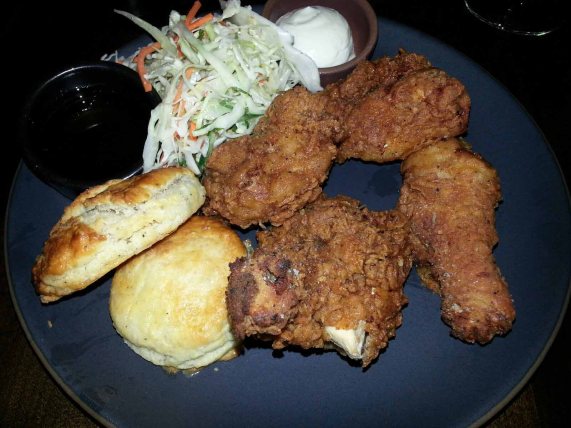
Back to the raison d’etre. Fried to a golden caramel color, four pieces of chicken share the plate with cole slaw and two thin, but surprisingly, flakey biscuits. The crunchy coating is peppery and the meat is juicy. The slaw is made with a vinegar-based dressing featuring sliced almonds. The biscuits can be slathered with the accompanying whipped butter and amber honey.
The servings are large, which makes Tuesdays the day for leftover fried chicken.
Little Beast
Four-and-a-half Plates
1496 Colorado Blvd.
Los Angeles
Back-to-back taco tastings at two Los Angeles taquerias may not constitute a true test, but it did provide a fun opportunity for comparison – plus alliteration. Both Mexicali Taco & Co. and Yuca’s have garnered a lot of ink in The Los Angeles Times, mainly thanks to critic Jonathan Gold; all of it well deserved.
I first heard of Mexicali Taco several years ago in a Gold review. What I recall is that the owners travel to Baja a few times a week for the tortillas. While I think there are plenty of good tortillerias in East L.A., I appreciate Mexicali’s efforts. They are worth it. We ordered carne asada tacos. The meat comes almost naked on a plate, wrapped only in a soft tortilla. A grilled scallion is added for can only be color. It was the carne we were after, but a small salsa bar features a few different heat levels, pickled onions, radishes, slaw, cucumbers and lime. The charred diced meat is surprisingly tender.
However, Yuca’s carne asada is a bit more flavorful. These feature grilled pieces of meat with fresh onion, tomatoes and cilantro. They don’t need anything else except two corn tortillas, which don’t hold up well. Yuca’s offers a few outdoor tables, otherwise plan to eat in your car – if you can’t wait to get home.
The best of the taco world, where these two are concerned, would be Mexicali’s tortillas because they hold up well and have a distinct corn taste, and Yuca’s melt-in-your-mouth carne asada.
Mexicali’s Taco & Co.
Four Plates
702 N. Figueroa St.
Los Angeles
Yuca’s
Four Plates
2056 Hillhurst Ave.
Los Angeles

One house, 13 siblings, ghosts and the city of Detroit provide the foundation for The Turner House by Angela Flournoy. Thank goodness she provides a family tree to keep track of Francis and Viola Turner’s offspring. It helps that much of the present-day story focuses on Cha Cha, the eldest of the Turner children, and Lelah, the youngest. They’re separated by 23 years; their issues are familiar but not quite cliches.
Flournoy also takes the reader back to 1944 when Francis leaves Viola and young son in his rural Arkansas hometown to seek a better life in Detroit. Francis plans to send for his family once he’s settled. He stays away for more than a year, leaving Viola to consider other options.
This backdrop is interspersed with how the family has coped through the years. Francis is dead, Cha Cha has grandchildren of his own; even Lelah is a grandmother. Few have intact marriages or relationships, yet the family is close-knit. The house, the one in which all 13 Turners grew up, is empty and fallen into disrepair. Viola is no longer well enough to live on her own; she lives with Cha Cha and his wife in the suburbs.
The house, vividly described with Pepto Bismo pink bedroom walls, narrow stairs and large porch reflects the rise and fall of Detroit. Once alive with the large family’s comings and goings, its monetary worth is practically non-existent. The brothers and sisters, though, are mixed in their assessment of its sentimental value.
The Turner House
Four Bookmarks
Houghton Mifflin Harcourt, 2015
338 pages

I was baffled by Emma Hooper’s Etta and Otto and Russell and James. It’s sweet but confusing. It’s a love story that considers lost chances and perhaps poor decisions. It’s also surprisingly descriptive in its brevity.
Etta is 83 years old when she embarks on a trek across Canada to the ocean. The five-sentence letter she leaves as explanation to her husband sets the tone for the novel: “Otto, I’ve gone. I’ve never seen the water, so I’ve gone there. Don’t worry, I’ve left you the truck. I can walk. I will try to remember to come back.”
This isn’t the kind of thing she’s planned, she simply leaves to see the coast. Briefly, Otto considers trying to find her. Ultimately, it’s Russell who does so, while Otto remains on the farm.
Along her trek, Etta gains unwanted attention from the media and towns people she encounters. She also acquires a companion in James, a source of bewilderment.
The relationships among the four title characters are complex. Otto and Russell have known each other since childhood. Both love Etta. Hooper develops the bond between Etta and Otto through letters the pair exchanged during the war. Their correspondence evolves from the mundane to the heartfelt.
Hooper intersperses the characters’ backstories with their present day adventures: Etta bound for the sea, Russell in search of Etta and Otto discovering daily rhythms on his own. Meanwhile, there’s James, who’s difficult to describe. Hooper has crafted a terse novel unpredictably rich with humor and longing.
Etta and Otto and Russell and James
Almost Four Bookmarks
Simon & Schuster, 2015
305 pages

Hive-Mind by Gabrielle Myers is labeled a memoir, but it’s slightly more than that. Written in diary-like form, Myers describes her summer of 2006 on a farm in Northern California. This is no kiddie account, though. While it’s the focus of her narrative, Myers alternates the chronicle with a look back to her relationship with her mother and growing up in Virginia. As if this isn’t enough, she also includes poetry.
It’s evident that sharing the earlier memories is cathartic; this is true of the latter ones, but is less obvious until the end. Myers’s descriptions of life on the farm, from early spring to late September, are vivid and stunning. I can practically feel dirt stuck in my fingernails as she, Baker (also working on the farm) and Farmer (the woman who owns the land and decides the daily chores) sow and weed and sweat and harvest. The author is also impressive in describing meals prepared from food on the farm.
Farmer is an enigma. This may be Myers’s point: Farmer never reveals enough about herself to know who she is. Myers shares her own thoughts and reactions, but that isn’t enough to make Farmer compelling. Baker is an open book and, consequently, is more interesting.
Myers isn’t writing about coming of age, but of becoming aware. This is evident as she connects the different phases in her life following a 1995 conversation with her mother: “… how I feel can become how someone else feels.”
Hive-Mind
Three and three-quarter Bookmarks
Lisa Hagen books, 2015
299 pages

The title of Kathleen Flinn’s experience at Le Cordon Bleu in Paris is what initially caught my eye: The Shaper Your Knife, The Less You Cry. These words are advice from one of her chef instructors as begins the first of three sections required to earn a diploma from the prestigious cooking school. The subtitle offered more foreshadowing than I would have liked, though: “Love, Laughter and Tears in Paris at the World’s Most Famous Cooking School.”
Flinn’s account combines her background, her romance and her Parisian education, which involved much more than cooking as she learned to navigate a new city with only un petit peu knowledge of French.
The book is divided into the three parts that correspond with the units at the school: Basic, Intermediate and Superior Cuisine. Flinn’s culinary undertaking is humorous, honest and, unfortunately, predictable. Of course she grows through this journey; of course she learned techniques that were as foreign as the language; and of course she is with the man of her dreams. The latter requires no spoiler alert; this is revealed early in the narrative.
Despite its predictability, Flinn gives an insider’s view of how the classes are taught, the types of people who enroll (not surprisingly from all over the world) and the friendliness of the French people. She also includes several recipes and even includes a menu guide for book groups. Fortunately, none require deboning a chicken or dealing with dead rabbit heads.
The Sharper Your Knife, The Less You Cry
Three-and-a-half Bookmarks
Penguin Books, 2007
278 pages

FUDS: A Complete Encyclofoodia by Alfredo & Antonio Mizretti is neither for the weak of stomach nor the humorless. Let’s start with the fact it’s actually written by Kelly Hudson, Dan Klein and Arthur Meyer. This trio has taken the mystique and the occasional arrogance often associated with haute cuisine out of the kitchen and onto the equivalent of a culinary comedy stage.
The authors are irreverent, silly and occasionally gross in the manner of pre-adolescents. They’re also fun and creative. Although the book is “Dedicated to Food,” it could easily be earmarked for those who love food and don’t mind heavy-handed metaphorical flavoring.
The Mizretti personas assumed by the true authors are twin brothers who grew up in Denver eating Mama Mizretti’s homemade specialties, which, according to Alfredo and Antonio “was awful.” Eventually, they open a restaurant, FUDS, in Brooklyn with only three items on the menu.
The content is ridiculous, but for anyone interested in food, and not so full of him or herself that a good laugh can’t be appreciated, it’s entertaining.
The book is comprised of several chapters related to the Mizrettis’ background, food basics a la FUDS, satirical descriptions of kitchen tools and several chapters of recipes – the kind made up at summer camp or on a college campus. Some are, frankly, gross. All are absurd.
A little FUDS go a long way. Its 160 pages, of which many are illustrations, is just about the right length. Of course, it also lends itself to return reads.
FUDS: A Complete Encyclofoodia from Tickling Shrimp to Not Dying in a Restaurant
Four Bookmarks (0 plates)
Bloomsbury, 2015
160 pages

Trends are like appetites, which is particularly true in the food industry. Sometimes we binge, sometimes we graze, sometimes we walk away when we’ve had enough. New food treats show up for our palates to enjoy, extol and, eventually, outgrow.
In an engaging and intelligent manner, David Sax examines food trends in his book, The Tastemakers: Why We’re Crazy for Cupcakes but Fed Up with Fondue. There are foods that are hip, inspire copycat versions and subject to whims. In other words, the popularity of some foods depends on more than taste. Sax quotes a trend forecaster who says, “If you can Google a trend, you’ve completely missed the trend.”
Culture, economics, politics and marketing are among the areas Sax addresses. He incorporates humor with extensive research that took him coast to coast interviewing food truck owners, a heritage rice grower, goat farmers and Baconfest organizers, among many others.
Sax often seems as baffled by some food trends as the rest of us, especially when he writes about the Summer Fancy Food Show sponsored by the Specialty Food Association. As if describing the Academy Awards or Golden Globes, Sax puts the reader at this annual event where new foods are introduced and their purveyors cling to the possibility that theirs (anything from iced rice tea to beer-flavored crackers, and more – much, much more) will take the spotlight on America’s plates and napkins.
Sax’s research is thorough, but it’s no surprise that food trends are difficult to anticipate.
The Tastemakers: Why We’re Crazy for Cupcakes but Fed Up With Fondue
Four Bookmarks
PublicAffairs, New York, 2014
318 pages, including index and selected bibliography

When the hostess at the Silver Creek Diner in Lone Tree told us that once we were seated we’d still have at least another 25-minute wait for our food, I laughed and asked if she wanted us to leave. She laughed, too, and assured me that wasn’t her intent. We’d already been waiting 10 minutes for a table. We decided to hope for the best. Wrong call.
Given that we had waited so long from the time we walked in the door to when the food arrived, it’s hard to know if we were simply so famished that anything would have tasted good. It wasn’t that Silver Creek was particularly busy, but the way orders were coming out of the kitchen it seemed as if all the cooking was done by one person with his/her hand tied behind his/her back.
Breakfast is standard; lots of egg possibilities and pancakes. The latter aren’t the “ridiculously large ones that some places serve” we were told. The Blueberry Pancake Plate featured two eggs, hash browns, choice of breakfast meats (bacon, sausage or ham) and two cakes full of fresh blueberries. It was a lot of food.

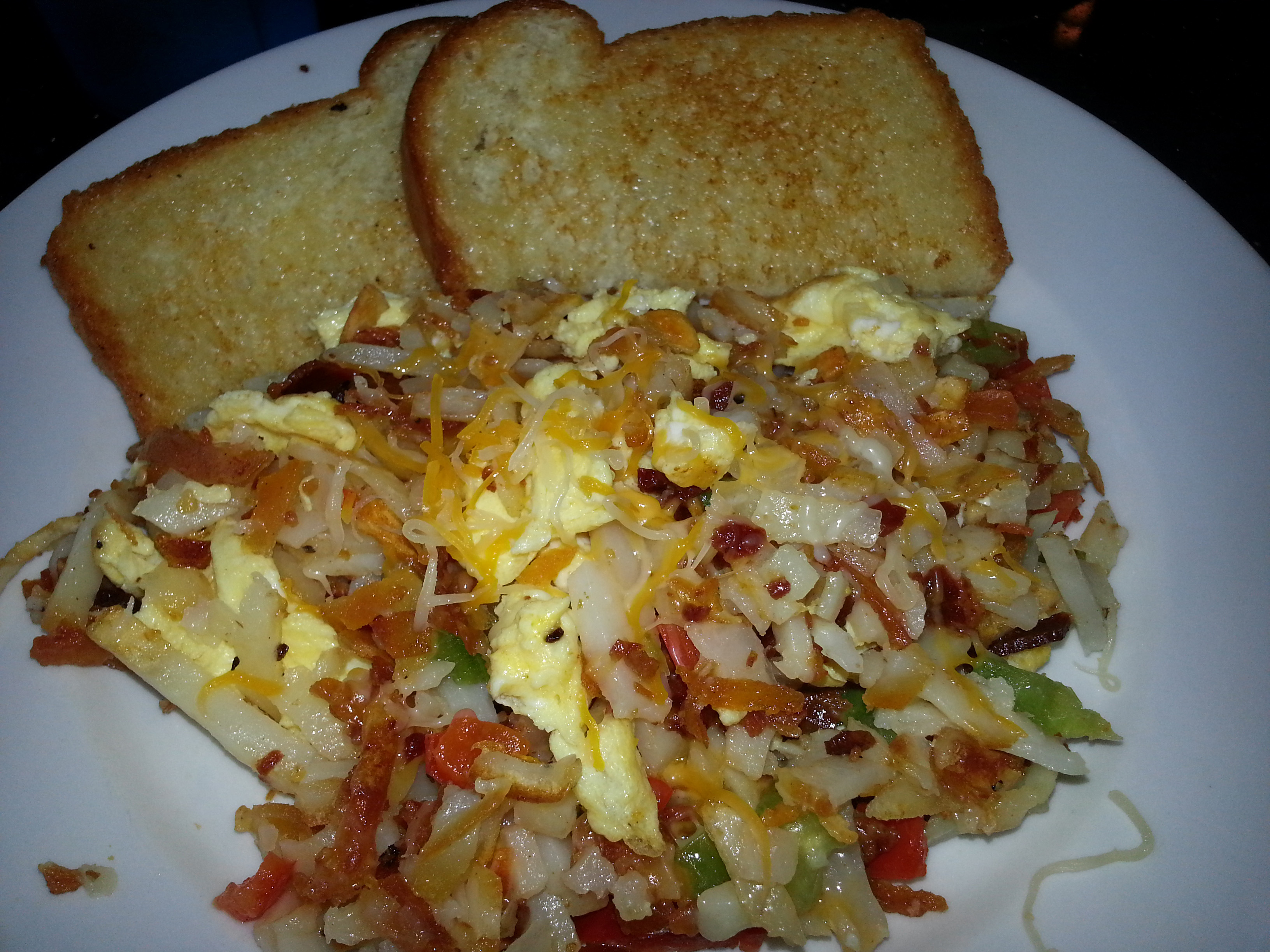
The Hash Brown Mix blended crispy and creamy shredded potatoes with diced red and green peppers, onions, eggs and choice of bacon or sausage. Two size options are available, and even the smaller of the two is a substantial amount of food.
In truth, it all tasted fine, but I can’t say the time spent waiting for it was justified.
Silver Creek Diner
Three Plates
7824 Park Meadows Dr.
Lone Tree, Colo



 The Blue Page Special