Archive for the ‘fiction’ Tag
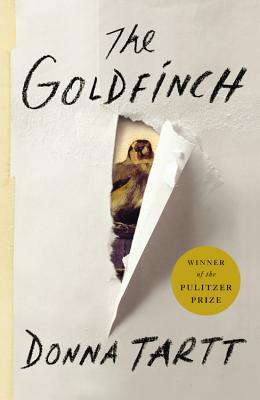
After talking to a friend who had just completed a marathon, I saw a similarity to reading Donna Tartt’s The Goldfinch. At times I wondered if I would ever finish. Occasionally I was completely engrossed and enjoyed the scenery, so to speak. Ultimately, I kept returning to the question of completion, could I do it? The answer is yes. However, unlike my runner friend who was euphoric after crossing the finish line, I was simply relieved: just glad to be done.
I know Tartt has received numerous accolades (including the Pulitzer Prize) for her 771-page novel about Theo Decker and the rare painting that, at the request of a dying man in a museum explosion, he takes and has overshadowing his adolescence and young adulthood. Yet, I had an extremely hard time allowing for my suspension of disbelief to fully be in the driver’s seat.
Theo’s mother is killed in that explosion and Theo, who is 13 years old at the time, walks out of the museum practically unnoticed, certainly not unscathed emotionally, but unnoticed. Don’t bother trying to forget that he had an irreplaceable piece of art in his backpack. Through a series of temporary living situations – some better than others, drug abuse and unrealized potential, Theo doesn’t undergo too much transformation through the years. Tartt offers an interesting premise, with Theo narrating, but the story gets bogged down with too many inattentive adults and too many far-fetched situations.
Mostly, I was tired after putting the book down for good.
The Goldfinch
Three-and-a-half Bookmarks
Little, Brown Co., 2013
771 pages

Hate crimes, altruistic youth, deception and not fitting in are themes driving James Klise’s The Art of Secrets. Although this falls into the young adult genre, there’s no age limit to the ideas behind his novel.
Fifteen-year-old Saba Kahn is a first generation American of Pakistani descent. Her family’s two-bedroom apartment and all its contents are lost in a fire, believed to be a hate crime. Saba is a scholarship student at a Chicago private school, where the student body rallies behind two fellow students who conceive of a fundraiser to help the Kahns.
Klise is masterful in the way the story unfolds. His characters are vivid, thanks to each sharing his or her perspective and unique voice. Each chapter is told either through the use of a diary, emails or in separate one-sided conversations with a reporter, the police and an insurance adjustor. It’s clever and effective. Beginning with Saba’s diary entry a few weeks after the fire, the story follows the fundraising efforts, with asides from school administration and their not-so-subtle efforts to appear open-minded. Saba, a bright, gifted student, is suddenly the center of attention. Those who had previously walked past her in the hall suddenly see her. She’s somebody. Meanwhile, Javier, an exchange student from Spain, is nearly invisible to those around him, including his host family who insist on calling him “Savior.”
This poignant story, with a twist, is filled with humor as Klise demonstrates the ease of believing something we want very much to believe.
The Art of Secrets
Four Bookmarks
Algonquin, 2014
255 pages

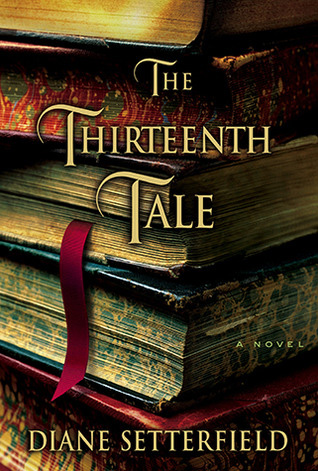
When I mentioned to a friend that I was reading Diane Setterfield’s The Thirteenth Tale, she was surprised it was new to me. It is, after all, a book for booklovers and a mystery, two aspects I find appealing. There is also a sense of the gothic, which typically doesn’t grab me. Yet, I had trouble putting the book down.
This story within a story is compelling on many levels. There’s Margaret Lea, a reclusive woman whose companions are the books in her father’s antiquarian bookshop. Although close to her father, her mother is distant, practically absent from family life. Margaret had a twin sister who died at birth, an event from which Mrs. Lea never recovered.
Margaret receives a letter from Vida Winter, considered one of Britain’s most prolific and beloved authors. Despite her popularity, Vida has creatively maintained her privacy. However, in poor health she summons Margaret to write her biography. In the process, dark secrets emerge.
Each character is transformed through the story telling. Margaret becomes softer as she learns about Vida’s mysterious and startling past. Vida, whose strength diminishes day by day also begins to demonstrate warmth and concern. The more Vida reveals about herself and her dysfunctional family (long before the term was coined), the more engrossing the tale becomes.
Vida tells about the twin sisters, Adeline and Emmaline, and just when the reader is certain to have determined who is who and what is what, Setterfield adds more ingredients into the tantalizing mix.
The Thirteenth Tale
Four Bookmarks
Washington Square Press, 2006
406 pages
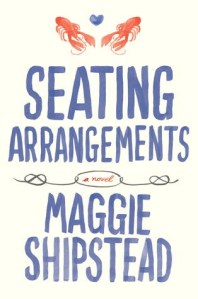
Anyone planning a wedding in the next few months, or ever, might consider avoiding Seating Arrangements by Maggie Shipstead; but they would be missing a fun, albeit satirical, and poignant look at families under stress.
Shipstead’s debut novel focuses on Winn Van Meter, father of the bride-to-be, in the three days prior to the ceremony. Winn is a banker, a Harvard man whose greatest disappointments are that he didn’t have sons and has yet to be granted membership in a private golf club. His daughter Daphne, seven months pregnant, is marrying Greyson Duff. That name alone suggests privilege, which is an apt description for the entire wedding party.
The nuptials are taking place on a fashionable island off the New England coast. The Van Meters have long had a vacation home there, although, as it turns out, the Duffs have their own island. Yet, the only character concerned with one-upmanship is Winn. And, perhaps, his younger daughter, Livia, who was recently dumped by her boyfriend, Teddy Fenn – whose father, Winn surmises, is responsible for obstructing admittance to the private club.
Shipstead’s multiple talents lie in her ability to create distinct voices and flaws for each of her characters. The cast of which include friends, family, and the Fenns. Biddy Van Meter, Winn’s wife, is the voice of reason while humoring her husband. However, her patience and fortitude wane as his attraction to one of the bridesmaids waxes.
In Shipstead’s hands, humor and heartache are worn with the ease of a properly fitted cummerbund.
Seating Arrangements
Four Bookmarks
Alfred A. Knopf, 2012
302 pages
Fidel Castro is never identified by name in Cristina Garcia’s King of Cuba, but it’s easy to fill in that blank. The novel should be entitled The Kings of Cuba because the two main characters share a passion for the island nation and philandering. The difference is that one is a despot and the other an exile: the former in Cuba and the latter in Miami.
Both are nearing the end of their lives. Although El Commandante (also referred to as the tyrant and El Lider) remains vain, he can see his failing body reducing his political power. Goya Herrera wants nothing more than to help the tyrant’s life to a speedy conclusion. Goya’s disdain for the Cuban leader is tied to a lost love and living as an expatriate. It doesn’t matter that Goya’s life has been financially successful.
Alternating between El Commandante and Goya’s voice, other perspectives regarding Cuban history also are included in the form of footnotes. At first, this is annoying – as footnotes usually are. Eventually, they’re entertaining and edifying.
Goya’s family life is in ruins; his wife is deceased and his grown children have few positive attributes. By contrast, the tyrant has progeny he doesn’t even know about. The legacies they will leave behind are entirely shaped by the history they helped create. The tyrant led his country into a revolution that lasted 50 years, and the businessman personifies the American Dream.
Garcia’s disarming narrative combines history with satire, and Castro’s presence is felt on every page.
King of Cuba
Three-and-a-half Bookmarks
Scribner 2013
235 pages
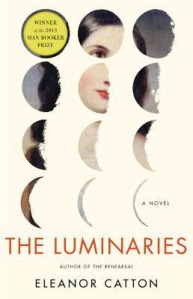
I’ve written once before about giving myself permission not to finish a book. I usually make the decision within the first 50 pages. I just stopped after 360 pages of Eleanor Catton’s 830 page tome, The Luminaries. The strange thing is, I will probably finish. Someday. Not now though; I have too many other books on my nightstand, and the library copy I’m reading is already overdue.
I can’t say it took me more than 300 pages to get into the 2013 Man Booker Prize winner, but it was no easy trek to make it that far, which is not even halfway.
The tale begins in January 1866 when Walter Moody arrives in a New Zealand mining town seeking his fortune. His first night in town finds him among 12 men ready to discuss a series of events to which they are all directly or tenuously connected. Catton pays meticulous attention to detail. Each character is exhaustively described from appearances, mannerisms, likes, dislikes, self-perceptions and reputation. Moody and company aren’t the novel’s only characters: a few women of mystery and ill-repute and several men who have either died or gone missing are also fastidiously introduced. Yet.
The relationships through business, friendship and happenstance actually do make for an interesting story. Hidden gold, lost fortunes, prejudices and the association of the characters is a maze. while easy to follow from one possible explanation only to be thwarted by another, is eventually, and finally, enthralling. I just hate to have library fines.
The Luminaries
Undecided on Bookmarks
Little, Brown and Co., 2013
360 pages of 830
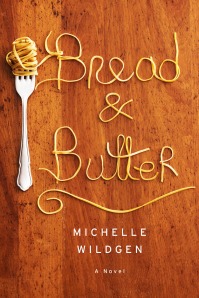
Bread & Butter is bound to appeal to foodies. Author Michelle Wildgen combines her talents as a writer with her past restaurant experience to tell the story of three brothers with two competing eateries in their hometown.
Leo and Britt have been running Winesap, their fashionable restaurant for more than a decade. When their younger brother, Harry, returns home they find it difficult to be enthusiastic about his plans to open another upscale establishment in a weak economy. Yet, it’s not just the competition that has the older two apprehensive. Harry has bounced around from educational pursuits to various jobs in the years since he’s been gone. Leo and Britt are certain Harry lacks the stamina, knowledge and commitment to run a successful business. They see him as a neophyte, and Harry, who wants their support, is driven to prove them wrong.
Wildgen has created likeable, sometimes exasperating, characters whose voices and situations ring true. Eventually, Britt signs on as Harry’s partner while maintaining his front-of-house role at Winesap. Tensions mount as expectations, many unfounded, lead to several surprises when Harry’s place opens for business.
Descriptions of food, prepping for dinner service and the relationships among the employees (and owners) are vivid and realistic.
Ultimately, the siblings have credible culinary chops; they also have difficulty relinquishing family issues precipitated by birth order. This tends to bog things down a bit. Wildgen emphasizes that sometimes family members are often seen as what we want them to be, rather than who they truly are.
Bread & Butter
Three-and-a-half Bookmarks
Doubleday, 2014
314 pages

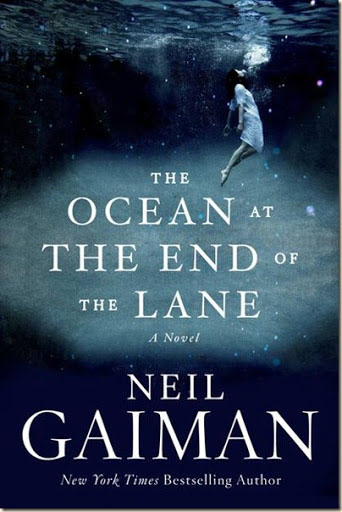
Part Harry Potter, part Alice’s Adventures in Wonderland, The Ocean at the End of the Lane by Neil Gaiman compels the reader’s imagination to relinquish, among other things, fear of the unknown. It’s worth the little effort needed to suspend belief, but Gaiman makes it very easy through his sensitive story telling that mixes memories, nightmares, and hope into one gripping tale.
The story begins as the narrator returns to his hometown for a funeral. He recalls how 40+ years earlier as a shy, reclusive seven-year-old he is befriended by Lettie Hempstock, who lives with her mother and grandmother. The boy has no friends, but Lettie, who is four years his senior, draws him out of himself. It’s Lettie who believes the pond on her family farm is an ocean.
At the same time, a nanny, Ursula Monkton, arrives in the boy’s home. It will come as no surprise that Ursula isn’t what she appears to be. In fact, she appears as many things. Lettie becomes a protector who in the process of caring for her young charge takes on numerous risks – dangers the young boy would never face on his own, but who willingly approaches them with Lettie.
Gaiman blends magic, mystery and the passage of time into a single cauldron where dreams, recollections and reality are hard to distinguish. The now-grown man finds himself at the Hempstock farm with whom he initially believes is Lettie’s mother since it’s unlikely, in his mind, that Grannie Hempstock is still alive. Yet.
The Ocean at the End of the Lane
Four Bookmarks
William Morrow, 2013
181 pages
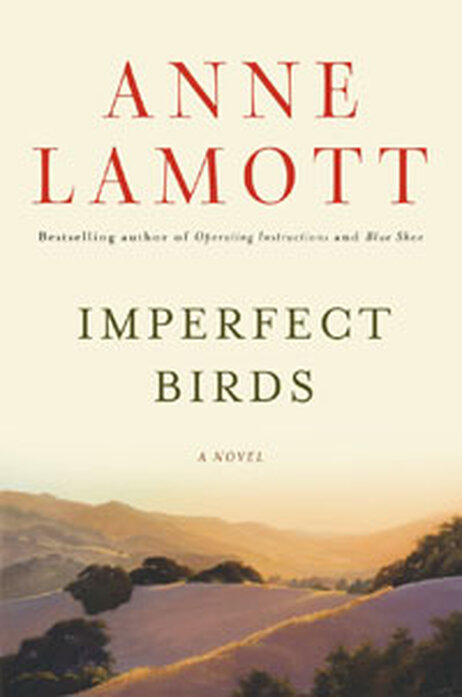
Anne Lamott’s Imperfect Birds is either a wake-up call or a near-miss experience for parents and their kids. Either way, it’s a disheartening look at teenagers, parenting, and community. The first paragraph sets the tone: “… a teenager died nearly every year after a party and kids routinely went from high school to psych wards, halfway houses, or jail.” The first thing I’d do is move, no matter how idyllic the little town, where the story’s set, with its appealing proximity to San Francisco.
Lamott writes with purpose, honesty and humor. Yet her characters are not likeable. Rosie is an entitled high school senior, facing real and difficult situations where peer pressure, availability of drugs, and opportunities for sex are abundant. Elizabeth and James, Rosie’s mother and stepfather, know these dangers exist, but are reluctant to parent. Why should they? Rosie’s a good student and involved at church. Plus, as a consummate liar she successfully overrides her parents’ arbitrary concerns.
It doesn’t help that Elizabeth is a recovering alcoholic – except it should. She shouldn’t be such an easy mark. James doesn’t fare much better, although he tries. Elizabeth’s fault is her desire to be Rosie’s friend first and parent second. The book does lend itself to a discussion about parenting.
If Lamott’s goal is to show how blind loving parents can be, she’s successful. When Elizabeth and James finally see the light, it’s not through their personal epiphanies, rather from Rosie forgetting to keep the wool over her own eyes.
Imperfect Birds
Three Bookmarks
Riverhead Books, 2010
317 pages

Easy to visualize characters, plots driven by class conflict, issues of the heart (or both) and a very proper sense of, well, what’s proper are what make English Lit so appealing to me. Yes, the above could easily refer to classic British literature, but it also applies to Helen Simonson’s Major Pettigrew’s Last Stand – a very contemporary work.
Simonson’s novel begins with a chance meeting between the Major (his first name is Ernest, while apt doesn’t fit him as snugly as his military title) and Mrs. Jasmina Ali, a Pakistani shopkeeper. Although their paths have crossed in the past, this encounter comes at a vulnerable point in the Major’s life: he’s just learned of his brother’s death. What follows is the evolution of a friendship based on a passion for books and widowhood.
Both characters are thoroughly engaging. The Major in his stilted, decorous yet sensitive manner has appeal, and Mrs. Ali is an exceptionally intelligent woman burdened by a certain sadness associated with being considered an outsider in her home country. Simonson portrays people we know or would like to; they’re well-defined individuals with foibles, principles and dreams. The cast of lesser characters, including Roger, the Major’s obnoxious status-seeking son, enhance the story.
The novel moves at a leisurely pace as the Major and Mrs. Ali embark on a relationship that puts a spark in their step and ultimately has tongues wagging throughout the village. Simonson clearly enjoys thumbing her nose at what’s considered suitable or not.
Major Pettigrew’s Last Stand
Four Bookmarks
Random House Trade Paperbacks, 2011
358 pages (not including the Reader’s Guide)