Archive for the ‘fiction’ Tag
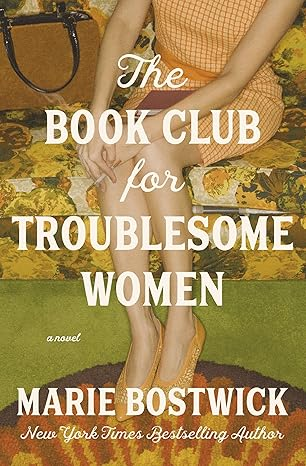
Set in 1960s in a northern Virginia suburb of Washington, D.C., Marie Bostwick’s novel, The Book Club for Troublesome Women is a misnomer– at least by today’s standards.
The housing development where the women live is new, so none of the neighbors know one another well. After visiting the local bookstore, Margaret Ryan decides to form a book club. She invites three other women to discuss Betty Friedan’s The Feminine Mystique, which has just hit the shelves. The group calls itself The Bettys.
Bostwick ascribes interesting attributes to each woman. Marilyn, Viv and Charlotte are all married with children. Charlotte is brash and creative unlike anyone Marilyn has ever met. Bitsy, the youngest and married to a much older man, is desperate to get pregnant.
The novel focuses on the personalities and friendships, which are initially in line with the times in which they live. This is primarily focused on the sexism they face in their marriages and outside their homes. Slowly, and predictably, as the women grow closer they begin to change by challenging the norms of the day.
There’s plenty of humor and nostalgia, even for those who weren’t part of that era. The women’s frustrations at not being taken seriously are palpable, but so is their joy when they are.
The final chapter takes readers to the early 2000s. As for the title, these women aren’t troublesome; rather they’re brave, progressive and evolve to become defiant. There’s little that’s unexpected, but it’s a fun read nonetheless.
The Book Club for Troublesome Women
Almost four bookmarks
2025, Harper Muse
371 pages, including acknowledgements and Discussion Questions
Keiko, a 36-year-old convenience store employee in Tokyo, is the main character in Sayaka Murata’s poignant novella, Convenience Store Woman. She’s had the job for 18 years and is perfectly content with her life. The work gives her the structure she needs to feel valued – even though she’s the only one who sees it that way. She knows that she’s out of step with the rest of the world.
The problem is that her family and friends consider the job unsuitable for a woman Keiko’s age. They also question the fact that she’s unmarried and worry she has never had a boyfriend. This falls in line with the perception, both hers and others, that she doesn’t fit in. Yet, at the Smile Mart, she does. She’s a diligent, dedicated worker. She also has little to no social life outside the store. She’s unmarried, considered unskilled by those who don’t understand what she brings to the position and, perhaps most importantly, has no desire to conform.
When a new employee, Shiraha, is hired, Keiko is dismayed at his lack of motivation and disregard for company policies. Although he doesn’t last long at the store, he ingratiates himself into her life.
Murata provides a heartwarming glance into the power of believing in oneself, but not before having Keiko consider how culture and those around her, including the wormy Shiraha, make her question her self-worth.
This is a short work that’s long on ideas and feelings.
Convenience Store Woman
3.75 Bookmarks
Translated by Ginny Tapley Takemori
Grove Press, 2018
163 pages
The Ministry of Special Cases by Nathan Englander is a gripping narrative about family, sacrifice and grief.
Although those elements are far from uplifting, Englander’s characters demonstrate the power of parental love and the ability to find inner strength where it once seemed impossible to exist.
Set in Buenos Aires during the time of Argentina’s Dirty War when people were “disappeared”, Kaddish Poznan is a ne’er do-well Jew, the illegitimate son of a prostitute. The sins of his mother taint all aspects of Poznan’s life. Only his wife, Lillian, tries to see his potential; but his son, Pato, despises him.
Poznan is always one scheme away from success; some are near brilliant and others simply far-fetched. His steady, albeit clandestine, work involves removing names on tombstones in the Jewish section of a cemetery for wealthy families wanting to stay under the regime’s radar.
When Pato disappears, Poznan and Lillian do everything possible to find him. Much involves needing large sums of money which leads to some humorous but agonizing situations for the parents. In their search for Pato, the couple ends up at the Ministry of Special Cases. This proves to be an exercise in futility thanks to the maze of bureaucratic red tape and ineptitude. All of this stumps Poznan, but motivates Lillian, which creates a rift between them.
Englander’s characters are vividly described as is the situation in Argentine at the time when thousands of people were killed or kidnapped by the country’s military leaving families ripped apart.
The Ministry of Special Cases
Four Bookmarks
Vintage International, 2007
339 pages
When Phoebe Stone abruptly leaves her Midwest college teaching job at the beginning of the semester, she heads to an upscale hotel on the Rhode Island coast. It’s a place she’d always dreamt of going with her husband, but he’s left her for another woman and Phoebe needed to get away; she’s had enough.
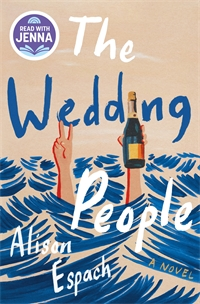
Alison Espach’s humorous and compassionate novel, The Wedding People, is as much about self-discovery as it addresses misplaced emotions, chance encounters and probable bad decisions.
The hotel is booked for a weeklong private affair and Phoebe is easily mistaken as a wedding guest; albeit without any luggage. It’s a large group of family and friends. No one takes particular notice until the bride, Lila, realizes Phoebe’s presence has the potential of ruining the festivities. Lila has planned everything, while sparing no expense, practically down to the minute. The unanticipated presence of a stranger could ruin everything.
Yet, Phoebe intrigues Lila, who spends time in the older woman’s room regaling her with the efforts involved in planning the wedding. Phoebe learns how Lila met her fiancé, the relationships she has with her mother, her sister-in-law to be and many of the (invited) guests.
Phoebe assures Lila that she has no intention of being a disruption: she plans to stay at the hotel one night and not interact with anyone. This soon goes awry.
The engaging, well-paced narrative, full of nuanced characters, leads Phoebe to a better understanding of herself, an acceptance of others, new friendships – and more.
The Wedding People
Four Bookmarks
Henry Holt and Co., 2024
367 pages, includes acknowledgements
I’ve struggled with how to review All Fours by Miranda July about a woman’s search for, well, more particularly when it comes to sex.
The unnamed narrator, an artist, by all accounts has a good, if not completely satisfying life with her husband and child. After receiving a large sum of money for the use of some of her work, she plans a trip to New York City. Rather than flying, she drives.
She stops 30 miles from her Southern California home, briefly meets Davy, learns his wife is an interior decorator stays at a nondescript motel. There she uses the money to hire the young man’s wife to redecorate the room.
While the upscale redecorating takes place our narrator fantasizes about the man, the man and his wife and mostly the man being with her.
Rather than a road trip, the novel becomes a jaunt through sexual fantasies. Once the remodel is complete, the narrator and Davy routinely meet. He’s adamant about not having sex with the narrator, their relationship is a close to being unconsummated as it gets. This is only the first third of the novel.
The remaining thirds feature plenty of sexual escapades that do occur in the posh room, but all involve women. Once home again, the narrator’s marriage becomes a co-living, co-parenting relationship; and she returns weekly to the motel room where she meets other women.
There’s humor and sex so this may be for the faint hearted. There’s also a lot of repetition.
All Fours
Three Bookmarks
Riverhead Books, 2024
326 pages
Louise Erdrich seamlessly weaves together a fast-paced, engaging story of young love, manipulative relationships, the environment and secrets in The Mighty Red.
This novel is rich in well-developed characters beginning with Kismet is a bright, sensitive yet impulsive high school senior with plans to leave her small town in the rural Red River Valley of North Dakota. Her best friend is Hugo, a brilliant home-schooled social outcast is in love with Kismet. Gary is the son of the wealthiest family in town and star quarterback. He’s not an enigma but carries a dark secret, and is also in love with Kismet. He’s desperate to marry her believing that she can help him forget that which haunts him.
Yes, there are adults, but the actions of some are less mature than the teens. Gary’s mother and Kismet’s father have their own (unrelated) agendas, which alternate between the comical and sad. Only Crystal, Kismet’s mother, seems to have a logical take on things, until she briefly doesn’t.
The tragic humor Erdrich interjects throughout the narrative is not limited to the relationships, but also to the over-cultivation of the land, land that once belonged to Native Americans and now makes a lucky few rich through sugarbeet farming. There’s no mistaking the irony that Crystal and Kismet are Ojibwe; with the mother driving the crops to the sugar refinery and Kismet as the farmer’s son object of desire.
As critical as the characters are to the storyline, the land is also a significant element.
The Mighty Red
Four Bookmarks
Harper, 2024
372 pages
For a light, easy read, Welcome to the Hyunam-Dong Bookshop by Hwang Bo-Reum fits the bill.
After leaving a successful career that left her unfulfilled, Yeongju opened a bookshop in a quiet, off-the beaten path in a Seoul neighborhood. She has no business experience, but she does have a love of books and their ability to transport readers away from their daily lives.
Initially, she does little to make the shop inviting; she simply reads while waiting for customers. Slowly, she discovers what she needs to do. First, she writes a blog about the shop, then hires a barista, and eventually she begins hosting book-related events such as monthly book groups, writing workshops and more. Slowly patrons become regulars, each contributing in their own way, to create a sense of community none realized was missing from their lives.
In the process of Yeongju becoming more business savvy she opens herself to accepting more about herself. Toward this end, the author intersperses a little back story, not only about Yeongju, but the other characters, too, including the barista; a coffee roaster who sells the beans used in the shop but is in an unhappy marriage; a woman dissatisfied with her spends time among the books crocheting; a teen uninterested in anything; and, a writer invited to speak about his newly published book.
The narrative is observational and ultimately uplifting without being heavy handed, even if it does become predictable.
Welcome to the Hyunam-Dong Bookshop
Three bookmarks
Bloomsbury Publishing, 2024
301 pages
Set in the small town of Crosby, Maine, many of Elizabeth Strout’s previous (and distinctly different) characters populate the town and novel.
Bob Burgess, a semi-retired lawyer, takes on a case involving a lonely, isolated man accused of murdering his mother.
Bob has a long-standing relationship with Lucy Barton and reluctantly finds himself falling in love with her, despite being married. Lucy is divorced, but lives with her ex-husband William. Still, Lucy and Bob regularly walk together talking about the many aspects of their lives. There are many things they reveal only to each other.
Olive Kitteridge is another familiar character known for her cantankerous, usually, insensitive, dealings with others. Olive lives in a retirement home; she and Lucy often spend time together sharing stories about people they’ve known or situations they’ve experienced. The women attempt to give these stories meanings, but often they are simply glimpses of life’s ups, downs and unknowns.
Strout imbues the novel with empathy and intrigue. There are Bob’s emotions, not just his love for Lucy, but the emptiness he feels following his sister-in-law’s death and concern for his client charged with murder. Interestingly, even Olive has more empathy than disdain for those around her (although in limited doses). Lucy is in more of a recipient; her feelings for Bob are never fully disclosed, although suggestions are inferred.
Descriptions of small-town life, changes in seasons and day-to-day routines of the characters are, in Strout’s hands, much more interesting than they might otherwise be.
Tell Me Everything
Four Bookmarks
Random House, 2024
326 pages
Piglet may be the name of a beloved children’s book character, but it’s the fictional main character in Lottie Hazell’s debut novel. And, it’s far from childish. In fact, it’s dark and disturbing.
Piglet and Kit are soon to be married; they’ve just purchased a new home in Oxford, she’s a successful cookbook editor and Kit, who’s from a wealthy family, seemingly adores his fiancé. That is until 13 days before the wedding when Kit confesses to Piglet a transgression that the reader can only guess. Despite his profuse apologies, it is enough to upend Piglet’s world and send her spiraling into a literal feeding frenzy.
Of course, the childhood nickname is enough of a clue that self-esteem may not be the main character’s strong suit. It’s eventually explained which only emphasizes the issues that have been part of Piglet for most of her life.
Although the author doesn’t describe Piglet’s size at the novel’s beginning, the character grows on the page. How could she not after ordering one of everything on a restaurant menu?! The most graphic image comes when her sister, parents and sister’s boyfriend struggle to get Piglet into her wedding dress. If it wasn’t so sad, it would be comical. This is an eating disorder gone off the rails before our very eyes.
Piglet’s anxiety about whether to go through with the wedding is palpable. Initially, she seemed to have everything, but after losing trust in Kit, there’s little that can satisfy her ravenous appetite for more.
Piglet
Three-and-half bookmarks
Henry Holt and Company, 2024
309 pages (includes acknowledgements)
Even after reading 19 books featuring Inspector Armand Gamache, his investigative team and the quirky residents of Three Pines, none of it gets old. Louise Penny continues to keep the magic and intrigue going strong in her latest, The Grey Wolf.
Repeated phone calls, which Gamache refuses to answer, interrupt an otherwise peaceful, late summer morning. This is only the beginning of disturbances that threaten to go beyond his quiet village. He soon discovers the entire Quebec province is at risk.
Through a series of seemingly unrelated events such as a stolen coat, a cryptic note and, of course, a murder lead Gamache, Jean-Guy and Isabel LaCoste to far reaching locales in order to avert a national catastrophe. This includes revisiting characters and places from previous novels (investigations), such as the remote Gilbertine monastery.
Gamache suspects colleagues and a self-serving politician with an axe to grind against him are involved.
While the potential danger moves the narrative forward, the novel is rich with descriptions of the recurring people and places readers have come to know. Subtle humor and meaningful relationships remain hallmarks of the Gamache series.
In thinking about the appeal of the series, Louise Penny sums it up best in the book’s acknowledgements: “The Gamache books are proudly crime novels … but at their core they’re about community. Acceptance. Belonging. Courage. … About trying to do better.” After all, who doesn’t want to read about such attributes, especially when there’s good writing, engaging characters and a murder to solve?!
The Grey Wolf
Four Bookmarks
Minotaur Books, 2024
419, includes acknowledgements







 The Blue Page Special