Archive for the ‘books’ Tag
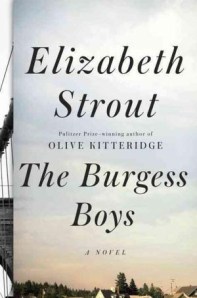
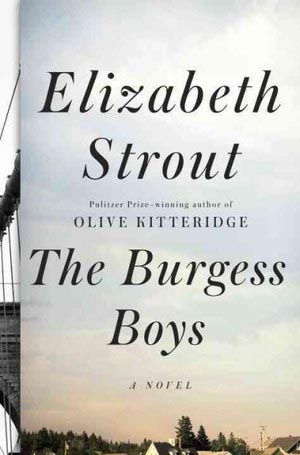
My sons are in their twenties and I still refer to them as the boys. It’s not so unusual, then, that Elizabeth Strout’s latest novel since her Pulitzer Prize-winning Olive Kittridge identifies the 50-something protagonist brothers as The Burgess Boys. Yet, it’s unsettling that they are such poorly matured men.
The backstory of Bob being accidently responsible for his father’s death is almost a character unto itself. This aspect of the novel emerges slowly and evolves, just as everyone else does, providing an especially interesting angle.
Jim is the older brother, the successful, high-achieving one. Bob, on the other hand, is less driven, and far more endearing. He rarely grows weary of Jim’s disparagements toward him, although reading them is tiresome. The boys left their childhood home in Maine years ago to pursue their lives in New York City. Jim is a hot-shot lawyer and Bob, also a lawyer, serves a different clientele. They receive word from their perpetually-unhappy sister (Bob’s twin) in rural Maine that her son is charged with a hate crime. This is the driving narrative, but that backstory is never far behind.
Strout has created a novel full of multiple layers, but not different versions. She provides snapshots of what happens in real life. Some are faded, some in black and white. The characters are heartbreaking in their deception, confusions and naiveté. Unlike Olive Kittridge which was a collection of connections among its characters, The Burgess Boys focuses on a family’s past and present, along with its shortcomings.
The Burgess Boys
Three-and-a-half Bookmarks
Random House, 2013
337 pages

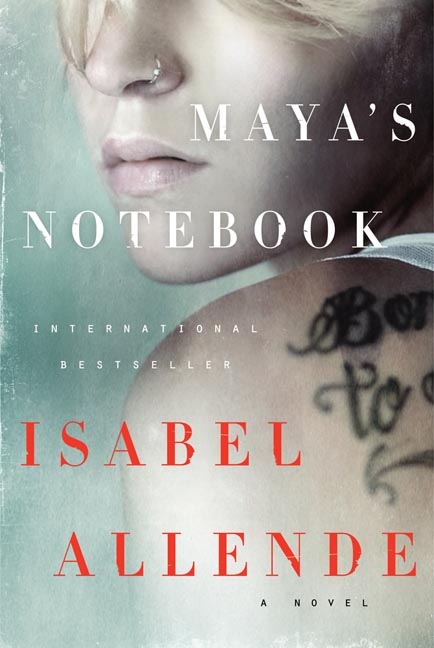
Isabel Allende is a master storyteller. Her characters have depth; their lives are full of mystery, love and befuddlement. Her most recent novel, Maya’s Notebook, is no exception. Well, it is, because it’s exceptional – even for Allende.
Maya is a 19-year-old girl on the lam on a remote island off the coast of Chile, her grandmother’s homeland. Maya was raised in Berkeley by her grandparents, a couple remarkable in their differences and their passion for life. Maya’s father floats in and out in a minor role; her mother doesn’t even rate that distinction. Several stories are told through Maya’s journal. She recounts her magical childhood, her arrival in Chiloe’ and counters these almost idyllic recollections with the explanation of why she is in hiding. The book’s first sentence, while seemingly melodramatic, creates suspense: “… if I valued my life at all, I should not get in touch with anyone I knew until we could be sure my enemies were no longer looking for me.”
Maya writes of her past and present in chronological order until the two eventually intersect. She begins with how her grandparents met and moves into how, as an infant, she came to live with them. Allende builds tension through Maya’s descriptions of her avalanche of mistakes made as an adolescent. Grief and environment contributed to one bad decision after another. Yet, a sense of calm surfaces as Maya relates her life in Chiloe’ while learning to appreciate the world around her and her place in it.
Maya’s Notebook
Five Bookmarks
Harper Collins, 2013
387 pages
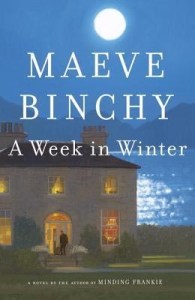
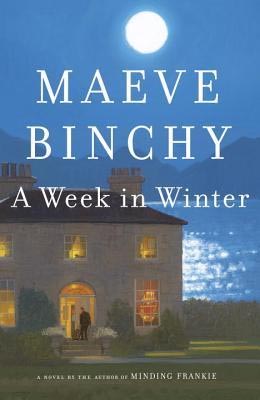
I’m a sucker for a Maeve Binchy novel. Yeah, I know her books are predictable, mushy and fast reads, but she gets me every time. Say what you will, Binchy is a marvelous story teller, and I was saddened to learn she died last summer. A Week in Winter was published posthumously.
Her last work has the requisite characters: independent women who are misled by handsome but unreliable men; ne’er do well young men who, despite the odds, turn their lives around; well-meaning parents who misunderstand their adult children; and, well, many more. For the most part, they are all quite lovely — young and old alike.
Chicky Starr left her family home on Ireland’s west coast as a young twenty-something, only to return some 20-plus years later to renovate an old mansion overlooking the sea as a hotel. Each of the book’s chapters focuses on a different character, while continuing the thread established in getting the hotel ready for guests. Of course, the guests figure prominently in the story. A few names from some of Binchy’s other works find their way into A Week in Winter, which only makes sense: Ireland is not that large a country.
Family relationships, friendships and learning to navigate life are the themes Binchy weaves into her novels; and the Irish landscape is always as important as its inhabitants in her hands.
Binchy has authored 22 books, of which two are nonfiction; I’m glad there are still several I have yet to read.
A Week in Winter
Three-and-a-half Bookmarks
Alfred A. Knopf, 2013
326 pages
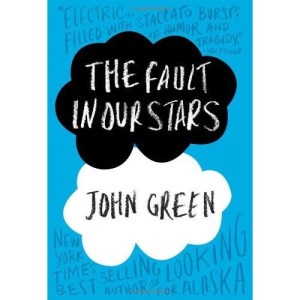
Hazel, the insightful narrator of John Green’s The Fault in Our Stars, is a 17-year-old who’s fought cancer most of her life. While talking about another book, she could just as easily be talking about this one: “But it’s not a cancer book, because cancer books suck.” Green has written much more than that, and it comes nowhere close to sucking.
This is about living with the knowledge of death’s inevitability loitering closer than it does for most, especially the young. Hazel meets Augustus at a cancer survivor’s support group. Eyes meeting across a semi-circle of young adults in varying degrees of bad health may not sound romantic, yet it’s the beginning of a beautiful relationship between two young adults who teeter alarmingly near to death’s grasp.
Hazel is an endearing character: intelligent, witty and aware of what she has in life, versus what she might be missing. She does not want to be defined by her diagnosis. Although Augustus might be a little too good to be true, he is fun and expands Hazel’s world.
Through a shared passion for the book that is “not a cancer book,” which simply stops with no real ending, the pair find a way to look toward the future. They want to know what happens. Yes, this may be a metaphor for their lives, but it’s far less dismal than that.
A few plot twists help overshadow the novel’s predictability. The story’s beauty is based not on what’s lost, but is grounded on what’s gained.
The Fault in Our Stars
Four Bookmarks
Dutton Books, 2012
313 pages
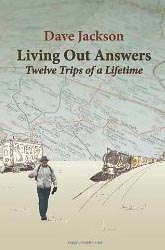
Living Out Answers – Twelve Trips of a Lifetime by Dave Jackson, is one of two indie books I recently read for pleasure (others I read for one of my few paid writing gigs). In the interest of full disclosure: I almost know the author. We’ve never met, but Jackson’s the father of a good friend who gave me the book as a gift.
This is a memoir based on trips, yup 12 of them, that he began taking when he turned 50 in 1979. He kept journals of the adventures which are the book’s foundation supplemented by recent afterthoughts. The trips include finding a way to spend time on the Mississippi River, to working for a circus, to learning about coal mines in West Virginia, along with nine others. He hitchhiked, hopped trains, hiked, rode in the cabs of big rigs and developed sea legs on boats.
Nearly as interesting is how the book evolved: Jackson’s granddaughter was prompted by a photo which led to discussions about the travels. Others entered the picture offering advice and encouragement. Although the book became a family endeavor of sorts, the stories are Jackson’s.
Jackson embraced the new opportunities and experiences no matter how exciting, frustrating or unpleasant, but there was always the safety net of a comfortable lifestyle awaiting him after each exploit. What’s most impressive is that Jackson made these journeys at a point in his life where many think self-reflection is either unnecessary or inconvenient. He demonstrates neither is the case.
Living Out Answers – Twelve Trips of a Lifetime
Three and a half bookmarks
Brokey’s, 2012
281 pages

Easy to visualize characters, plots driven by class conflict, issues of the heart (or both) and a very proper sense of, well, what’s proper are what make English Lit so appealing to me. Yes, the above could easily refer to classic British literature, but it also applies to Helen Simonson’s Major Pettigrew’s Last Stand – a very contemporary work.
Simonson’s novel begins with a chance meeting between the Major (his first name is Ernest, while apt doesn’t fit him as snugly as his military title) and Mrs. Jasmina Ali, a Pakistani shopkeeper. Although their paths have crossed in the past, this encounter comes at a vulnerable point in the Major’s life: he’s just learned of his brother’s death. What follows is the evolution of a friendship based on a passion for books and widowhood.
Both characters are thoroughly engaging. The Major in his stilted, decorous yet sensitive manner has appeal, and Mrs. Ali is an exceptionally intelligent woman burdened by a certain sadness associated with being considered an outsider in her home country. Simonson portrays people we know or would like to; they’re well-defined individuals with foibles, principles and dreams. The cast of lesser characters, including Roger, the Major’s obnoxious status-seeking son, enhance the story.
The novel moves at a leisurely pace as the Major and Mrs. Ali embark on a relationship that puts a spark in their step and ultimately has tongues wagging throughout the village. Simonson clearly enjoys thumbing her nose at what’s considered suitable or not.
Major Pettigrew’s Last Stand
Four Bookmarks
Random House Trade Paperbacks, 2011
358 pages (not including the Reader’s Guide)
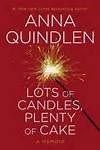
Anna Quindlen’s Lots of Candles, Plenty of Cake is a poignant, yet cheerful perspective on getting older. This is the kind of book to share with friends, particularly if they’re around the age of what is now considered to be the new-40s.
As in most of her writing, Quindlen relies on personal experience to make her points. Her writing career includes several stints as a columnist (at the New York Times and later Newsweek) as well as authoring several works of fiction, nonfiction and children’s books. She has a keen sense of observation. Better still, she’s an extraordinary wordsmith. Those two skills result in crafting pieces readers can easily make connections with. Of control, she writes: “I thought I had a handle on my future. But the future, it turns out, is not a tote bag.”
Quindlen examines the important aspects of life, which can be applied to most people, women in particular: friendship, family, love, parenting, and more. She’s humorous and honest. She writes of near-misses, both good and bad. She reflects on how much her younger self was sure she knew and how her older self readily acknowledges what she doesn’t. Without citing the tired phrase that youth is squandered on the young, it’s a major thread. Quindlen puts a new spin on it.
Yes, this is a memoir, but it is much more. It’s a guidebook to accepting that each morning we wake up is a gift – even if we’re older than we were the day before.
Lots of Candles, Plenty of Cake
Four Bookmarks
Random House 2012
182 pages

I’m probably not alone in my preference to read the book before I see its film adaptation. The Perks of Being a Wallflower was no exception. I am now anxious to watch the movie.
Stephen Chbosky’s novel is told through letters written by Charlie, an insecure 15-year-old, to an unknown recipient. Charlie’s letters are brutally honest in their reflection of his life as the youngest of three children in a traditional family. It’s clear from the outset, though, that he is far more sensitive than most teenage boys. Sure, he faces teen angst like most kids, but his sensitivity and intelligence set him apart from his peers. Through what can only best be described as chutzpah, he introduces himself to Patrick and Sam (Samantha) – step-siblings in their senior year. Charlie is a freshman, but his new friends don’t seem to mind and welcome him into their circle.
As Charlie becomes more involved with his new friends, he discovers that he is not the only teenager with problems. His letters reveal more and more about himself and those around him. It’s evident that his issues are intense: misplaced guilt and an ability to keep a family secret he shouldn’t be burdened with. Lingering in the background are topics of sexuality, identity, and perceptions.
Charlie may never be a popular boy, but he has friends and family who care deeply about him. Even for those of us long removed from school days, it’s still possible to appreciate the value of those intangibles.
The Perks of Being a Wallflower
Four Bookmarks
Gallery Books, 1999
213 pages

Beautiful Ruins is a cinematic novel. It’s easy to imagine this story playing on the silver screen. It spans years and continents, relies heavily on the relationship between Elizabeth Taylor and Richard Burton, and features a strong connection to the movie industry. At its core, this is a love story, and a beautiful one at that.
Jess Walter’s tale involves a young actress, Dee, who arrives in an isolated Italian fishing village on the Ligurian Sea, where she meets Pasquale the owner of the Adequate View Hotel. Dee has been sent from Rome, where she had a bit part in the filming of Cleopatra. Dee is also pregnant with Burton’s child. Although it may sound like a blurb from People magazine, Walter imbues his narrative with deep feelings, humor, interesting characters and a clear passion for romance.
However, just when it seems the story will settle in the fishing village (the most interesting place) or even Los Angeles (because of the Hollywood scene), several miscellaneous locales are introduced: Seattle, London, Spokane, Florence, even Donner Pass in Northern California. Walter includes an assortment of characters, none of whom, surprisingly, are superfluous. Added, to this mix are different time periods: the early 1960s, the 1800s, and something more contemporary. The myriad of people, places and eras at first seems disparate, but they actually are essential what makes this such an engaging work.
Ruins are most often associated with architecture. Here Walter incorporates them into the erosion, but not extinction, of human emotions.
Beautiful Ruins
Four Bookmarks
Harper, 2012
337 pages

Any number of factors figure into how I, or anyone for that matter, respond to a book. Experience, age, education, even mood, come quickly to mind. I was struck by these considerations as I read Sheila Heti’s How Should A Person Be? because the novel makes me feel that whatever I bring to this particular reading experience is a negative: my experience, my age, and yes, my mood.
Sheila is the narrator, a young writer in Toronto struggling to finish a long-overdue play; she is easily distracted by life, specifically people in her life. She is so caught up with what others think and do that she lacks focus. Sheila stretched my patience as a reader. She has a wonderful friend in Margaux, an unhealthy but lively sex relationship with a man named Israel, and an undiguised inability to recognize or accept what is good and positive in her life. She is not quite a loser, but teeters awfully close to becoming one.
Perhaps the issue lies in Heti’s attempt to fictionalize her autobiography, for she is clearly the narrator and there is little reason not to believe that the other characters comprise her circle of friends. Frankly, Sheila is not that interesting. That honor goes to Margaux who comes across as honest, talented and a good friend, but it’s hard to explain what she sees in Sheila. Israel is depicted as a depraved man who uses Sheila to fulfill his debased sexual fantasies. Unfortunately, it’s too easy to see he’s attracted to her.
How Should A Person Be?
Two-and-a-half Bookmarks
Henry Holt and Co., 2012
306 pages



 The Blue Page Special