Archive for the ‘Alfred A. Knopf’ Tag
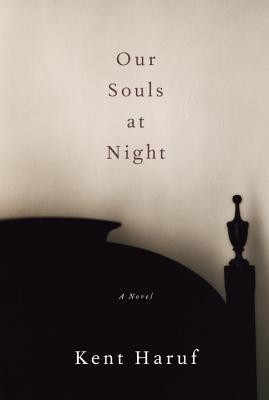
Our Souls at Night by Kent Haruf is best described as sweet. This terse novel was published posthumously, and its content makes me imagine that the author was in his final days when he penned it. This is a story of finding a way out of loneliness while believing that the opinions of others have little value or impact.
Addie Moore and Lewis Waters are widowed and living in the fictional town of Holt on Colorado’s eastern plains. This is Haruf’s preferred setting as many of his previous works have centered around this small communityand its residents. Anyone familiar with his writing will recognize names and places.
One day, Addie calls Lewis. They have known each other for years, but only peripherally. She wonders if he would like to spend the night. This is no brazen, immoral solicitation. It is one lonely heart reaching out to another.
Addie’s son and grandson figure into the narrative as does Lewis’s daughter. The townspeople make sure these adult children are aware of what their parents are doing.
Haruf provides a lot of detail such as teeth brushing and lawn care for someone trading in a scarcity of words (after all, the book is less than 200 pages long).
Unfortunately, the premise, which is touching and somewhat whimsical, overshadows the writing, which is too mundane to be enchanting. Anyone who has experienced a meaningful relationship (be it lover or friend) will appreciate the warmth drawn from conversations that happen just before sleep.
Our Souls at Night
Three bookmarks
Alfred A. Knopf, 2015
179 pages

When author Stieg Larsson died 11 years ago, it appeared to be the death knell for the Millennium Series featuring Swedish journalist Mikael Blomkvist and heroic bad girl Lisbeth Salander. Thanks to David Lagercrantz, the demise of the fictional characters was greatly exaggerated.
Lagercrantz has written the fourth installment, The Girl in the Spider’s Web — doing so in a voice and style remarkably similar to Larsson’s. This is a good thing.
The two protagonists have moved on with their lives; Blomkvist still writes for Millennium magazine and Salander continues to hack computers. They have not stayed in touch with one another. Then, Blomkvist receives a call in the middle of the night from a source who has been in contact with a hacker whose description can only fit Salander. This thinnest of threads ultimately expands to hold the narrative together. Blomkvist’s source and Salander’s work for him are linked to international cyber-spying, old family vendettas and the pair’s respect and faith in one another.
Many characters introduced by Larsson have new-found life thanks to Lagercrantz. He follows a similar pattern of simultaneous stories occurring within a single chapter until they ultimately come together.
Blomkvist’s source is murdered, the NSA is hacked and a child autistic savant not only has the missing piece to the puzzle that brings these events together, but he brings out an unlikely, albeit extremely slight, maternal side in Salander.
There’s intrigue, righting wrongs and descriptions of Stockholm that make it seem as if Lagercrantz is channeling Larsson.
The Girl in the Spider’s Web
Four Bookmarks
Alfred A. Knopf, 2015
400 pages

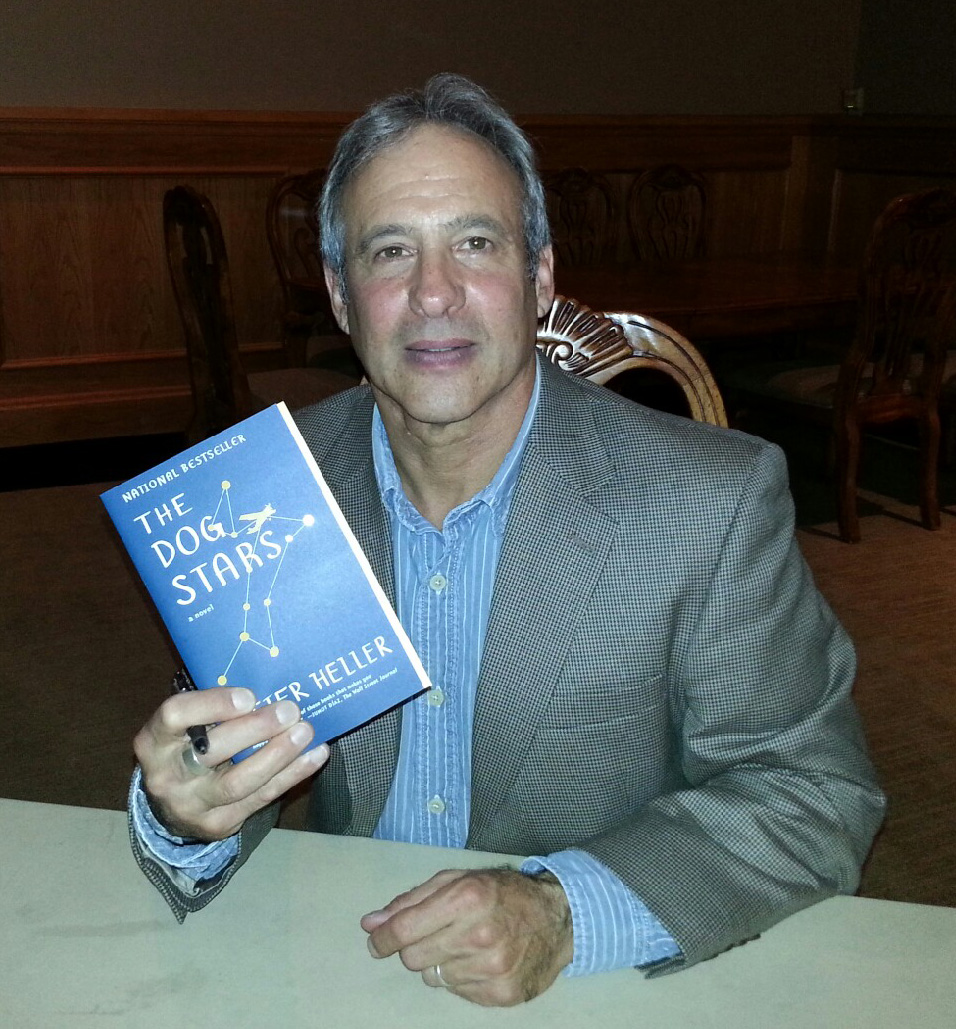
A few weeks ago I reviewed Peter Heller’s The Painter. That was shortly after Station Eleven. While I enjoyed both books, I thought I’d wait before starting another work by Heller, and I certainly had no intention of being drawn into another novel about a post-apocalyptic world. Then I heard Heller talk. He shared his experiences as a freelance writer and told how he came to write fiction. He read some from The Painter and The Dog Stars. I really had no good excuse not to read the latter.

It takes a little time adjusting to Heller’s stream of consciousness style with no quotation marks and single word sentences. It’s a terse yet fitting approach for Hig, a pilot who’s survived a flu pandemic, to tell his story. He lives with his dog, Jasper, and Bangley, a weapons-hoarder-ask-questions-later neighbor on an abandoned airfield northeast of Denver.
They must constantly be on alert from human predators. Hig is the least vigilant of the trio. What’s left of the world is not a friendly place. Yet, despite his best efforts, given the losses he’s faced, Hig is an optimist. A chance static-riddled radio transmission three years earlier from western Colorado has made him restless. Against Bangley’s better judgment, Hig needs to know what and, more importantly, who may still be out there.
His discovery is beautiful and gut-wrenching. Like Hig, the reader comes to appreciate Bangley. Although it hardly seems possible, as the story progresses Hig’s sensitivity and humanity gain greater significance.
The Dog Stars
Four Bookmarks
Alfred A. Knopf, 2012
320 pages

The Book of Unknown Americans by Cristina Henriquez is a timely read with the issue of immigration never far beneath the political surface. Yet, the novel isn’t about politics, but people.
Arturo and Alma leave Mexico for Delaware because they want to do more for their teen-aged daughter, Maribel, who suffered a brain injury. They believe she’ll benefit in a better school. They’re not illegals; they have work visas. Each chapter is told from one of the character’s perspectives, some in greater detail than others; only never Maribel’s.
Woven in with the challenges of living in a new land with a new language is the relationship that develops between Maribel and Mayor.
Sixteen-year-old Mayor Toro lives in Maribel’s apartment building; his parents left Panama when he was less than a year old, but he’s never fit in. From Mayor’s perspective, Henriquez writes: “The truth was that I didn’t know which I was. I wasn’t allowed to claim the thing I felt and I didn’t feel the thing I was supposed to claim (Panamanian).”
This sums up the experience of those introduced in the book. Henriquez has created a montage of immigrants: from Mexico, Panama, Puerto Rico, Guatemala, Nicaragua, even Venezuela and Paraguay. These places are all part of the Americas, which is what makes the title so appropriate with its double entendre. In brief, compelling chapters, among those told in Alma and Mayor’s voices, the neighbors share their pasts explaining why they left their native countries for the U.S.A.
The Book of Unknown Americans
Four Bookmarks
Alfred A, Knopf, 2014
286 pages

Maeve Binchy died in 2012. Since then, two posthumously published works made their way to readers. And as much as I’d like to keep reading her poignant, if often overly-sentimental, stories, enough is enough. I previously reviewed A Week in Winter here. It was typical Binchy full of coincidences, lessons learned and colorful characters; it was fun to read. Unfortunately, I am less enthralled by Chestnut Street, a collection of unrelated vignettes – or chestnuts, if you will.
Like her more complete novels, Binchy’s characters reflect humor and insight into human failings and triumphs. The stories touch on lost loves, personal sacrifices and family relationships. However, the residents of this fictional neighborhood need further fleshing out. Obviously, that’s not going to happen.
The title, Chestnut Street, is what ties everything together, but the strands are too loose. The collection reads as if someone simply went through and identified a place to insert the name of the fictional Dublin road. It doesn’t work. All the characters share an address, but no one has a connection to anyone else. The stories are short, more like sketches. Just because they bear a faint semblance to her style, doesn’t mean they’re book-worthy. What’s next, a compilation of her shopping lists or recipe file?
Binchy was prolific. My suggestion is to read the works she completed, and if you have already done. Start over. That will be far less disappointing than trudging along Chestnut Street.
Chestnut Street
Two-and-a-half Bookmarks
Alfred A. Knopf, 2014
368 pages
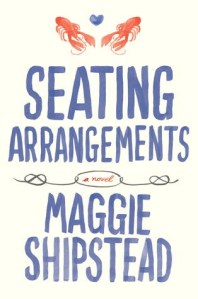
Anyone planning a wedding in the next few months, or ever, might consider avoiding Seating Arrangements by Maggie Shipstead; but they would be missing a fun, albeit satirical, and poignant look at families under stress.
Shipstead’s debut novel focuses on Winn Van Meter, father of the bride-to-be, in the three days prior to the ceremony. Winn is a banker, a Harvard man whose greatest disappointments are that he didn’t have sons and has yet to be granted membership in a private golf club. His daughter Daphne, seven months pregnant, is marrying Greyson Duff. That name alone suggests privilege, which is an apt description for the entire wedding party.
The nuptials are taking place on a fashionable island off the New England coast. The Van Meters have long had a vacation home there, although, as it turns out, the Duffs have their own island. Yet, the only character concerned with one-upmanship is Winn. And, perhaps, his younger daughter, Livia, who was recently dumped by her boyfriend, Teddy Fenn – whose father, Winn surmises, is responsible for obstructing admittance to the private club.
Shipstead’s multiple talents lie in her ability to create distinct voices and flaws for each of her characters. The cast of which include friends, family, and the Fenns. Biddy Van Meter, Winn’s wife, is the voice of reason while humoring her husband. However, her patience and fortitude wane as his attraction to one of the bridesmaids waxes.
In Shipstead’s hands, humor and heartache are worn with the ease of a properly fitted cummerbund.
Seating Arrangements
Four Bookmarks
Alfred A. Knopf, 2012
302 pages

In Wave, Sonali Deraniyagala writes with intensity and candor as she describes the tsunami she survived but which her family did not.
The memoir begins in the minutes before one of the most deadly forces of nature hit the Sri Lankan coast Dec. 26, 2004. She is initially incredulous that she should survive; it only makes sense that her husband, their seven- and five-year-old sons, along with her mother and father also made it through alive. Unlike the 2012 film, The Impossible, about the same topic, Wave does not have a happy ending. Neither does it have a happy beginning.
Deraniyagala slowly moves through the stages of grief and gets stuck in denial. She is angry, she is depressed and though her narrative extends to 2012, she can’t wrap her heart or mind around the loss she has endured. Yet, she brings her family to life in the memories she shares. She vividly details her sons’ antics and dissimilar personalities. She recounts her courtship with her husband, Steve, and their life in London before and after kids. It takes longer for her to deal with the loss of her parents, so they aren’t as fully portrayed.
Gradually, she’s able to revisit family homes, places her children played, friends and even the devastated Yala resort. The author moves from the present to the past, from her childhood in Sri Lanka to Cambridge, from Yala to London. At each juncture pain is never far from the surface; fortunately, it becomes less raw.
Wave
Four Bookmarks
Alfred A. Knopf, 2013
228 pages
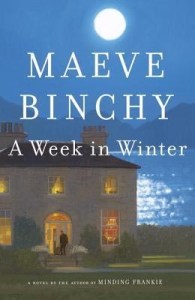
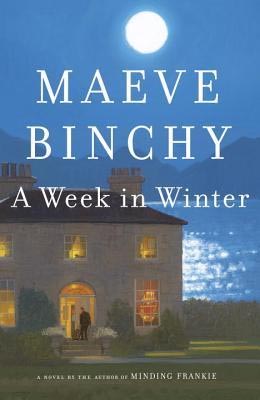
I’m a sucker for a Maeve Binchy novel. Yeah, I know her books are predictable, mushy and fast reads, but she gets me every time. Say what you will, Binchy is a marvelous story teller, and I was saddened to learn she died last summer. A Week in Winter was published posthumously.
Her last work has the requisite characters: independent women who are misled by handsome but unreliable men; ne’er do well young men who, despite the odds, turn their lives around; well-meaning parents who misunderstand their adult children; and, well, many more. For the most part, they are all quite lovely — young and old alike.
Chicky Starr left her family home on Ireland’s west coast as a young twenty-something, only to return some 20-plus years later to renovate an old mansion overlooking the sea as a hotel. Each of the book’s chapters focuses on a different character, while continuing the thread established in getting the hotel ready for guests. Of course, the guests figure prominently in the story. A few names from some of Binchy’s other works find their way into A Week in Winter, which only makes sense: Ireland is not that large a country.
Family relationships, friendships and learning to navigate life are the themes Binchy weaves into her novels; and the Irish landscape is always as important as its inhabitants in her hands.
Binchy has authored 22 books, of which two are nonfiction; I’m glad there are still several I have yet to read.
A Week in Winter
Three-and-a-half Bookmarks
Alfred A. Knopf, 2013
326 pages
I’m not entirely sure how I feel about The Twelve Tribes of Hattie by Ayana Mathis. Mathis has created a family, beginning in 1925 continuing through 1980, of which Hattie is the matriarch. The tribes, her 11 children and one grandchild, are revealed in single, captured episodes (chapters) reflecting a lifetime of longing and emotional neglect. On one hand Hattie is a mother who loves her children too much; yet, she doesn’t love them well.
Parents are not always infallible, and Hattie makes no apologies for her shortcomings. The first chapter, about her twins, and later that of her daughter, Rosie, are told through Hattie’s eyes; the rest of the stories are shared from her children’s perspectives. These include looks back on their childhoods and a glimpse of them as adults. No one fares well, and the question surfaces: how much is a parent’s responsibility? Except that’s not the only issue here.
Hattie and her husband, August, share the burden of poverty and heartache. Their relationship, however, is grounded more in the physical than sentimental realm. Consequently, her nine offspring struggle with everything from sexuality to religion, from addiction to mental illness. How would life had been different if Hattie’s first two children, twins Philadelphia and Jubilee, not died in infancy? It’s possible they would have grown up to be just as miserable as their siblings.
Mathis’s writing is the redeeming element: evocative and haunting. What she writes may be difficult to read, but how she does it is memorable.
The Twelve Tribes of Hattie
Probably Four Bookmarks
Alfred A. Knopf, 2012
243 pages

What begins campy and comic book-like soon assumes a more serious tone about
familial dysfunction in Karen Russell’s Swamplandia! This enigmatic coming-of-
age story is set in Florida’s Everglades, where the harsh environment is full of danger-
ous creatures and rich in bittersweet memories for the Bigtree family.
Thirteen-year-old Ava Bigtree is the narrator for most of the novel; when the setting
switches to the nearby coastal town of Loomis, Russell narrates. Swamplandia! is the
name of the Bigtree family’s alligator theme park. When Ava’s mother, the main attract-
ion as an alligator wrestler, dies, the family disintegrates. Ava’s 16-year-old sister is in
love with a ghost; Kiwi, the older brother, leaves to work at the competing theme park
in Loomis; and Chief, the children’s father, leaves Swamplandia to look, he says, for
funding. Through most of the novel, Ava is the most level-headed, so when she shows
her age, it’s a good thing for the reader, but not so much for Ava.
This is one whopper of a tale, but Russell creates complex characters facing difficult
issues in their lives, not the least of which is dealing with the mother’s death. The back-
drop of the theme park and alligators provides some levity on one hand and heavy-duty
allegory on the other. Russell’s beautifully-written descriptions and sentence structure
are captivating. There are some laugh-out-loud moments countered by creepy events.
Several times I considered closing the book to stop what was likely to happen, but
needed to keep reading just in case I was wrong.
Swamplandia!
Four Bookmarks
Alfred A. Knopf, 2011
316 pages





 The Blue Page Special