
Some nights, no matter how hard you try to convince yourself, are simply not
meant to highlight a fine dining experience. This includes New Year’s Eve. If
not for the humor, warmth and companionship of friends, dinner at the
Crystola Roadhouse would have been a sorry way to end 2011.
Granted, the kitchen and wait staff was running on all cylinders, but most of
the misfires on the plate had nothing to do with being busy. The regular Friday
and Saturday night special is Prime Rib. It was the December 31st special as
well. It came with salad, mixed vegetables, roasted potatoes and bread. This
all sounds good.
The iceberg salad, with a few pieces of tomato added for color, arrived (literally)
a split second before the entrée. So much for pacing the meal.
The Prime Rib was cooked well and, despite using a steak knife with the tension
of a rubber band, was tender and flavorful. Nothing else could make the same
claim. The potatoes were undercooked. The mixed vegies, of corn, green beans,
peas and lima beans, came straight out of a supermarket’s frozen food section.
The bread was simply buttered toast.
I’m happy to note that service was above average, and the beer was plentiful.
Thank goodness for the company of good friends. Otherwise, as just a date night
destination, the Crystola Roadhouse might have had the potential to put a chill
on the evening that has nothing to do with temperatures on a cold winter’s night.
“Crystola Roadhouse”
Two Plates
20918 East U.S. Highway 24, Woodland Park, CO

Even though my own name belies the family stories I’ve heard about Echo Park,
I admit I judged Brando Skyhorse by his. I didn’t expect him to know much, if
anything, about Echo Lake, Chavez Ravine, and Elyssian Park near downtown Los
Angeles. Lo siento. His novel, The Madonnas of Echo Park, proves that he knows
the geography well and the community, too. Although not written in an especially
unique format, he creates a cohesive portrait of Mexican Americans in a time when
it is easy to overlook the fact that one word is an adjective and the other a noun.
Skyhorse relies on different narrators, all of whom are Latino, to relate varied
perspectives of a series of coincidently overlapping events. In their quest to wake
up in the American Dream, they recount nightmarish experiences.
Aurora Esperanza is the character about whom everything is connected. The story
weaves in and out of her childhood in the Echo Park area (when its residents were
primarily Spanish-speaking families) to the gentrification now underway. The grown
-up Aurora acknowledges that she has trouble recognizing her old haunts. Skyhorse
plays and replays the theme of being cast out of one once-distained area into an-
other with numerous references to Chavez Ravine. Families were forced to leave
their homes there to make room for Dodger Stadium.
I know the verdant Echo Park that sits like an island in a sea of automobile traffic,
and Skyhorse doesn’t just describe a neighborhood, he portrays its heart and soul.
“The Madonnas of Echo Park”
Three and a half Bookmarks
Free Press, 2010
199 pages

For years, the only thing we ever stopped for in Woodland Park en route to the
mountains from Colorado Springs was donuts. That’s changed. Now we stop at
Joanie’s Mountain Gourmet Deli.
We’ve been three times in the past few months: lunch-to-go, a snack-for-the-road,
and a hot breakfast after a cold morning searching for a Charlie Brown Christmas
tree. All experiences were tasty and presented challenges because of the plentiful
offerings.
Lunch is typical deli fare and more. Menu items include fresh salads, sandwiches
(cold, hot, grilled, wrapped) and freshly-made soups. I ordered Joanie’s Veggie,
awrap with hummus, tomato, cukes, artichoke hearts and roasted red peppers.
I’m a pushover for those ingredients. Tangy, smooth hummus was the star, a
perfect complement to the vegies. My husband ordered the Oven Gold Turkey on
sourdough and had little to say: he was too busy eating.
A pastry case features in-house baked goods, which was the impetus for the second
visit: we left with a cream cheese cherry croissant and a mega peanut butter
cookie.
Recently, my husband tried the biscuits and gravy, which, in general, needs a
makeover, not for its taste but the way it looks. The thick gravy has a subtle kick.
I had the roast beef, roasted red pepper and provolone quiche. The flavors woke
up the silky egg custard and flakey crust.

The food is good, fresh; and service is exuberant. The only visible downside is that
Joanie’s closes at 3 p.m.; so plan those drives west accordingly.
Four Plates
110 E U.S. Highway 24
Woodland Park, CO

I can’t remember all the books I read this past year. This says more about
my memory than necessarily reflecting poorly on the ones I can’t recall.
The standouts, however, are another story. They feature characters with
depth, situations I had never considered, and writing that practically
dances off the page in its lyricism and rhythm. In no particular order,
here are my favorite reads of 2011. Enjoy!
Room by Emma Donoghue
Cutting for Stone* by Abraham Verghese
State of Wonder by Ann Patchett
The Lonely Polygamist by Brady Udall
The Snowman* by Jo Nesbo
Freedom by Jonathan Franzen
Blood, Bones & Butter: The Inadvertent Education of a Reluctant Chef* by Gabrielle Hamilton
The Hunger Games (Catching Fire and Mockingjay) by Suzanne Collins
* The Blue Page Special reviews.

Two very sad things are conspicuous about Blood, Bones & Butter: The Inadvertent
Education of a Reluctant Chef by Gabrielle Hamilton: she was essentially abandoned
as a kid, and her parents probably have no clue what they missed. In spite of being
neglected, or perhaps because of it, Hamilton developed an inner strength and the
talent to express herself through food – and writing.
Hamilton appears as baffled by her life circumstances as any reader. She recounts
a happy early childhood as the youngest of five children in rural Pennsylvania.
However, those years were short-lived. Her family disintegrated through her parents’
divorce, and she was left to her own devices. With only a trace of bitterness
(mostly directed toward her mother), Hamilton recalls what it was like eking out
a living when she was still a kid.
By age 13, she knew she needed a job. She hasn’t stopped working since, and much of
her employment has been in restaurants or catering, it’s almost always been related
to food. Hamilton’s writing is vividly descriptive making it easy to not just see the
images she depicts, but also to feel the cool morning dew or to smell the smoke from
a pit fire or taste “a cold ham sandwich on good buttered grainy bread.”
Today, Hamilton is an accomplished chef and owner of Prune restaurant in New York City,
and her writing is stellar. Still, who leaves an almost-12-year-old to fend for herself,
even if the ultimate outcome appears to be exceptional?
Four and a half Bookmarks
Random House, 2011
291 pages

After reading the first eight – practically in one sitting – Stephanie Plum
comedy-mysteries, I knew I had to stop. And I did, cold turkey. I’d notice
a new catchy title, or a friend would mention the Morelli/Ranger lines of
division; but I stayed away. Except, for the past six months Smokin’ Seventeen
by Janet Evonovich has been languishing on my nightstand. It doesn’t matter
how it got there, only that I had successfully ignored it, for a while.
A few pages in, I remembered why I had abandoned Stephanie and all the other
whacky characters, the silly repartee and the inane situations. Nothing had
changed. Yet, I kept reading, and as I did, I was hooked. The banter became
less hare-brained: it was laugh out loud funny. I found myself enjoying the
flaws I had identified years ago.
Smokin’ Seventeen once again finds bounty hunger Stephanie in Trenton, N.J.
She remains caught between feelings (the ones that stir certain body parts
and emotions) for Morelli, the good cop, and Ranger, the sexy equivalent of
a bad cop. The story centers around a rash of dead bodies left near the places
Stephanie works and lives. Several corpses have notes addressed to her. The
possibility of a third romantic interest, one who can cook, also appears.
Evanovich is nothing if not prolific and humorous. Explosive Eighteen is now
in bookstores, but I plan on exercising self-control and not reading it any time
soon. Sometimes too much of a good thing gets old fast.
Three Bookmarks
Bantam Books, 2011
308 pages

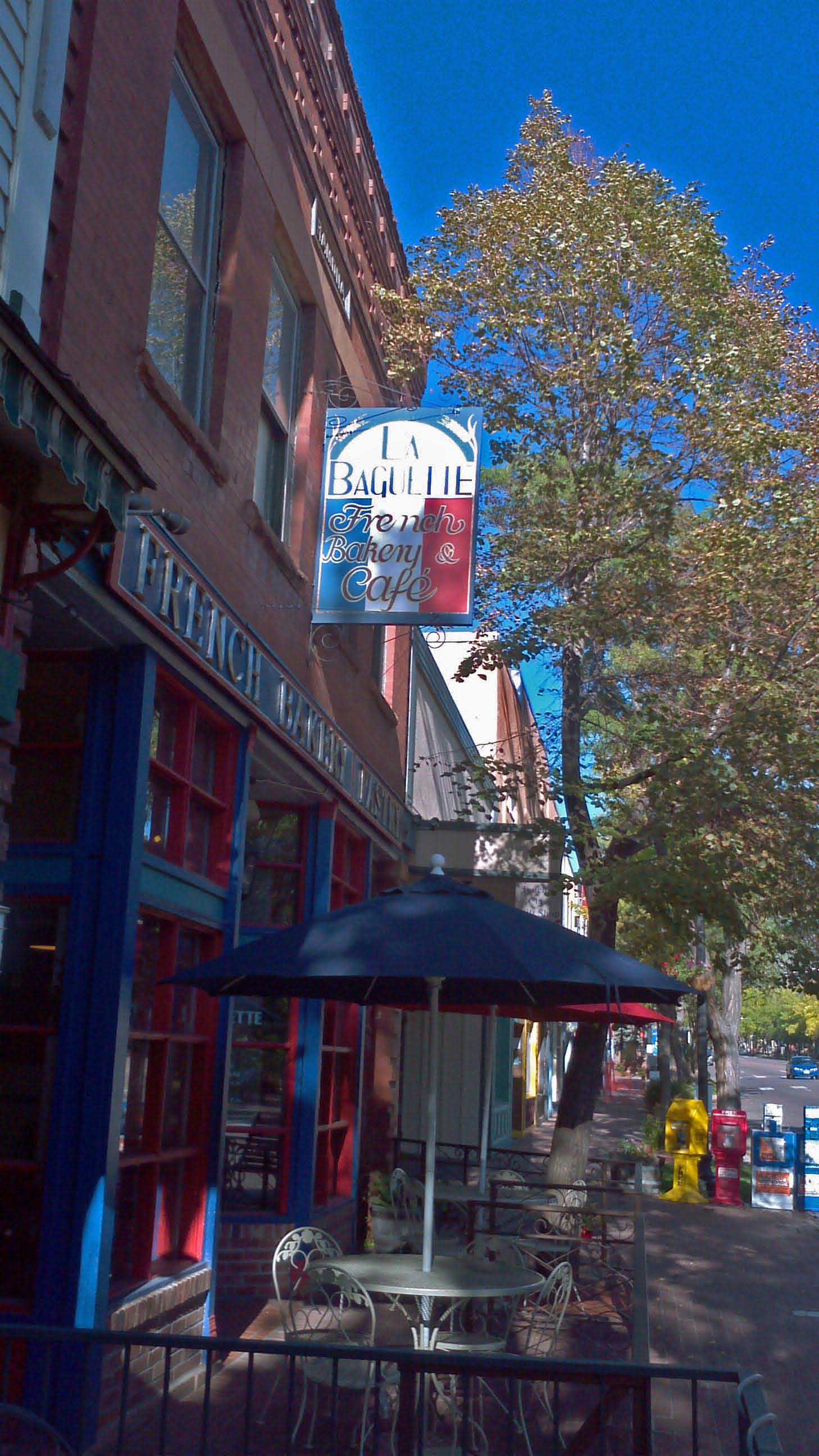
Solace is found in the familiar, and La Baguette with its French onion
soup sets the benchmark for comfort. Although I encourage others to
sample different dishes, the only deviation I’ll make is including a
salad or extra roll with my order.
The venerable Westside eatery has been serving soups, sandwiches and
a few hot entrees for 28 years. It rarely varies in quality. The gooey
cheese stretches like soft taffy from the steaming rich beef broth thick
with onions; the house specialty is comfort food deified. Served with
a hard roll, whose crust shatters when broken, this remarkably simple
meal ($6.25) is complete.
The house salad is romaine dressed with olive oil, tarragon and lemon
juice. Again, simplicity is as much an ingredient as salt and pepper.
La Baguette’s combination of French onion soup and salad ($7.75) is
the best of all worlds.
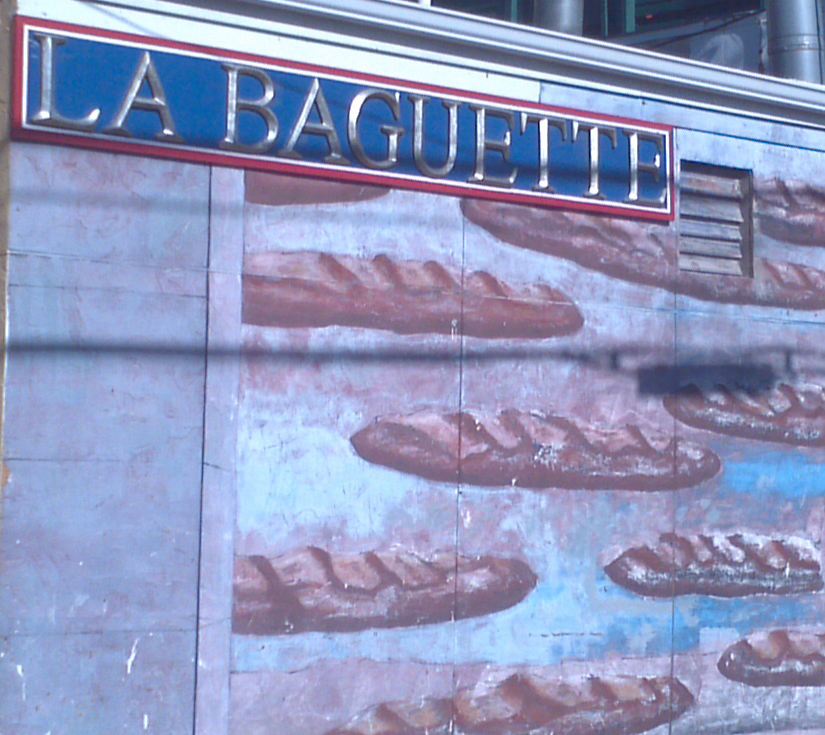
Orders are placed at the counter behind which are stacked more than a
baker’s dozen of bread types – from extra long French batards to round
walnut-raisin loaves. All are airy with a hard crust. To be honest even
day-old bologna would be elevated by this bread – but that would be a
waste. The pastry case includes croissants, Napoleons, clafoutis, and
more. The overall décor is bistro-like with tables crowded together
making for snug dining companions.
On each visit, I am thrilled with the delicious consistency of the soup
a la maison. Looking around at the elbow-to-elbow tables, I always seem
to be in good company.
Five Plates
La Baguette
2417 W. Colorado Ave., Colorado Springs, CO 80904
719-577-4818

The trouble with reading Joan Didion’s Blue Nights is that I feel I have
eavesdropped on a private conversation. And it’s one she’s having with
herself.
This is Didion’s most recent work since The Year of Magical Thinking. It,
like Blue Nights, focuses on loss. In the former, it was the death of her
husband, John Gregory Dunne; and in the latter, the death of their daugh-
ter Quintana Roo, also known as Q. These are heart-breaking events but
Didion candidly shares a range of emotions. She writes, “When we talk
about mortality we are talking about our children.” Then, before I can
phrase the question myself, she asks what that means. I am still not sure.
What I do know that is Didion loved her daughter. Q was adopted, an only
child, insightful and perhaps a bit frightening, as a young child, in her
assessment of situations. Didion acknowledges she was not prepared to be
a parent, although it was something she wanted. Nonetheless, much of the
book has her questioning the decisions she made as a mother – something
not necessarily unique.
Surprisingly, the book has a lot of humor, after all who names a child
Quintana Roo (after the state in Mexico)? Didion also addresses the issue
of growing old, of experiencing physical decline. Overall, the strength
lies in her descriptions of those moments that set one family apart from
another: memories. In doing so, she may not be talking to herself as much
as thinking out loud.
Three and a half Bookmarks
Alfred A. Knopf, 2011
188 pages

A bungled reservation, an over-zealous server, and cold air wafting into the room
could have contributed to a disastrous dining experience at Springs Orleans.
Instead, the food not only ruled the night, it negated the coulda-been problems.
The menu is a what’s what in New Orleans cooking: Shrimp Etouffee, Red Beans
and Rice, Shrimp and Grits, Gumbo and much more. Prices range from moderate
($11 for a shrimp Po’Boy) to pricey ($20 for the Shrimp Platter).
We started with the Calamari and Creole marinara. Dual textures from the crunchy,
suggestively spicy breading and the chewy soft squid were a treat. The bonus was
the sauce: a spin on a traditional marinara with the addition of Cajun seasoning –
which, the hostess explained, has 32 herbs and spices.
I ordered the pasta with lobster and sundried tomatoes in a creamy tarragon sauce.
It was Mardi Gras on a plate: an exciting, festive combination but you can only take
so much. It wasn’t just rich, it was luxurious. The tubular spring-like pasta was
eclipsed by the profusion of flavor. My husband ordered the Fried Shrimp that was
neither greasy no heavy shone on the Platter. It featured the same breading as the
calamari. The Platterscome with choices of several sides including crispy French
fries, balsamic grilled vegies, mashed potatoes, greens and coleslaw.
The loud, cheerful atmosphere is enhanced by the live music from the keyboardist.
This is not the place for a romantic meal, but it’s perfect for being transported to
Louisiana without ever leaving town.
Four Plates
Springs Orleans
123 E. Pikes Peak
Colorado Springs

Feeding Christine by Barbara Chepaitis has most of the themes I enjoy
in a novel: friendship, food, mystery and personal growth. Unfortunately,
the plot and creativity, two fundamental elements for a truly engaging work,
lack flavor.
The book centers around four women who gather to prepare for the annual
holiday party hosted by their catering company. A fifth woman, Nan the
deceased sister of Teresa, is also a prominent character. And, Nan is the
mother of the title character. Rather than hold the party at their shop,
Teresa insists on having it in her home. The story takes place over three
days, but retells memories that span years.
Three of the women spend much of the time cooking in Teresa’s kitchen.
Meanwhile, the fourth is tied up in the basement – and everyone knows
it. I am not making this up. It’s difficult to know if Chepaitis’s intent
was to create a dark comedy, or if that was a consequence of the weak
storyline. Occasional references are made to the “hostage” but each
woman goes about her business. Trips are made to the grocery store,
delicious sounding ginger trout is prepared, love is a topic of conversa-
tion, and all the while someone they care about is secured in the cold,
dark basement. It’s almost comical.
The lone strength of the novel lies in the description of food and its
bond among the women. However, a menu at a nice restaurant could
provide the same thing without the contrived drama.
One Bookmark
Bantam Books, 2000
244 pages





 The Blue Page Special