
The word submission has multiple meanings, and all find their way
into Amy Waldman’s The Submission. On its surface, the reference
is to the design proposal for a 9/11 Memorial; subsequent insinuat-
ions include compliance, obedience and capitulation – among others
– as associated with religion, politics, marriage, relationships, em-
ployment: in other words, life.
Waldman’s finely woven novel begins with a committee charged
with selecting a memorial design. As the jury argues the merits of
one proposal over another, the most vocal advocate for one in parti-
cular is Claire, a widow representing the families who lost loved ones
in the World Trade Center. The initial conflict, however, is not what
creates the intrigue that results in turning the pages at an exception-
ally rapid rate; it’s the discovery that the selected memorial designer
is Mohamed Khan, a Muslim American.
The ripple effect evolves into a racial tsunami with politicians, report-
ers, other families directly affected by 9/11, and extremist organiza-
tions. Waldman raises questions that have no easy answers. Just as
the characters ask themselves how to best deal with this difficult
situation, the issues confront the reader as well. Emotions, values,
and preconceptions taint major and minor players alike.
The passage of ten years has not diminished the image of the twin
towers in flames, or other indelible impressions from that day.
Waldman’s portrait of the lingering aftermath demonstrates that
cultural and personal prejudices remain. Although the novel focuses
on New York City residents, it will resonate with American citizens
no matter where they live.
The Submission
Four-and-a-Half Bookmarks
Farrar, Straus and Giroux, 2011
299 pages

Amanda’s Fonda has been our neighborhood Mexican restaurant for years.
I’ve always enjoyed walking the five blocks from my house to the popular
eatery. Although my neighborhood hasn’t changed, Amanda’s has – and
not necessarily for the best.
The margaritas are still very good, and worth the walk – which makes it easy
to have more than one. Although the service remains attentive and friend-
ly, a recent visit proved disappointing when it came to the actual reason for
dining: food. Chips and salsa were just okay, not exceptional. Orders arriv-
ed a little too quickly, and without the blazing hot-plate warning. The food
was warm, but not even close to sizzling. In the past, the chicken and mole
entree featured chicken cooked in the spicy, chocolate sauce. Now, the mole
is simply poured over the top of two chicken breasts and garnished with ses-
ame seeds. There was not enough sauce to hide the dry texture of the other-
wise flavorless poultry. The standard rice and beans were the best thing on
the dish.
My husband’s colorful combination enchilada plate had easy to swallow fla-
vors, but offered nothing that really wowed us. Nonetheless, he barely left
any trace of its existence.
Our server explained to the group next to us that Amanda’s is no longer
family-owned. Instead, a local businessman has taken over but, she said,
he has left everything intact. I can only hope this was just an off night
for the food, and that the margaritas will continue to be tangy, refreshing
and strong.
Amanda’s Fonda
Three plates
3625 W. Colorado Ave.
Colorado Springs, CO

I’m a writing tutor at a community college. It’s at once rewarding, challenging,
and, sometimes, frustrating. In a break from rhetorical analyses and summaries,
a student, with the aid of an ASL interpreter, asked for reading help. Initially
I recommended a reading tutor, but soon realized she was more interested in
books than the process.
“I don’t know how I should feel at the end of the book,” she explained.
Her face revealed she was being neither ironic nor sarcastic; she was earnest.
I was silent. What should you feel at the end: joy, relief, disappointment?
“It’s pretty subjective,” I finally answered. “So much depends on the book and
where you are in your life. Some books I don’t want to end; the good ones I think
about long after setting it down for the last time. Others make want me to read
something better where I can know the characters, revel in the language, be awed
by the images, or just enjoy the story. Sometimes after finishing an exceptional
book, I don’t even want to read anything new for a while.”
Her rapid hand movements interrupted me, “But have you read any famous books?”
The inquiry seemed sincere. “I read a lot,” I said, “including books that could be
considered famous.”
For a moment she was still before she scrunched her face, moving her lips and
her hands at the same time. “Like Harry Potter?”
“Sure, like Harry Potter,” I said. “I read those to my kids, at the end we couldn’t
wait for the next one.”
Was that it? Did she really just want to know how she should feel at the end of
Harry Potter?
We all shrugged our shoulders.
It left me wanting to read a good book, one I can’t put down. How should you feel
when you finish a book?
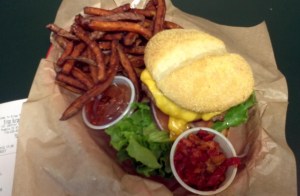
Before I finished eating, I wondered if Five Plates were appropriate for a
burger joint. The truth is Bingo Burger scored big on everything from food
to service, from mostly locally-sourced ingredients to the casual atmosphere,
but especially the food. Ultimately, I found two problems: it’s about 50 miles
from my doorstep and it’s pricey.
This is a colorfully decorated, upscale burger bastion. As soon as we entered,
my friend and I were greeted with a warm hello and admonished to take our
time ordering, but we weren’t to hesitate if we had any questions. And, by
the way, the ultra-friendly counterperson said, the milkshake flavor of the
day was banana chocolate. Ultimately, we were walked through the process:
pick a burger; we each opted for the namesake Bingo Burger, made with pueblo
chilies. Next was whether it should be “pink or not pink.” The usual accouter-
ments were available, as were other options ranging from different cheeses to
caramelized onions from fried egg to guacamole (and more). Thankfully, there
was no variation for the bun, which complemented rather than overwhelmed.
To have missed it would have shortchanged the burger.
Ordering the milkshake was a no brainer; banana chocolate is a hard-to-resist
combination, and it didn’t disappoint. This was thick, creamy and dense with
flavor. It, the shared side of hand-cut sweet potato fries served with tangy,
smoky curry ketchup, and the burgers made for a complete, delicious dining
experience – about $25 for two (including the shake we shared).
Bingo Burger
Four and half Plates
101 Central Plaza
Pueblo, CO
(Closed Sundays)

Labeled as a “novel about food and friendship,” The Recipe Club by
Andrea Israel and Nancy Garfinkel chronicles a long-time friendship
through emails, letters and recipes. The latter are the real stars. From
appetizers such as, “Good Karma Veggie Samosas,” to desserts includ-
ing, “Wash-Away the Blues Berry Cobbler,” each recipe is named to
coincide with the events in the characters’ lives.
Roughly ninety percent of the book is written as correspondence. I
suspect each author assumed the role of one of the two main charact-
ers, friends Val and Lily, who weather every imaginable squall as
young girls/teenagers. The distinct voices reflect their contrary per-
sonalities, which add weight to the opposites-attract-theory of re-
lationships.
With two narrators, it’s easy to provide both sides to every story. It
is also not difficult to see how misinterpretations occur. The novel
begins with an email exchange between the two women as they try
to bridge a 28-year rift in their friendship. It’s no spoiler to say the
attempts prove fruitless. This is followed by the main section of the
book: letters written between 1964 and 1973, and nearly all are
accompanied by a recipe for their recipe club. Everything leads to-
ward their falling out.
The result of the book’s structure is a “Forest Gump” approach to
showing the times as they were a changin’ for Val and Lily. The for-
mat was an uncomplicated way to introduce others who impacted
their lives. Friendship and food are important connections; the
authors show sometimes they aren’t always stress-free.
The Recipe Club
Three Bookmarks (thanks to the recipes)
HarperCollins, 2009
337 pages

When restaurant kitchens are open for all to see, it’s kind of important for the
cooks not to be distracted. A late lunch at McGill’s at Crested Butte took
a little longer than necessary, and we could see why: the chef was on the phone
– a very long time; even though ours was the only order, he was slow ending
the call.
McGill’s is more diner than restaurant, with more grill than kitchen. Plus, the
guy preparing our food was probably more line cook than chef. Still, he was the
one putting things together. When the plates finally arrived, we agreed it was
tasty, but would have been much better if served sooner.
The bread was fresh, but it wasn’t like the cook was waiting for it to finish
baking so he could place all of the accouterments atop it. Nor did it look
like he mashed avocados for the freshest possible guacamole. The bottom line
is that he talked at length instead of grilling.
Nonetheless, this was not a standard sandwich; it was a Grilled Chicken
Cobb Sandwich. It combined all the elements of a Cobb Salad (sans diced
turkey and hardboiled egg) between two slices of ciabatta. The result, except
for the tardiness, was a treat. Bacon, blue cheese, avocado in the form of guac,
and tomatoes made for a twist on the original concept of the traditional salad
and its reincarnation as a sandwich.
Maybe the secret to eating at McGill’s is to phone in the order.
Three Plates (Barely)
McGill’s at Crested Butte
228 Elk Ave.,
Crested Butte, CO

The sense of smell is rich in clichés: “Wake up and smell the coffee;”
“stop and smell the roses;” “relatives and fish smell after three days.”
In her book, Season to Taste, Molly Birnbaum writes of her life
without the ability to smell, so everything associated with scent
renders those sayings not just tired, but impossible.
Months before Birnbaum was to enter the Culinary Institute of Ameri-
ca she was struck by a car and suffered multiple injuries, including
losing her sense of smell which is known as anosmia. As she comes to
grip with the repercussions of this loss, she relinquishes her dream to
become a chef and latches onto the quest of learning about all things
olfactory.
Birnbaum’s writing is forthright, conversational yet occasionally bord-
erline academic. She experiences grief, anger and panic over the now-
missing sense she once took for granted. Aromas, odors, scents, what-
ever the name given, are, of course, everywhere. They evoke memories,
they provide contexts, they affect taste. With this in mind, Birnbaum
interviews numerous experts in the field of olfaction. She meets others
with anosmia. She studies at a perfume school in France, and visits flavor
design labs. Through these experiences, she relearns to identify smells,
falls in love, and reminds readers that this often under-rated of the
five senses really does enhance life in many, many ways.
The scientific information is interesting, but the best parts of Birnbaum’s
story are the personal elements she shares. That’s why it’s exciting when
she begins to cook again.
Season to Taste
Three Bookmarks
Ecco/HarperCollins, 2011
304 pages

In Great House, Nicole Krauss considers not just how an object is acquir-
ed, but how it is passed on to others. She shows that to bestow and to re-
ceive is not always a welcome, or even happy, occasion.
The novel has multiple characters, but it is really about just one thing: a
desk. Nonetheless, it is transformed from simply being household furniture
to something representing the different traits and lives of its owners. It is
imbued not only with personal histories, but also past world events. In
each of its homes, however, the desk physically overshadows everything
else, so the question that surfaces early on is: why is this particular piece
so important?
I found a lot of similarities between Kraus’s work and Accordion Dreams
by Annie Proulx. Both follow one specific item (in the latter, it’s the title
instrument) and both are haunting. The main difference is that Kraus
shows a connection among the five owners so the result is an amazingly
serendipitous puzzle. Here, Kraus, the author of A History of Love, has
written a fairy tale of sorts. In keeping true to that genre, Great House is
mournful and low on humor.
One problem lies with voice because everyone sounds the same. The pri-
mary distinction among the many narrators is in the descriptions of their
lives, rather than one personality being different from another. It’s the
situation that brings the desk into play and moves the story forward. Ulti-
mately, it’s something inanimate that drives the characters’ experiences.
Great House
Three Bookmarks
W.W. Norton & Co., 2011
289 pages

A look at fast food establishments I’ve frequented through the years
doesn’t just show where I’ve eaten, but also explains certain points
in my life – usually involving my kids, and/or a younger me. Match
column A with column B:
1. Taco Bell a. Parent of college-age children
2. McDonald’s b. Parent of preteen kids
3. Subway c. Life before kids
4. Local burger joints d. Parent with no kids at home
5. Panera Bread e. High school kid (before Chipotle)
6. Chipotle f. Parent of young children
I’m not proud to confess some of this. On the other hand, many of
these places are rites of passage. Right now I’m at d – a perfect
match for Panera Bread. It’s quick, consistent (in a positive way),
and the menu changes often.
Recently, the vegetable soup was a perfect way to rebuff the cold,
finally-winter day. Full of vegies, pasta and augmented in flavor by
a dollop of pesto that was quickly absorbed by the hot tomato-base.
I added a superfluous and unimaginative salad. It was my own fault
for ordering a basic mix of greens dressed with bland vinaigrette.
Panera has numerous salads that are well-above average (like the
Fuji Apple). I was uninspired when ordering and my taste buds bore
the brunt of that decision. Thankfully, the accompanying baguette
had a hard chewy crust; its inside was soft and airy.
The way I match the columns is 1 e; 2 f; 3 b; 4 c; 5 d; and 6 a.
Panera Bread
Three Plates
1845 Briargate Parkway
Colorado Springs, CO
(Panera Bread is located in most cities across the country)


With so many recent literary references to tigers it’s easy to think
The Tiger’s Wife has something to do with Asia. That’s not the
case with Tea Obreht’s lyrical, engaging debut novel. Instead, she
writes about fear, imagination, survival, and war’s shadow – on an-
other continent altogether.
The title’s namesake and the “deathless man” are told like fairytales
along with the narrator’s, Natalia, desire to know the circumstances
of her much-loved grandfather’s death. These tales also figure promi-
nently in how he lived his life; he was a doctor and survived an earlier
war. It’s his demise that propels Natalia, and even though death is a
constant throughout the book, it is not disheartening.
Natalia, too, is a young physician in a devasted eastern European
country, whose story begins with her memories of going to the zoo
with her grandfather: to see the tigers. Other animals are mentioned,
but the tigers drive their visits. As Natalia grows up, the threat of war
is never far removed, yet she is surprised at her cavalier attitude
toward it. Later, when she treats children orphaned by war, she still
never appears to believe it’s real.
Although, she’s preoccupied with her grandfather’s death, the more
she looks for understanding, the more she explains the myths he shar-
ed. There actually was a tiger and a young girl known as its wife in
the grandfather’s childhood village. By contrast, the deathless man
was known only to the grandfather, and Natalia clearly wants to know
more about both men.
Four Bookmarks
Random House, 2011
338 pages



 The Blue Page Special