Heartwood by Amity Gaige was just the kind of book I’d been looking for: one I couldn’t put down. Gaige’s writing hooked me from the very first paragraph. Consider: “You could read the weather like a poem.” This is written by Valerie Gillis, also known by her Appalachian Trail name “Sparrow,” in a letter to her mother.
Valerie has been hiking the AT for the past three months and is now lost in Maine’s North Woods. Rather than simply chronicling what’s happening in a journal, Valerie addresses her entries as letters to her mom. This helps sustain her; it’s evident through her writing, that Valerie has deeper bond with her mother than with anyone else.
Lt. Bev Miller is the Game Warden who oversees the search, formally known as the Incident Management Team, for Valerie that spans a 12-day period. Throughout a stellar career, Bev has worked her way up the ladder to her current position, something fraught with sexism.
The letters/Valerie and Bev’s perspectives are told through first person voices. A third, critical character is Lena, a resident in a senior care facility in Connecticut. The story alternates among these three. What they initially have in common is determination in their quest for Valerie’s survival. Through their backstories, mother/daughter relationships are revealed as another similarity, which vary among them.
The three women are distinct, representing different phases of life and experiences. A handful of other interesting characters populate the novel. Gaige imbues the story with humor, tension and intrigue.
Heartwood
Four-and-a-half Bookmarks
Simon & Schuster, 2025
309 pages
Kalmann An Icelandic Mystery
by Joachim B. Schmidt
Kalmann Odinsson, 33, is a man with special needs man: mentally he hasn’t progressed beyond that of a six-year-old; he’s uncoordinated and socially awkward. He lives alone in the small town of Raufarhofn, Iceland, nearly 400 miles from the country’s capital.
Fishing is the primary industry and because of the small population, everyone knows everybody. Most are sympathetic to Kalmann who considers himself the town sheriff. He wears a cowboy hat and has a badge to prove it. He also carries an antique Mauser pistol.
For most of Kalmann’s life, his Grandfather was his constant companion, but the elder man was moved to a senior care facility in another town. Kalmann’s mother also moved away, but frequently checks in on her son.
The best times of his life were those times spent with his Grandfather, which helps explains why Kalmann is as self-sufficient as he is. Although he visits his Grandfather weekly, his absence is deeply felt.
The novel is told from Kalmann’s perspective which is both humorous and, at times, heartbreaking. When he discovers blood while hunting for an Arctic fox, a mystery unfolds. First, whose blood and where is the body?
Despite his limitations, Kalmann is often insightful; and perhaps because of them, he is also frustrated. This is similar to my reaction while reading. This is due largely to the novel’s pacing, which is, at times, laborious. In developing Kalmann’s character in such tedious detail, the author, unfortunately, lets the mystery at hand take the back seat.
Kalmann: An Icelandic Mystery
Bitter Lemon Press, 2022
301 pages
Three bookmarks
Vanessa Miller author of The Filling Station has crafted a novel based on the historic events surrounding the 1921 Tulsa Race Massacre.
Greenwood was a prosperous, self-sustaining community known as “Black Wall Street.” It was home to movie theatres, clothing stores, law and medical offices, banks and much more until it was completely destroyed by an angry mob of white men. Homes and businesses were burned to the ground, hundreds died and thousands were displaced.
The narrative focuses on sisters Margaret and Evelyn Justice, the daughters of Greenwood’s grocery store. It’s the eve of Evelyn’s high school graduation and Margaret has returned home from college with an offer to teach in the fall. Evelyn’s been accepted to a fashion design school in New York City.
When the violence begins the Justice girls’ world is upended. Their home is burnt; they left with only the clothes on their backs fleeing for their lives. Exhausted, hungry and afraid they walk for miles before arriving at the Threatt Filling Station, a black-owned business, where they’re taken in by the Threatt family.
The horrific actions and devastating loss are vividly described. Margaret and Evelyn deal with the loss in different ways with the older sister willing herself to find a way forward to rebuild what was taken; and Evelyn looks for ways to numb her pain.
Grief, hope, faith and love are among the many themes Miller weaves. The writing is occasionally stilted, but knowing the factual roots of the story is overwhelmingly powerful.
The Filling Station
3.75 bookmarks
Thomas Nelson, 2025
365 pages, includes Author’s notes, acknowledgements, discussion questions and sources.
The Ministry of Special Cases by Nathan Englander is a gripping narrative about family, sacrifice and grief.
Although those elements are far from uplifting, Englander’s characters demonstrate the power of parental love and the ability to find inner strength where it once seemed impossible to exist.
Set in Buenos Aires during the time of Argentina’s Dirty War when people were “disappeared”, Kaddish Poznan is a ne’er do-well Jew, the illegitimate son of a prostitute. The sins of his mother taint all aspects of Poznan’s life. Only his wife, Lillian, tries to see his potential; but his son, Pato, despises him.
Poznan is always one scheme away from success; some are near brilliant and others simply far-fetched. His steady, albeit clandestine, work involves removing names on tombstones in the Jewish section of a cemetery for wealthy families wanting to stay under the regime’s radar.
When Pato disappears, Poznan and Lillian do everything possible to find him. Much involves needing large sums of money which leads to some humorous but agonizing situations for the parents. In their search for Pato, the couple ends up at the Ministry of Special Cases. This proves to be an exercise in futility thanks to the maze of bureaucratic red tape and ineptitude. All of this stumps Poznan, but motivates Lillian, which creates a rift between them.
Englander’s characters are vividly described as is the situation in Argentine at the time when thousands of people were killed or kidnapped by the country’s military leaving families ripped apart.
The Ministry of Special Cases
Four Bookmarks
Vintage International, 2007
339 pages
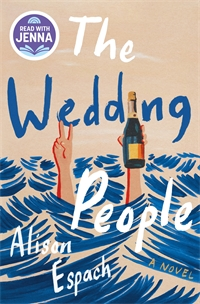
When Phoebe Stone abruptly leaves her Midwest college teaching job at the beginning of the semester, she heads to an upscale hotel on the Rhode Island coast. It’s a place she’d always dreamt of going with her husband, but he’s left her for another woman and Phoebe needed to get away; she’s had enough.
Alison Espach’s humorous and compassionate novel, The Wedding People, is as much about self-discovery as it addresses misplaced emotions, chance encounters and probable bad decisions.
The hotel is booked for a weeklong private affair and Phoebe is easily mistaken as a wedding guest; albeit without any luggage. It’s a large group of family and friends. No one takes particular notice until the bride, Lila, realizes Phoebe’s presence has the potential of ruining the festivities. Lila has planned everything, while sparing no expense, practically down to the minute. The unanticipated presence of a stranger could ruin everything.
Yet, Phoebe intrigues Lila, who spends time in the older woman’s room regaling her with the efforts involved in planning the wedding. Phoebe learns how Lila met her fiancé, the relationships she has with her mother, her sister-in-law to be and many of the (invited) guests.
Phoebe assures Lila that she has no intention of being a disruption: she plans to stay at the hotel one night and not interact with anyone. This soon goes awry.
The engaging, well-paced narrative, full of nuanced characters, leads Phoebe to a better understanding of herself, an acceptance of others, new friendships – and more.
The Wedding People
Four Bookmarks
Henry Holt and Co., 2024
367 pages, includes acknowledgements
I’ve struggled with how to review All Fours by Miranda July about a woman’s search for, well, more particularly when it comes to sex.
The unnamed narrator, an artist, by all accounts has a good, if not completely satisfying life with her husband and child. After receiving a large sum of money for the use of some of her work, she plans a trip to New York City. Rather than flying, she drives.
She stops 30 miles from her Southern California home, briefly meets Davy, learns his wife is an interior decorator stays at a nondescript motel. There she uses the money to hire the young man’s wife to redecorate the room.
While the upscale redecorating takes place our narrator fantasizes about the man, the man and his wife and mostly the man being with her.
Rather than a road trip, the novel becomes a jaunt through sexual fantasies. Once the remodel is complete, the narrator and Davy routinely meet. He’s adamant about not having sex with the narrator, their relationship is a close to being unconsummated as it gets. This is only the first third of the novel.
The remaining thirds feature plenty of sexual escapades that do occur in the posh room, but all involve women. Once home again, the narrator’s marriage becomes a co-living, co-parenting relationship; and she returns weekly to the motel room where she meets other women.
There’s humor and sex so this may be for the faint hearted. There’s also a lot of repetition.
All Fours
Three Bookmarks
Riverhead Books, 2024
326 pages
Louise Erdrich seamlessly weaves together a fast-paced, engaging story of young love, manipulative relationships, the environment and secrets in The Mighty Red.
This novel is rich in well-developed characters beginning with Kismet is a bright, sensitive yet impulsive high school senior with plans to leave her small town in the rural Red River Valley of North Dakota. Her best friend is Hugo, a brilliant home-schooled social outcast is in love with Kismet. Gary is the son of the wealthiest family in town and star quarterback. He’s not an enigma but carries a dark secret, and is also in love with Kismet. He’s desperate to marry her believing that she can help him forget that which haunts him.
Yes, there are adults, but the actions of some are less mature than the teens. Gary’s mother and Kismet’s father have their own (unrelated) agendas, which alternate between the comical and sad. Only Crystal, Kismet’s mother, seems to have a logical take on things, until she briefly doesn’t.
The tragic humor Erdrich interjects throughout the narrative is not limited to the relationships, but also to the over-cultivation of the land, land that once belonged to Native Americans and now makes a lucky few rich through sugarbeet farming. There’s no mistaking the irony that Crystal and Kismet are Ojibwe; with the mother driving the crops to the sugar refinery and Kismet as the farmer’s son object of desire.
As critical as the characters are to the storyline, the land is also a significant element.
The Mighty Red
Four Bookmarks
Harper, 2024
372 pages
For a light, easy read, Welcome to the Hyunam-Dong Bookshop by Hwang Bo-Reum fits the bill.
After leaving a successful career that left her unfulfilled, Yeongju opened a bookshop in a quiet, off-the beaten path in a Seoul neighborhood. She has no business experience, but she does have a love of books and their ability to transport readers away from their daily lives.
Initially, she does little to make the shop inviting; she simply reads while waiting for customers. Slowly, she discovers what she needs to do. First, she writes a blog about the shop, then hires a barista, and eventually she begins hosting book-related events such as monthly book groups, writing workshops and more. Slowly patrons become regulars, each contributing in their own way, to create a sense of community none realized was missing from their lives.
In the process of Yeongju becoming more business savvy she opens herself to accepting more about herself. Toward this end, the author intersperses a little back story, not only about Yeongju, but the other characters, too, including the barista; a coffee roaster who sells the beans used in the shop but is in an unhappy marriage; a woman dissatisfied with her spends time among the books crocheting; a teen uninterested in anything; and, a writer invited to speak about his newly published book.
The narrative is observational and ultimately uplifting without being heavy handed, even if it does become predictable.
Welcome to the Hyunam-Dong Bookshop
Three bookmarks
Bloomsbury Publishing, 2024
301 pages
Set in the small town of Crosby, Maine, many of Elizabeth Strout’s previous (and distinctly different) characters populate the town and novel.
Bob Burgess, a semi-retired lawyer, takes on a case involving a lonely, isolated man accused of murdering his mother.
Bob has a long-standing relationship with Lucy Barton and reluctantly finds himself falling in love with her, despite being married. Lucy is divorced, but lives with her ex-husband William. Still, Lucy and Bob regularly walk together talking about the many aspects of their lives. There are many things they reveal only to each other.
Olive Kitteridge is another familiar character known for her cantankerous, usually, insensitive, dealings with others. Olive lives in a retirement home; she and Lucy often spend time together sharing stories about people they’ve known or situations they’ve experienced. The women attempt to give these stories meanings, but often they are simply glimpses of life’s ups, downs and unknowns.
Strout imbues the novel with empathy and intrigue. There are Bob’s emotions, not just his love for Lucy, but the emptiness he feels following his sister-in-law’s death and concern for his client charged with murder. Interestingly, even Olive has more empathy than disdain for those around her (although in limited doses). Lucy is in more of a recipient; her feelings for Bob are never fully disclosed, although suggestions are inferred.
Descriptions of small-town life, changes in seasons and day-to-day routines of the characters are, in Strout’s hands, much more interesting than they might otherwise be.
Tell Me Everything
Four Bookmarks
Random House, 2024
326 pages
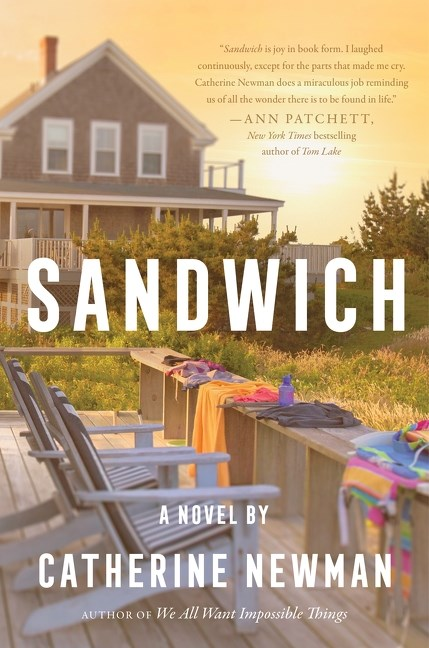
Rocky, a 50-something wife and mother, is caught between the lives of her aging parents and young adult children in Catherine Newman’s aptly-titled Sandwich.
It’s summer vacation which means the family’s annual weeklong trip to Cape Cod. They’ve stayed in the same rental cottage for decades making it rife with memories for everyone, but especially Rocky.
There are certain traditions Rocky strives to maintain even when events threaten to thwart them. Her efforts to recreate days at the beach and dinners out are crafted from long-standing habits; the family has always taken a cooler filled with the same type of sandwiches or always gone to a specific restaurant on a certain day within the seven spent at the beach. Yet this year things are different.
The rental has seen better days. Rocky is in the throes of menopause; she frequently acknowledges this which is also evident in her reactions to situations around her. But there’s more: other matters surface connected to long-held secrets and the realization that her children are increasingly more independent and parents are more so; they always join the family midweek.
The narrative is told through Rocky’s voice moving back and forth from the past to the present. Some memories are more joyful than others, as are some of the current happenings. All impact her mood and her relationship with her husband, daughter, son and his girlfriend.
Newman’s writing is engaging resulting in a well-paced relatable novel. In many ways, a week has never gone so quickly.
Sandwich
Three-and-a-half Bookmarks
Harper, 2024
240 pages







 The Blue Page Special