Remember by Lisa Genova is about all those little, and sometimes big, things we often can’t recall – and why.
She is the bestselling author of Still Alice, an account of a woman diagnosed with early-onset Alzheimer’s disease. Genova is a neuroscientist whose grandmother was the novel’s inspiration.
In Remember, Genova has written an engaging nonfiction work about memory lapses and triggers for recall that sometimes work and sometimes don’t. She uses personal experience and humor to describe easily-relatable experiences.
The contents are divided into three sections: How We Remember; Why We Forget; and Improve or Impair. With few exceptions, she notes, most people do not have the capability to remember everything; she also gives an example of a man unable to maintain any memories. Most of us fall in the middle.
Stress, sleep deprivation, and emotions are among the contributors to faulty recollections. Apparently, there is also a tendency to embellish or discard elements either consciously or not.
Tip of the Tongue (TOT) situations are addressed. We might be able to remember details related to the main point (such as a movie title). Such details are often distractions keeping us from finding exactly what we’re seeking (an actor’s name).
When describing the book’s premise to a friend, I actually forgot some of the points I found most fascinating. One thing Genova does offer is reassurance that not all forgetfulness is an indication of Alzheimer’s. Yes, age does lead to a decrease in recall, but only because life creates a lot of memories.
Remember: The Science of Memory and the Art of Forgetting
Four-and-a-half Bookmarks
Harmony Books, 2021
256 pages, including suggested readings
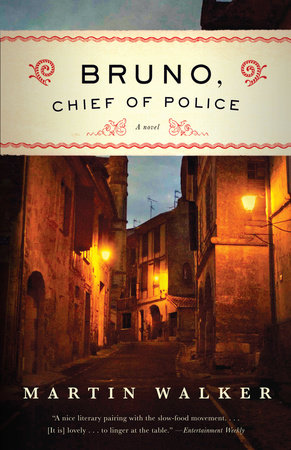
Author Martin Walker introduces readers to Bruno in the first of the Chief of Police series. The title character, whose formal name is Benoit Courreges, is a former soldier who’s drawn to the peaceful existence surrounding the small village of St. Denis in Southern France. This doesn’t mean his life is boring.
The brutal murder of an elderly North African, a veteran who fought with the French army, draws national attention. The novel addresses racism, victims of war, Nazis and more.
Although Bruno is not the point man in a murder investigation he contributes a lot when it comes to solving the case. Initially, two young people, including the son of the town doctor, are arrested as suspects. Bruno is certain their only crime involves drugs.
While working behind the scenes with the national police, Bruno enjoys his pastoral lifestyle living in a restored cottage in the country with his hunting dog, playing tennis and helping the locals stay one step ahead of the EU inspectors. He’s respected, intelligent and knows good wine when it crosses his lips.
Walker’s descriptions of the landscape, townspeople, French food and wine are enticing on their own. The murder investigation is almost secondary. Three women attract his attention, which creates another mystery wondering which one will ultimately win his affections.
The narrative is sweet, at times humorous and engaging without being saccharine. Bruno is a likeable, credible character full of common sense and a sharp mind. Identifying the murderer was logical without being predictable.
Bruno: Chief of Police
Four Bookmarks
Vintage Books, 2008
273 pages
In a small French village in 1714, on the brink of being forced into marriage, Addie LaRue makes a pact with the devil: to live her life without limits with the caveat that she determines when she’ll finally relinquish her soul. The result is a story spanning centuries, with historic events referred to only in passing.
Instead, V.E. Schwab’s The Invisible Life of Addie LaRue highlights Addie’s evolution from a young woman alone who must fend for herself to her realization that no one remembers her from day to day, often hour to hour. Thus, she steals not only to survive, but to thrive – even if she isn’t particularly happy. She never ages, yet she’s lived 400 hundred.
Luc, aka Lucifer, checks in with Addie from time to time to see if she’s ready to finally surrender to him. She dreads these meetings; yet at times they’re also what save her (long) life since he’s the one who transports her from place to another.
Fast forward to New York City 2014 when she meets Henry, a bookseller, who remembers Addie the next day, the day after and many days to come. Thus begins a relationship that endures beyond the one-night stands she’d previously experienced.
Yet, there’s a twist. Henry’s story begins in 2013. (I’ll leave it at that rather than include any spoilers.)
Surprisingly, the narrative isn’t far- fetched. Rather, it’s an engaging love story, a story of regrets, loss and an acknowledgement of what it means to be alive.
The Invisible Life of Addie LaRue
Tom Doherty Associates Books, 2020
444 pages
Four and a-half Bookmarks
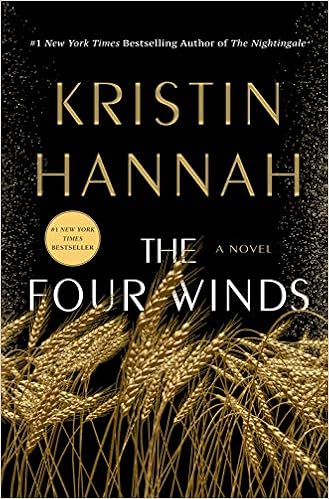
Although I’ve only read a few of Kristen Hannah novels, it’s clear she does her homework. This is true whether the novel’s setting is France during World War II, Leningrad or the Pacific Northwest; her writing evokes a strong sense of time and place. The Four Winds, set in the 1930s Dust Bowl era, is no exception. Hannah’s work also features strong, independent women; here Elsa Wolcott follows the pattern.
At 25 Elsa is considered past her prime as a marriage candidate. When she meets Rafe Martinelli, seven years her junior, her life changes. With no intention of a marrying Elsa, Rafe has no choice when she becomes pregnant.
By the 1930s, Elsa has settled in on the Martinelli farm, which in Northern Texas does not escape the devastation of the drought and dust storms that wreaked havoc across the Great Plains. Rafe abandons Elsa, their two children and his parents. Eventually, Elsa makes the trek to California, where word has it life is better.
Hannah’s vivid descriptions of the poverty, prejudice and injustices faced by the flood of migrants could easily, and unfortunately, be applied today. Elsa and her children aren’t immune to the incivilities, but the family’s relationships grow stronger in its struggle to find a better life.
The weakest element of the narrative is the insertion of efforts by union organizer Jack Valen. He comes across as the hero the family, and all farm workers, need. Yet, in some ways this negates Elsa’s intelligence and inner strength.
The Four Winds
Four Bookmarks
St. Martin’s Press, 2021
454 pages
Heather McGhee is an economist and social policy advocate. As former president of Demos, a think tank, she helped draft legislation, was a regular on news programs, has a law degree and chairs the board of Color of Change, an online racial justice organization. To say she was the right person to write The Sum of Us is an understatement.
McGhee’s premise is racism doesn’t only impact people of color, but also affects (financially and emotionally) whites. She traveled across the country interviewing people who have lost their homes, opportunities for better jobs, health care and been denied better education. Not everyone she interviewed was Black.
The issues are rooted in politics, greed and perception. She writes of a once-booming mill town in Maine, where Somali and other African nation immigrants now live. Local politicians claim their arrival accounts for lost jobs; yet, this occurred long before. Rather, they contribute to the economy and culture of the community. Through their experiences, McGhee tells of individuals of different races reaching out to one another and benefitting from the effort.
The chapters address a range of topics: Racism Drained the Pool; The Same Sky and The Solidarity Dividend, among others. The latter is an example of one of the many beauties of this work; McGhee not only identifies the issues; she offers solutions. If only people were willing to apply them. Her strong belief is based on people working together rather than at odds. Of course, she acknowledges this can’t/won’t happen overnight.
The Sum of Us: What Racism costs Everyone and How We Can Prosper Together
Four-and-a-half Bookmarks
One World, 2021
415 pages (includes Notes and Index)
Of Women and Salt by Gabriela Garcia is a novel I wanted to fall in love with. Unfortunately, despite it having so many elements I’m drawn to, that didn’t happen.
With the exception of a Mexican immigrant and her young daughter, Garcia’s debut work focuses on the women in a Cuban family, several generations removed. Immigration, abuse, mother/daughter relationships, addiction, miscommunication and loss are brought together through glimpses into each woman’s life. The result is a disjointed narrative.
Loss is the most dominant thread, beginning with Maria Isabel in a cigar-rolling company in rural Cuba in 1866. As the only female roller, hers was the most compelling story. To keep the workers engage, a man read either from a novel or newspaper until war made it impossible to continue.
The next chapter is a leap to Miami 2014, where Jeanette, Maria Isabel’s great-great granddaughter is a grown woman and substance abuser. She’s a much less engaging character; yes she makes poor choices, but more is needed than illustrations of her bad decisions. Although she briefly helps the young daughter of the Mexican neighbor who’s apprehended by ICE, there’s little else appealing about her.
The characters need to be fully developed. It’s as if they’re faded photos without any nuance. While this is a work of fiction, the experiences the women endure are important because, unfortunately, they’re not unique. The impact would be greater if, instead of multiple situations, more details were limited to only a few.
Of Women and Salt
Two-and-a-half bookmarks
Flatiron Books, 2021
207 pages

What happens when a close-knit neighborhood loses a cherished resident – especially when it’s a five-year-old child killed in an accident?
What happens now without Aiden? Of course, we carry on; certainly we offer support to his parents – and each other. But my hope is we’ll also share memories with one another and continue to appreciate where we live – and why.
Our community is more than spectacular views, shared streets and intermittent contact. The few we don’t know by name, we recognize and acknowledge with a wave or smile. We know at least a little about one another, often through conversations in the street. Since the first week of June, however, those talks have focused on our grief.
Aiden was a child many of us have known since his birth. Yet, our feelings were more than the collective enjoyment of watching him grow. We embraced his curiosity, smile, friendliness and general joie de vivre. Aiden arrived in yards and driveways ready to engage. Sometimes it was a simple inquiry as to what we were doing; other times he told about recent adventures or to show a newly-unearthed treasure. Topics were never in short supply. He made everyone feel special, instead of the other way around.
His funeral was attended by many from far beyond the boundaries of our ‘hood. Most impressive was the number from down our street and around the corners who gathered to mourn the loss of what might have been, while relishing what he brought to our lives.
The Night Portrait by Laura Morelli has four narrators: two from the Renaissance and two associated with World War II. The result is a gripping story about the importance of art and its redemptive qualities — both as masterpieces are created and later rescued.
Edith is a German art restorer for a museum in Munich at the outbreak of the war. She’s ordered to catalog the artwork confiscated in Poland by the Nazis. Most of the pieces are destined for a museum Hitler plans to build, but high ranking officers keep some for their own private collections. This includes a painting by Leonardo Da Vinci.
The painting is the link to the Renaissance. Cecilia Gallerani recounts her life as the mistress of the lord of Milan in the late 1400s; DaVinci, the other narrator in this time period, is commissioned to paint her portrait.
In 1944-45, the war is nearing its end and there’s work to be done. Dominic, an Army GI, is part of a squad charged with guarding a small group of the Monuments Men, the allied troops trying to locate the hidden, stolen art.
The connections among the four narrators works well. Each chapter/speaker is clearly identified, not only by name and year, but by distinctions in voice, descriptions of the era.
Morelli addresses several issues, including Edith’s sense of guilt, Dominic’s discovery of purpose, Cecilia’s realization she will never be the lady of the manor, and DaVinci’s efforts to establish himself not only as a painter, but an inventor.
The Night Portrait
Four Bookmarks
William Morrow, 2020
455 pages
Shuggie Bain, the title character of Douglas Stuart’s debut novel, is heartbreaking. But, don’t avoid it. The characters, notably Shuggie and his mother Agnes, are vividly portrayed with hopes and flaws.
The story is bookended by 1992 when Shuggie is a young man. By contrast, most of the narrative occurs in the 1980s. The seamy parts of Glasgow are brought to life, complete with Scottish dialect, out-of-work miners, alcoholics and low-rent housing. The setting is as much a character as Shuggie and others.
Agnes is an alcoholic whose efforts at sobriety are rare. She left her first husband for Shuggie’s father, who in turn, leaves her. Her two older children find ways to escape the toxic home life, so Shuggie remains to care for his mother while dealing with her neglect. He’s optimistic she’ll change and be a proper parent. He also believes if this happens, he’ll become a normal boy.
Shuggie is effeminate, so he’s bullied, but never understands the insults nor reasons he’s taunted. In this regard, Douglas has crafted a beautiful character whose innocence is his downfall. When coupled with his devotion to Agnes as her caregiver, he’s not left with much of a childhood.
Because of her beauty, Agnes believes she deserves more in life but does nothing to attain it. Although it’s evident to everyone around her, she refuses to acknowledge her alcoholism. She’s also certain the right man will come along to save her. In fact, he’s been at her side all his life.
Shuggie Bain
Four Bookmarks
Grove Press, 2020
430 pages
As disturbing as The Push is by Ashley Audrain, it’s nearly impossible to put down. It’s not exactly like watching a disaster unfold before your eyes, but it’s close.
Blythe Connor’s mother was not an exemplary maternal role model; although they never met, neither was Blythe’s grandmother. Audrain offers some background about these women, which helps explains the younger woman’s anxiety about becoming a mother herself. The pressure is magnified by her husband, Fox, who’s certain she’ll be a Mother of the Year candidate.
After their daughter, Violet, is born, Fox is the parent of choice; Mother and daughter never bond. Initially, Blythe is certain it’s her fault; however, as Violet gets older, Blythe becomes convinced she’s not entirely to blame. Something isn’t right with Violet, and Fox refuses to acknowledge it.
Blythe and Fox’s marriage falls apart, something revealed early in the novel. Audrain uses a direct address approach to Fox for Blythe to explain her side of the story. She recounts falling in love with him in college, the early days of their marriage, and Violet’s birth which marks the beginning of problems. She tries to rationalize the issues with Violet are only in her imagination. When the couple has a second child, Blythe is surprised by her deep feelings for him.
Audrain has crafted a profound, often dark, family portrait. Blythe is a sympathetic character, but the haunting question is whether or not she’s a reliable narrator. The result is compelling.
The Push
Four-and-a-half Bookmarks
Pamela Dorman Books, 2021
307 pages