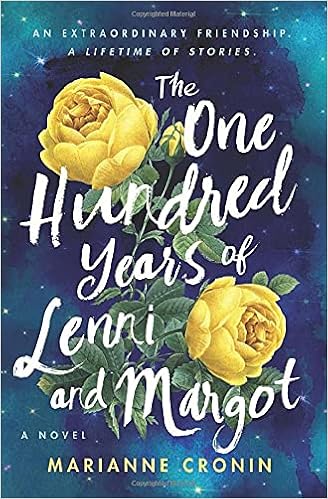
The 100 Years of Lenni and Margot by Marianne Cronin is about the sustaining and enduring power of friendship. Lenni is the 17-year-old narrator hospitalized with “life-limiting” cancer – usually referred to as terminal. She meets 83-year-old Margot and an immediate bond is formed. Between them is a 100-year-old life.
Lenni’s acerbic, insightful humor is beyond her age. This isn’t a criticism; it makes sense given her situation. She’s a no-nonsense teen who doesn’t get to live the life of a healthy teenager. She still manages to sling attitude, though. Yet, she makes the most of her situation: she’s curious, so she meets with the hospital chaplain; she creative, so she has the idea to collaborate with Margot to share their life stories through art. Each painting is associated with a particular and significant situation, which they reveal to each other. The result, besides bringing them closer, is a compelling narrative rich with life’s joys and sorrows.
Lenni’s parents never visit, which is eventually explained. Whether intentional or not, Lenni creates her own family within the hospital. Father Arthur, New Nurse , Paul the Porter, the Temp and Pippa the art teacher are those with whom she has meaningful relationships.
Cronin’s characters are vividly portrayed. The novel is both heartwarming and heart wrenching. After all, the word terminal is stated on page one. The friendship with Margot transcends age. Although Lenni will never have Margot’s experiences, she’s able to appreciate what life does offer, and everyone is enriched by knowing Lenni.
The One Hundred Years of Lenni and Margot Four+ Bookmarks HarperCollins, 2021 326 pages, plus Reading Group Guide and Author Interview
I enjoy reading books about chefs probably because I like food. I’ve never been to Eric Ripert’s Le Bernadin, a three star Michelin rated New York City restaurant, but I have heard of him.
His memoir, 32 Yolks, recounts his childhood in southern France, his first encounters with fine dining and his journey to becoming a renowned chef. Unfortunately, the account lacks personality. It’s bland, More flavoring is needed in the form of humor and descriptions of food lack vibrancy.
As a child, and later young adult, Ripert was happiest when cooking was part of the scene, whether it was in his mother’s, grandmothers’ or a friend’s kitchen. His parents divorced when he was six and his father died soon afterward. In an effort to alleviate her son’s sadness, Ripert’s mother took him to a dinner at an exclusive restaurant. This led to a long-standing friendship with the chef/owner.
Ripert attended culinary school, which he explained, didn’t fully prepare him for what actually takes place in a restaurant kitchen. He had to learn that the hard way.
The title comes from one of his first kitchen duties: to break 32 eggs for a hollandaise sauce. An undertone of self-deprecation comes through in Ripert’s first professional kitchen experiences, yet it rings false. Hard knocks are a way of life, but his memories of working on the line are soft.
Still, learning about how people get to where they are today is of interest.
32 Yolks: From My Mother’s Table to Working the Line
Three Bookmarks
Random House, 2016
247 pages
Cloud Cuckoo Land may be the looniest book title I’ve heard of. Nonetheless, it’s Anthony Doerr’s most recent, aptly-named novel. This epic work traverses centuries and locales; it’s about five children, books and the importance of libraries in their lives and throughout time.
Anna is an orphan in Constantinople; Omeir is a village boy in the same era. Zeno and Seymour are from Idaho living in the 2000s; and Konstance lives on an interstellar ship. Some them converge, and they’re not the ones readers might expect.
Libraries could, collectively, be a sixth character. They serve as gathering places for four of the five to learn about their individual worlds. A Greek book ties everything together. It’s the namesake of this narrative and a story within the main story.
Each section expands on the ancient tale of Cloud Cuckoo Land wherein a man is turned into an ass. His efforts to regain his human self result in a far-fetched adventure with a potent moral.
At 600+pages, some might consider this to be a daunting undertaking. Yet, it’s worth reading every word. The characters age and not all for the better; the paths they pursue, often driven by information gleaned from their respective library visits or exposure to the Greek story, are ones easily imaginable despite the different settings.
Doerr has crafted a rich and vivid narrative through empathy, tension and curiosity. It’s a given the different eras and places will make sense. How it occurs is captivating.
Cloud Cuckoo Land
Five Bookmarks
Scribner, 2021
626 pages
Lucy Foley’s The Guest List is an easy-to-read mystery without having to worry about anything lurking behind closed doors. There’s plenty of tension but the short chapters and the focus on a handful of characters are balanced with the eery remote Irish island locale; all contribute to creating the scene for not only a whodunit, but to whom?
Mostly, the plot moves back forth between the day before and day of Jules and Will’s wedding; at times it is more specific: the morning of, the night of, now and the next day. The narrative is told from several perspectives: Jules; the bridesmaid; the best man; a plus one; and the wedding planner.
The first chapter, not ascribed to any particular character, sets the scene of a large, posh wedding reception with a powerful storm raging outside multiple tents. When the lights go out no one is overly concerned, but what evokes chills is a terrifying scream.
Foley doesn’t return to the source of the scream until more than 50 pages later. In the interim, the main characters are introduced – broadly at first before they become more real making it possible to develop attitudes and feelings toward each one. What surfaces in the character developments are jealousies, insecurities and, not surprisingly, several motives for murder.
Interspersed among the characters’ back stories are descriptions of the wedding, the island and storm, and, most significantly, what interrupted the festivities. This is perhaps the least engrossing element. Foley provides plenty of whys, which leaves the question of who‘s the victim since there so many possibilities.
The Guest List
Four Bookmarks
HarperCollins, 2020
313 Pages
Nella Rogers is proud of herself for getting her foot in the door of a New York City publishing company. She assumes her presence alone should cause people to think about race. Yet, in the two years since her hiring, she’s made little effort in changing the office culture. She is the only woman of color until Hazel arrives; suddenly Hazel is seen and heard where Nella never was before.
Zakiya Dalila Harris’s The Other Black Girl addresses several topics and formats in one swift effort. First is the issue of race, but it is from the Black perspective. What initially appears to be a narrative about the lives of two Black women with different life experiences evolves into espionage; it becomes a mystery of sorts.
Nella grew up in a suburb among few Blacks; Hazel’s background is much different: she grew up in Harlem. Hazel immediately ingratiates herself among the office staff, including Nella’s boss. A book under consideration for publication is troublesome to Nella because she views it as racist, but is reluctant to say so. When Hazel encourages her to speak up, things begin to change, but not as expected.
The novel includes two time periods: 1983 and 2018. The connection between the two isn’t fully addressed until the end. This, along with several threatening notes left at Nella’s desk, creates tension and intrigue. Inconsistencies in some of Hazel’s story cause Nella to suspect her colleague and make the reader wonder which one is the other black girl?
The Other Black Girl
Four Bookmarks
Atria Books, 2021
357 pages
I’m not only a fan of Swedish mysteries, I also have affinity for the Scandinavian country thanks to hosting an exchange student years ago. While that relationship remains strong, it has no connection to the often dark tales involving murder and deceit.
Knock Knock by Anders Roslund reintroduces readers to criminal detective Ewert Grens. Seventeen years earlier Grens found a five-year-old girl as the lone survivor of a mass shooting in the family home that included her parents and two siblings.
Now, nearing retirement age, Grens discovers someone has broken into the same house. He’s convinced someone is looking for the girl, long ago given a new name as part of witness protection, and fears her life may be in danger.
A parallel narrative involves Piet Hoffman, a former police informer, whose life and family are threatened. Eventually the two plotlines intersect as several execution-type murders take place, similar to the one Grens investigated all those years ago.
Grens is an ill-tempered loner and long-time widower. That he has a soft side, albeit one rarely seen, is no surprise. By contrast, Hoffman is a devoted family man despite his past. The two are intelligent and complement one another. Their association goes back years to Hoffman’s informant days, but suggesting Grens is pleased to reconnect is far from the truth.
Knock Knock is just the kind of Swedish mystery that hooks me: vivid descriptions of Sweden, in this case Stockholm, a fast-paced narrative and interesting characters with often-imperfect moral codes.
Knock Knock
Four-and-a-half Bookmarks
G.P. Putnam’s Sons, 2021
438 pages
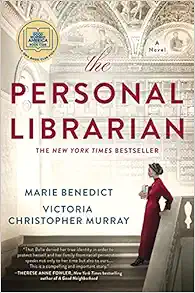
The story of Belle da Costa Greene is important on many levels: her contributions to the art world; her success as a female in the male-dominated society of the early 1900s; and achieving the above as a woman of color.
Marie Benedict and Victoria Christopher Murray have crafted a novel based on da Costa Greene, nee Belle Marion Greener the daughter of Black parents. Their fair skin tones were passed along to their children allowing them to pass as Caucasians. The deceit led to the Greeners’ divorce, but allowed Belle and her siblings to live free of racial prejudices.
J.P. Morgan hired Belle as his personal librarian to curate rare books, art, manuscripts and more. Belle proved herself to be a formidable negotiator at auctions when she was often the only woman in the room. The J. Pierpont Morgan Library in New York City holds invaluable collections thanks to Belle’s acquisitions. She was also instrumental in ensuring the library be a public one.
The fast-paced narrative is taut with tension. The importance of Belle hiding her identity is paramount as her prominence among the rich and powerful grows. Although her role as personal librarian allowed her to provide well for her mother and siblings, this was much more than a job to Belle. It was her passion.
The authors allude to speculation that Belle and Morgan had more than a professional relationship; but that remains a mystery. Nonetheless, the shared passion for the one-of-a-kind works was the mainstay of their bond.
The Personal Librarian
Four+ Bookmarks
Berkley, 2021
341 pages (includes author’s notes and acknowledgements)
Ordinary Grace by William Kent Krueger, a coming-of-age story, center, around three mysterious deaths.
Forty years after the fact, Frank Drum recounts the summer he was 13. His musically-gifted older sister is getting ready for Julliard. His kid brother, more often than not, is Frank’s shadow. His father is a minister and his mother resents not having the life she imagined.
It’s early 1960s, school’s out and attending services where his father preaches on Sundays is the only real routine Frank has. Otherwise, it’s a halcyon, small town existence. That is until a young boy is found dead on railroad tracks; Frank discovers a vagrant’s body near the river and another death strikes closer to home.
The author blends vivid imagery of summer’s joys with a family’s grief. Frank is no-nonsense kid who’s sometimes insightful and at other times naïve. He’s protective of his brother whose shyness stems from his self-conscious stuttering. Such characterization is one of the novel’s strengths. Besides the close relationship with his dad, Frank bonds with Gus, who served in the war with his dad. When Frank isn’t sure about sharing concerns with his dad, he turns to Gus.
It’s unusual for a novel to feature not just one but two positive male role models; although at times, Gus’s behavior does raise eyebrows. The females are secondary characters even though their talents and interests are well-defined, they’re peripheral in Frank’s world.
The take-away, though, is the power of forgiveness and acceptance in the face of sorrow.
Ordinary Grace
Four Bookmarks
Atria Books 2013
307 pages
Miss Benson’s Beetle, by Rachel Joyce, is meant to be a charming book, but falls short. It’s predictable and the characters are caricatures.
Margery Benson’s life is a sorrowful one. Her father commits suicide when she’s a young girl and most of her life is spent living with her depressed mother and dour aunts. Before his death, however, her father showed her a book about bugs, which created an interest in beetles, in particular.
As a middle-aged woman whose life is passing her by, she resolves to find the mythic golden beetle of New Caledonia. Before setting off on this venture, Margery decides an assistant is required. She opts for Enid Pretty, a woman she’s never met, whose correspondence suggests dyslexia, in favor of a Mr. Mundic with post-traumatic stress disorder (although that wasn’t identified following World War II).
Enid is the opposite of Margery in style, personality and intellect. Enid, whose lively demeanor is off-putting to her employer, does help keep Margery on track. The two set off on their adventure and, unbeknownst to them, are followed by the rejected Mundic. Actually, it’s outright stalking. His inclusion in the plot does little to help move it forward.
In their travels, the women overcome numerous obstacles and forge a bond. Their search for the elusive beetle is secondary. While their eventual friendship is unsurprising, it is, nonetheless – at times – endearing. Perhaps most enjoyable is the author’s inclusion of an “interview” with the characters at the end of the book.
Miss Benson’s Beetle
The Dial Press, 2020
353 pages (includes Reader’s Guide)
Three Bookmarks
The New York Times Cooking No-Recipes Cookbook might sound like an oxymoron, but it promotes a fun approach to preparing food. Sam Sifton who founded the Times Cooking section offers non-recipes with the barest suggestions for ingredients and the loosest of instructions.
Yet, even with unembellished directions, Sifton’s creative ideas, humor and confidence inspire readers’ abilities to rise to the challenge. Not wanting to let him down, I tried several no-recipes with, what I consider, great success.
Main dishes, ranging from tacos to fish, pasta to chowder are among the (non)recipes included. For example, the Curry Beef begins includes such vague guidelines as “Chop a bunch of garlic and ginger and onion into the finest sort of dice…” Who needs exacts amount, it’s all about taste. It’s clear if you’re not a fan of any of these three items, skip or reduce them. It’s that easy.
Or how about this for the Crispy Pork Sandwiches with Spicy Mayo and Scallions: “Get some pork belly if you can or some fatty pork chops if you can’t.” that’s precise, hah!
Among my favorites, though, is Pasta with Sausage and Parm. With orecchiette and you can probably guess the other ingredients, although you might not think about including sage. Sifton wraps up his directive for this with “ … grate a lot of parmesan over the top, and let me know how it goes.”
On the page featuring Terriyaki Salmon with Mixed Greens, Sifton writes, “Cooking’s not difficult. It just takes practice.”
The New York Times Cooking No Recipes Cookbook
Five Bookmarks
Ten Speed Press, 2021
256 pages