Archive for the ‘Reviews’ Category

The adage that opposites attract is evident in Crooked Heart by Lissa Evans. Noel and Vera aren’t exactly drawn together as much as they are forced upon each other: Noel is an orphaned 10-year-old evacuee and Vera is a middle-aged woman who reluctantly agrees to care for him.
Before they meet, Noel has managed to fly under the radar in London with his elderly Godmother, Mattie, with whom he’s been living since the death of his parents. Both have a disdain for authority and are content in their relative isolation. As World War II becomes more imminent, Mattie’s health deteriorates and England increasingly is in Germany’s crosshairs.
Noel is unusual, and Vera is initially convinced he is not very bright. Today he’d be considered a nerd; certainly his intellect and lack of social skills don’t make him a popular child. Vera is widowed and trying to make ends meet, although her efforts aren’t on the up and up. Soon, Noel offers suggestions to improve upon Vera’s scams and their efforts prove to be quite successful, if not quite moral.
Among Noel and Vera’s prey is Mrs. Gifford who unwittingly (and repeatedly) donates to whatever charity the two have concocted. However, they don’t just take her money, they spend time getting to know her. Eventually, Noel becomes protective of the old woman.
Evans’ writing style is subtle as the relationships evolve. Attitudes begin to shift and bonds are created. The couple begins to accept each other’s flaws while recognizing their own.
Crooked Heart
Four Bookmarks
HarperCollins, 2015
282 pages

When author Stieg Larsson died 11 years ago, it appeared to be the death knell for the Millennium Series featuring Swedish journalist Mikael Blomkvist and heroic bad girl Lisbeth Salander. Thanks to David Lagercrantz, the demise of the fictional characters was greatly exaggerated.
Lagercrantz has written the fourth installment, The Girl in the Spider’s Web — doing so in a voice and style remarkably similar to Larsson’s. This is a good thing.
The two protagonists have moved on with their lives; Blomkvist still writes for Millennium magazine and Salander continues to hack computers. They have not stayed in touch with one another. Then, Blomkvist receives a call in the middle of the night from a source who has been in contact with a hacker whose description can only fit Salander. This thinnest of threads ultimately expands to hold the narrative together. Blomkvist’s source and Salander’s work for him are linked to international cyber-spying, old family vendettas and the pair’s respect and faith in one another.
Many characters introduced by Larsson have new-found life thanks to Lagercrantz. He follows a similar pattern of simultaneous stories occurring within a single chapter until they ultimately come together.
Blomkvist’s source is murdered, the NSA is hacked and a child autistic savant not only has the missing piece to the puzzle that brings these events together, but he brings out an unlikely, albeit extremely slight, maternal side in Salander.
There’s intrigue, righting wrongs and descriptions of Stockholm that make it seem as if Lagercrantz is channeling Larsson.
The Girl in the Spider’s Web
Four Bookmarks
Alfred A. Knopf, 2015
400 pages

Okay, okay. I know donuts offer little to no redeeming value other than that they’re palate pleasing. Besides, it’s not like eat I them often. When I do, my go-to choice is of the chocolate frosted raised cake variety. That is until I discovered Amy’s Donuts. This is the warehouse of the fried pastry treats; not because it’s large and impersonal, rather for the sheer number of creative possibilities concocted on the premises.
Amy’s is actually an old fast-food establishment southeast of downtown Colorado Springs. It’s far enough away from my house and daily driving routines that I don’t have to worry – too much. My waist line, and wallet, would be in trouble otherwise.
I was glad to have people ahead of us in line to have time to peruse the options, of which there were too many to count. We narrowed it down to half a dozen with the caveat that we’d share our choices with each other (there are only two of us). Thus, it was like getting a dozen without all the guilt.

We selected Crème Brulee, Bronco Blueberry, White Pearls, Chocolate with Almonds, Orange Creamsicle and the Elvis – featuring a banana, peanut butter and bacon topping. Oh yeah! I liked them all. It’s not just the frostings and garnishes that set Amy’s off from the pack. The raised cakes are light and airy.
Our selections barely made in a dent in the display case; there were still dozens and dozens from which to choose!
Amy’s Donuts
Four Plates
2704 E. Fountain Blvd.
Colorado Springs, Colo.

I am humbled and surprised when I run into someone who tells me my blog is enjoyable and a good place to learn about books (and restaurants when I write about them). When I started The Blue Page Special nearly three years ago, that’s what I hoped for. What’s even better is when one of my readers shares a book title with me, introducing me to a new author or genre. Such is the case with The Rosie Project by Graeme Simsion.
Simsion presents Don Tillman: a nerd. This renowned genetics professor at a Melbourne, Australia, university has created a life so structured that all of his activities are scheduled to the minute. He finds the slightest deviation unnerving. This, along with his intelligence and inclination to view the world through literal eyes, makes him socially inept.
Nonetheless, he decides it’s time to find a life partner and creates the Wife Project, complete with a multi-point questionnaire which has no place for romance. That is until Rosie Jarman, a graduate student in psychology, unwittingly becomes a candidate in the project. Don quickly dismisses her as a viable contender because of what he perceives as her many (human) faults.
The novel is predictable which might warrant a spoiler alert, but I encourage reading it anyway. Don’s voice and personality quirks are well-developed — complete with a few laugh-out-loud moments. Also, Rosie’s criticism that the Wife Project objectifies women is unarguable. Yet, the premise results in a fun read where transformations occur on several, some even surprising, levels.
The Rosie Project
Four Bookmarks
Simon & Schuster, 2013
292 pages

Coming of age can be a mystery, and Karen Brown has combined the two genres in The Longings of Wayward Girls.
The story begins with a 1974 news clipping about the abduction of a young girl, Laura Loomis, and moves back and forth between 1979 and the early 2000s. Laura remains a mystery throughout, while other secrets surface its place. The narrative instead focuses on Sadie Watkins as a creative, energetic young teenager and later as a married mother of two. It hardly seems possible that the two characters are the same; the adult Sadie lacks imagination. That is, until Ray Filey returns to town.
Set in a rural New England community, Brown’s descriptions of the landscape and close-knit neighborhood are intriguing and easy to visualize. The novel is also evocative of a time when parents thought nothing of letting their children roam nearby woods and streets. Or, when parents (in this case, mostly mothers) chain-smoked and drank their way through summer afternoons and evenings.
Sadie teeters on the edge of being a mean girl with childhood friend, Betty, following her lead. Ray is a few years older than Sadie. As a girl she was aware of his presence, although he was never part of her circle of friends. His interest in her as a woman is intriguing, but Sadie’s response to his appearance doesn’t entirely make sense, nor do her actions. However, Brown’s merging of the two themes does offersenough interest to see the novel to its conclusion.
The Longings of Wayward Girls
Three-and-a-half Bookmarks
Washington Square Press, 2013
337 pages
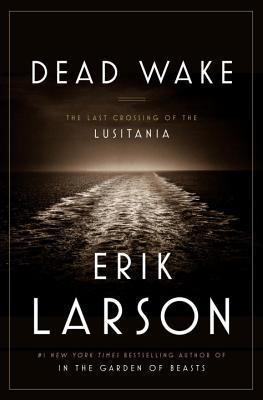
It takes Erik Larson about 100 pages to finally let the Lusitania set sail from New York City in May 1915. Dead Wake, his account of the doomed luxury liner, is exhaustive in detail and detached in its descriptions of the events leading to its historic sinking. No need for a spoiler alert here; many consider the German sinking of the Lusitania is what ultimately led the United States to join the British and French allies in World War I.
Larson’s research on the subject is thorough (there are more than 50 pages of notes). He addresses everything from the backgrounds of the ships’ captains involved, to the weather leading up to the point the ship left sight of land, to how the dining room was decorated for first class passengers. There’s more: brief bios about passengers, history of submarines, how Cunard came to name its fleet, and even Wilson’s love life as he strove to maintain neutrality for the U.S. even as events continued to escalate in Europe.
While it is heartbreaking to know that a record number of families with children were on board, the concise elements Larson provides about the passengers makes it difficult to have a true sense of their characters. This does not mean the event was less tragic, just that the book offers little except a historic narrative.
As with any tragedy, fingers pointing blame are plentiful; Larson offers numerous what ifs, which, of course, do nothing to change the course of history.
Dead Wake
Not-quite-three Bookmarks
Crown Publishers, 2015
430 pages (including notes and index)

In The Sunlit Night by Rebecca Dinerstein, the never-setting sun has such a significant role that it’s practically a character alongside almost-18-year-old Yasha and 21-year-old Frances. These are not star-crossed lovers; in fact, they’re quite lucky. Their story begins with the two in New York City. They don’t meet until circumstances put them on a small island in the Norwegian Sea near the Arctic Circle.
Initially, the chapters alternate between Frances and Yasha’s voices. Eventually, they merge into one. Dinerstein evokes a strong sense of place in the isolated far north as the two find each other. As with any love story, there are obstacles including dysfunctional families, complicated backstories and quirky sub-characters.
Frances leaves Manhattan for a Norwegian artist’s community. Yasha arrives soon after to fulfill his father’s dream. Perhaps the most engaging part of the narrative is the life Yasha and his father have running their bakery in Brighton Beach. This is something they’ve done since immigrating from Russia 10 years earlier. Yasha’s mother, Olyana, was to join them; years pass and the family is never reunited.
Still, Olyana is among those in the quirky classification (it’s actually a long list). She’s an important part of the story, not only because she’s the mother of a protagonist but because of her lengthy absence as such. Meanwhile, Frances has family issues of her own. Among other things, her eccentric parents are separating.
Dinerstein injects humor with captivating prose to create something more than a tale of young love.
The Sunlit Night
Not-quite-four Bookmarks
Bloomsbury, 2015
249 pages

Although it’s only been in the hands of the general public for little more than a month, the reviews for Harper Lee’s Go Set a Watchman have been mixed. Now I see why, it’s difficult to know whether this is because long-standing images have been shattered, if the story is less engaging or if the writing simply isn’t as strong as To Kill a Mockingbird: an integral part of American culture since its publication 55 years ago. The 1961 Pulitzer Prize winning novel is still taught in classrooms, and Gregory Peck’s portrayal of Atticus Finch in the movie adaptation remains iconic.
Jean Louise Finch, aka Scout, returns to Maycomb, Ala., from New York City. Atticus is ailing and many of the familiar characters from Mockingbird reappear to remind Scout, and readers, how some things change and some never do.
Scout’s memories are mixed with her current day events as she begins to see her hometown and, especially, her father in a new, unflattering light.
My take is that the story, albeit worth reading, is less engrossing due to lackluster prose. In fact, I found it easy to put down and had to remind myself of its imminent library due date.
Racism and human imperfection are looming themes. Given what’s happening across the country, the former continues needing to be more openly addressed. Perhaps it takes seeing Atticus Finch as a racist, despite his efforts at justification, for us to see the deep-rooted problem. As for the latter, that’s something we just have to accept.
Go Set a Watchman
Three-and-three-quarter-bookmarks
Harper-Collins, 2015
278 pages

Our youngest son recently graduated from Knox College; I’d been vaguely aware of it years before because of Sixteen Pleasures, a book I enjoyed for its setting (Florence, Italy) and strong female narrator. This same son gave me an autographed copy of Hellenga’s most recent work, The Confessions of Frances Godwin, which had been languishing on my nightstand far too long.
The setting is mostly Galesburg, Ill., with Knox figuring prominently; other locales include Milwaukee, Rome and Verona. With Frances, Hellenga introduces another female narrator. I admit I’m intrigued by his ability to create such true female voices.
It’s 2006 and Frances has retired from a career as a high school Latin teacher. At first, the novel appears to be a vehicle for her to reflect on her past because she soon recounts how she met her husband, Paul, a Shakespeare scholar from whom she took classes (at Knox). She tells of their affair, their eventual marriage and life together in Galesburg. They have a daughter, Stella, who as a grown woman appears to make a series of bad choices when it comes to men.
The story is occasionally heavy handed. Consider, Frances’ name: Godwin. Several times, she converses with God, who, among other things, entreats her to go to confession. By this point it’s clear that she does have more than a few things to own up to.
Love and guilt are not unusual companions; for Frances, they’re a large part of who she is.
The Confessions of Frances Godwin
Four Bookmarks
Bloomsbury, 2014
305 pages

We learned about TIGHT in Copenhagen the last night of our vacation and we wanted the momentum of our fun travels to continue. We were initially told to expect a 45-minute wait – maybe longer. We considered going elsewhere. Instead, our fatigue from a full day of sightseeing compelled us to relax on a nearby bench.
It wasn’t long before Willie, our host and server, had a table ready. Although the place was hopping, he gave us his full attention throughout the evening. Unlike other places we’d dined while in Scandinavia, TIGHT was the first where English was the dominate language. The menu reflected a more international range: from foie gras to barbecue ribs.
We started with potato croquettes. These thick cakes of mashed spuds seasoned with green onions, dill and other spices were served with a tangy remoulade. The plating on slabs of black slate was stunning.

Still in the mood for Danish flavors, I chose salmon with new potatoes, asparagus and a green “mojo” sauce drizzled with a balsamic glaze. The fish was cooked to flakey perfection. I cleaned my plate; even Willie commented on this. My husband selected the half-slab of ribs, which were tangy and smoky.

We should have stopped there, but were so intrigued by the Nanaimo Bar that we couldn’t resist the chocolate-coconut-crumb base layered with rich vanilla cream and topped with a layer of crispy chocolate. House-made pecan-maple ice cream further upped the decadence level.

Our last dinner in Copenhagen did not disappoint.
TIGHT
Four-and-a-half Plates
Hyskenstræde 10, 1207 København K







 The Blue Page Special