Archive for the ‘Reviews’ Category
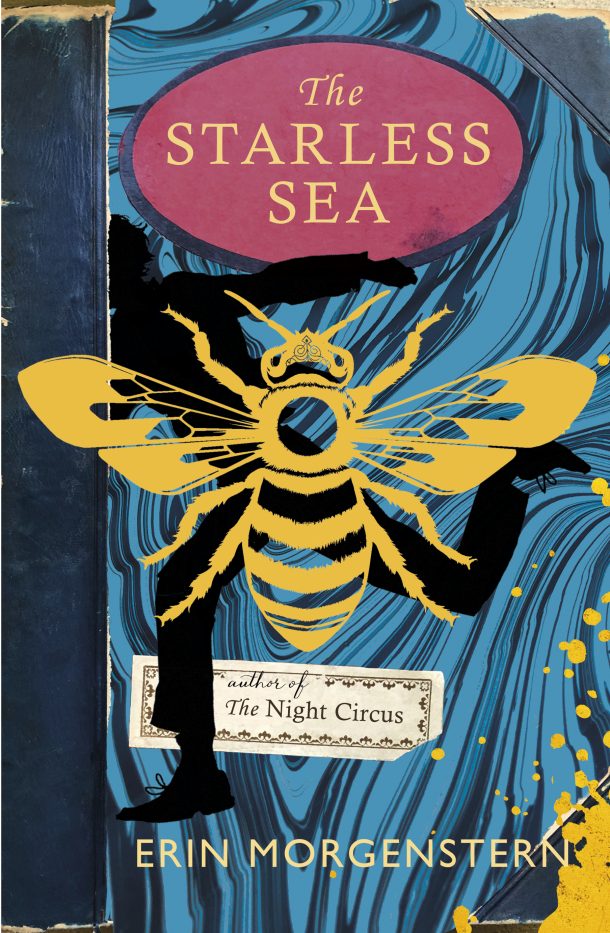
The Starless Sea by Erin Morgenstern is a cross between a fairy tale and a video game, with some magic thrown. This requires the ability to suspend one’s sense of disbelief.
Most chapters begin with the name of Zachary Ezra Rawlins, a graduate student who finds a mysterious, uncatalogued book in his school library. It’s especially baffling since it’s about him. Alternating chapters relate to a particular story within the found book. Confused yet? I’ll back up. A land, beneath ours, contains an ancient library with guardians who protect the books and the stories they contain. Zachary’s efforts to uncover the book’s meaning take him on adventure where bees, cats, doors, books – lots of books – and swords are important symbols.
Morgenstern creates a literary world unlike any other. It’s dependent on imagination and an appreciation of the different realms books take us to when we read. The writing is rich in visual detail, even if, at times, it doesn’t always make sense. This is similar to what Zachary experiences. He encounters multiple choices in his quest; almost as many subplots presented to the reader trying to fit all the pieces together.
Pirates, a sea of honey, searches for lost loves, artists, friends and mysterious passageways also inhabit the novel. The deeper Zachary goes into what is ultimately a search for the starless sea, the less engaging the narrative becomes. Yes, I wanted to know what was going to happen, but at almost 500 pages, it took too long to find out.
The Starless Sea
Three-and-three-quarter bookmarks
Doubleday, 2019
494 pages

Family dynamics, as much as cultural expectations, are at the heart of A Place for Us. Fatima Farheen Mirza’s debut novel follows an Indian-American Muslim family. Years ago, parents Layla and Rafiq left their homes in India to establish a new life in Northern California and raise three children. Their faith determines their lifestyle, much of their social interactions, fashion and appearance.
The story begins the day before Hadia’s wedding. She is the elder sister of Huda and their brother Amar. His presence is both a reason for joy and a cause for concern. He’d been estranged – for reasons which are exhaustively detailed in the subsequent sections/chapters.
Mirza’s narrative moves to the past. First, summarizing Layla and Rafiq’s marriage; then focusing on the children as they grow up. Initially, the focus is on Hadia, but slowly shifts to Amar. Rafiq’s expectations of his daughters are few. Both sisters are obedient, studious and observant of Muslim practices; yet they have dreams and goals beyond what their parents envision.
Amar is intelligent and sensitive, but he struggles in school and questions some Muslim principles. A forbidden romance, a long-troubled relationship with Fariq and more contribute to Amar leaving his family three years prior.
The penultimate chapter returns to the wedding day, which is filled with tension felt by all the characters. In an interesting, and unexpected, change of narrator, the final chapter provides Fariq’s perspective, most notably his love for Amar. Unfortunately, slow pacing and some predictable consequences are the book’s downfall.
A Place for Us
Three Bookmarks
SPJ for Hogarth, 2018
377 pages

A Rule Against Murder is the fourth in Louise Penny’s Inspector Gamache series. I’ve been told to read the canon, comprised of 16, in order. Clearly, I have a ways to go, but what a fun journey to undertake. The problem lies in wanting to pick up the next book immediately after putting down the last.
Armand Gamache is the kind, intelligent, perceptive, chief inspector on vacation with his wife celebrating their anniversary. They are at a luxurious, remote inn where they’ve often stayed. However, this time a death occurs, which isn’t initially clear as accidental or murder, but since he is already on the scene, Gamache oversees the investigation.
Penny writes mysteries, so it’s no surprise there will be something for Gamache and his team to uncover. What’s most engaging is the slow, methodical, yet lyrical, manner the author incorporates to arrive at a possible crime, which isn’t immediate. Instead, the author describes the calm, rustic setting, the inn’s staff, the guests and, most fun of all, the Gamaches’ relationship. The scene unfolds like a travelogue for a get-away to a relaxing resort, complete with vivid, mouthwatering descriptions of the food served.
Also staying at the inn is an extended family, most of whom prove to be as unlikable as Gamache is charming. When a family member is found crushed beneath a newly erected statue commemorating the patriarch, clues are sought to determine the cause. There is no shortage of possible suspects and motives, although deciphering who remains in question.
A Rule Against Murder
Four-and-a-half bookmarks
Minotaur Books, 2008
322 pages

Killers of the Flower Moon: The Osage Murders and the Birth of the FBI is an exhaustive look at a compelling story. Unfortunately, the narrative is bogged down with too many details. While this has all the makings of an excellent series perfect for streaming, as a book it lacks binge-worthiness.
Author David Grann has certainly done his research. He combines two story lines: how the Osage nation in Oklahoma, once among the wealthiest people in the world, lost its fortune; and the early days of the FBI under J. Edgar Hoover.
New to me was the story of the numerous Osage Indians who were murdered as a means of obtaining their oil rights. Grann focuses on the Burkhart family, although many others are mentioned, whose members were either shot or poisoned. Efforts to identify the murderers and press charges were stymied. Evidence was often conveniently misplaced, coroner’s reports were inaccurate and juries in the 1920s were reluctant to convict a white man of murdering an Indian.
Initially, it was believed the death toll rose to 24, which is when the FBI got involved. Grann’s research indicates the number is much higher. Nonetheless, federal agents at Hoover’s directive began an investigation led by Tom White, a former Texas Ranger.
The story deals with double agents, small town politics and grossly unfair treatment of the Osage. American history buffs are sure to find Grann’s work a gripping true-life account. As much as I wanted to be captivated, it didn’t happen for me.
Killers of the Flower Moon: The Osage Murders and the Birth of the FBI
Three bookmarks
Doubleday, 2017
338 pages, including selected bibliography

Usually it’s the first line of a Barbara Kingsolver book that grabs me; it took much longer with Unsheltered. However, what may have been lacking in initial engagement is negated by the lingering thoughts since closing the pages of her newest novel.
This is a two-in-one story about two families living in the same house but separated by two centuries. Aside from the dilapidated structure, at first it seems there is little else in common. Yet, it’s surprising how much they share. Kingsolver methodically reveals the similarities by alternating chapters between the old and the contemporary. Politics, prejudices, meaning of family and beauty of friendship are portrayed in each time frame. And always, another part of the house is falling apart. Neither family has the wherewithal to make the necessary repairs.
Willa Knox is the matriarch whose family has inherited the home. Her counterpart from the previous century is Thatcher Greenwood, a science teacher, who lived with his wife, mother-in-law and spirited younger sister-in-law.
While researching the history of the house, Willa learns about Mary Treat, a 19th century botanist who corresponded with Darwin and other scientists of her day and becomes a friend of Thatcher’s. Treat is another connection between the past and present.
Kingsolver incorporates several techniques such as the parallels among the characters in each era and ending each chapter with a line that serves as the title of next section. These, and other aspects, kept me turning pages – even if not always at a rapid rate.
Unsheltered
Four Bookmarks
Harper, 2018
464 pages

Mary Beth Keane’s Ask Again, Yes is an unconventional love story: familial and romantic. Human tragedy and honest, important contemporary issues are at its heart when the intersecting lives of two neighboring families are forever changed.
Kate Gleeson and Peter Stanhope are born within weeks of each other. They grow up next door to one another in a suburban town, both of their fathers are with the NYPD. Where the Gleeson home is full of activity with Kate and her two older sisters, Peter is an only child whose mother is reclusive and father stays uninvolved. Nonetheless, Peter and Kate are best friends.
Keane has crafted more than what could simply be a boy/girl next door romance. When they’re not quite 14 years old, a near-catastrophic event takes place involving the parents. Its impact is felt for the next four decades. The kids have no contact with one another for years.
Mental health, abandonment and alcoholism all contribute to the characters’ development and propel the story. The narrative is told with a wide-angle lens with changes in perspectives making for multifaceted and engaging storytelling.
The novel has the potential to languish in despair, but instead it resonates with subtle glimpses of hope and moments of real joy. The past is always close to the surface, but Keane makes it clear the future is also on the horizon. It’s less about second chances and more about acknowledging, if not outright appreciating, life’s goodness and finding the wherewithal to take one day at a time.
Ask Again, Yes
Four Bookmarks
Scribner, 2019
390 pages

City of Girls, by Elizabeth Gilbert, is narrated by 89-year-old Vivian Morris reflecting on her life in response to a question posed by Angela, who writes “…I wonder if you might now feel comfortable telling me what you were to my father?”
The short answer is no. The 400-page response is Vivian revealing her history to ultimately explain what he meant to her. Although Vivian knows who Angela is, it’s evident this isn’t a close relationship. In attempting to answer the question regarding her relationship with Angela’s father, Vivian recounts her lively, scarlet past.
Vivian arrives in 1940’s New York City where she’s been banished for tarnishing the family name. She’s failed all of her classes at Vassar. Being sent to live with her bohemian Aunt Peg, who runs a third-rate theatre, is the best thing to ever happen to Vivian.
Vivian lacks an education but is a creative, innovative seamstress and is soon making costumes. Life is good for Vivian until she makes a grave mistake she carries the rest of her life, as does someone else for a completely reason.
After her fall from grace, Vivian briefly returns to her parents’ home before being summoned back to the City by Peg.
Gilbert provides glimpses of the theatre, war effort and beyond as Vivian eventually lives life on her own terms. Although, Angela is frequently addressed throughout the novel, the unexpected connection to Vivian is not revealed until near the end. Herein lies one of the narrative’s many beauties.
City of Girls
Four-and-half bookmarks
Riverhead Books, 2019
470 pages

If Ann Patchett is the author, I know it’s a book I want to read. The Dutch House, her latest, was no exception and I feel rewarded for being a fan.
Danny and Maeve Conroy are siblings living in a massive estate in a Philadelphia suburb with their father, housekeeper and cook. Mrs. Conroy abandoned the family years ago, leaving Danny, who is much younger than his sister, with little to no memory of his mother. Maeve assumed the role of caretaker for her brother. Their emotionally distant father made his money as a real estate developer. When he begins to date and eventually remarries, everyone’s circumstances change.
The novel focuses on the influence of the house on Danny and Maeve’s lives as they go from its well-to-do residents to finding their own place in the world. In fact, the house is an obsession; through the years the pair visit it from a distance while parked on the street.
Patchett’s characters are interesting with quirks and personalities making them come alive in the reader’s mind. She provides their backstories, including one for the house with an unusual history, including how it got its name.
The close relationship between Danny and Maeve drives the narrative through five decades with The Dutch House metaphorically always in view. There’s a one-upon-a-time sense to the novel, complete with an evil stepmother. However, this is a sophisticated, touching look at the importance of a caring family, even if it’s just a family of two.
The Dutch House
Four-and-a-half Bookmarks
HarperCollins, 2019
337 pages

Bad Blood: Secrets and Lies in a Silicon Valley Startup reads like a mystery but is based on fact. John Carreyrou, a reporter for The Wall Street Journal, provides a thorough look at Theranos and its founder Elizabeth Holmes. Fraud and manipulation are the tools Holmes used to convince big name donors to invest in her startup that she boasted would radically change the way blood testing is done in the medical industry.
Holmes is portrayed as an attractive, brilliant Stanford University student who left school to pursue her vision of producing a compact, in-home blood testing device. In her early 20s she managed to create a company valued at more than $9 billion.
Suspense is created through Carreyrou’s extensive research and interviews indicating deceit, poor management and greed. His efforts to convey the truth are nearly thwarted multiple times by Holmes, Sunny Balwani (chief operating officer and Holmes’ boyfriend) and their attorneys. Further roadblocks include well-respected, leaders and business gurus who refused to consider Holmes as anything other than a medical-startup miracle worker. The board included, among others, former Secretary of State George Schultz and Gen. James Mattis, who later served as Secretary of Defense.
Despite the incredulity of many Theranos employees and a lawsuit by a vindictive former neighbor, Holmes was able to secure contracts with Walgreen’s and Safeway to place Theranos products in stores without producing a successful prototype.
Holmes acted on the theory that people believe what they want to believe. True, until they no longer can.
Bad Blood: Secrets and Lies in a Silicon Valley Startup
Four-and-a-half bookmarks
Alfred A. Knopf, 2018
339 pages (includes notes and index)

Rules For Visiting is much more than a guide for would-be guests (and hosts) to follow. Rather, Jessica Francis Kane’s novel is an introspective look at how one moves through life based on the influences family and friends have on that journey.
May Attaway is a 40-year-old, single gardener. She pays more attention to the flora than to most people and situations. She’s observant when it comes to nature, but hasn’t mastered the art of social niceties. She has a few friends, but no one with whom she is in regular contact. It doesn’t occur to her that Leo, her car mechanic and the owner of a local taco shop, could be more than an acquaintance. Nor has she considered a co-worker would be more than a colleague.
When given a bonus at work for four weeks off with pay, May deliberates how to spend the time and ultimately decides to visit the four people she considers friends. Each represents different phases of her life.
The visits are spaced throughout different seasons. Between the trips, May ponders the relationships with her deceased mother, other family members and neighbors. The author deftly reminds the reader of May’s true passion through the many references of plants (including their formal scientific names). She also includes drawings of trees by Edward Carey marking the five sections of the book.
It’s no surprise that May learns much about herself and the importance of friendship in travels, but the process is nonetheless refreshing.
Rules for Visiting
Four Bookmarks
Penguin Press, 2019
287 pages


 The Blue Page Special