Archive for the ‘Books’ Category
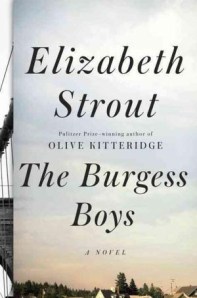
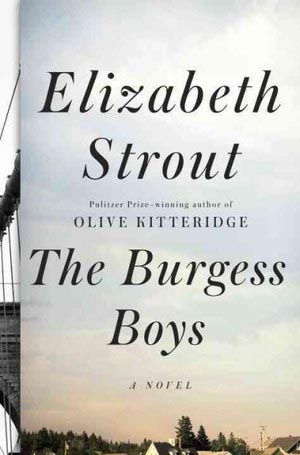
My sons are in their twenties and I still refer to them as the boys. It’s not so unusual, then, that Elizabeth Strout’s latest novel since her Pulitzer Prize-winning Olive Kittridge identifies the 50-something protagonist brothers as The Burgess Boys. Yet, it’s unsettling that they are such poorly matured men.
The backstory of Bob being accidently responsible for his father’s death is almost a character unto itself. This aspect of the novel emerges slowly and evolves, just as everyone else does, providing an especially interesting angle.
Jim is the older brother, the successful, high-achieving one. Bob, on the other hand, is less driven, and far more endearing. He rarely grows weary of Jim’s disparagements toward him, although reading them is tiresome. The boys left their childhood home in Maine years ago to pursue their lives in New York City. Jim is a hot-shot lawyer and Bob, also a lawyer, serves a different clientele. They receive word from their perpetually-unhappy sister (Bob’s twin) in rural Maine that her son is charged with a hate crime. This is the driving narrative, but that backstory is never far behind.
Strout has created a novel full of multiple layers, but not different versions. She provides snapshots of what happens in real life. Some are faded, some in black and white. The characters are heartbreaking in their deception, confusions and naiveté. Unlike Olive Kittridge which was a collection of connections among its characters, The Burgess Boys focuses on a family’s past and present, along with its shortcomings.
The Burgess Boys
Three-and-a-half Bookmarks
Random House, 2013
337 pages
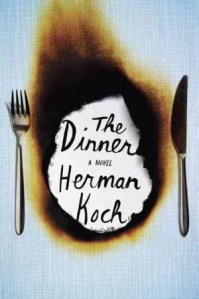
Most parents, whether with young children or those who remember when their kids were small, are familiar with meals being a time for whining and dining. Herman Koch’s The Dinner applies the concept at a very different level.
In Amsterdam, where the story takes place, two couples meet one evening at an upscale restaurant. The novel is narrated by Paul who is unhappy about the location, the companionship and, ultimately, the reason for getting together. Paul whines, a lot. He, with his wife, is joined by his brother and sister-in-law. The dining establishment is pretentious and so is his brother, Serge. Paul’s lack of enthusiasm is understandable, although none of Koch’s characters are worth embracing.
Initially, Paul’s attitude seems justified. Serge comes across as shallow, and the food does sound haughty: “The ‘grapes’ were lying beside a deep-purple piece of lettuce, a full two inches of empty plate away from the actual main course — ‘filet of guinea fowl wrapped in paper-thin German bacon.’”
As the novel and meal progress, it’s evident that the story is less about the five courses than about Paul, in addition to his son and nephew. The latter are the impetus for the couple getting together; the parents share a lot of responsibility when it comes to dealing with a criminal act committed by their boys.
By meal’s end, what has been served are layers of rationale that demonstrate how far some parents go to protect their children. Thankfully, there’s no to-go box for this repast.
The Dinner
Three-and-a-half Bookmarks
Hogarth, 2012
292 pages

Isabel Allende is a master storyteller. Her characters have depth; their lives are full of mystery, love and befuddlement. Her most recent novel, Maya’s Notebook, is no exception. Well, it is, because it’s exceptional – even for Allende.
Maya is a 19-year-old girl on the lam on a remote island off the coast of Chile, her grandmother’s homeland. Maya was raised in Berkeley by her grandparents, a couple remarkable in their differences and their passion for life. Maya’s father floats in and out in a minor role; her mother doesn’t even rate that distinction. Several stories are told through Maya’s journal. She recounts her magical childhood, her arrival in Chiloe’ and counters these almost idyllic recollections with the explanation of why she is in hiding. The book’s first sentence, while seemingly melodramatic, creates suspense: “… if I valued my life at all, I should not get in touch with anyone I knew until we could be sure my enemies were no longer looking for me.”
Maya writes of her past and present in chronological order until the two eventually intersect. She begins with how her grandparents met and moves into how, as an infant, she came to live with them. Allende builds tension through Maya’s descriptions of her avalanche of mistakes made as an adolescent. Grief and environment contributed to one bad decision after another. Yet, a sense of calm surfaces as Maya relates her life in Chiloe’ while learning to appreciate the world around her and her place in it.
Maya’s Notebook
Five Bookmarks
Harper Collins, 2013
387 pages

Gillian Flynn writes books that are hard to put down filled with characters that are even harder to enjoy – or forget. Like her wildly popular recent work Gone Girl, Flynn’s 2006 debut novel, Sharp Objects, is full of dysfunctional relationships and twisted back stories; imagine Mommie Dearest meets Mean Girls.
Sharp Objects is immediately engaging: Camille Preaker, a third-rate newspaper reporter at an equally-lackluster Chicago newspaper, is sent to her hometown in rural Missouri to investigate the murder of two preteen girls. Camille’s self-deprecating manner initially creates empathy. It’s enhanced, for a short time, by the strained connection she has with her cold, distant mother, Adora. Slowly, the murders become background material as Camille’s childhood, and how she relates to them, comes to the forefront.
Adora lacks maternal instinct, and Camille’s approach to dealing with the emotional damage inflicted by her mother is as far from healthy as Neptune is from earth. In fact, Adora, unapologetically voices her disdain for Camille. In addition to Adora and Camille, the novel features a range of characters affected by the murders, and no one emerges kindly. The degree to which they are disturbed is varied and this is what helps make the book so compelling.
This who-dunnit is very creepy. The list of possibilities is short, so when the culprit is revealed, it’s not surprising just jarring. What’s most unexpected is the number of clues Flynn provides about Camille’s and the town’s secrets; those are much more difficult to anticipate.
Sharp Objects
Four Bookmarks
Three Rivers Press, 2006
254 pages

Like other Harry Hole mysteries by Norwegian author Jo Nesbo, Phantom accelerates from zero to 120 in no time flat. The quick-pace, heart-thumping action alternates voices between a third-person omniscient narrator and a recently-murdered drug dealer. The latter isn’t as disturbing as it sounds. In fact, it’s a powerful device, identified by italics, having the deceased Gusto reveal a lot about his wasted life and elements of his demise, without divulging who dunnit.
Harry returns to Oslo from his self-imposed exile in Bangkok to help exonerate Oleg, the son of the woman he’s never stopped loving. Although they are not flesh and blood, Harry has strong paternal feelings for Oleg. Consequently, Harry finds it unlikely the young man could be guilty. Harry relies on former connections within the police force to help in his unofficial investigation, as well as employing his own brand of whatever-it-takes approach to solve a crime.
Russian drug lords, crooked politicians and policemen, and Harry’s own demons help propel the story beyond drug deals gone bad. Nesbo is impressive in his ability to create black and white characters with nuance; that is, even the bad guys have a few redeeming qualities, while the good ones can’t help but disappoint from time to time. In the process, it’s difficult to determine the guilty person before Nesbo spells it out.
It is not necessary to have read any of the previous Harry Hole mysteries before jumping into Phantom, the only question is why would you not want to?
Phantom
Four-and-a-half Bookmarks
Alfred A. Knopf, 2012
378 pages
http://jonesbo.com/
(The University of Tennessee College of Communications and Information, where I attended graduate school, was in the shadow of the football stadium. At the time, the Volunteers were the nearest thing in the state to a pro team. Close as I was to the gridiron, I never attended a game. Instead, my attention was drawn to the Lady Vols basketball team because the coach, then in her fifth year, and I shared a name. I’ve followed Tennessee women’s basketball ever since.)

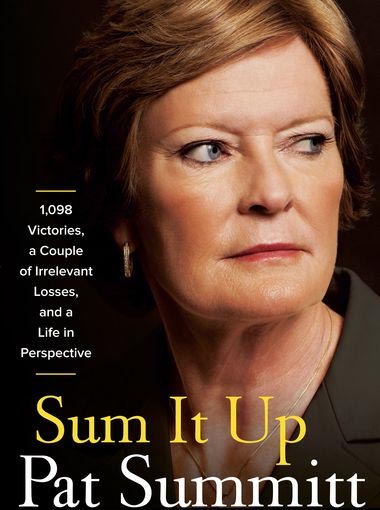
Nearly two years ago, Pat Summitt who coached the Lady Vols for 38 years, announced that she had been diagnosed with early onset dementia. She continued to coach for a year, but last season handed over the reins to an assistant. Although still involved in the program, Summitt spent a large portion of the past year writing her memoir, Sum It Up with Sally Jenkins. It’s subtitled “1,098 Victories, a Couple of Irrelevant Losses, and a Life in Perspective.”
Her records aside, what is particularly noteworthy is that when she began coaching, Tennessee high school girls were still relegated to playing half-court ball. Summitt recounts growing up on a farm in rural Tennessee, and after graduating from college initially being offered an assistance coaching job at UT. That never happened. Instead, she became head coach where, in the beginning, she did everything except sell tickets. Ultimately, she was instrumental in drawing national attention to women’s basketball.
Summitt’s accolades include Olympic medals, as a player and coach, national college championships, and the fact that 100 percent of all of her athletes graduated from college – many of whom went into teaching or coaching.
The latter and her love for her son are what fuel her passion for life. Anyone who’s seen Summitt pace the sidelines during games knows her as a no-nonsense, disciplined and demanding coach. What many don’t know is the depth of her compassion for her players, colleagues, and women’s sports. In an honest, unsentimental voice, this is what comes through in her book.
Sum It Up
Four Bookmarks
Crown Archtype, 2013
385 pages, including appendices
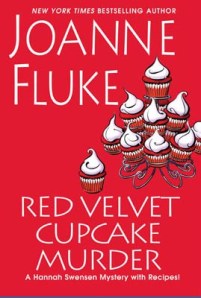
A wholesome, but fiercely independent, young woman in rural Minnesota isn’t exactly who comes to mind when a murder needs to be solved. Yet, author Joanne Fluke has developed quite the following with her Hannah Swensen mysteries. The only explanation I can surmise lies in the fact that Hannah, who fits the above depiction, is also a baker extraordinaire and it’s worth the easy reading to get some new recipes.
Fluke’s most recent addition to the Hannah Swensen oeuvre is Red Velvet Cupcake Murder, which had been on The New York Times Best Seller’s List for several weeks. That, along with my own penchant for cupcakes, is what drew me to the book. Nonetheless, my expectations, fortunately, were not high, so I was not disappointed.
Hannah lives in Lake Eden, a small town, where she owns the Cookie Jar, a bakery and coffee shop. The story begins with her catering the opening of a renovated hotel. The cupcakes are a featured attraction, along with several delicious-sounding baked goods. Readers are immediately introduced (or for those Hannah followers re-introduced) to Hannah’s mother, sister, love interests (yes, plural) and friends. Hannah’s nemesis from an earlier book reappears on the scene.
It doesn’t take long for an accident to occur, which requires a lot of cooking on Hannah’s part to help make people feel better. Soon thereafter someone is murdered, and instead of being part of the unofficial investigation, Hannah becomes a suspect. Somehow, thanks to friends and family, the bakery continues to serve the delicious sweets it is known for, and readers can continue to drool over their descriptions.
All of the delectables include clever names to fit the situation. Among them are Razzle Dazzle Brownies, Tickled Pink Lemonade Cookies, Snappy Turtle Pie and the Red Velvet Cupcakes with a Surprise Filling — the storyline is so predictable it’s nice there is at least one revelation that truly unfolds.
Red Velvet Cupcake Murder
Three Bookmarks
Kenninsgton Books, 2013
323 pages, including recipes
Rules of Civility might sound like an oxymoron today, but author Amor Towles has crafted an engaging novel set in 1938 about social mores that provides plenty to contemplate now.
Katey Kontent (as in the adjective, not the noun) is the narrator whose memory is jarred at an art exhibit in 1966 which takes her back to that one eventful year and the cast of characters who filled it. Katey is a lively, intelligent 25-year-old trying to survive in New York City. A chance encounter on New Year’s Eve 1937 sets the stage for her friendships, romantic relationships, disappointments and her career.
Towles evokes a lively, and noir-ish, portrait of New York City where martinis, jazz and social status dictate. He does so with humor and emotion. Katey works in a secretarial pool in a large financial firm, but her interests lie elsewhere. No sooner is she promoted then she quits to work for an editor past his prime: “He stopped taking on projects and watched with quiet reserve as his authors died off one by one – at peace with the notion that he would join them soon enough in that circle of Elysium reserved for plot and substance and the judicious use of the semicolon.”
Plot and substance are the stuff of Towles writing, which focuses on Katey’s relationship with Tinker Grey, a dashing banker of means. Through Tinker, she has access to upper society, although, as is often the case, appearances in any circle aren’t always what they appear.
Rules of Civility
Four-and-a-half Bookmarks
Penguin Books, 2011
335 pages, which includes The Young George Washington’s Rules of Civility and Decent Behavior in Company and Conversation
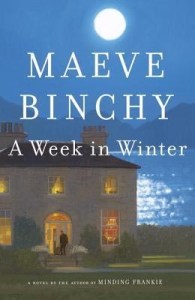
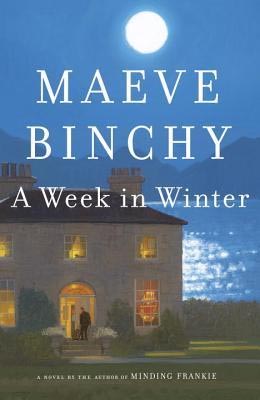
I’m a sucker for a Maeve Binchy novel. Yeah, I know her books are predictable, mushy and fast reads, but she gets me every time. Say what you will, Binchy is a marvelous story teller, and I was saddened to learn she died last summer. A Week in Winter was published posthumously.
Her last work has the requisite characters: independent women who are misled by handsome but unreliable men; ne’er do well young men who, despite the odds, turn their lives around; well-meaning parents who misunderstand their adult children; and, well, many more. For the most part, they are all quite lovely — young and old alike.
Chicky Starr left her family home on Ireland’s west coast as a young twenty-something, only to return some 20-plus years later to renovate an old mansion overlooking the sea as a hotel. Each of the book’s chapters focuses on a different character, while continuing the thread established in getting the hotel ready for guests. Of course, the guests figure prominently in the story. A few names from some of Binchy’s other works find their way into A Week in Winter, which only makes sense: Ireland is not that large a country.
Family relationships, friendships and learning to navigate life are the themes Binchy weaves into her novels; and the Irish landscape is always as important as its inhabitants in her hands.
Binchy has authored 22 books, of which two are nonfiction; I’m glad there are still several I have yet to read.
A Week in Winter
Three-and-a-half Bookmarks
Alfred A. Knopf, 2013
326 pages
I’m not entirely sure how I feel about The Twelve Tribes of Hattie by Ayana Mathis. Mathis has created a family, beginning in 1925 continuing through 1980, of which Hattie is the matriarch. The tribes, her 11 children and one grandchild, are revealed in single, captured episodes (chapters) reflecting a lifetime of longing and emotional neglect. On one hand Hattie is a mother who loves her children too much; yet, she doesn’t love them well.
Parents are not always infallible, and Hattie makes no apologies for her shortcomings. The first chapter, about her twins, and later that of her daughter, Rosie, are told through Hattie’s eyes; the rest of the stories are shared from her children’s perspectives. These include looks back on their childhoods and a glimpse of them as adults. No one fares well, and the question surfaces: how much is a parent’s responsibility? Except that’s not the only issue here.
Hattie and her husband, August, share the burden of poverty and heartache. Their relationship, however, is grounded more in the physical than sentimental realm. Consequently, her nine offspring struggle with everything from sexuality to religion, from addiction to mental illness. How would life had been different if Hattie’s first two children, twins Philadelphia and Jubilee, not died in infancy? It’s possible they would have grown up to be just as miserable as their siblings.
Mathis’s writing is the redeeming element: evocative and haunting. What she writes may be difficult to read, but how she does it is memorable.
The Twelve Tribes of Hattie
Probably Four Bookmarks
Alfred A. Knopf, 2012
243 pages







 The Blue Page Special