Archive for the ‘Books’ Category
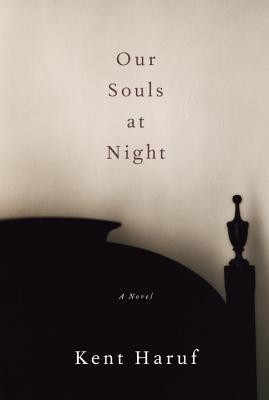
Our Souls at Night by Kent Haruf is best described as sweet. This terse novel was published posthumously, and its content makes me imagine that the author was in his final days when he penned it. This is a story of finding a way out of loneliness while believing that the opinions of others have little value or impact.
Addie Moore and Lewis Waters are widowed and living in the fictional town of Holt on Colorado’s eastern plains. This is Haruf’s preferred setting as many of his previous works have centered around this small communityand its residents. Anyone familiar with his writing will recognize names and places.
One day, Addie calls Lewis. They have known each other for years, but only peripherally. She wonders if he would like to spend the night. This is no brazen, immoral solicitation. It is one lonely heart reaching out to another.
Addie’s son and grandson figure into the narrative as does Lewis’s daughter. The townspeople make sure these adult children are aware of what their parents are doing.
Haruf provides a lot of detail such as teeth brushing and lawn care for someone trading in a scarcity of words (after all, the book is less than 200 pages long).
Unfortunately, the premise, which is touching and somewhat whimsical, overshadows the writing, which is too mundane to be enchanting. Anyone who has experienced a meaningful relationship (be it lover or friend) will appreciate the warmth drawn from conversations that happen just before sleep.
Our Souls at Night
Three bookmarks
Alfred A. Knopf, 2015
179 pages

For a minute forget that Elizabeth Gilbert wrote Eat, Pray, Love. It may take a little longer, but the idea is to not let this dissuade you from reading The Signature of All Things. Gilbert’s novel is as different from her memoir as ice milk is from ice cream. The latter is much richer and nuanced; it’s worth every moment of guilty pleasure spent under its grip.
Gilbert transports the reader from London, across the seas (on multiple occasions), and to Tahiti and Amsterdam. Philadelphia provides the lengthiest setting where the brilliant, unattractive Alma Whitaker is introduced to the world: her birth is literally the first sentence of this epic narrative. In Gilbert’s words, Alma’s childhood “was not yet noble, nor was it particularly interesting …” Thus, the focus turns, albeit temporarily, to Alma’s father, Henry Whitaker.
Henry stole his way out of poverty. He didn’t just acquire wealth, he attained knowledge and became a leading botanist and businessman. Alma’s mother, a stoic and harsh parent intent on fortifying her daughter’s intellect, also possessed a great mind and interest in botany.
Through humor, interesting botanical descriptions and strong, insightful characters, Gilbert creates a story that not only spans continents, but also scientific ideas along with notions regarding love and relationships. The vivid imagery of the various landscapes is a bonus.
Alma is a passionate character rich in curiosity (and foibles). Yet, despite the limits placed on her gender, she explores life in miniscule proportions and unexpectedly reveals its grand scale.
The Signature of All Things
Four-and-a-half Bookmarks
Viking, 2013
499 pages

The title of Kathleen Flinn’s experience at Le Cordon Bleu in Paris is what initially caught my eye: The Shaper Your Knife, The Less You Cry. These words are advice from one of her chef instructors as begins the first of three sections required to earn a diploma from the prestigious cooking school. The subtitle offered more foreshadowing than I would have liked, though: “Love, Laughter and Tears in Paris at the World’s Most Famous Cooking School.”
Flinn’s account combines her background, her romance and her Parisian education, which involved much more than cooking as she learned to navigate a new city with only un petit peu knowledge of French.
The book is divided into the three parts that correspond with the units at the school: Basic, Intermediate and Superior Cuisine. Flinn’s culinary undertaking is humorous, honest and, unfortunately, predictable. Of course she grows through this journey; of course she learned techniques that were as foreign as the language; and of course she is with the man of her dreams. The latter requires no spoiler alert; this is revealed early in the narrative.
Despite its predictability, Flinn gives an insider’s view of how the classes are taught, the types of people who enroll (not surprisingly from all over the world) and the friendliness of the French people. She also includes several recipes and even includes a menu guide for book groups. Fortunately, none require deboning a chicken or dealing with dead rabbit heads.
The Sharper Your Knife, The Less You Cry
Three-and-a-half Bookmarks
Penguin Books, 2007
278 pages

Bawdy, excessive and slightly unbelievable are my first impressions of Caitlin Moran’s How to Build a Girl.
Set mostly in Wolverhampton, England, Joanna Morrigan is a 14-year-old girl going on 35 who is certain she has outgrown the life into which she’s been born. Joanna is intelligent, funny, overweight and practically exudes anguish since she is still a virgin; in fact, she’s never been kissed. There’s also an awkward, embarrassing moment when she’s on TV. So, she does what most teenagers attempt: she reinvents herself. This involves a new name and a career; that’s right, a career. As a music critic.
At first, Joanna, now known as Dolly Wilde, manages to remain true to herself while projecting a much more confident demeanor. However, the need to fit in eventually overwhelms her and her journey of self-discovery leads to predictable consequences – especially since it involves sex, drugs and rock and roll.
The Morrigan family relies on government assistance to get by. When Joanna innocently mentions this to a neighbor she worries this could mean an end to their life on the dole. This is, in large part, the reason she decides to pursue a career, so she can help financially. This, of course, means quitting school.
Moran’s writing is vivid, albeit at times also lurid. There are plenty of laugh-out-loud moments, but not enough to compensate for the exasperation Joanna/Dolly causes.
My initial reaction to the novel doesn’t change much by its end.
How to Build a Girl
Three Bookmarks
HarperCollins, 2014
341 pages

I’m a fan of Alice Hoffman’s prolific work and her most recent, The Marriage of Opposites, reminds me why. She often incorporates elements of little-known history with a touch of the mystical. On the surface that may not sound enticing, but in Hoffman’s hands it is never overwhelming.
Set on the Caribbean island of St. Thomas in the early 1800s, Rachel’s father is among a group of Jewish immigrants who fled persecution from the European Inquisition. To describe his daughter as headstrong is an understatement.
The narrative primarily focuses on Rachel’s life, but later alternates with others. While still in her teens, Rachel is forced to marry Isaac, a man nearly twice her age. Following his death she’s left without property of own and seven children – three from Isaac’s first marriage.
This is not a tale of survival, though. It is part biography but largely a love story. It’s full of passion that emerges when Rachel meets Isaac’s young cousin, Frederic Pizzaro*, who arrives from Paris to take over the family business.
Going against their religion and social mores, Rachel and Frederic marry. Their youngest son, Camille, shares his mother’s obstinate nature; she acknowledges him as her favorite, although the two are often in conflict. The story soon becomes his as he struggles to pursue his artistic endeavors and eventually find his place among the French Impressionists.
Hoffman’s tale is also about of the influence of the island’s bright colors, cultural expectations and what happens when they collide with dreams.
The Marriage of Opposites
Four Bookmarks
Simon & Schuster, 2015
365 pages
*Camile changed the spelling of the name when he moved to Paris.

The adage that opposites attract is evident in Crooked Heart by Lissa Evans. Noel and Vera aren’t exactly drawn together as much as they are forced upon each other: Noel is an orphaned 10-year-old evacuee and Vera is a middle-aged woman who reluctantly agrees to care for him.
Before they meet, Noel has managed to fly under the radar in London with his elderly Godmother, Mattie, with whom he’s been living since the death of his parents. Both have a disdain for authority and are content in their relative isolation. As World War II becomes more imminent, Mattie’s health deteriorates and England increasingly is in Germany’s crosshairs.
Noel is unusual, and Vera is initially convinced he is not very bright. Today he’d be considered a nerd; certainly his intellect and lack of social skills don’t make him a popular child. Vera is widowed and trying to make ends meet, although her efforts aren’t on the up and up. Soon, Noel offers suggestions to improve upon Vera’s scams and their efforts prove to be quite successful, if not quite moral.
Among Noel and Vera’s prey is Mrs. Gifford who unwittingly (and repeatedly) donates to whatever charity the two have concocted. However, they don’t just take her money, they spend time getting to know her. Eventually, Noel becomes protective of the old woman.
Evans’ writing style is subtle as the relationships evolve. Attitudes begin to shift and bonds are created. The couple begins to accept each other’s flaws while recognizing their own.
Crooked Heart
Four Bookmarks
HarperCollins, 2015
282 pages

When author Stieg Larsson died 11 years ago, it appeared to be the death knell for the Millennium Series featuring Swedish journalist Mikael Blomkvist and heroic bad girl Lisbeth Salander. Thanks to David Lagercrantz, the demise of the fictional characters was greatly exaggerated.
Lagercrantz has written the fourth installment, The Girl in the Spider’s Web — doing so in a voice and style remarkably similar to Larsson’s. This is a good thing.
The two protagonists have moved on with their lives; Blomkvist still writes for Millennium magazine and Salander continues to hack computers. They have not stayed in touch with one another. Then, Blomkvist receives a call in the middle of the night from a source who has been in contact with a hacker whose description can only fit Salander. This thinnest of threads ultimately expands to hold the narrative together. Blomkvist’s source and Salander’s work for him are linked to international cyber-spying, old family vendettas and the pair’s respect and faith in one another.
Many characters introduced by Larsson have new-found life thanks to Lagercrantz. He follows a similar pattern of simultaneous stories occurring within a single chapter until they ultimately come together.
Blomkvist’s source is murdered, the NSA is hacked and a child autistic savant not only has the missing piece to the puzzle that brings these events together, but he brings out an unlikely, albeit extremely slight, maternal side in Salander.
There’s intrigue, righting wrongs and descriptions of Stockholm that make it seem as if Lagercrantz is channeling Larsson.
The Girl in the Spider’s Web
Four Bookmarks
Alfred A. Knopf, 2015
400 pages

I am humbled and surprised when I run into someone who tells me my blog is enjoyable and a good place to learn about books (and restaurants when I write about them). When I started The Blue Page Special nearly three years ago, that’s what I hoped for. What’s even better is when one of my readers shares a book title with me, introducing me to a new author or genre. Such is the case with The Rosie Project by Graeme Simsion.
Simsion presents Don Tillman: a nerd. This renowned genetics professor at a Melbourne, Australia, university has created a life so structured that all of his activities are scheduled to the minute. He finds the slightest deviation unnerving. This, along with his intelligence and inclination to view the world through literal eyes, makes him socially inept.
Nonetheless, he decides it’s time to find a life partner and creates the Wife Project, complete with a multi-point questionnaire which has no place for romance. That is until Rosie Jarman, a graduate student in psychology, unwittingly becomes a candidate in the project. Don quickly dismisses her as a viable contender because of what he perceives as her many (human) faults.
The novel is predictable which might warrant a spoiler alert, but I encourage reading it anyway. Don’s voice and personality quirks are well-developed — complete with a few laugh-out-loud moments. Also, Rosie’s criticism that the Wife Project objectifies women is unarguable. Yet, the premise results in a fun read where transformations occur on several, some even surprising, levels.
The Rosie Project
Four Bookmarks
Simon & Schuster, 2013
292 pages

Coming of age can be a mystery, and Karen Brown has combined the two genres in The Longings of Wayward Girls.
The story begins with a 1974 news clipping about the abduction of a young girl, Laura Loomis, and moves back and forth between 1979 and the early 2000s. Laura remains a mystery throughout, while other secrets surface its place. The narrative instead focuses on Sadie Watkins as a creative, energetic young teenager and later as a married mother of two. It hardly seems possible that the two characters are the same; the adult Sadie lacks imagination. That is, until Ray Filey returns to town.
Set in a rural New England community, Brown’s descriptions of the landscape and close-knit neighborhood are intriguing and easy to visualize. The novel is also evocative of a time when parents thought nothing of letting their children roam nearby woods and streets. Or, when parents (in this case, mostly mothers) chain-smoked and drank their way through summer afternoons and evenings.
Sadie teeters on the edge of being a mean girl with childhood friend, Betty, following her lead. Ray is a few years older than Sadie. As a girl she was aware of his presence, although he was never part of her circle of friends. His interest in her as a woman is intriguing, but Sadie’s response to his appearance doesn’t entirely make sense, nor do her actions. However, Brown’s merging of the two themes does offersenough interest to see the novel to its conclusion.
The Longings of Wayward Girls
Three-and-a-half Bookmarks
Washington Square Press, 2013
337 pages
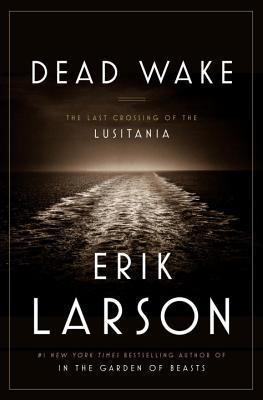
It takes Erik Larson about 100 pages to finally let the Lusitania set sail from New York City in May 1915. Dead Wake, his account of the doomed luxury liner, is exhaustive in detail and detached in its descriptions of the events leading to its historic sinking. No need for a spoiler alert here; many consider the German sinking of the Lusitania is what ultimately led the United States to join the British and French allies in World War I.
Larson’s research on the subject is thorough (there are more than 50 pages of notes). He addresses everything from the backgrounds of the ships’ captains involved, to the weather leading up to the point the ship left sight of land, to how the dining room was decorated for first class passengers. There’s more: brief bios about passengers, history of submarines, how Cunard came to name its fleet, and even Wilson’s love life as he strove to maintain neutrality for the U.S. even as events continued to escalate in Europe.
While it is heartbreaking to know that a record number of families with children were on board, the concise elements Larson provides about the passengers makes it difficult to have a true sense of their characters. This does not mean the event was less tragic, just that the book offers little except a historic narrative.
As with any tragedy, fingers pointing blame are plentiful; Larson offers numerous what ifs, which, of course, do nothing to change the course of history.
Dead Wake
Not-quite-three Bookmarks
Crown Publishers, 2015
430 pages (including notes and index)


 The Blue Page Special